
When I watch football players carrying out their roles with such passion, energy, and enthusiasm, I often find myself wondering: Why can’t the same thing happen in organizations?
If we think of an organization as a football field, the head coach becomes the CEO or senior manager, and the players become the employees. I have always believed that if a “football culture” could take root in our organizations, Knowledge Management (KM) would be much easier to implement and institutionalize. After all, I see a lack of employee motivation and engagement as one of the major Achilles’ heels of Knowledge Management.
Recently, I came across an insightful discussion by Professor Abolalaei, which beautifully explained this concept.
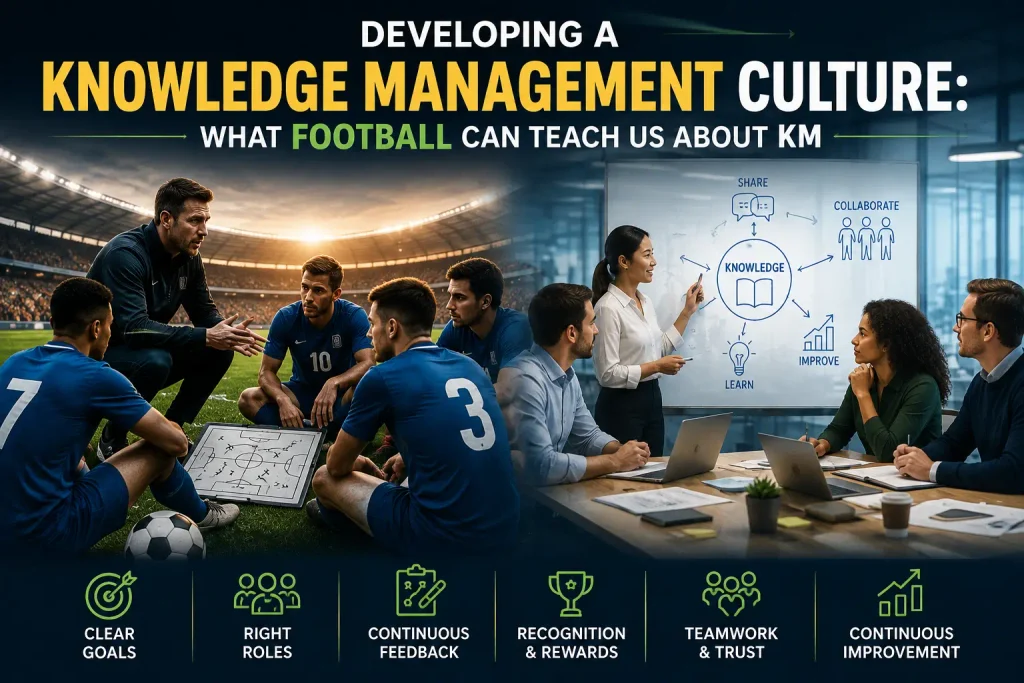
The Football Culture in Organizations
At the end of every football match, we see the losing team leave the field with tears in their eyes and a deep sense of disappointment, while the winning team celebrates enthusiastically, sometimes like children overwhelmed with joy.
Another remarkable characteristic of football players is that they often continue playing despite injuries.
This raises an important question: Why don’t we see the same behaviors in organizations? Similar levels of commitment, passion, and dedication are rarely observed in the workplace.
So, what creates these loyal and passionate behaviors in a football team? What conditions encourage players to give their best?
Some of the key factors include:
- The goal is clear and understood by every player. There is little ambiguity about what the team is trying to achieve.
- Players’ performance is visible and continuously observed and evaluated.
- Players have chosen the sport because they are genuinely interested in it and willing to participate.
- Good and effective performance is quickly recognized and rewarded.
- There is a strong fit between players and the roles they perform within the team.
- When a player’s performance declines, substitutes are ready to take their place. This creates healthy competition and encourages every player to maintain a high level of performance.
- Every player has a clearly defined role and understands what is expected of them.
- Players have sufficient freedom and opportunity to demonstrate their capabilities, creativity, and initiative.
- The coach observes the players from close to the field and intervenes whenever necessary through timely feedback. The coach also has the authority to encourage, correct, discipline, or substitute players.
- Strong performance can lead to a better position, higher income, and greater recognition and popularity in the future.
- Rewards are primarily linked to individual performance and effort rather than unrelated factors.
- A player’s performance is not unfairly attributed to someone else, and the rewards earned by one player do not simply benefit others.
- Players build friendships and camaraderie within their own team while competing against the opposing team.
- Feedback is immediate. After almost every positive or negative performance, players receive reactions from the coach, teammates, spectators, and supporters.
Can’t we bring all—or at least some—of these conditions into our organizations so that employees, like football players, invest their effort, commitment, and energy in achieving organizational goals?
Immediate managerial feedback can also be a powerful motivational factor. The following example, again inspired by Professor Abolalaei’s work, illustrates this idea particularly well.
Why Do Coaches Stand So Close to the Field?
Why do sports coaches typically position themselves so close to the field and guide their teams from there?
If managers adopted a similar position and maintained a close connection with the workplace—the actual “field of play”—they would have the opportunity to:
- Observe employees closely and evaluate them accurately, rather than relying primarily on subjective perceptions or assumptions. When employees know that their performance is being observed and that the evaluation can affect their future, they are more likely to perform effectively.
- Provide immediate and continuous feedback and correct inappropriate behaviors, processes, or trends before they become serious problems.
- Assess employees’ talents, skills, and performance more accurately over time and make better decisions about them. One CEO who occasionally played football with his middle managers explained that he used these opportunities to understand their personalities and behavioral characteristics, including their ability and willingness to work as part of a team.
- Continuously energize employees and encourage them to stay motivated and committed to the journey.
- Provide employees with the information they need quickly, directly, without unnecessary intermediaries, delays, or distortion.
- Serve as a behavioral role model for employees.
- Gain access not only to explicit information contained in formal reports, but also to tacit information that is rarely documented or formally reported. This can be particularly valuable when making important, information-dependent decisions.
Gemba: Going Where the Work Happens
The Japanese call this management approach “Gemba,” a concept strongly associated with Toyota’s management philosophy. In a Gemba-oriented approach, managers go directly to the place where work is actually happening and observe the situation firsthand.
This creates an environment in which employees know that managers may be present at any time, encouraging greater readiness, discipline, and alignment with expected standards.
When it comes to employee motivation, however, there is another point that managers often overlook: employees are different, and so are their needs and expectations.
Football players are not all at the same level. They have different personalities, behaviors, skills, ambitions, and professional characteristics. Employees are no different. They have different concerns, priorities, motivations, and expectations.
Therefore, senior managers need to take these differences into account when designing appropriate financial and non-financial rewards.
This brings us to another valuable idea from Professor Abolalaei’s work.
Segmenting Employees
The world of marketing is complex and fascinating. In competitive markets, marketers use insights from social psychology to attract customers, retain them, and build satisfaction and loyalty.
Marketing also has many lessons for Human Resources. It can help organizations attract and retain talented and committed employees.
One of the fundamental concepts in marketing is market segmentation.
Under this approach, a target market or potential customer base is divided into different segments using logical criteria. Organizations can then design products or services that better match the preferences, needs, expectations, and budgets of each segment.
Naturally, achieving this fit can increase sales and ultimately contribute to organizational success.
So why not apply the same logic to employees?
Why not segment employees into different groups so that, when the appropriate time comes—for example, when designing reward and recognition programs—we can provide each group with something that best matches its needs, preferences, and circumstances?
For example:
- Providing supplementary health insurance to high-performing employees who have significant and costly healthcare needs.
- Providing educational support to high-performing employees pursuing postgraduate studies.
- Providing childcare support to high-performing employees with young children.
These are examples of a more adaptive and employee-centered approach to rewards and recognition.
Employee segmentation helps organizations understand their people better and adopt a more situational management style.
When employees receive something that genuinely addresses their needs, they recognize that the organization understands them. They also develop a stronger sense of being valued because the organization has invested time and effort in understanding who they are and what matters to them.
The Connection Between Football Culture and Knowledge Management
By now, the connection between football culture and Knowledge Management should be clear.
Knowledge Management is ultimately embedded in organizational culture.
If managers and employees develop some of the characteristics demonstrated by football coaches and players—and if organizations create a culture that resembles the positive dynamics of a football team—the likelihood of successfully implementing and institutionalizing Knowledge Management increases significantly.
Consider an organization where:
- Employees clearly understand the goals.
- Their performance is visible.
- Roles and expectations are clear.
- Feedback is timely.
- Good performance is recognized.
- Rewards are aligned with individual contribution.
- Managers are closely connected to the actual work.
- Employees have room to demonstrate their capabilities and initiative.
- Teamwork is encouraged.
- Healthy competition exists.
- Individual differences and needs are recognized.
Such an environment creates fertile ground for Knowledge Management.
When employees feel motivated, recognized, trusted, and fairly rewarded, they are more willing to share knowledge, learn from one another, capture experience, seek help, contribute ideas, and participate in knowledge-sharing practices.
In other words, the Knowledge Management system does not operate in isolation. Its success depends heavily on the cultural environment in which it is embedded.
A KM platform can provide the infrastructure. Processes can define how knowledge should be captured, shared, and reused. Frameworks such as ISO 30401 can provide structure and governance.
But none of these, by themselves, can create a genuine knowledge-sharing culture.
That culture emerges when people have a reason to participate.
Perhaps this is one of the most important lessons football can teach us about Knowledge Management:
People do not give their best simply because they are told to do so. They give their best when the goal is clear, their contribution matters, their performance is recognized, feedback is immediate, and they feel that they are an important part of the team.
And that is exactly the kind of culture in which Knowledge Management can truly come alive.
Explore More from the Author:
- Motivation in Knowledge Management: Social Norms and Market Norms
- Stone and Story: Documentation as a Window to Ancient Times
- Knowledge Management in Practice: From Mischievous Cats to the Miracle Room! (Part 1)
- Knowledge Management in Practice: From ‘Just Half a Bar’ to Motorbike Leadership (Part 2)
- Knowledge Management in Practice: From “Student-Style CEOs” to Sweet KM Lunches (Part 3)
- Knowledge Management in Practice: From “Gunny Bag of Maps” to “Guests Are Good for You” (Part 4)
- Gilgamesh and the Library of Ashurbanipal: The Roots of Documentation and Knowledge Transfer in Human History
- Storytelling Through the Lens of Hormones
Author

I am a Knowledge Management consultant and instructor, currently serving as the CEO and Board Member at DANA KM Consulting Group. With over 15 years of experience, I specialize in implementing practical KM solutions, fostering knowledge-sharing cultures, and embedding knowledge into core business processes across both public and private sectors.
Internationally, I’ve participated in professional development programs in consulting and hold certification as a Productivity Specialist by the Asian Productivity Organization (APO). An international mentor in the KM Peer Mentoring Program 2025–26, organized by the KM4Dev and SIKM Leaders communities of KM practitioners, I am also an active member of the Iranian Management Consultants Association (IMCA), contributing to the profession’s development in Iran.