One of the most important—and at the same time most challenging—concerns of organizational leaders is how to motivate employees to participate in knowledge management (KM) initiatives. The question of whether participation should be encouraged through financial rewards, recognition, career opportunities, or intrinsic motivation has been debated for decades.
Many executives believe that employees should take the first step by actively contributing to knowledge management activities. Once a culture of participation emerges, organizations can then establish incentive mechanisms to recognize and reward those contributions. On the other hand, many employees argue that management must first create motivating conditions and appropriate reward systems before expecting meaningful engagement in KM initiatives.
Both perspectives have merit and deserve consideration. One could spend hours debating which approach is more effective. However, in this article, I would like to explore a fascinating concept introduced by Dan Ariely in his book Predictably Irrational: the distinction between social norms and market norms. Based on my experience implementing knowledge management systems across various organizations over the years, I believe this concept offers valuable insights for designing effective KM incentive systems.
Social Norms and Market Norms
Imagine that you have been invited to your mother-in-law’s house for Thanksgiving dinner. She has prepared an impressive feast: a perfectly roasted turkey, delicious steaks, and a table overflowing with carefully prepared dishes.
As everyone admires the meal, you stand up, smile warmly at your mother-in-law, pull out your wallet, and say, “Thank you for all the love and effort you put into preparing this dinner. How much do I owe you? Would $40 be enough? Actually, let me make it $50.”
An uncomfortable silence fills the room. Your mother-in-law leaves the table in disbelief, your sister-in-law gives you an angry look, and your spouse is likely close to tears. Needless to say, next year’s Thanksgiving invitation may never arrive.
What went wrong?
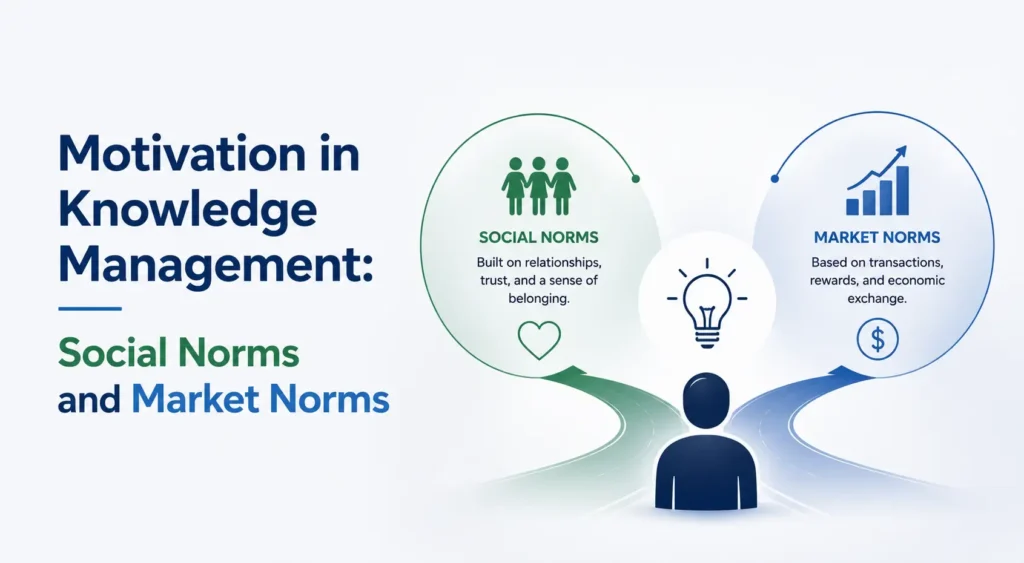
According to researchers Margaret Clark, Judson Mills, and Alan Fiske, the answer lies in the fact that we simultaneously live in two different worlds: the world of social norms and the world of market norms.
Social norms govern the friendly, relationship-based interactions between people. They include requests such as:
- “Can you help me move this table?”
- “Would you help me change a flat tire?”
- “Could you water my plants while I’m away?”
Social norms are deeply rooted in our social nature and our desire to belong to a community. They are warm, flexible, and based on goodwill rather than immediate reciprocity. If you help your neighbor move furniture today, there is no expectation that they must immediately return the favor. Like holding a door open for someone, the act itself creates value and strengthens relationships.
Market norms operate very differently. They are transactional, explicit, and measurable. Salaries, consulting fees, rent payments, interest rates, and cost-benefit calculations all belong to the realm of market norms. Expectations are clear, and exchanges are defined by economic value.
As long as social norms and market norms remain separate, interactions tend to work smoothly. Problems arise when the two systems collide.
Three Experiments on Social and Market Norms
Experiment 1: Circles and Squares
Several years ago, Dan Ariely and James Heyman from the University of St. Thomas conducted an experiment to investigate the effects of social and market norms.
Participants were asked to drag circles displayed on a computer screen into a square as quickly as possible over a five-minute period. One group received $5 for participating, another received only a small payment (either $0.50 or $0.10), and a third group was simply asked to help as a favor, with no mention of money.
The results were surprising.
Participants who received $5 completed an average of 159 circles. Those paid $0.50 completed about 101 circles. However, participants who received no payment at all completed an average of 168 circles.
In other words, individuals working under social norms outperformed those working under market norms. Their motivation came not from financial compensation, but from responding to a social request.
Experiment 2: Providing Free Legal Services
A striking example of the power of social norms comes from an initiative involving retired Americans with limited financial resources.
A professional association approached lawyers and asked whether they would be willing to provide legal services to retirees at a discounted rate of approximately $30 per hour. Virtually all lawyers declined.
The association then asked a different question: Would they be willing to provide legal services free of charge?
Surprisingly, many agreed.
How can zero dollars be more attractive than thirty dollars?
The answer lies in the shift between market norms and social norms. Once money entered the discussion, lawyers evaluated the offer against market rates and found it unattractive. When compensation was removed entirely, the interaction moved into the social domain, where contributing to a meaningful cause became the primary motivation.
This experiment highlights an important principle: when market norms enter the picture, social norms often disappear.
Experiment 3: Daycare Center Fines
Researchers Uri Gneezy and Aldo Rustichini studied a childcare center that struggled with parents arriving late to pick up their children.
To discourage lateness, the center introduced a financial penalty.
Contrary to expectations, late pickups increased.
Before the fine was introduced, parents operated under a social contract. Arriving late generated feelings of guilt and responsibility. After the fine was implemented, however, the situation shifted into the realm of market norms. Parents no longer felt they were violating a social expectation; instead, they viewed the fine as the price of being late.
Even more interestingly, when the daycare later removed the fine, the original social norms did not return. The sense of guilt had already been replaced by a market-based mindset.
The lesson was clear: once social norms are displaced by market norms, restoring them can be extremely difficult.
Social Norms and Market Norms in Organizations
Organizations can learn a great deal from understanding how employees respond to these two systems of motivation.
Consider a company that wants to reward an employee with the equivalent of $1,000. Should it provide the money directly as a cash bonus, or should it offer a thoughtful and meaningful gift?
If employees are asked, many may prefer the cash. However, gifts carry symbolic value that can strengthen the social relationship between employer and employee. They communicate appreciation, recognition, and belonging in ways that money alone often cannot.
This principle can be observed in organizations such as Google, where employee benefits are designed not merely as economic compensation but as mechanisms for strengthening social bonds and organizational culture. Such practices generate goodwill and reinforce employees’ emotional connection to the organization.
In many high-performing organizations and startups, extraordinary effort emerges not primarily because of financial incentives, but because employees feel part of a shared mission and a collective purpose.
Social Norms and Market Norms in Knowledge Management
The challenge of designing effective KM incentive systems lies precisely in balancing these two forms of motivation.
Many organizations focus heavily on financial rewards for activities such as knowledge sharing, lesson learned documentation, idea submission, or participation in communities of practice. Others rely primarily on non-financial recognition, career development opportunities, and public appreciation.
The concept of social and market norms suggests that neither approach is universally effective.
Employees differ in their motivations, professional backgrounds, and expectations. Some participate in knowledge management because they value collaboration, professional reputation, and contributing to organizational success. For these individuals, introducing small financial rewards may actually weaken motivation by shifting participation from the social domain to the market domain.
Conversely, some employees view knowledge-related activities through a market-oriented lens. For these individuals, relying exclusively on recognition programs, appreciation ceremonies, or symbolic rewards may fail to create meaningful motivation.
Therefore, effective KM leaders should avoid applying a single incentive model to all employees. Instead, they should carefully understand the motivational drivers of different groups and design incentive systems that preserve the positive effects of social norms while strategically leveraging market-based incentives where appropriate.
Ultimately, the success of a knowledge management initiative depends not only on technology, processes, or governance structures, but also on understanding a fundamental human reality: people do not always contribute knowledge for money, and sometimes introducing money can reduce the very behavior organizations seek to encourage.
Explore More from the Author:
- Stone and Story: Documentation as a Window to Ancient Times
- Knowledge Management in Practice: From Mischievous Cats to the Miracle Room! (Part 1)
- Knowledge Management in Practice: From ‘Just Half a Bar’ to Motorbike Leadership (Part 2)
- Knowledge Management in Practice: From “Student-Style CEOs” to Sweet KM Lunches (Part 3)
- Knowledge Management in Practice: From “Gunny Bag of Maps” to “Guests Are Good for You” (Part 4)
- Gilgamesh and the Library of Ashurbanipal: The Roots of Documentation and Knowledge Transfer in Human History
- Storytelling Through the Lens of Hormones
Author

I am a Knowledge Management consultant and instructor, currently serving as the CEO and Board Member at DANA KM Consulting Group. With over 15 years of experience, I specialize in implementing practical KM solutions, fostering knowledge-sharing cultures, and embedding knowledge into core business processes across both public and private sectors.
Internationally, I’ve participated in professional development programs in consulting and hold certification as a Productivity Specialist by the Asian Productivity Organization (APO). An international mentor in the KM Peer Mentoring Program 2025–26, organized by the KM4Dev and SIKM Leaders communities of KM practitioners, I am also an active member of the Iranian Management Consultants Association (IMCA), contributing to the profession’s development in Iran.