A knowledge base can contain a correct definition while an AI-assisted summary still gives a misleading impression. One reason is timing: the definition used to produce the text may no longer be the definition that readers see when they follow its link.
Consider a fictional organisation that uses the label “reviewed supplier”. In the first version of its internal glossary, the label means that a supplier’s contact details and basic company information have been checked. It does not mean that the supplier has passed a security assessment or been approved for sensitive work.
Later, the organisation changes its process. The second glossary version requires a completed security assessment before the label can be applied. The wording has become more demanding, but the label itself has not changed. Neither have the old records automatically acquired the evidence now required by the new definition.
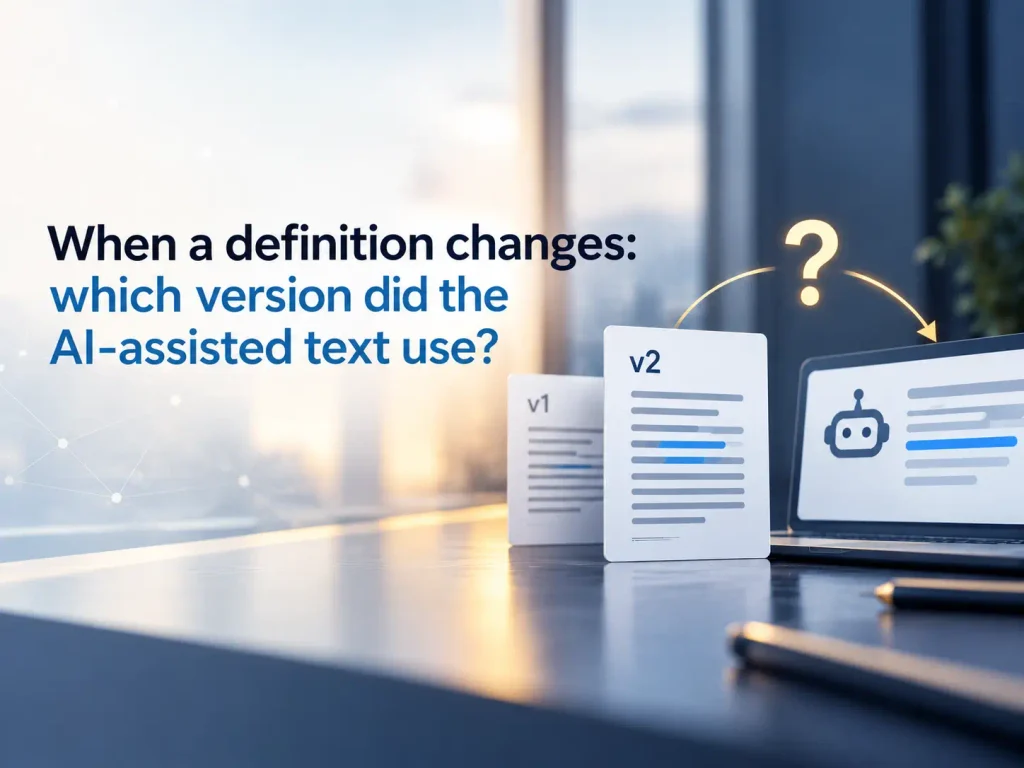
The gap between a current definition and an old statement
Imagine that an AI assistant produced a procurement briefing before the change. It described a candidate as a “reviewed supplier”, based on a record created under the first definition. A colleague opens the briefing after the glossary has been updated. The link now displays the second definition.
The colleague may reasonably read the old sentence as a stronger assurance than the underlying record supports. The briefing has not necessarily invented a supplier status. The difficulty is that the same words now refer to different criteria.
This fictional example does not establish how frequently such mistakes occur. It isolates a practical question: can a reader identify which meaning a statement relied on when it was written?
A definition alongside its history
For a consequential term, a useful definition record could include the wording, a stable identifier, a version identifier and the date from which that version applies. It could also state what changed and who is responsible for maintaining it.
Those fields perform different jobs. A date tells readers when a version became applicable. A change note tells them whether the revision corrected punctuation or changed the criteria for a decision. An owner gives them somewhere to take an unresolved question.
None of this proves that the definition is sensible or that a particular supplier qualifies. Version information makes the source of a claim easier to inspect. It does not replace the evidence needed to apply the definition.
The connection between an output and its source version
Suppose the briefing records “reviewed supplier — glossary version 1” and points to the preserved wording. A later reviewer can now see that the phrase covered basic company information only. The current glossary can remain available alongside it, with a clear notice that the criteria have changed.
That distinction matters because a link to a live page is not necessarily a record of what the page said earlier. If a system cannot preserve the relevant version, a short dated extract may help, subject to the organisation’s rules for handling and retaining information.
A meaningful reference would identify the material actually used in the workflow. Asking an assistant to invent a plausible version label after drafting would create the appearance of traceability without its substance. An explicit gap would be more informative than an unverified reference.
What happens to older statements?
A glossary update is also a prompt to consider affected outputs. For a small, low-impact wording change, no further action may be needed. A revision that changes eligibility, authority or the conditions for proceeding deserves a more deliberate decision.
In the supplier example, the knowledge owner could identify active briefings that still use the old label. Their reviewers could then decide whether to retain the historical wording with an explanation, update the statement after checking new evidence, or withdraw the status pending review.
Simply substituting the new definition into an old record would not show that the additional checks had taken place. The change to language and the change to the underlying evidence are separate events.
A small review record can make the distinction visible
In this fictional workflow, a review record could contain four things: the claim being made, the definition version used, the supporting record and the decision made after review. One term affecting an actual choice would be enough to explore the idea; an elaborate history for every word is not assumed.
The test is practical. Can a colleague reconstruct what the statement meant without relying on its author’s memory? Can they distinguish a later change in terminology from a later change in the facts? Can they see what remains unresolved?
An AI-assisted text can be fluent and still leave those questions unanswered. A modest version record will not make the text automatically reliable. It can, however, give the next reader a precise place to begin checking: this was the meaning used, this was the evidence available, and this is what changed afterwards.