Knowledge management has traditionally focused on helping organizations capture, organize, share, and reuse what they know. The challenge has never been simply storing information. Organizations have accumulated enormous volumes of documents, policies, procedures, reports, lessons learned, technical documentation, and expertise, yet employees can still struggle to find the right knowledge when they need it.
Generative AI changes the nature of that problem. Large language models can understand natural language and produce highly fluent answers, but they do not automatically have access to an organization’s latest policies, internal processes, proprietary information, or institutional knowledge. This is where retrieval augmented generation, commonly known as RAG, becomes important.
RAG connects generative AI with external knowledge sources so that an AI system can retrieve relevant information before generating a response. For knowledge management, this creates a potentially powerful connection between organizational knowledge and AI. Instead of asking an AI model to answer from its learned parameters alone, organizations can give it access to selected internal knowledge and ask it to generate responses based on that retrieved information.
The significance of RAG for knowledge management is therefore much greater than simply improving an AI chatbot. It can change how organizational knowledge is discovered, accessed, interpreted, and applied.
What Is RAG in Knowledge Management?
RAG stands for Retrieval-Augmented Generation. In simple terms, it combines two capabilities: retrieving relevant information from an external knowledge source and using a generative AI model to produce an answer based on that information.
A conventional large language model generates an answer based primarily on patterns and information learned during training. That approach is useful for general knowledge, but it creates limitations when the question concerns proprietary or frequently changing information.
Consider an employee asking, “What is our current parental leave policy?” A general-purpose language model does not inherently know the organization’s current policy. A RAG-enabled system can search an approved internal knowledge source, retrieve the relevant policy, and provide that information to the language model as context before generating the response.
This makes RAG particularly relevant to enterprise knowledge management. The knowledge can remain in an organization’s own repositories while AI provides a more natural interface for finding and using it.
A 2026 systematic literature review of RAG and large language models in enterprise knowledge management examined 63 rigorously selected studies and found that RAG is increasingly being explored for practical enterprise applications, although significant challenges remain around production-scale integration, evaluation, and real-time deployment.
Why Does Knowledge Management Need RAG?
One of the fundamental problems in knowledge management is the gap between knowledge availability and knowledge accessibility.
An organization may already possess the answer to a question somewhere in its systems. The problem is that employees may not know where the information is stored, which version is current, which document is authoritative, or which search terms will locate it.
Traditional enterprise search can help, but keyword-based search has limitations. A user has to formulate a query that matches the terminology used in the underlying content. This becomes difficult when people use different language to describe the same concept.
RAG provides another approach. Instead of requiring the user to know the exact wording used in an organization’s documents, the retrieval system can search for information based on the meaning and context of the question.
This creates a more direct relationship between the question a person asks and the knowledge the organization possesses.
The potential value for knowledge management is significant. Knowledge no longer needs to be accessed only through folders, portals, document libraries, or carefully constructed search queries. It can become available through a conversational interface that understands the user’s question and retrieves relevant organizational knowledge.
How Does RAG Work?
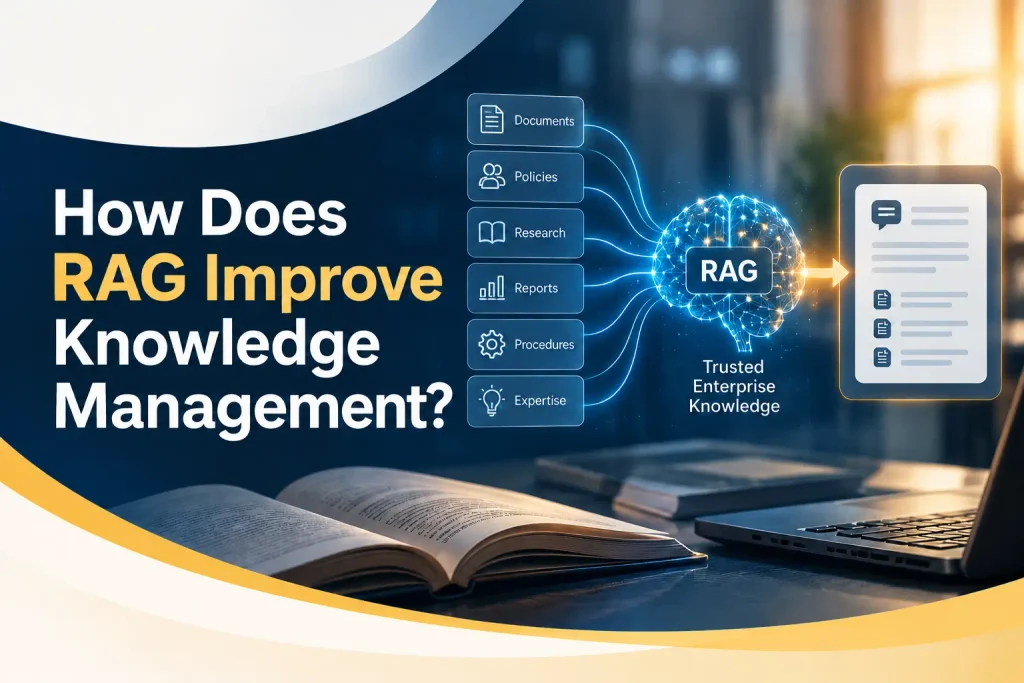
A typical RAG system begins with a collection of organizational knowledge. This could include policies, procedures, manuals, research, technical documentation, customer information, project records, or other approved sources.
The content is processed and indexed so that relevant information can be retrieved when someone asks a question. Depending on the architecture, the retrieval layer may use keyword search, semantic search, vector retrieval, hybrid search, reranking, or other retrieval techniques.
When a user asks a question, the system searches the available knowledge and identifies content that appears relevant. That retrieved information is then supplied to the language model as context. The model uses the context to generate the response.
The basic flow can therefore be understood as organizational knowledge, retrieval, contextual information, AI generation, and finally an answer.
The important point is that the language model is not operating in isolation. It is being connected to an external knowledge environment.
This distinction is fundamental to enterprise AI because organizational knowledge changes much faster than a model’s training data can be updated.
How Does RAG Improve Knowledge Discovery?
Knowledge discovery is one of the areas where RAG can have a particularly strong impact.
Traditional knowledge management often focuses on helping employees find existing information. But finding information and discovering relevant knowledge are not always the same thing.
Imagine an employee asking, “What are the main lessons from our previous projects involving this type of customer?” The answer may not exist in a single document. Relevant information could be distributed across project reports, retrospective documents, customer records, and lessons-learned repositories.
A RAG system can potentially retrieve relevant passages from multiple sources and bring them together in the context of the user’s question.
This changes the experience from document retrieval to knowledge discovery.
The user does not necessarily need to know which document contains the answer. The retrieval system can identify relevant evidence across the available knowledge environment.
This is particularly valuable for large organizations where knowledge has become fragmented across departments and systems.
How Can RAG Reduce AI Hallucinations?
One of the most frequently discussed benefits of RAG is its ability to reduce the risk of unsupported AI-generated answers.
Large language models can produce convincing responses even when they do not have reliable information for a particular question. RAG attempts to address this problem by giving the model relevant external evidence before generation.
For example, if an AI assistant is answering questions about an organization’s internal security policy, the system can retrieve the organization’s approved policy documents and use them as context.
This does not mean RAG eliminates hallucinations.
That distinction is important.
If the retrieval system finds the wrong document, retrieves incomplete information, or fails to retrieve the necessary evidence, the language model can still produce an incorrect answer. A RAG system can therefore move the problem from “What does the model know?” to a broader question: “What knowledge did the system retrieve, and was that knowledge appropriate?”
Recent research into RAG continues to identify retrieval quality, evidence grounding, evaluation, and governance as important challenges. A 2026 review of RAG research describes the field as evolving from basic retrieve-and-generate pipelines toward more sophisticated architectures involving hybrid retrieval, reranking, knowledge graphs, agentic workflows, and other techniques.
This means that reducing hallucinations is not simply a matter of adding a vector database to an AI application. The quality of the knowledge environment and retrieval process matters enormously.
Why RAG Makes Knowledge Quality More Important
There is an important paradox in the relationship between RAG and knowledge management.
RAG can make organizational knowledge easier to access, but that also means weaknesses in the knowledge environment can become more visible.
Suppose an organization has three versions of the same policy. One is two years old, another was updated six months ago, and the third was recently revised but has not been clearly identified as the authoritative version.
A RAG system may retrieve information from any of those documents unless the knowledge environment contains sufficient metadata, version information, authority signals, or governance rules.
The problem is therefore not necessarily the AI model. The underlying knowledge is ambiguous.
This is why RAG can strengthen the strategic importance of knowledge management. Organizations need to understand which information is authoritative, who owns it, how often it should be reviewed, which users can access it, and when it should be retired.
RAG makes those questions operational.
How Does RAG Support Knowledge Reuse?
Knowledge reuse has always been a central objective of knowledge management.
Organizations invest significant effort in creating knowledge, but value is only created when that knowledge can be applied again in another context.
A project team may document a successful implementation. A support team may resolve a difficult customer issue. An engineering team may identify the cause of a recurring problem. A compliance team may interpret a complex requirement.
Without effective knowledge reuse, these experiences can remain isolated.
RAG provides a mechanism for bringing previously captured knowledge back into the context of new questions.
An employee working on a similar project could ask an AI assistant about previous approaches, and the system could retrieve relevant project knowledge. A support agent could ask about previous solutions to a particular problem and receive information from earlier cases.
The value comes from connecting past organizational knowledge with present work.
This is an important shift. Knowledge management is not only about preserving organizational memory. It is about making organizational memory usable when it matters.
How Does RAG Improve Enterprise Search?
Enterprise search has traditionally been based heavily on keywords and structured navigation. That approach remains useful, but organizations increasingly need search systems that understand the meaning behind a question.
RAG can sit on top of modern retrieval systems and connect search with generative AI.
Instead of returning a list of documents, an AI-powered knowledge system can retrieve relevant sources and synthesize an answer from them.
This can reduce the amount of manual effort required to interpret search results.
However, this does not mean that traditional search results should disappear. In enterprise environments, users may need to inspect the underlying documents, verify the source, understand the context, or access the complete policy or procedure.
A well-designed RAG system should therefore make the relationship between an answer and its underlying sources clear.
The goal is not to hide the knowledge repository behind AI. The goal is to make the repository more useful.
What Role Does Knowledge Governance Play in RAG?
RAG makes knowledge governance a technical requirement as well as a management responsibility.
An enterprise knowledge system needs to know which sources can be used, which users can access them, which content is authoritative, and how information should be handled when it becomes outdated.
Access control is particularly important.
If an employee does not have permission to access a confidential document through the organization’s normal systems, an AI assistant should not bypass that restriction simply because the document happens to be indexed for retrieval.
Similarly, an AI system should be able to distinguish between approved corporate information and unofficial or obsolete content.
This is why enterprise RAG is increasingly being discussed as a governance problem rather than simply a search problem. Production systems have to consider source authority, permissions, freshness, evaluation, auditability, and human oversight alongside retrieval performance.
For knowledge management professionals, this represents a familiar responsibility in a new technical environment.
Can RAG Capture Tacit Knowledge?
RAG works best with knowledge that has been captured in a retrievable form.
This raises an important question for knowledge management: what happens to tacit knowledge?
Much organizational expertise exists in people’s experience, judgment, relationships, and ability to recognize situations that are difficult to document.
RAG cannot magically retrieve knowledge that has never been captured.
However, organizations can use knowledge management practices to transform portions of expert experience into usable organizational knowledge through interviews, retrospectives, lessons learned, case documentation, communities of practice, expert contributions, and other knowledge-sharing practices.
Once that knowledge is captured and appropriately validated, RAG can potentially make it easier to discover and reuse.
This reinforces an important principle: RAG is not a substitute for knowledge capture. It is an accelerator for knowledge access and reuse.
What Are the Limitations of RAG for Knowledge Management?
RAG is powerful, but it is not a complete knowledge management solution.
One limitation is retrieval quality. If the system does not retrieve the right information, the generated answer may still be incorrect.
Another limitation is content quality. RAG cannot determine automatically whether an organizational policy is fundamentally wrong or whether a business process documented in an internal file is no longer followed in practice.
Another challenge is fragmented knowledge. Important organizational knowledge may exist across incompatible systems, making comprehensive retrieval difficult.
There are also security and privacy concerns, particularly when knowledge contains confidential, personal, regulated, or commercially sensitive information.
Production deployment presents additional challenges. The 2026 systematic review of enterprise RAG and LLM research found that fewer than 15% of the studies it examined addressed the real-time integration challenges required for production-scale deployment.
This highlights the difference between demonstrating that RAG works and building an enterprise knowledge system that can operate reliably at scale.
How Should Organizations Prepare Their Knowledge for RAG?
The most important preparation may have little to do with AI.
Organizations should first understand what knowledge they have, where it resides, who owns it, and which knowledge is actually important to business operations.
They should then identify outdated information, duplicate documents, conflicting versions, unclear ownership, missing metadata, and inappropriate access.
This is where established knowledge management practices become valuable.
Taxonomy, metadata, content governance, information architecture, knowledge ownership, retention policies, expertise location, and knowledge quality processes can all influence how effectively an AI system can retrieve organizational knowledge.
The objective should not be to put every document into a RAG system.
More information does not necessarily mean better knowledge.
The objective should be to create a trustworthy knowledge environment from which AI can retrieve appropriate information.
What Is the Future of RAG and Knowledge Management?
RAG is already moving beyond the basic model of retrieving a few document passages and asking an LLM to summarize them.
Emerging architectures are exploring hybrid retrieval, knowledge graphs, multimodal retrieval, iterative retrieval, agentic workflows, and more sophisticated approaches to evidence evaluation.
This evolution could make RAG increasingly relevant to the broader knowledge management ecosystem.
An AI agent may retrieve organizational knowledge before performing a task. An enterprise assistant may combine information from several approved systems before answering a question. A decision-support application may retrieve relevant policies, previous cases, and expert knowledge before presenting recommendations.
In such environments, knowledge becomes more than content that employees search for.
It becomes an operational layer that AI systems depend on.
That creates an important opportunity for knowledge management professionals. KM can play a role in determining what knowledge should be available to AI, how it should be structured, who owns it, how it is governed, and how its quality is maintained.
Final Thoughts
RAG improves knowledge management by creating a stronger connection between organizational knowledge and generative AI.
It can make knowledge easier to discover, support more natural enterprise search, improve knowledge reuse, provide AI systems with current organizational information, and reduce reliance on a model’s internal knowledge when answering enterprise-specific questions.
But RAG should not be viewed as a technological shortcut around knowledge management.
If organizational knowledge is outdated, fragmented, poorly governed, or difficult to interpret, RAG can expose those weaknesses rather than eliminate them.
The real opportunity lies in combining the two disciplines.
RAG provides the retrieval and generation capability. Knowledge management provides the knowledge, context, governance, ownership, and organizational processes that make that capability useful.
This is why RAG may become more than an AI architecture. It could become an important part of the infrastructure through which organizations make their collective knowledge available to both humans and machines.
The organizations that gain the greatest value from RAG may therefore not be those that simply build the most sophisticated retrieval pipeline. They may be the organizations that first understand what they know, where that knowledge exists, which knowledge can be trusted, and how it should be used.
Sources
1. Karakurt, E. and Akbulut, A. Retrieval-Augmented Generation (RAG) and Large Language Models (LLMs) for Enterprise Knowledge Management and Document Automation: A Systematic Literature Review, Applied Sciences, 2026. The review examines 63 rigorously selected studies and specifically evaluates RAG and LLM applications in enterprise KM. Read the research
2. Faridi, T. et al. Retrieval-Augmented Generation for Large Language Models: Evolution, Architectures, Applications, and Challenges, Wiley, 2026. The review examines the evolution of RAG architectures, including hybrid retrieval, reranking, GraphRAG, agentic workflows, and multimodal approaches. Read the review
3. Enterprise RAG Governance Playbook, 2026. The practical governance discussion covers source authority, permission-aware retrieval, freshness, evaluation, auditability, and human review in enterprise RAG systems. Read the playbook