
Organizations Are Surrounded by Knowledge They Cannot See
Most knowledge management discussions focus on what organizations know.
We talk about knowledge assets, repositories, expertise, lessons learned, communities of practice, and organizational memory. We invest in systems designed to capture knowledge, preserve knowledge, and share knowledge. We measure how much content has been created, how many documents have been stored, and how many employees contribute to knowledge platforms.
Yet despite decades of investment in knowledge management, a paradox continues to exist inside many organizations.
The knowledge required to solve a problem often already exists, but nobody knows where to find it.
A project team spends months developing a solution that another team created three years earlier. A business unit hires external consultants to answer a challenge that internal experts have already solved. Senior leaders make decisions without realizing that the organization encountered a similar situation in the past. Employees spend hours searching for information while relevant knowledge remains buried inside repositories, collaboration platforms, project archives, emails, and conversations.
These situations occur so frequently that many organizations accept them as normal.
They should not.
What these examples reveal is the existence of a growing organizational phenomenon that can be described as invisible knowledge.
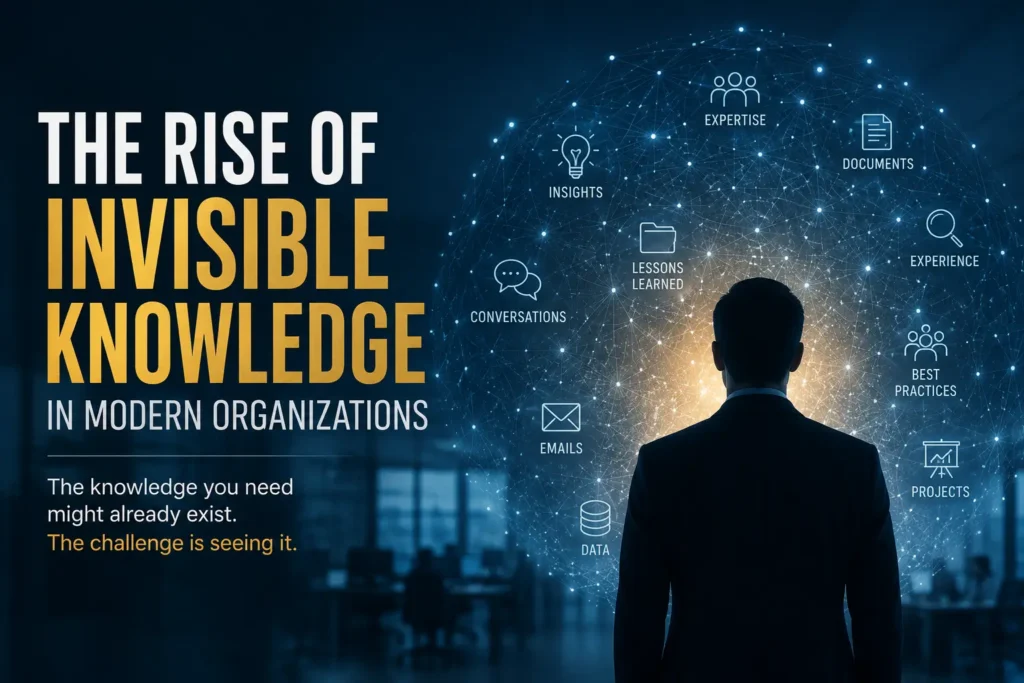
Invisible knowledge is knowledge that exists within an organization but remains largely unseen, undiscovered, or inaccessible to those who need it. It may reside within experienced employees, project documentation, lessons learned databases, communities of practice, collaboration platforms, customer interactions, operational systems, or organizational memory. The knowledge itself has not been lost. The organization simply lacks sufficient visibility into its existence.
This distinction is important because invisible knowledge is fundamentally different from missing knowledge.
When knowledge is missing, organizations need to create it, acquire it, or develop it. When knowledge is invisible, the challenge is entirely different. The organization already possesses the knowledge required to improve decisions, solve problems, reduce risk, or accelerate innovation. The problem is that the knowledge cannot be effectively discovered or applied.
For many organizations, this may represent one of the most significant yet least recognized barriers to performance.
Historically, knowledge management has focused heavily on preventing knowledge loss. Organizations worried about retiring experts, employee turnover, and the erosion of institutional memory. These concerns remain valid. However, a growing number of organizations now face a different challenge. They are not losing knowledge. They are accumulating more knowledge than they can effectively see.
Every year organizations generate vast amounts of new information. Projects produce reports. Teams create documentation. Collaboration platforms capture conversations. Artificial intelligence generates summaries, analyses, and recommendations. At the same time, employees continue developing expertise through experience, problem-solving, and professional practice.
The result is an expanding body of organizational knowledge that grows faster than the organization’s ability to understand it.
As knowledge volumes increase, visibility often decreases.
Employees may know their immediate colleagues and local experts, but they rarely possess a comprehensive understanding of organizational expertise. They know the projects they have worked on, but not necessarily similar projects completed elsewhere in the enterprise. They can access repositories, but they often lack awareness of which knowledge assets are relevant to their current needs.
Knowledge exists. Visibility does not.
This challenge becomes even more significant in large organizations where knowledge is distributed across geographies, business units, technologies, and professional domains. Valuable expertise may reside on another continent. Lessons learned may be stored within unfamiliar systems. Critical historical knowledge may remain buried inside project archives that no longer receive attention.
The organization becomes increasingly knowledgeable while simultaneously becoming less aware of what it knows.
In many respects, invisible knowledge is an unintended consequence of organizational growth and digital transformation. The more knowledge organizations create, the harder it becomes to maintain visibility into that knowledge. Repositories expand. Systems multiply. Expertise becomes specialized. Information fragments across platforms and networks.
What emerges is not a shortage of knowledge but a shortage of discoverability.
This reality has profound implications for knowledge management leaders.
For years, the dominant question was how to capture knowledge before it disappeared. Increasingly, the more important question may be how to reveal knowledge that already exists.
The organizations that address this challenge successfully will gain access to capabilities that competitors often overlook. They will discover expertise faster, reuse knowledge more effectively, reduce duplication of effort, improve decision-making, and strengthen organizational learning. Most importantly, they will become better at leveraging the intellectual capital they already possess.
In an era defined by information abundance, invisible knowledge may represent one of the largest untapped assets within modern organizations.
The challenge is not creating more knowledge.
The challenge is making the invisible visible.
Why Knowledge Becomes Invisible
If invisible knowledge represents a growing organizational challenge, an important question follows: why does knowledge become invisible in the first place?
The answer is not that organizations lack knowledge management systems. Most large enterprises have invested heavily in repositories, collaboration platforms, enterprise search tools, document management systems, and knowledge-sharing initiatives. Yet invisible knowledge continues to exist despite these investments.
The root cause is that knowledge visibility and knowledge availability are not the same thing.
A document may exist within a repository and still remain effectively invisible. An expert may work within the organization for years without being recognized beyond a small network of colleagues. A valuable lesson learned may be documented but never influence future decisions. Knowledge can be available without being visible.
One of the most common causes of invisible knowledge is organizational complexity.
As organizations grow, knowledge naturally becomes distributed across multiple teams, functions, geographies, and business units. Specialization increases. Employees focus on narrower domains of expertise. New systems are introduced. Additional layers of management emerge. Knowledge that was once visible across a small organization becomes increasingly fragmented as the enterprise expands.
This fragmentation creates an important challenge. Individuals possess visibility into their immediate environment but limited visibility into the broader organizational landscape. They know the experts within their teams, the projects within their departments, and the systems they use daily. Beyond those boundaries, awareness declines rapidly.
The organization knows more than any individual can possibly know.
As a result, valuable knowledge often remains hidden simply because no one has a complete view of the enterprise.
Expertise represents perhaps the most significant form of invisible knowledge.
For decades, knowledge management has focused heavily on documents and repositories. Yet some of the most valuable organizational knowledge exists within people. Experienced professionals develop judgment, intuition, contextual understanding, and problem-solving capabilities that are difficult to document and even harder to transfer.
An engineer who has solved a recurring operational problem for ten years possesses knowledge that extends far beyond technical documentation. A project manager who has successfully navigated multiple complex transformations develops insights that may never appear in formal reports. A customer service specialist often understands customer behavior in ways that cannot be captured through data alone.
The challenge is that organizations frequently have limited visibility into these capabilities.
Job titles rarely tell the full story. Organizational charts reveal reporting relationships but not expertise networks. Professional experience is often richer and more nuanced than what appears in employee profiles. Consequently, organizations possess extensive expertise that remains largely invisible outside local teams and personal networks.
The larger the organization becomes, the greater this challenge tends to be.
Information overload creates another significant source of invisibility.
Ironically, organizations often lose visibility into knowledge because they create so much of it.
Every project produces documentation. Every meeting generates records. Every collaboration platform captures conversations. Every business process creates reports, presentations, and supporting materials. Artificial intelligence is now accelerating content creation even further.
The result is an environment where valuable knowledge competes for attention alongside vast quantities of routine information.
Employees searching for answers are often confronted with hundreds or thousands of potential results. Determining what is relevant, current, and trustworthy becomes a challenge in itself. Important knowledge does not disappear. It becomes buried.
In this environment, invisibility is often created by abundance rather than scarcity.
Knowledge silos further amplify the problem.
Most organizations are structured around specialized functions and business objectives. While this structure supports operational performance, it can unintentionally restrict knowledge visibility. Teams become highly effective at sharing knowledge internally while remaining disconnected from experiences and expertise elsewhere in the organization.
Over time, these silos create isolated knowledge environments. Valuable insights remain confined within projects, departments, regions, or communities. Employees continue solving similar problems without realizing that relevant solutions already exist elsewhere.
Knowledge remains active within local contexts but invisible at the enterprise level.
Technology fragmentation adds another layer of complexity.
The average enterprise operates dozens, and often hundreds, of systems containing valuable knowledge. Content management platforms, collaboration tools, customer relationship systems, project management applications, operational databases, learning platforms, and communication systems all contribute to the organizational knowledge landscape.
The challenge is that these systems rarely function as a unified ecosystem.
Knowledge becomes distributed across multiple environments with different structures, search capabilities, permissions, and governance models. Employees may know that relevant knowledge exists somewhere, but locating it requires navigating an increasingly complex technological landscape.
As systems multiply, visibility declines.
Perhaps the most difficult form of invisible knowledge, however, is tacit knowledge.
Tacit knowledge exists within experience, judgment, intuition, and practice. It is often acquired over years of professional work and is deeply influenced by context. Unlike explicit knowledge, tacit knowledge cannot always be easily documented or codified.
Organizations often underestimate how much of their intellectual capital exists in tacit form.
Experts recognize patterns that others overlook. They understand subtle relationships between variables. They know which approaches are likely to succeed and which are likely to fail. Much of this knowledge remains unspoken because it has become second nature.
When tacit knowledge is not actively surfaced, shared, or connected to organizational learning processes, it becomes one of the most valuable forms of invisible knowledge within the enterprise.
Collectively, these factors create a significant organizational challenge. Expertise becomes hidden. Lessons remain disconnected. Information becomes overwhelming. Systems become fragmented. Knowledge becomes trapped within organizational boundaries.
The result is not a lack of knowledge but a lack of visibility.
This distinction matters because invisible knowledge creates costs that are often difficult to measure. Organizations duplicate work. Teams repeat mistakes. Opportunities for innovation are missed. Decisions are made without access to relevant expertise. Valuable institutional memory remains disconnected from current activities.
In many organizations, the greatest knowledge risk is not that knowledge will disappear.
It is that knowledge will remain invisible despite being available.
Understanding why knowledge becomes invisible is therefore the first step toward addressing the problem. The next challenge is understanding the business consequences of invisible knowledge and why organizations can no longer afford to ignore it.
The Business Cost of Invisible Knowledge
Many organizations view invisible knowledge as a knowledge management issue. In reality, it is a business performance issue.
When knowledge remains hidden, the consequences extend far beyond repositories, search systems, and collaboration platforms. Invisible knowledge influences how quickly organizations learn, how effectively they innovate, how well they make decisions, and how efficiently they operate. The costs are often difficult to measure directly because they appear across multiple functions and activities. Yet collectively, they can be substantial.
One of the most common consequences is the duplication of effort.
Across large organizations, teams frequently spend time solving problems that have already been solved elsewhere. Similar research is conducted multiple times. Comparable project methodologies are developed independently. Teams create new processes, templates, and frameworks despite the existence of suitable alternatives within the organization. This duplication rarely occurs because employees intentionally ignore existing knowledge. It occurs because they do not know that the knowledge exists.
From a business perspective, invisible knowledge creates unnecessary work.
Resources that could be directed toward innovation, growth, and improvement are instead spent recreating knowledge that the organization already possesses. The larger the organization becomes, the greater the likelihood that this duplication will occur.
Invisible knowledge also contributes to repeated mistakes.
One of the primary goals of knowledge management has always been organizational learning. Organizations invest in lessons learned exercises, after-action reviews, project retrospectives, and knowledge-sharing initiatives because they want experience to inform future decisions. Yet learning can only occur when knowledge is visible and accessible.
When lessons remain hidden within reports, repositories, or project archives, organizations lose the ability to benefit from previous experience. Teams encounter challenges that have already been documented elsewhere. Risks that have been identified previously emerge again. Problems that were once solved must be solved repeatedly.
The organization retains the knowledge but fails to learn from it.
This creates a significant gap between organizational experience and organizational performance.
Decision-making is affected as well.
Executives and managers rarely make decisions with complete information. Instead, they rely on available knowledge, expertise, and organizational experience. When relevant knowledge remains invisible, decisions are made without the full benefit of what the organization already knows.
An experienced specialist may possess insights that could significantly improve an initiative. A previous project may contain lessons that could reduce risk. Historical decisions may provide valuable context for navigating uncertainty. Yet if these knowledge assets remain hidden, decision-makers operate with an incomplete picture of reality.
In this sense, invisible knowledge introduces a form of organizational blindness.
The organization possesses knowledge that could improve outcomes, but that knowledge remains disconnected from the decisions that shape those outcomes.
Innovation is another area where invisible knowledge creates substantial costs.
Innovation is often described as the creation of new ideas. In practice, innovation frequently emerges through the recombination of existing knowledge. New products, services, processes, and business models often result from connecting expertise, experiences, and insights that previously existed in separate domains.
When knowledge remains invisible, these connections become less likely.
Experts remain isolated within functions. Communities remain disconnected. Valuable experiences fail to reach new audiences. Ideas that could complement one another never intersect.
The result is not simply slower knowledge sharing. It is reduced organizational creativity.
Many organizations focus on generating new knowledge while overlooking a more fundamental challenge: connecting the knowledge they already possess.
Invisible knowledge also creates significant risks related to workforce transitions.
Organizations routinely invest in succession planning, talent development, and knowledge retention initiatives because they recognize the importance of preserving expertise. Yet these efforts are often triggered only when critical employees prepare to leave.
The problem is that invisible knowledge may exist for years before anyone recognizes its importance.
Organizations frequently discover expertise dependencies only when experts become unavailable. They realize that certain individuals possess unique knowledge that was never documented, mapped, or connected to broader organizational capabilities. By the time these dependencies become visible, opportunities for effective knowledge transfer may be limited.
This transforms invisible knowledge from an operational challenge into a strategic risk.
The issue becomes particularly significant as industries face demographic shifts, retirements, workforce mobility, and increasing specialization.
Perhaps the most important cost of invisible knowledge, however, is its impact on organizational agility.
Modern organizations operate in environments characterized by rapid change, technological disruption, market uncertainty, and increasing complexity. Under these conditions, competitive advantage often depends on how quickly organizations can learn and adapt.
Learning requires visibility.
Organizations must be able to identify relevant expertise, access institutional memory, locate previous experiences, and connect knowledge across boundaries. The faster knowledge can be discovered and applied, the faster organizations can respond to emerging opportunities and challenges.
Invisible knowledge slows this process.
It increases the time required to locate expertise. It delays problem-solving. It weakens organizational learning. It creates friction between what the organization knows and what it is capable of doing.
For knowledge management leaders, this represents an important shift in perspective.
The challenge of invisible knowledge is not simply that valuable knowledge cannot be found. The challenge is that hidden knowledge limits organizational performance.
Organizations invest significant resources creating knowledge, developing expertise, and accumulating experience. When those assets remain invisible, much of that investment fails to generate its full value.
This is why invisible knowledge should be viewed as more than a KM concern. It is a strategic issue that affects efficiency, innovation, decision-making, resilience, and competitiveness.
The organizations that succeed in the coming decade will not necessarily be those that possess the most knowledge.
They will be those that can most effectively see, connect, and leverage the knowledge they already have.
Why AI Is Making Invisible Knowledge More Visible
For years, invisible knowledge remained largely hidden because organizations lacked effective mechanisms for discovering it at scale.
Employees relied heavily on personal networks, institutional memory, and informal conversations to locate expertise and information. If someone needed help solving a problem, they asked colleagues who might know the answer. If they needed historical context, they searched repositories or contacted individuals who had been involved in previous initiatives. Knowledge discovery depended largely on human effort.
This approach was imperfect but manageable when organizations were smaller, less complex, and generated lower volumes of information.
Today, that environment no longer exists.
Modern enterprises produce knowledge at a scale that exceeds the ability of individuals to navigate it manually. Millions of documents, conversations, reports, emails, presentations, recordings, and data assets accumulate across organizational systems. Expertise becomes increasingly specialized. Workforces become more distributed. Organizational memory becomes fragmented across multiple platforms and generations of technology.
Under these conditions, invisible knowledge expands faster than traditional discovery methods can address it.
Ironically, this challenge is one of the reasons artificial intelligence has become so important within knowledge management.
Much of the excitement surrounding enterprise AI focuses on productivity gains, automation, and conversational interfaces. Yet beneath these discussions lies a more fundamental opportunity. Artificial intelligence provides organizations with new ways to reveal knowledge that has always existed but remained difficult to see.
In many respects, AI is functioning as a visibility technology.
One of the most significant shifts involves how organizations access knowledge.
Historically, employees searched for information. They entered keywords, reviewed search results, and interpreted content themselves. The process required employees to know what they were looking for and where it might be located.
AI changes this dynamic.
Instead of searching for information, employees increasingly ask questions. AI systems retrieve relevant knowledge, synthesize information from multiple sources, and provide contextual responses. The interaction becomes less focused on locating documents and more focused on understanding knowledge.
This may appear to be a technological improvement, but its implications are much broader.
Organizations are beginning to discover expertise, experiences, lessons learned, and institutional knowledge that previously remained hidden within vast collections of content. Information that was technically available but practically inaccessible becomes easier to surface and apply.
However, artificial intelligence is also exposing an uncomfortable reality.
AI can only discover knowledge that is discoverable.
Organizations often assume that AI will solve their knowledge problems automatically. Yet many early AI initiatives have revealed the opposite. Hidden expertise remains hidden. Poorly structured repositories remain difficult to navigate. Fragmented systems continue to limit visibility. Duplicate content creates confusion. Weak governance reduces trust in AI-generated outputs.
In other words, AI is not eliminating invisible knowledge. It is revealing how much invisible knowledge already exists.
This is particularly evident in Retrieval-Augmented Generation (RAG) architectures.
RAG systems retrieve information from organizational repositories before generating responses. Their effectiveness depends on the ability to locate relevant knowledge quickly and accurately. When organizational knowledge is fragmented or poorly connected, retrieval quality declines. The AI does not fail because the technology is inadequate. It fails because the underlying knowledge ecosystem lacks visibility.
As a result, many organizations are discovering that AI readiness is closely linked to knowledge discovery maturity.
The organizations achieving the greatest value from enterprise AI are often those that have already invested in knowledge governance, metadata, expertise mapping, taxonomy development, and organizational memory. They possess knowledge environments that make discovery possible.
Organizations that have neglected these foundations frequently struggle to achieve similar results.
Knowledge graphs are further accelerating this shift.
Traditional repositories store knowledge as individual assets. Documents exist separately from projects. Projects exist separately from experts. Experts exist separately from communities and business outcomes.
Knowledge graphs focus on relationships.
They connect people, projects, expertise, decisions, systems, and experiences into a unified knowledge network. This relational structure allows AI systems to identify patterns and connections that would be difficult for humans to discover manually.
An expert can be connected to previous projects, project outcomes, lessons learned, and related communities. Organizational knowledge becomes less about isolated information and more about interconnected intelligence.
This capability is particularly important because invisible knowledge often exists not as individual assets but as hidden relationships.
The organization may know who its experts are. It may know which projects have been completed. It may know what lessons have been documented. Yet it often lacks visibility into how these elements connect.
Artificial intelligence is helping reveal these relationships at scale.
Perhaps the most significant impact of AI, however, involves expertise discovery.
For decades, organizations have struggled to identify who knows what.
Traditional employee profiles and expertise directories provide limited visibility into actual capabilities. Much of an individual’s expertise is developed through experience and remains poorly represented in formal systems. Employees frequently possess valuable knowledge that is unknown beyond their immediate teams.
AI is beginning to change this.
By analyzing project histories, publications, collaboration patterns, contributions, and organizational activities, AI systems can develop more dynamic representations of expertise. Organizations gain greater visibility into the knowledge embedded within their workforce.
This is particularly valuable because expertise remains one of the largest sources of invisible knowledge in modern organizations.
The implications extend beyond technology.
Artificial intelligence is forcing organizations to rethink a fundamental assumption that has shaped knowledge management for decades. Historically, knowledge management focused on capturing and storing knowledge. The assumption was that if knowledge existed within organizational systems, it would eventually be used.
Experience has demonstrated otherwise.
Knowledge can exist and still remain invisible.
What organizations increasingly need is not more knowledge capture. They need greater knowledge visibility.
This shift represents one of the most important developments in the evolution of knowledge management. As organizations continue investing in artificial intelligence, attention is moving away from the question of how knowledge can be stored and toward the question of how knowledge can be discovered.
The future competitive advantage may not belong to organizations that possess the most knowledge.
It may belong to organizations that can most effectively reveal the knowledge they already have.
From Knowledge Management to Knowledge Visibility
For much of its history, knowledge management has been defined by a series of dominant priorities.
In the 1990s, the focus was knowledge capture. Organizations were concerned about losing expertise as workforces expanded, technologies evolved, and experienced employees retired. The primary objective was to document knowledge before it disappeared.
In the 2000s, attention shifted toward knowledge sharing. Collaboration platforms, intranets, communities of practice, and social technologies emerged as mechanisms for distributing knowledge more effectively across organizations. The goal was to encourage participation and improve access.
In the 2010s, organizations increasingly focused on knowledge storage and governance. Enterprise content management, taxonomy development, metadata strategies, and information architecture became important areas of investment. Knowledge needed to be organized, managed, and maintained at scale.
Each of these developments contributed significant value.
Yet despite decades of progress, a fundamental challenge remains.
Organizations continue to struggle with visibility.
Knowledge may be captured, shared, and stored, but that does not guarantee it can be seen.
This distinction is becoming increasingly important because modern organizations are not constrained primarily by a lack of knowledge. They are constrained by a lack of awareness of the knowledge they already possess.
The challenge is no longer accumulation.
The challenge is visibility.
This shift represents what may be the next major evolution of knowledge management.
Traditionally, knowledge management has been concerned with managing knowledge as an asset. Future knowledge management may increasingly focus on making knowledge visible as a capability.
The difference is subtle but significant.
Managing knowledge as an asset emphasizes preservation. Organizations seek to capture expertise, store lessons learned, and maintain institutional memory. Success is often measured through repository growth, content creation, and participation metrics.
Managing knowledge visibility emphasizes discoverability. Organizations seek to ensure that expertise can be identified, organizational memory can be activated, and relevant knowledge can be surfaced at the moment it is needed. Success is measured not by how much knowledge exists but by how effectively knowledge can be found and applied.
This shift changes how knowledge leaders think about value.
A repository containing thousands of documents may appear impressive, but its value depends entirely on whether employees can locate and use the knowledge it contains. An organization may possess world-class expertise, but that expertise creates limited impact if nobody knows where it resides. Lessons learned may be carefully documented, yet they contribute little if future teams remain unaware of their existence.
Visibility becomes the mechanism through which knowledge creates value.
In many respects, invisible knowledge represents evidence of a visibility gap.
The organization has already completed the difficult work of generating expertise, accumulating experience, and developing intellectual capital. The problem is not the absence of knowledge. The problem is the inability to connect that knowledge to people, decisions, and opportunities.
This perspective is particularly relevant in the age of artificial intelligence.
Many discussions about AI focus on automation and content generation. However, one of AI’s most significant contributions may be its ability to improve visibility. AI systems can identify patterns, surface expertise, reveal relationships, and connect previously disconnected knowledge assets.
Yet AI is only one part of the story.
Technology can help reveal knowledge, but organizations must first recognize visibility as a strategic objective.
This requires moving beyond traditional KM questions.
Instead of asking:
“How much knowledge have we captured?”
Organizations may need to ask:
“How much knowledge can we see?”
Instead of asking:
“How many documents exist?”
They may need to ask:
“How easily can employees discover relevant knowledge?”
Instead of asking:
“How much expertise do we possess?”
They may need to ask:
“How visible is that expertise across the enterprise?”
These questions reflect a different understanding of organizational knowledge.
Knowledge is not valuable simply because it exists.
Knowledge becomes valuable when it can be discovered, connected, and applied.
The organizations that recognize this shift are likely to approach knowledge management differently. They will invest in expertise visibility rather than expert directories alone. They will focus on organizational memory activation rather than archival preservation. They will build connected knowledge ecosystems rather than isolated repositories. They will measure discoverability alongside knowledge creation.
Most importantly, they will understand that the future challenge is not creating more knowledge.
It is making existing knowledge visible.
This is why knowledge visibility may become one of the defining concepts of the next generation of knowledge management. As organizations continue generating increasing volumes of information, expertise, and experience, the ability to reveal hidden knowledge will become increasingly important.
The organizations that thrive will not necessarily be those that know the most.
They will be those that can see the most of what they already know.
Making the Invisible Visible
Recognizing the existence of invisible knowledge is only the first step. The more important challenge is determining how organizations can make that knowledge visible.
The answer does not lie in creating additional repositories or generating more content. Most organizations already possess far more knowledge than they can effectively use. The objective is not accumulation. The objective is visibility.
Achieving this requires a shift in how organizations think about knowledge management itself.
For many years, knowledge initiatives were designed around the movement of knowledge into systems. Experts were encouraged to document their experiences. Teams were asked to capture lessons learned. Organizations invested in repositories designed to preserve institutional memory.
These activities remain important. However, preservation alone is no longer sufficient.
Organizations must now focus on creating environments where knowledge can be discovered, connected, and activated.
One of the most important starting points is expertise visibility.
Most organizations know far less about their expertise than they assume. Employee directories typically provide information about roles, departments, and reporting relationships. They reveal very little about the knowledge employees have accumulated throughout their careers.
An experienced engineer may possess expertise developed across multiple industries. A project manager may have solved challenges relevant to dozens of future initiatives. A customer-facing employee may understand market dynamics better than any report or dashboard.
Yet much of this expertise remains hidden because organizations lack mechanisms for making it visible.
Future-focused organizations are increasingly investing in expertise mapping, skills intelligence, expertise location systems, and professional communities that help reveal who knows what across the enterprise. These initiatives are not simply about building directories. They are about creating visibility into intellectual capital that already exists.
Organizational memory requires similar attention.
Every organization generates knowledge through projects, decisions, successes, failures, customer interactions, and operational experience. Collectively, these experiences form a powerful source of institutional intelligence. Unfortunately, much of this intelligence remains trapped within archives, repositories, and historical records that are rarely revisited.
The challenge is not preserving organizational memory.
The challenge is activating it.
Organizations must find ways to connect historical experience with current decision-making. Lessons learned should influence future projects. Previous decisions should provide context for new challenges. Institutional knowledge should remain accessible long after the original participants have moved on.
This requires moving beyond archival thinking and treating organizational memory as a living asset.
Visibility also depends on connectivity.
Invisible knowledge often exists because knowledge assets remain disconnected from one another. Experts are disconnected from projects. Projects are disconnected from lessons learned. Lessons learned are disconnected from future initiatives. Valuable knowledge exists, but the relationships that give it meaning remain hidden.
Organizations that excel at knowledge visibility increasingly focus on creating connected knowledge ecosystems.
Knowledge graphs, integrated metadata frameworks, enterprise taxonomies, communities of practice, and cross-functional networks all contribute to this effort. Their purpose is not merely to organize information. Their purpose is to reveal relationships.
The ability to see connections often matters more than the ability to see individual knowledge assets.
Artificial intelligence is likely to play an important role in this transformation.
AI systems can identify patterns, surface expertise, reveal hidden relationships, and recommend knowledge that might otherwise remain undiscovered. However, the greatest value of AI may not be content generation or automation.
Its greatest value may be visibility.
By helping organizations identify what they already know, AI has the potential to transform how knowledge is discovered and applied.
Yet technology alone is insufficient.
Knowledge visibility is ultimately an organizational capability rather than a technological feature. It depends on culture, leadership, governance, and strategy. Employees must be encouraged to share expertise. Leaders must recognize the value of organizational learning. Knowledge initiatives must be aligned with business objectives rather than treated as standalone activities.
Organizations that succeed in making invisible knowledge visible are often those that recognize a simple truth.
Knowledge does not create value because it exists.
Knowledge creates value because it can be found.
This distinction is becoming increasingly important as organizations enter an era defined by information abundance, workforce mobility, and artificial intelligence. The volume of organizational knowledge will continue to grow. Expertise will become more specialized. Information environments will become more complex.
Under these conditions, visibility becomes essential.
The future challenge is not creating more knowledge.
The future challenge is ensuring that knowledge remains visible enough to be used.
Visibility Is Becoming the New Competitive Advantage
For decades, organizations focused on accumulating knowledge.
The assumption was straightforward. More knowledge would lead to better decisions, stronger innovation, improved performance, and greater resilience. As a result, organizations invested heavily in capturing expertise, documenting lessons learned, building repositories, and preserving institutional memory.
These investments created enormous knowledge assets.
Yet many organizations now face an unexpected reality.
They possess more knowledge than ever before while simultaneously struggling to access it.
This paradox lies at the heart of the invisible knowledge challenge.
Knowledge can exist without creating value. Expertise can remain hidden despite being available. Lessons can be learned without influencing future decisions. Organizational memory can be preserved without being applied. The issue is not whether knowledge exists. The issue is whether the organization can see it.
This is why visibility is becoming increasingly important.
In the coming years, competitive advantage will depend less on the ability to generate information and more on the ability to reveal and leverage existing knowledge. Organizations that can rapidly identify expertise, activate organizational memory, connect insights across boundaries, and surface relevant knowledge at the point of need will possess capabilities that others struggle to replicate.
Artificial intelligence will accelerate this trend.
As AI systems become integrated into everyday work, organizations will discover that the quality of outcomes depends heavily on the visibility of underlying knowledge. Hidden expertise, fragmented repositories, and disconnected knowledge ecosystems will increasingly limit organizational performance. Visible knowledge, by contrast, will become a strategic asset that supports learning, innovation, and decision-making at scale.
This represents an important shift in the evolution of knowledge management.
The discipline began by addressing knowledge loss. It then focused on knowledge sharing and knowledge storage. Increasingly, its future may be defined by knowledge visibility.
The central question is no longer:
“What knowledge do we have?”
The more important question is:
“How much of that knowledge can we actually see?”
Organizations that answer this question successfully will gain access to capabilities that remain invisible to others. They will learn faster, adapt more effectively, and make better use of the expertise they already possess.
In an age of information abundance, invisible knowledge may be one of the largest untapped assets within modern organizations.
Making that knowledge visible may become one of the most important responsibilities of knowledge management.