
Why Knowledge Discovery Has Become a Strategic Capability
For decades, knowledge management was primarily concerned with one challenge: preventing knowledge loss. Organizations invested heavily in repositories, intranets, document management systems, lessons learned databases, and content management platforms because they feared losing expertise when employees retired, projects ended, or teams were restructured. Knowledge capture became the dominant paradigm. If organizations could document what they knew, conventional thinking suggested that future employees would be able to access and reuse that knowledge when needed.
That assumption shaped an entire generation of knowledge management strategies. Success was often measured by the number of documents stored, the volume of lessons learned captured, or the growth of organizational repositories. Knowledge preservation became synonymous with knowledge management itself.
Yet something interesting happened along the way. Organizations became remarkably effective at storing knowledge while remaining surprisingly ineffective at finding it.
Today, most large enterprises are not suffering from a shortage of information. They are surrounded by it. Every project generates documentation. Every meeting creates records. Every collaboration platform produces content. Every business process creates data. At the same time, organizations employ thousands of specialists whose expertise extends far beyond what is captured in formal systems. The result is an environment characterized not by knowledge scarcity but by knowledge abundance.
This abundance has fundamentally changed the nature of the knowledge management challenge.
When knowledge is scarce, the priority is preservation. When knowledge is abundant, the priority becomes discoverability.
Many organizations possess valuable expertise, historical experience, and institutional memory that remain largely invisible. Employees frequently spend significant time searching for information that already exists. Teams unknowingly duplicate work that has been completed elsewhere. Decisions are made without awareness of previous lessons learned. Experts remain hidden outside their immediate networks despite possessing knowledge that could significantly improve organizational outcomes.
These situations are not evidence of knowledge failure. They are evidence of discovery failure.
The strategic question for knowledge leaders is therefore changing. Instead of asking how knowledge can be captured, organizations are increasingly asking how knowledge can be found, connected, and applied. This shift is particularly important as enterprises become more complex, distributed, and dependent on digital technologies. Knowledge now resides across people, systems, projects, communities, and networks. Its value depends less on whether it exists and more on whether it can be discovered when needed.
Artificial intelligence is accelerating this transition. Organizations implementing enterprise AI are quickly discovering that AI systems can only leverage knowledge that is visible and accessible. Hidden expertise, disconnected repositories, poor metadata, and fragmented information architectures limit the effectiveness of even the most advanced technologies. As a result, knowledge discovery is emerging as a foundational capability not only for knowledge management but also for organizational intelligence itself.
In many respects, the future of knowledge management may be defined by a simple question: Can organizations effectively discover what they already know?
What Is a Knowledge Discovery Process?
The term knowledge discovery process is often used in different ways across disciplines. In data science, it is frequently associated with data mining and the extraction of patterns from large datasets. Within knowledge management, however, the concept is broader and more strategically significant.
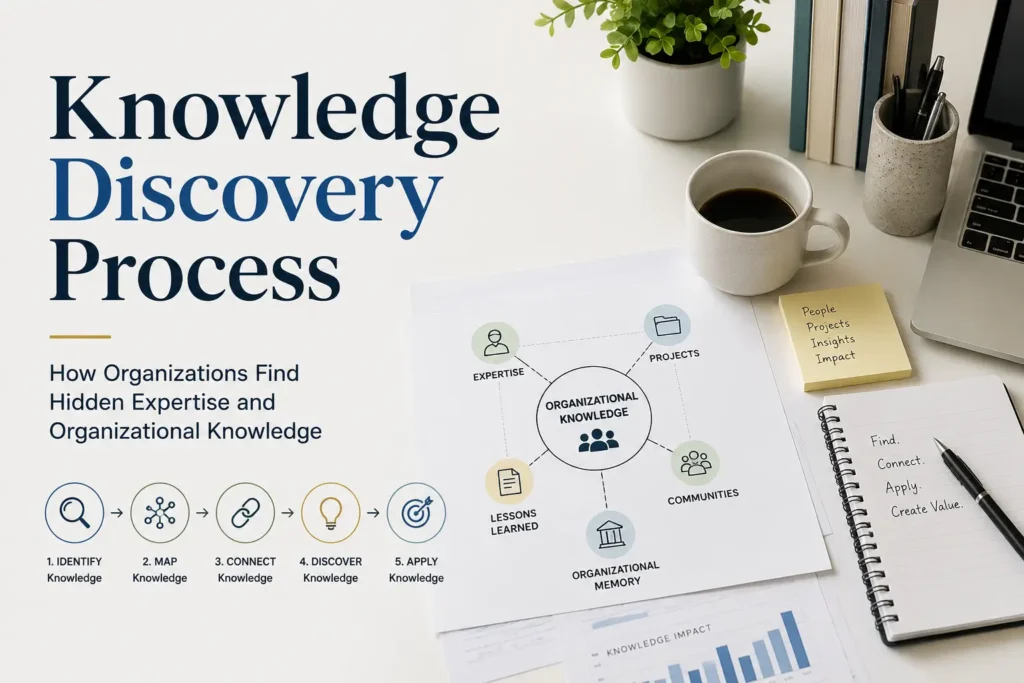
A knowledge discovery process is the systematic approach through which organizations identify, locate, connect, uncover, and apply knowledge that already exists within the enterprise.
This distinction is important because knowledge discovery is not simply a search activity. Search assumes that users know what they are looking for. Discovery addresses a different challenge. It helps organizations reveal knowledge that may be unknown, hidden, disconnected, or difficult to access.
Consider a project team tasked with solving a complex business problem. Traditional search tools may help them locate relevant documents, policies, or reports. However, some of the most valuable knowledge may reside elsewhere. An expert in another business unit may have faced a similar challenge several years earlier. A project team in another region may have developed an effective solution that was never widely shared. A lessons learned database may contain insights that are highly relevant but difficult to locate through conventional searches.
The purpose of knowledge discovery is to surface these hidden assets and connect them to current organizational needs.
Seen through this lens, knowledge discovery is not about finding more information. It is about reducing the distance between organizational knowledge and organizational action.
This capability becomes increasingly important as organizations grow. In smaller environments, employees often know who possesses relevant expertise and where important information resides. In large enterprises, however, knowledge becomes fragmented across functions, geographies, systems, and communities. Valuable insights remain distributed throughout the organization, making them difficult to discover without deliberate mechanisms and processes.
A mature knowledge discovery process addresses this challenge by creating pathways through which knowledge can be identified, connected, and applied. It transforms knowledge from a static organizational asset into a dynamic organizational capability.
The Five Stages of the Knowledge Discovery Process
Knowledge discovery should not be viewed as a single event. It is a continuous process that enables organizations to transform dispersed knowledge into actionable intelligence. While different frameworks exist, most effective discovery initiatives involve five interconnected stages: knowledge identification, knowledge mapping, knowledge connection, knowledge discovery, and knowledge application.
Together, these stages create the conditions necessary for knowledge to move from hidden organizational assets to measurable business value.
Stage 1: Knowledge Identification
The first stage of any knowledge discovery process involves determining what knowledge actually matters.
This may appear straightforward, but it is one of the most frequently overlooked aspects of knowledge management. Organizations often attempt to manage all knowledge equally, creating repositories filled with information of varying relevance and strategic importance. In practice, however, some knowledge assets contribute significantly more value than others.
Knowledge identification focuses on recognizing the expertise, experiences, lessons, decisions, and intellectual assets that are most important to organizational success. These assets may include technical expertise, operational know-how, customer insights, innovation capabilities, regulatory knowledge, historical lessons, or institutional memory.
Importantly, knowledge identification extends beyond formal documentation. Some of the most valuable organizational knowledge exists as tacit knowledge embedded within employees, communities of practice, and professional networks. Experienced professionals often possess judgment, contextual understanding, and problem-solving capabilities that cannot be fully documented yet remain critical to organizational performance.
Without a clear understanding of what knowledge matters, discovery efforts become fragmented and unfocused. Knowledge identification provides the foundation upon which all subsequent discovery activities depend.
Stage 2: Knowledge Mapping
Once critical knowledge has been identified, organizations must understand where that knowledge resides.
Knowledge rarely exists in a single location. It is distributed across people, systems, projects, communities, and organizational networks. Knowledge mapping creates visibility into this landscape by helping organizations understand how knowledge is distributed throughout the enterprise.
At its most basic level, knowledge mapping answers questions such as: Who possesses critical expertise? Which systems contain valuable information? What communities generate organizational learning? Which projects have produced reusable knowledge? How does knowledge flow across organizational boundaries?
The purpose of knowledge mapping is not simply to create inventories. Its purpose is to reveal the knowledge ecosystem itself.
Many discovery challenges emerge because organizations lack visibility into where knowledge resides. Valuable expertise remains hidden. Lessons learned are stored in isolated systems. Communities generate insights that never reach wider audiences. Mapping helps overcome these limitations by making organizational knowledge visible.
In many respects, knowledge mapping serves as the bridge between knowing that knowledge exists and being able to discover it when needed.
Stage 3: Knowledge Connection
Knowledge creates value through relationships.
A lesson learned becomes more useful when connected to the project that generated it. An expert becomes easier to identify when connected to previous work, communities, and business outcomes. A document becomes more meaningful when linked to decisions, experiences, and organizational context.
Knowledge connection focuses on establishing these relationships.
Traditionally, knowledge management concentrated on storing individual assets. Modern discovery approaches recognize that understanding relationships is often more valuable than understanding individual pieces of information. Taxonomies, metadata frameworks, expertise networks, communities of practice, and knowledge graphs all contribute to this effort.
The objective is to transform isolated knowledge assets into an interconnected knowledge ecosystem where context and meaning become visible.
As organizations increasingly adopt artificial intelligence, the importance of knowledge connection continues to grow. AI systems perform most effectively when knowledge exists within rich relational structures rather than isolated repositories. Connected knowledge improves discoverability for both people and machines.
Stage 4: Knowledge Discovery
This is the stage where organizational knowledge becomes visible at the point of need.
Knowledge discovery involves surfacing relevant expertise, experiences, lessons, and information that can support current decisions and activities. Unlike traditional search, which relies on predefined queries, discovery seeks to reveal knowledge that users may not know exists.
Effective discovery reduces duplication of effort, accelerates learning, improves decision quality, and strengthens organizational agility. It enables organizations to leverage existing knowledge before investing resources in creating new knowledge.
Increasingly, discovery is being enhanced through artificial intelligence, recommendation engines, expertise location systems, semantic search technologies, and knowledge graph architectures. These capabilities help organizations move beyond keyword retrieval toward more contextual and intelligent forms of discovery.
The ultimate goal is simple: ensure that the right knowledge reaches the right people at the right time.
Stage 5: Knowledge Application
The final stage is where knowledge generates value.
Knowledge that is identified, mapped, connected, and discovered remains a potential asset until it influences decisions and actions. Application occurs when knowledge improves project outcomes, informs strategy, reduces risk, supports innovation, or strengthens operational performance.
This stage highlights an important reality. The purpose of knowledge discovery is not discovery itself. The purpose is action.
Organizations often know more than they use. Valuable knowledge exists throughout the enterprise but remains disconnected from day-to-day decision-making. Application closes this gap by ensuring that discovered knowledge becomes part of organizational behavior.
Ultimately, the success of a knowledge discovery process should be measured not by how much knowledge is stored or discovered but by how effectively knowledge contributes to business outcomes.
Together, these five stages form the foundation of a mature knowledge discovery capability. They enable organizations to move beyond repositories and search engines toward a more dynamic model of organizational intelligence, one in which knowledge can be continuously identified, connected, discovered, and applied wherever it creates the greatest value.
Why Knowledge Discovery Efforts Fail
If knowledge discovery is becoming a strategic capability, an obvious question follows: why do so many organizations struggle to do it effectively?
The answer is not a lack of technology. Most large organizations already possess sophisticated collaboration platforms, enterprise search tools, document management systems, intranets, knowledge bases, and increasingly, AI-powered assistants. Yet despite these investments, employees continue to spend significant time searching for information, locating experts, and recreating knowledge that already exists elsewhere in the organization.
The challenge is that discovery failures are rarely caused by a single problem. They emerge from a combination of structural, cultural, and technological factors that collectively create what might be called knowledge discovery friction.
Knowledge discovery friction refers to anything that increases the effort required to find, understand, trust, and apply organizational knowledge. The higher the friction, the less likely knowledge will be discovered and reused.
One of the most visible sources of friction is information overload.
Organizations are generating knowledge at unprecedented rates. Every project creates documentation. Every meeting produces notes. Every collaboration platform captures conversations. Every business process generates reports and data. Artificial intelligence is accelerating this trend by making content creation easier and faster than ever before.
The result is a paradox. Employees have access to more information than any previous generation of workers, yet they often struggle to find the knowledge that matters most. Valuable insights become buried beneath thousands of documents, reports, and records. Search results produce overwhelming volumes of information without clearly indicating what is most relevant or trustworthy. The challenge is no longer access to information. The challenge is filtering and prioritizing it.
A second challenge involves organizational silos.
Most enterprises are structured around functions, regions, business units, and specialized domains. While these structures support operational efficiency, they often limit knowledge visibility. Teams become highly effective at sharing knowledge internally while remaining disconnected from expertise and experiences elsewhere in the organization.
This fragmentation creates significant costs. Similar problems are solved repeatedly. Innovations spread slowly. Valuable lessons remain confined to the teams that originally generated them. Organizations frequently invest resources recreating knowledge that already exists because employees simply do not know where to find it.
The problem becomes even more significant during mergers, acquisitions, and large-scale transformation initiatives. Knowledge may exist across multiple repositories, platforms, and organizational units, but employees lack a unified view of where that knowledge resides.
Hidden expertise represents another major obstacle.
Traditional knowledge management initiatives have historically focused on content. Documents can be stored, categorized, and searched. Expertise is more difficult to manage because it resides within people.
Some of the most valuable organizational knowledge exists not in repositories but in experience. Experts develop judgment through years of practice. They learn how to navigate ambiguity, manage exceptions, and recognize patterns that are difficult to document. Yet organizations often have limited visibility into who possesses this expertise.
Employees may know the experts within their immediate teams but remain unaware of specialists elsewhere in the enterprise. As a result, expertise remains underutilized despite being readily available.
This issue is becoming increasingly important as work becomes more specialized. In many organizations, locating the right expert is more valuable than locating the right document.
Metadata and governance challenges further complicate discovery.
Knowledge assets are only as discoverable as the structures used to organize them. Inconsistent terminology, poor classification practices, duplicate content, and weak governance make it difficult to connect knowledge across systems and business units. Employees may use different language to describe similar concepts, preventing discovery systems from recognizing relationships between knowledge assets.
Over time, repositories become increasingly difficult to navigate. Valuable knowledge remains available but effectively invisible because it lacks the contextual information necessary to support discovery.
Perhaps the most overlooked challenge, however, is cultural.
Organizations often assume that knowledge discovery is primarily a technological problem. In reality, technology can only expose knowledge that people are willing to share.
Employees may hesitate to share expertise because knowledge is associated with influence, authority, or job security. Business units may prioritize local objectives over enterprise-wide learning. Incentive structures may reward individual performance rather than collaboration. These dynamics create barriers that technology alone cannot overcome.
This is why some organizations with relatively modest technology environments achieve stronger knowledge sharing outcomes than organizations with sophisticated platforms and extensive KM investments. Culture influences whether knowledge flows. Technology merely influences how easily it can flow.
The common thread across all of these challenges is that discovery failures rarely stem from a lack of knowledge. Organizations typically possess the expertise, experiences, and insights required to address many of their challenges. The problem is that this knowledge remains difficult to see, connect, and apply.
In other words, the challenge is not knowledge availability. It is knowledge visibility.
Artificial Intelligence and the Future of Knowledge Discovery
The rise of artificial intelligence is reshaping how organizations think about knowledge discovery. In many ways, AI represents the most significant shift in knowledge management since the emergence of enterprise collaboration technologies.
Yet one of the most important lessons from early enterprise AI initiatives is that artificial intelligence does not solve knowledge discovery problems. It exposes them.
Many organizations initially approached AI with the expectation that conversational interfaces and large language models would make knowledge instantly accessible. Employees would ask questions in natural language and receive accurate answers drawn from organizational knowledge. The vision appeared straightforward.
The reality proved more complex.
Organizations quickly discovered that AI systems are only as effective as the knowledge they can access. Fragmented repositories, hidden expertise, poor metadata, duplicate content, disconnected systems, and weak governance structures significantly limit AI performance. In many cases, AI simply reveals weaknesses that already existed within the organization’s knowledge ecosystem.
This observation has profound implications for the future of knowledge management.
For years, organizations could compensate for fragmented knowledge environments because employees relied on personal networks, institutional memory, and informal communication channels. AI systems cannot do this. They depend on discoverable, connected, and contextualized knowledge.
As a result, AI is elevating the importance of knowledge discovery rather than reducing it.
One of the most significant developments in this area is the rise of Retrieval-Augmented Generation, or RAG. Unlike traditional language models that rely solely on training data, RAG architectures retrieve information from organizational knowledge sources before generating responses. This allows AI systems to provide answers grounded in enterprise-specific knowledge.
However, RAG introduces a critical dependency. Knowledge must be discoverable before it can be retrieved.
If expertise remains hidden, if repositories are fragmented, or if metadata structures are inconsistent, retrieval quality declines. The effectiveness of AI therefore becomes directly linked to the effectiveness of knowledge discovery.
Knowledge graphs are emerging as another important component of the future discovery landscape.
Traditional repositories focus on storing content. Knowledge graphs focus on relationships. They connect people to projects, projects to outcomes, outcomes to lessons learned, and lessons learned to future initiatives. This relational structure more closely reflects how knowledge functions within organizations.
For AI systems, these relationships provide essential context. They enable more sophisticated forms of reasoning, recommendation, and discovery than traditional repository structures can support.
Expertise discovery is also likely to become increasingly important.
Historically, organizations relied on informal networks to locate expertise. AI now makes it possible to identify experts based on project histories, collaboration patterns, publications, contributions, and demonstrated experience. Rather than relying solely on self-reported profiles, organizations can develop dynamic representations of expertise that evolve over time.
This capability has the potential to significantly improve organizational learning by making previously hidden expertise visible at scale.
Perhaps the most important implication of AI, however, involves organizational memory.
Organizations generate enormous amounts of knowledge through projects, decisions, customer interactions, operational activities, and strategic initiatives. Historically, much of this knowledge was preserved but rarely revisited. AI creates opportunities to activate organizational memory by surfacing relevant historical experiences, lessons learned, and previous decisions at the moment they are needed.
In this sense, AI is transforming organizational memory from a passive archive into an active organizational capability.
The future of knowledge discovery will therefore involve more than search engines and repositories. It will increasingly depend on connected knowledge ecosystems where expertise, experiences, relationships, and organizational memory can be discovered through context rather than keywords alone.
For knowledge leaders, this shift presents both a challenge and an opportunity.
The challenge is that discoverability has become a prerequisite for AI readiness. Organizations with fragmented knowledge environments will struggle to realize the full value of AI investments.
The opportunity is that knowledge management is becoming more strategically relevant than it has been in years. As enterprises seek to leverage AI, they are rediscovering the importance of discoverable knowledge, connected expertise, and organizational memory.
The organizations that succeed in the age of AI will not necessarily be those that possess the most knowledge. They will be those that can most effectively discover, connect, and apply what they already know.
Discovery Is Becoming the New Competitive Advantage
For decades, organizations focused on accumulating knowledge. The assumption was that more knowledge would naturally lead to better decisions, stronger innovation, and improved performance. Yet the experience of many enterprises suggests otherwise. Knowledge that cannot be discovered creates little value regardless of how carefully it is captured or stored.
The challenge facing modern organizations is not a lack of information. It is the ability to surface relevant expertise, connect organizational memory to current decisions, and make hidden knowledge visible at the moment it is needed.
This is why knowledge discovery is emerging as a strategic capability rather than a supporting process. As organizations generate increasing volumes of information and adopt AI-enabled technologies, discoverability becomes the bridge between intellectual capital and business value.
The organizations that thrive in the coming decade will not necessarily be those that create the most knowledge. They will be those that can most effectively discover, connect, and apply what they already know.
In that sense, the future of knowledge management may be defined by a simple shift in perspective. The question is no longer how knowledge can be stored. The question is how knowledge can be made visible.
And for many organizations, that difference may become a source of lasting competitive advantage.