Introduction
There is a common misconception about Knowledge Management that has followed the profession for decades.
Ask someone outside the KM community what a Knowledge Manager does, and the answers are remarkably similar. They organize documents, manage intranets, maintain knowledge bases, oversee taxonomies, or ensure information is stored correctly. These responsibilities certainly exist, but they tell only a small part of the story. More importantly, they fail to explain why some Knowledge Managers become trusted strategic advisors while others struggle to demonstrate the value of their work.
The difference has never been the technology they use or the number of frameworks they understand.
It is how they think.
Exceptional Knowledge Managers approach their role differently. They do not see Knowledge Management as the process of collecting and organizing information. They see it as the discipline of helping organizations make better decisions, solve problems faster, reduce the cost of repeated mistakes, and ensure that valuable expertise remains available when it is needed most. Their focus is not knowledge for its own sake—it is knowledge that creates measurable business value.
This distinction has become even more significant as organizations invest heavily in digital transformation and artificial intelligence. According to McKinsey & Company, employees spend nearly 20% of their workweek searching for internal information or trying to identify colleagues with the expertise they need. At the same time, organizations continue to face the loss of institutional knowledge through employee turnover and retirement, while teams frequently duplicate work because previous experience is difficult to discover or trust. These challenges persist despite decades of investment in collaboration platforms, document management systems, and enterprise search.
The lesson is difficult to ignore. Technology alone has never solved Knowledge Management.
Artificial intelligence is unlikely to change that. AI can summarize reports, recommend content, generate answers, and analyze enormous volumes of information in seconds. What it cannot do is create a culture where people willingly share what they know, determine whether organizational knowledge is trustworthy, build relationships between experts, or understand the subtle business context that gives knowledge its real value. Those responsibilities remain deeply human, making the role of the Knowledge Manager more strategic—not less—in the age of AI.
If technology is not the defining characteristic of successful Knowledge Management, what is?
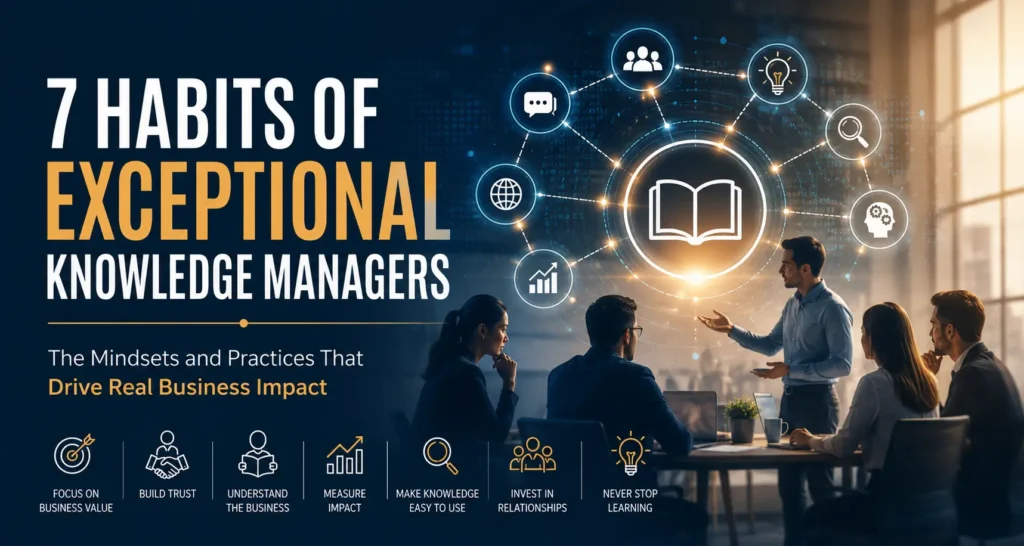
After observing high-performing Knowledge Management programs across industries, a consistent pattern emerges. The professionals who create the greatest impact are rarely distinguished by a single methodology, certification, or software platform. Instead, they share a set of habits and ways of thinking that influence every decision they make. They understand the business before proposing solutions. They earn trust before asking people to share knowledge. They measure outcomes instead of activity. They simplify complexity instead of adding it. Most importantly, they recognize that Knowledge Management is fundamentally about enabling people to perform at their best.
These habits are not reserved for Chief Knowledge Officers or professionals with decades of experience. They can be developed by anyone willing to look beyond the mechanics of Knowledge Management and embrace its broader purpose. In many ways, they represent the difference between managing knowledge as an operational function and using knowledge as a strategic capability.
This article explores the practices that consistently distinguish exceptional Knowledge Managers from the rest. They are not presented as a checklist or a universal formula for success. Every organization has its own culture, priorities, and challenges. Rather, they are enduring principles—shaped by experience, supported by research, and demonstrated by some of the most successful Knowledge Management practitioners around the world.
Because at the end of the day, organizations rarely remember the repository that was implemented or the taxonomy that was redesigned. They remember the projects that avoided failure because lessons were shared, the employees who became productive more quickly because expertise was accessible, and the innovations that emerged because knowledge flowed across teams.
That is the difference exceptional Knowledge Managers make. They do not simply manage knowledge.
They help organizations become smarter.
1. They Start with the Business, Not Knowledge Management
One of the biggest misconceptions about Knowledge Management is that success begins with implementing the right framework, choosing the right technology, or building the right repository.
Exceptional Knowledge Managers know that it doesn’t.
Before they think about taxonomies, metadata, Communities of Practice, lessons learned, or artificial intelligence, they ask a much simpler question:
“What business problem are we trying to solve?”
That question changes everything.
Organizations do not wake up one morning and decide they need better Knowledge Management. They recognize that projects are taking too long to deliver, customers are receiving inconsistent service, experienced employees are leaving without transferring their expertise, or teams are repeatedly solving problems that have already been solved elsewhere. These are business problems. Knowledge is often part of the solution, but it is rarely the problem itself.
This distinction is what separates competent Knowledge Managers from exceptional ones.
Average practitioners often begin with a KM initiative. They identify a need for a new knowledge base, propose a lessons learned program, launch a Community of Practice, or recommend an enterprise search solution. These initiatives may be well designed, but they frequently struggle to gain executive support because their connection to business outcomes is unclear.
Exceptional Knowledge Managers take the opposite approach.
They begin by understanding the organization’s priorities. They ask leaders what keeps them awake at night. They speak with project teams to uncover recurring challenges. They observe how work actually gets done rather than how processes are documented. They investigate where decisions are delayed, where knowledge is lost, where expertise is concentrated in a handful of individuals, and where employees spend unnecessary time searching for information.
Only after understanding these realities do they design a Knowledge Management solution.
This business-first mindset fundamentally changes the conversation.
Instead of saying:
“We need a better lessons learned repository.”
They ask:
“Why are we repeating the same project mistakes despite having years of experience?”
Instead of proposing an expertise directory, they ask:
“Why does it take employees days to find the right person when the expertise already exists inside the organization?”
Instead of measuring the number of documents stored, they ask:
“How much time could we save if trusted knowledge were available at the point of need?”
Notice that the conversation has shifted from Knowledge Management activities to business outcomes.
This is the language executives understand.
Consider an engineering company preparing for the retirement of several senior specialists. A traditional KM response might focus on documenting procedures, recording interviews, and creating a repository of technical knowledge. Those activities are valuable, but they are only part of the picture.
An exceptional Knowledge Manager looks beyond documentation.
They ask what the business stands to lose if that expertise disappears. Will project timelines increase? Will safety risks rise? Will new engineers repeat mistakes that experienced professionals learned to avoid decades ago? Will customer confidence be affected? The objective is no longer to preserve knowledge for its own sake. The objective is to protect organizational capability and reduce business risk.
That subtle shift transforms Knowledge Management from an administrative function into a strategic one.
The same principle applies to digital transformation and artificial intelligence initiatives. Many organizations invest heavily in AI-powered search, intelligent assistants, and knowledge automation with the expectation that technology alone will solve knowledge challenges. Yet AI is only as valuable as the knowledge it can access. If organizational knowledge is fragmented, outdated, inconsistent, or poorly governed, AI simply delivers faster access to unreliable information.
Exceptional Knowledge Managers recognize this immediately.
They understand that successful AI initiatives begin long before an AI tool is deployed. They begin with improving the quality, accessibility, governance, and context of organizational knowledge. In this way, Knowledge Management becomes an essential enabler of AI success rather than a separate discipline competing for attention.
This ability to connect Knowledge Management with broader organizational priorities is becoming increasingly important. Research from APQC consistently shows that organizations with mature Knowledge Management practices are better positioned to improve operational efficiency, accelerate innovation, and strengthen organizational learning. The common thread is not the sophistication of their technology—it is the alignment between knowledge initiatives and business objectives.
Perhaps the most important lesson is this: exceptional Knowledge Managers are deeply curious about the organizations they serve.
They understand the products their company builds, the customers it supports, the regulations it must comply with, the competitive pressures it faces, and the goals leadership is trying to achieve. They spend as much time learning the business as they do learning about Knowledge Management itself.
This curiosity earns them something far more valuable than technical credibility.
It earns them a seat at conversations where strategic decisions are made.
Over time, colleagues stop viewing them as the people responsible for the knowledge base. They begin to see them as professionals who help solve problems, improve performance, and strengthen the organization’s ability to learn.
And that is perhaps the defining characteristic of exceptional Knowledge Managers.
They do not ask, “How can we implement better Knowledge Management?”
They ask, “How can knowledge help this organization perform better?”
Everything else follows from that question.
2. They Build Trust Before They Build Knowledge Systems
Every Knowledge Manager has encountered the same frustrating situation.
A sophisticated knowledge platform is launched after months of planning. The search works well, the structure is logical, the governance model is carefully designed, and leadership is optimistic about the investment. Yet months later, the platform contains outdated documents, employees continue asking the same questions in meetings or chat channels, and valuable expertise remains locked inside the minds of a few experienced individuals.
The technology worked.
The Knowledge Management initiative did not.
Why?
Because knowledge is rarely withheld for technical reasons. More often, it is withheld for human ones.
People don’t share what they know simply because a repository exists. They share when they trust that doing so will help rather than harm them. They contribute when they believe their expertise will be respected, their time valued, and their knowledge used responsibly. Without that foundation of trust, even the most advanced KM platform becomes little more than another place to store documents.
Exceptional Knowledge Managers understand this instinctively.
They know that before an organization can improve how it manages knowledge, it must first create an environment where people feel comfortable exchanging it.
Research has reinforced this idea for years. Studies by scholars such as Amy Edmondson have shown that psychological safety—the belief that people can speak up, ask questions, admit mistakes, and share ideas without fear of embarrassment or punishment—is one of the strongest predictors of learning and collaboration in organizations. Teams with high psychological safety are more willing to exchange knowledge, challenge assumptions, and learn from failures. Those behaviors sit at the heart of effective Knowledge Management.
This is why exceptional Knowledge Managers spend as much time understanding people as they do understanding information.
They recognize that every organization has informal knowledge networks that are invisible on an organizational chart. Certain employees are trusted because they have solved difficult problems before. Others are known for connecting people across departments. Some quietly mentor colleagues without ever holding leadership positions. These relationships often determine how knowledge flows far more than any formal process.
Instead of trying to replace these human networks with technology, exceptional Knowledge Managers strengthen them.
They create opportunities for experts to teach one another rather than simply upload documents. They encourage conversations that uncover tacit knowledge—the practical judgment, intuition, and experience that cannot easily be captured in a manual. They facilitate Communities of Practice where professionals discuss real challenges instead of merely exchanging files. They understand that some of the organization’s most valuable knowledge is created through dialogue, reflection, and shared experience.
Trust also changes how Knowledge Managers respond to mistakes.
In organizations where failures are hidden, lessons are rarely learned. Teams become reluctant to discuss what went wrong because they fear blame, damaged reputations, or negative performance evaluations. As a result, the same mistakes reappear in different projects, often at significant cost.
Exceptional Knowledge Managers work to change this dynamic.
They frame lessons learned as opportunities for organizational improvement rather than individual criticism. They encourage honest reflection without assigning blame. Over time, people become more willing to share not only their successes but also the experiences that prevented future failures. These conversations often generate more organizational learning than polished success stories ever could.
Recognition matters as well.
Many professionals hesitate to contribute knowledge because they see little personal value in doing so. If expertise is continually requested but rarely acknowledged, knowledge sharing begins to feel like an additional task rather than a meaningful contribution.
Exceptional Knowledge Managers understand the importance of making contributors visible. Sometimes that means formal recognition programs. More often, it is much simpler—publicly acknowledging expertise, highlighting successful collaboration, or ensuring that those who share valuable knowledge receive credit for their contributions. Recognition reinforces a culture where knowledge sharing becomes part of professional identity rather than an obligation.
This emphasis on trust becomes even more important as organizations adopt artificial intelligence. AI can retrieve information in seconds, but it cannot determine whether employees genuinely trust that information. It cannot repair relationships between departments, encourage experts to share their judgment, or create the confidence required for open collaboration. If people do not trust the knowledge entering the system, they are unlikely to trust the answers coming out of it.
That is why exceptional Knowledge Managers continue to invest first in people.
They understand that technology accelerates knowledge flow, but trust enables it.
Without trust, repositories remain incomplete, lessons remain unspoken, and expertise remains hidden.
With trust, knowledge moves naturally through conversations, teams, communities, and digital systems, creating an organization that learns faster, collaborates more effectively, and adapts more confidently to change.
In the end, repositories can store knowledge.
Only trust persuades people to share it.
3. They Learn the Business as Deeply as They Learn Knowledge Management
Spend time with exceptional Knowledge Managers and you’ll notice something interesting. They don’t only talk about Knowledge Management.
They talk about supply chains, customer experience, product development, engineering, healthcare, financial risk, manufacturing, digital transformation, mergers, regulatory compliance, and business strategy. They ask questions about markets, competitors, operations, and organizational priorities with the same curiosity they bring to discussions about Communities of Practice or knowledge capture.
This isn’t because they’ve changed professions.
It’s because they’ve realized that Knowledge Management has no value outside the context of the business it serves.
One of the fastest ways for a Knowledge Manager to lose credibility is to become known as the person who understands KM but not the organization. When every recommendation is framed through the lens of methodology rather than business reality, colleagues begin to see Knowledge Management as a support function rather than a strategic capability.
Exceptional professionals avoid this trap.
Before proposing a solution, they invest time understanding how the organization creates value. They learn who its customers are, what differentiates it from competitors, where revenue comes from, which processes are mission-critical, and what risks keep senior leaders awake at night.
Because only then can they answer the most important question:
Where can knowledge create the greatest business impact?
Imagine two Knowledge Managers joining the same manufacturing company.
The first spends the first few months reviewing documentation standards, evaluating collaboration platforms, and designing a new taxonomy. These activities are useful, but they largely happen in isolation from the business.
The second spends those same months visiting production sites, sitting with engineers, observing quality reviews, speaking with customer service teams, attending project meetings, and asking frontline employees a simple question:
“What information do you struggle to find when you need it most?”
By the end of the year, both Knowledge Managers have learned about the organization.
But they have learned very different things.
One understands the knowledge system.
The other understands the business.
That difference shapes every decision they make.
When an engineering team reports recurring design errors, the exceptional Knowledge Manager doesn’t immediately recommend another repository. They investigate why previous project knowledge isn’t being reused. Is it difficult to find? Is it outdated? Do engineers trust it? Is valuable expertise exchanged informally but never captured? They look beyond symptoms to identify the underlying barriers preventing knowledge from improving performance.
The same mindset applies across industries.
In healthcare, the challenge may be ensuring clinicians can quickly access evidence-based practices while maintaining patient safety.
In consulting, it may involve helping teams reuse intellectual capital without sacrificing creativity.
In financial services, it may mean preserving regulatory knowledge while enabling faster decision-making.
In energy or infrastructure, it may focus on transferring decades of specialist expertise before experienced professionals retire.
The tools may differ.
The business problem always comes first.
This is why many of the world’s most respected Knowledge Management leaders spend significant time outside their own function. They attend operational meetings, participate in transformation initiatives, observe customer interactions, and build relationships across departments. They understand that the most valuable insights rarely emerge from sitting behind a desk reviewing documentation. They emerge from watching how work actually happens.
This curiosity has another benefit.
It changes how colleagues perceive the Knowledge Manager.
Instead of being viewed as someone who manages content, they become someone who understands the organization’s challenges. Project managers seek their advice because they know they can help teams learn from previous work. Business leaders involve them in strategic initiatives because they understand the operational implications of knowledge loss. HR partners collaborate with them on onboarding and succession planning because they appreciate the connection between people, learning, and organizational capability.
Knowledge Management becomes integrated into the business rather than operating alongside it.
This broader perspective is becoming even more important in the age of artificial intelligence.
AI is making access to information easier than ever before. What it cannot do is determine which business problems deserve attention first, understand the organizational consequences of knowledge gaps, or recognize the subtle context that experienced professionals develop over years of working within an industry.
Those judgments still require human insight.
Exceptional Knowledge Managers provide that insight because they have taken the time to understand both knowledge and business.
Ultimately, organizations do not need Knowledge Managers who simply know more about Knowledge Management than everyone else.
They need professionals who understand how knowledge can improve productivity, reduce risk, accelerate innovation, strengthen customer outcomes, and support strategic objectives.
The most successful Knowledge Managers are not defined by the depth of their knowledge about KM frameworks.
They are defined by the depth of their understanding of the organizations they serve.
That is what enables them to move from managing knowledge to influencing business performance.
4. They Measure Impact, Not Activity
One of the most persistent challenges in Knowledge Management is proving its value.
Unlike sales, where revenue can be tracked, or manufacturing, where output is visible, the benefits of Knowledge Management often appear indirectly. A project finishes ahead of schedule because lessons from a previous initiative were reused. A new employee becomes productive in half the expected time because critical expertise was readily available. A customer issue is resolved in minutes because someone quickly found a solution that had already been documented elsewhere.
These outcomes matter enormously.
The challenge is that they are easy to experience but difficult to attribute.
This is where exceptional Knowledge Managers distinguish themselves.
They understand that activity is not the same as impact.
Many KM programs report metrics such as the number of documents published, pages viewed, searches performed, training sessions delivered, or members participating in a Community of Practice. These indicators have operational value because they help assess whether systems are being used.
But they rarely answer the question every executive eventually asks:
“How has this improved the business?”
A repository containing one million documents is not necessarily more valuable than one containing ten thousand.
An enterprise search platform processing millions of queries each month does not automatically mean employees are finding what they need.
Likewise, a thriving Community of Practice cannot be considered successful simply because attendance is high.
Exceptional Knowledge Managers know that these are leading indicators, not proof of value.
Instead, they ask different questions.
Has onboarding time for new employees decreased?
Are project teams making fewer repeat mistakes?
Can engineers solve technical problems faster because previous solutions are easier to discover?
Has customer response time improved because support teams have access to trusted knowledge?
Are experts spending less time answering the same questions because knowledge is reusable?
Have innovation cycles shortened because teams can build on existing ideas instead of starting from scratch?
These questions shift the conversation away from Knowledge Management activities and toward organizational performance.
This distinction is becoming increasingly important as organizations seek measurable returns on digital transformation investments. According to APQC, leading organizations are progressively linking Knowledge Management initiatives to business outcomes such as productivity, operational efficiency, quality improvement, innovation, and risk reduction rather than relying solely on usage statistics. Mature KM programs recognize that success is demonstrated by improved organizational capability, not simply increased content volume.
Another hallmark of exceptional Knowledge Managers is that they establish success measures before launching an initiative.
Rather than implementing a new knowledge-sharing platform and hoping it delivers value, they define what success should look like from the beginning.
If the goal is to improve project delivery, they identify baseline performance and monitor whether project teams complete work more efficiently after knowledge interventions are introduced.
If the objective is to preserve critical expertise, they measure how effectively knowledge transfer reduces dependency on individual specialists.
If the focus is customer service, they examine whether employees resolve issues faster or deliver more consistent responses after improving knowledge accessibility.
This disciplined approach strengthens credibility.
Instead of saying, “People seem to like the new platform,” they can demonstrate that onboarding time fell by several weeks, first-contact resolution improved, or recurring operational errors declined after implementing specific KM practices.
The conversation changes completely.
Knowledge Management is no longer viewed as an internal support activity.
It becomes a measurable contributor to business performance.
There is another reason this mindset matters.
Metrics influence behavior.
If employees are rewarded simply for uploading documents, they will upload more documents—regardless of quality.
If teams are measured by repository growth, repositories will grow—even if much of the content is never reused.
Exceptional Knowledge Managers avoid creating incentives that prioritize quantity over usefulness.
Instead, they encourage behaviors that produce meaningful outcomes: sharing practical experience, improving the quality of knowledge, mentoring colleagues, documenting critical lessons, and making expertise easier to apply in real work.
Ultimately, the purpose of Knowledge Management has never been to create more information.
Its purpose is to enable better decisions.
Exceptional Knowledge Managers understand that every metric should reflect that principle.
Because organizations do not invest in Knowledge Management to increase document counts.
They invest to become more efficient, more innovative, more resilient, and better equipped to solve the challenges that matter most.
5. They Make Knowledge Easy to Use, Not Just Easy to Store
There is a question every Knowledge Manager should ask before launching a new repository, redesigning an intranet, or implementing an AI-powered search tool:
“Will this make someone’s job easier tomorrow?”
If the answer is uncertain, the initiative deserves another look.
One of the most common reasons Knowledge Management initiatives fail is not because knowledge is unavailable—it is because knowledge is difficult to use.
Many organizations have invested heavily in document management systems, enterprise search platforms, collaboration tools, and digital workplaces. Yet employees continue to ask colleagues for information they know already exists somewhere in the organization. They search multiple systems, browse outdated folders, or rely on experienced coworkers because finding the right knowledge feels slower than asking another person.
The problem is rarely the absence of knowledge.
It is the friction involved in accessing and applying it.
Exceptional Knowledge Managers are obsessed with reducing that friction.
They understand that every extra click, every confusing navigation menu, every duplicate document, every inconsistent naming convention, and every outdated piece of content increases the likelihood that employees will abandon the system altogether.
People naturally follow the path of least resistance.
If asking a colleague takes two minutes while searching the knowledge base takes fifteen, the repository has already lost.
This is why exceptional Knowledge Managers design for the user, not the system.
They spend time observing how people actually work rather than assuming how they should work. They watch engineers troubleshoot equipment, customer service teams resolve cases, consultants prepare client proposals, clinicians access clinical guidance, or project managers search for previous lessons. These observations reveal something that dashboards and analytics rarely capture: the moments when knowledge is needed most.
Rather than organizing knowledge according to departmental structures or technical classifications, exceptional professionals organize it around real work.
They ask questions such as:
- What information does someone need at the beginning of a project?
- Which decisions cause the most uncertainty?
- Where do employees repeatedly lose time?
- Which experts receive the same questions every week?
- What knowledge would prevent the most costly mistakes if it were immediately accessible?
The answers often lead to simpler, more intuitive solutions than elaborate knowledge architectures.
Simplicity is one of the most underestimated strengths in Knowledge Management.
It is tempting to believe that a sophisticated taxonomy, extensive metadata model, or highly customized repository automatically creates a better user experience. Sometimes the opposite is true.
When employees must decide between dozens of categories before uploading a document, many postpone the task—or skip it entirely.
When search results produce hundreds of nearly identical documents, users quickly lose confidence in the system.
When outdated content remains alongside current guidance, trust begins to erode.
Exceptional Knowledge Managers understand that complexity is not a sign of maturity.
Clarity is.
This philosophy is particularly relevant in the age of artificial intelligence.
AI has transformed how employees search for and interact with information. Instead of browsing folders, they increasingly expect conversational answers, personalized recommendations, and instant access to relevant expertise.
But AI does not eliminate the need for good Knowledge Management.
It raises the standard.
Artificial intelligence depends on high-quality knowledge. If the underlying content is fragmented, duplicated, outdated, or poorly governed, AI simply retrieves unreliable information more efficiently. The quality of the answer can never consistently exceed the quality of the knowledge behind it.
Exceptional Knowledge Managers recognize that their role is evolving from managing repositories to managing the integrity, context, and usability of organizational knowledge.
Perhaps the most important difference is that they never confuse storage with accessibility.
Just because knowledge has been captured does not mean it can be found.
Just because it can be found does not mean it can be understood.
Just because it can be understood does not mean it can be applied.
The true measure of successful Knowledge Management is not whether knowledge exists somewhere within the organization.
It is whether the right person can confidently use the right knowledge at the right moment to make a better decision.
That is the standard exceptional Knowledge Managers hold themselves to.
They know that employees rarely remember how sophisticated a knowledge system was.
They remember whether it helped them solve a problem when it mattered most.
And in the end, that is what Knowledge Management is really about—not creating more places to store knowledge, but removing every unnecessary barrier between knowledge and action.
6. They Invest in Relationships More Than Technology
If there is one lesson that has remained consistent throughout the evolution of Knowledge Management, it is this: knowledge moves at the speed of relationships.
Organizations have spent decades investing in increasingly sophisticated technologies. From document management systems and enterprise portals to collaboration platforms, enterprise search, and now artificial intelligence, each new generation of tools has promised to make knowledge easier to capture and share.
Many have delivered significant improvements.
Yet one challenge has remained remarkably persistent.
When employees face a complex problem, they often don’t begin by searching a repository.
They begin by asking someone they trust.
This simple observation reveals something fundamental about how knowledge works in organizations.
People trust people before they trust systems.
They seek context, judgment, and experience—not just information. A document may explain what to do. An experienced colleague can explain why it matters, when it applies, and what exceptions to consider. That difference often determines whether knowledge is merely consumed or genuinely applied.
Exceptional Knowledge Managers understand this better than anyone.
Rather than viewing technology as the center of Knowledge Management, they see it as an enabler of human connection. Their first instinct is not to ask, “Which platform should we implement?” Instead, they ask, “Who already knows how to solve this problem, and how can others learn from them?”
This shift in perspective transforms the role of the Knowledge Manager.
Instead of becoming the owner of a repository, they become a connector of people.
They know where expertise exists—not only in organizational charts but within the informal networks that keep every organization functioning. They understand who others naturally turn to for advice, who quietly mentors new employees, who consistently solves difficult problems, and who bridges gaps between departments.
These individuals are often invisible in formal processes, yet they are among the organization’s most valuable knowledge assets.
Exceptional Knowledge Managers make those connections visible.
They introduce people who would otherwise never meet. They facilitate Communities of Practice where professionals exchange practical experience instead of simply presenting information. They create mentoring opportunities between experienced specialists and emerging talent. They encourage project retrospectives that focus on learning rather than reporting. They design environments where conversations happen naturally because they know that some of the most valuable knowledge cannot be captured in a document.
This emphasis on relationships becomes even more important when organizations face change.
During mergers, restructures, digital transformation, or rapid growth, formal processes often struggle to keep pace. New teams are formed, experienced employees leave, responsibilities shift, and knowledge gaps emerge unexpectedly.
Technology can store information about these changes.
Relationships help people navigate them.
Employees who know whom to contact adapt faster than those who rely solely on documentation. Teams that trust one another share lessons more openly. Departments with strong collaborative relationships solve problems before they become organizational barriers.
Exceptional Knowledge Managers deliberately strengthen these networks because they understand that resilient organizations are built on trusted connections as much as on trusted information.
There is another advantage to investing in relationships.
People are far more willing to share knowledge with someone who has earned their respect.
Experienced professionals are often protective of their expertise—not because they want to withhold it, but because they value accuracy, context, and professional credibility. When a Knowledge Manager has spent time understanding their work, listening to their challenges, and recognizing their contributions, those experts become partners rather than reluctant participants.
Knowledge sharing becomes a collaborative effort instead of another administrative request.
This principle also has important implications for artificial intelligence.
Much of today’s conversation focuses on AI’s ability to retrieve knowledge instantly. While these capabilities are valuable, organizations should be careful not to confuse information retrieval with knowledge transfer.
AI can explain a process.
It cannot mentor a new engineer through an unexpected design challenge.
It can summarize previous project reports.
It cannot build the confidence that comes from learning directly from an experienced colleague.
It can recommend relevant content.
It cannot replace the trust that develops through human collaboration.
Exceptional Knowledge Managers recognize that the future of Knowledge Management is not a choice between people and technology.
It is about ensuring that technology strengthens the relationships through which knowledge already flows.
Ultimately, every successful KM initiative depends on one simple reality.
Knowledge does not move because a system requires it.
Knowledge moves because people choose to share it.
And people choose to share it when trust, respect, and meaningful relationships already exist.
That is why exceptional Knowledge Managers spend as much time building connections between people as they do building connections between information.
Because long after technologies evolve, platforms are replaced, and AI capabilities advance, organizations will continue to succeed or fail based on one enduring factor:
How effectively their people learn from one another.
7. They Never Stop Learning—Because Their Profession Never Stops Evolving
Knowledge Management has never been a static discipline.
Over the past three decades, the profession has evolved from document management and information repositories to organizational learning, collaboration, innovation, digital workplaces, enterprise search, expertise management, and now artificial intelligence. Each shift has changed not only the tools Knowledge Managers use, but also the expectations placed upon them.
Exceptional Knowledge Managers understand that keeping pace with this evolution is not optional.
It is part of the job.
What distinguishes them is not that they know everything. In fact, many would argue the opposite. They remain effective because they are comfortable admitting what they do not know and are committed to learning continuously.
This curiosity extends far beyond Knowledge Management itself.
They study organizational psychology to understand why people resist change. They explore behavioral economics to learn how decisions are made under uncertainty. They read about leadership because influence matters more than authority. They follow developments in artificial intelligence because it is reshaping how knowledge is created, discovered, and applied. They pay attention to cybersecurity, digital transformation, customer experience, and operational excellence because every one of these disciplines intersects with Knowledge Management.
They understand that becoming a better Knowledge Manager often means becoming a better business professional.
Continuous learning also changes how they approach their own work.
They do not assume that the practices which succeeded five years ago will succeed tomorrow. They regularly question existing processes, seek feedback from colleagues, and evaluate whether their initiatives are creating meaningful value. They are willing to refine their approach when evidence suggests a better way.
This mindset is particularly important in today’s environment.
Artificial intelligence is rapidly changing how organizations search for information, create content, and automate routine knowledge tasks. Some professionals view these developments with uncertainty, wondering whether technology will eventually replace traditional Knowledge Management roles.
Exceptional Knowledge Managers ask a different question.
Instead of asking, “How will AI change my job?”
They ask, “How can I help my organization use AI responsibly, effectively, and with trustworthy knowledge?”
That shift in thinking positions them as leaders rather than observers.
They recognize that AI increases—not decreases—the importance of high-quality knowledge. Intelligent systems depend on accurate content, clear governance, reliable context, and continuous validation. Someone must ensure that organizational knowledge remains trustworthy, current, and aligned with business objectives.
That responsibility belongs squarely within the future of Knowledge Management.
Learning also means engaging with the wider profession.
Exceptional Knowledge Managers rarely develop in isolation. They participate in professional communities, attend conferences, contribute articles, exchange ideas with peers, and learn from organizations facing different challenges. These interactions expose them to new perspectives and prevent them from becoming confined by the assumptions of a single workplace.
Perhaps the most valuable characteristic they share is intellectual humility.
The more experience they gain, the more they appreciate that every organization is different. They avoid searching for universal solutions because they understand that successful Knowledge Management is always shaped by culture, leadership, strategy, and context.
They remain students of the profession.
And that is precisely why they continue to grow within it.
Conclusion: Exceptional Knowledge Managers Leave Organizations Stronger Than They Found Them
There is no universal framework that guarantees success in Knowledge Management.
No software platform, certification, or methodology can transform an organization on its own. Every organization has different priorities, different cultures, and different ways of working. Yet despite these differences, exceptional Knowledge Managers consistently share a common philosophy.
They understand that Knowledge Management has never been about managing knowledge.
It has always been about enabling people to perform better.
They begin with business challenges instead of KM initiatives.
They build trust before expecting knowledge to be shared.
They learn the business as deeply as they learn their profession.
They measure business impact rather than repository activity.
They remove friction so knowledge becomes easier to use.
They invest in relationships because they know expertise flows through people before it flows through technology.
And they never stop learning because they recognize that both organizations and the profession itself are constantly evolving.
Taken individually, these habits may seem straightforward.
Together, they represent a profound shift in how the role of the Knowledge Manager is understood.
The profession is no longer defined by managing content or maintaining systems. It is increasingly defined by helping organizations make better decisions, preserve critical expertise, accelerate learning, improve collaboration, reduce operational risk, and adapt to change more effectively.
This shift is becoming even more important in the age of artificial intelligence.
As AI becomes more capable of processing information, generating content, and answering questions, the competitive advantage of organizations will depend less on how much information they possess and more on the quality, trustworthiness, and usability of the knowledge behind it. Technology can accelerate access to knowledge, but it cannot replace the judgment required to determine what knowledge matters, why it matters, and how it should be applied.
That is where exceptional Knowledge Managers create lasting value.
Their greatest achievement is rarely a successful platform implementation or a well-designed taxonomy.
It is something far more enduring.
They create organizations where people learn from one another instead of repeating the same mistakes.
Where expertise survives leadership changes, retirements, and organizational restructuring.
Where knowledge becomes a shared organizational asset rather than an individual possession.
Where better decisions become a daily habit instead of an occasional success.
Perhaps that is the true measure of an exceptional Knowledge Manager.
Not the systems they implement.
Not the documents they collect.
Not the technologies they introduce.
But the lasting capability they leave behind.
Because when Knowledge Management is practiced at its highest level, people rarely notice the mechanisms that make it work.
They simply experience an organization that is more intelligent, more connected, more resilient, and better prepared for whatever comes next.
And there is no greater contribution a Knowledge Manager can make than that.