KM and AI: An Overview of Opportunities and Challenges – Live expert session with Prof. Dr. Andreas Brandner →
Knowledge Management in the Age of AI: Keeping Humans at the Centre – Expert workshop with Stephanie Barnes →

How Knowledge Flows Across Complex Enterprises

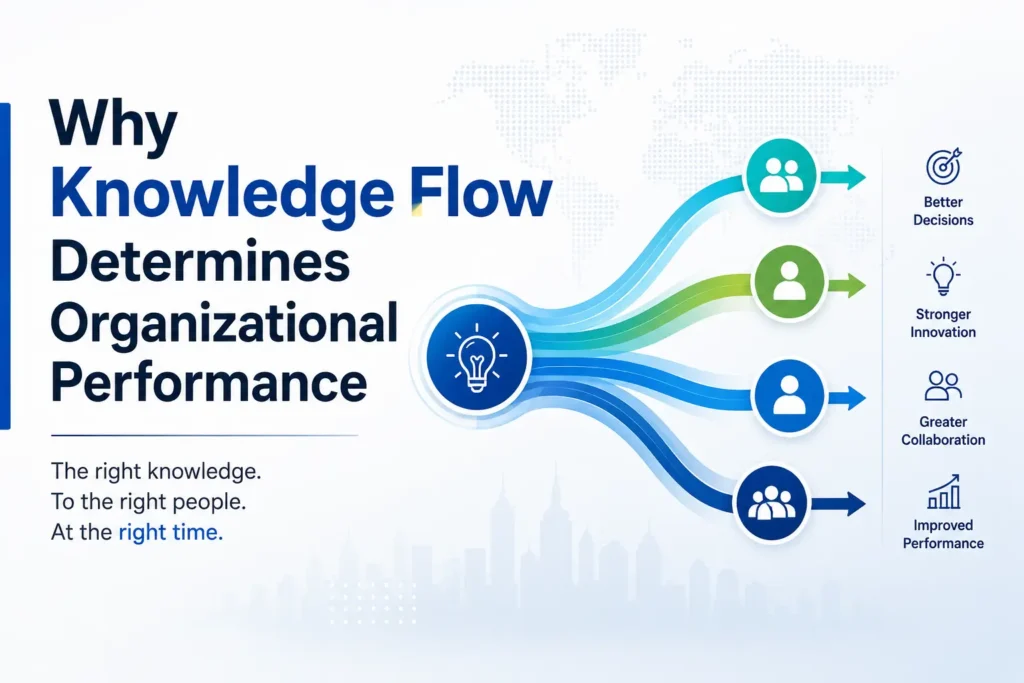
Most Enterprises Do Not Have a Knowledge Storage Problem

They have a knowledge flow problem.

This distinction explains why many global organizations continue struggling with operational inefficiency despite investing heavily in collaboration platforms, enterprise search systems, knowledge repositories, digital workplaces, AI copilots, workflow tools, and information management technologies. The enterprise may possess enormous quantities of information distributed across systems, yet employees still spend substantial portions of their workday searching for context, validating answers, reconstructing decisions, and identifying the right expertise to solve operational problems.

The issue is rarely that knowledge does not exist somewhere inside the organization.

The issue is that intelligence fails to move effectively across the enterprise.

How Knowledge Flows Across Complex Enterprises

For years, knowledge management was approached primarily through the logic of repositories. Organizations focused on storing information, documenting processes, centralizing content, and preserving institutional knowledge before it disappeared. These efforts were important during the early stages of enterprise digital transformation because they reduced dependency on isolated expertise and improved basic information accessibility.

But modern enterprises no longer operate inside stable, centralized knowledge environments.

They operate across globally distributed teams, fragmented collaboration ecosystems, hybrid work models, interconnected workflows, AI-driven systems, outsourced operations, matrix organizational structures, and continuously changing operational conditions. Under these circumstances, knowledge behaves less like static information sitting inside repositories and more like a dynamic flow moving continuously between people, systems, processes, decisions, and operational environments.

This changes everything.

The enterprises succeeding today are not necessarily the organizations storing the most information. They are the organizations most capable of sustaining healthy knowledge movement across complexity without losing contextual intelligence, governance integrity, operational trust, or institutional memory.

Understanding how knowledge flows across enterprises has therefore become one of the most strategically important areas in modern knowledge management.

Because organizational intelligence is no longer determined simply by what the enterprise knows.

It is determined by how effectively the enterprise allows knowledge to move.

Knowledge Flow Is the Hidden Infrastructure of Enterprise Intelligence

Most organizations underestimate how deeply operational performance depends on invisible knowledge movement occurring continuously across the enterprise. Every major business function relies on intelligence flowing between teams, departments, technologies, leadership structures, operational systems, and decision environments in ways that often remain unnoticed until those flows become disrupted.

A product development initiative depends on customer knowledge flowing from sales and support teams into engineering environments. Strategic decisions depend on operational intelligence moving upward from execution layers into leadership systems. Compliance environments rely on regulatory knowledge moving consistently across distributed operational units. Enterprise AI systems depend on contextual knowledge flowing accurately between repositories, workflows, governance models, and retrieval environments.

When these flows weaken, organizational friction increases rapidly.

Decisions slow down because context becomes fragmented. Teams duplicate work because prior learning cannot move efficiently across organizational boundaries. Employees spend more time searching for information than applying intelligence operationally. Expertise becomes concentrated around specific individuals rather than distributed through governed enterprise systems.

Many organizations interpret these issues as communication problems.

In reality, they are knowledge flow failures.

This distinction matters because communication alone does not guarantee intelligence movement. Enterprises can possess enormous communication activity while still operating with fragmented organizational knowledge. Information may travel continuously across emails, meetings, collaboration platforms, and messaging systems without creating coherent institutional learning.

Knowledge flow requires something deeper than communication volume.

It requires structural conditions allowing intelligence to move contextually, reliably, and operationally across the enterprise without excessive friction, distortion, delay, or fragmentation.

This is why systems thinking has become increasingly important in modern KM strategy. It recognizes that knowledge movement depends on relationships between governance structures, workflows, organizational incentives, operational pressures, technological ecosystems, retrieval systems, leadership behavior, and institutional trust simultaneously.

Knowledge flow is therefore not simply an information-sharing activity.

It is the operational infrastructure underlying enterprise intelligence itself.

Most Knowledge Friction Is Invisible Until Complexity Increases

One of the reasons enterprises struggle to diagnose knowledge flow problems early is because organizational friction accumulates gradually beneath the surface of operational activity. Employees often adapt to inefficient knowledge environments without leadership fully recognizing the long-term consequences.

Experienced workers learn where reliable information exists informally. Teams develop unofficial communication channels to bypass weak retrieval systems. Employees depend increasingly on personal networks because enterprise repositories fail to provide trustworthy operational guidance efficiently enough under real-world conditions.

At first, these workarounds appear manageable.

Over time, they become structurally dangerous.

As organizational complexity increases through scaling, acquisitions, digital transformation, remote work expansion, or AI integration, informal adaptation mechanisms begin breaking down. Institutional memory fragments across disconnected systems. Expertise becomes trapped inside isolated teams. Retrieval quality weakens. Governance consistency deteriorates. Operational continuity becomes increasingly dependent on hidden knowledge networks invisible to leadership.

This is one of the defining characteristics of unhealthy enterprise knowledge systems.

The organization continues functioning operationally while intelligence coherence quietly deteriorates beneath the surface.

Systems thinking becomes essential here because it allows enterprises to see knowledge flow structurally rather than episodically. Instead of examining isolated communication events, organizations begin examining how intelligence moves across the enterprise over time, where contextual degradation occurs, which workflows create bottlenecks, how retrieval delays affect decision-making, and why certain forms of knowledge fail to travel effectively between organizational domains.

These questions become critically important in large enterprises because complexity changes the physics of organizational learning itself.

Small organizations often rely successfully on informal communication because contextual proximity remains relatively high. People understand operational realities directly through frequent interaction. Knowledge moves organically through shared visibility and personal familiarity.

Large enterprises cannot rely on this model sustainably.

Once organizations scale across regions, departments, technologies, and operational layers, knowledge movement requires intentional architecture. Without structural coherence, complexity begins distorting intelligence automatically.

This is why many large organizations eventually experience similar symptoms regardless of industry. Teams recreate work repeatedly. Decision cycles slow down. Strategic alignment weakens. Institutional memory decays. Employees lose confidence in enterprise search. Leadership struggles to maintain contextual visibility across distributed operations.

The issue is not merely operational inefficiency.

It is systemic knowledge flow breakdown.

Knowledge Does Not Move Linearly Across Enterprises

Traditional knowledge management models often imagined organizational learning as a relatively straightforward process. Knowledge would be created, documented, stored, shared, and reused in predictable cycles across the enterprise. In practice, knowledge rarely behaves this neatly inside complex organizations.

Knowledge flows nonlinearly.

It moves through formal systems and informal networks simultaneously. It accelerates through trusted relationships while slowing dramatically across governance friction points. It becomes amplified inside collaborative environments and distorted across disconnected operational structures. It evolves continuously through interaction with workflows, technologies, politics, incentives, and institutional memory.

This nonlinear behavior explains why many enterprises struggle to operationalize knowledge consistently even when repositories technically contain relevant information.

For example, a strategic insight generated inside one department may never reach another business unit effectively because organizational boundaries interrupt contextual transfer. Operational lessons learned during one project may remain trapped inside localized systems because governance structures fail to connect related knowledge domains. Critical customer intelligence may degrade as it moves across layered reporting structures before reaching executive decision environments.

Knowledge does not merely travel.

It transforms as it moves.

Systems thinking is essential because it recognizes that organizational intelligence behaves dynamically rather than mechanically. Knowledge gains or loses value depending on the environments through which it flows. Context may strengthen understanding or distort meaning. Governance may improve reliability or increase friction. Technology may accelerate retrieval or amplify fragmentation depending on how systems are designed.

This perspective changes how enterprises should approach KM architecture entirely.

Instead of designing static repositories intended simply to preserve information, organizations increasingly need adaptive knowledge systems capable of supporting contextual intelligence movement across changing operational conditions.

This requires deeper attention to relationships between workflows, governance, retrieval systems, organizational behavior, AI environments, and institutional trust.

Because the quality of enterprise intelligence depends not only on what knowledge exists, but on how knowledge behaves while moving across the organization itself.

Knowledge Bottlenecks Quietly Limit Enterprise Performance

Every large organization contains knowledge bottlenecks, although many enterprises fail to recognize their existence until operational performance begins deteriorating visibly. These bottlenecks emerge whenever intelligence becomes dependent on specific individuals, isolated systems, fragmented workflows, or constrained communication structures that limit organizational learning scalability.

One of the most common bottlenecks appears around expertise concentration.

Certain employees gradually become invisible operational hubs because they possess contextual understanding unavailable elsewhere inside the organization. Teams depend on them repeatedly for historical reasoning, process clarification, operational interpretation, or decision guidance because enterprise systems fail to preserve that intelligence structurally.

Initially, this dependency appears efficient because experienced individuals solve problems quickly.

Over time, the organization becomes fragile.

Operational continuity weakens when knowledge movement depends excessively on human memory rather than governed systems. Employee turnover creates institutional disruption. Strategic decisions lose contextual depth. New employees struggle onboarding effectively because operational understanding exists informally rather than structurally.

Knowledge bottlenecks also emerge through technology fragmentation. Different departments introduce disconnected systems optimized for local efficiency while reducing enterprise-wide intelligence coherence. Information becomes trapped inside operational silos, inaccessible contextually across broader workflows.

Governance bottlenecks create similar problems. Excessively rigid approval structures slow knowledge validation and operational reuse. Weak governance creates inconsistency and trust deterioration. Both extremes disrupt healthy intelligence movement across the enterprise.

Systems thinking helps organizations identify these bottlenecks not as isolated operational failures but as structural characteristics emerging from broader organizational design conditions.

This distinction matters because removing bottlenecks requires systemic intervention rather than localized fixes.

The objective is not merely improving communication.

The objective is improving organizational intelligence circulation itself.

Enterprise Search Became a Knowledge Flow Problem

One of the clearest examples of systemic knowledge flow failure appears inside enterprise search environments. Many organizations still treat search primarily as a retrieval technology issue when, in reality, enterprise search quality reflects the structural condition of the broader knowledge ecosystem beneath it.

Search systems do not operate independently from governance quality, metadata consistency, taxonomy coherence, contextual relationships, workflow integration, and organizational trust.

When these systems weaken, retrieval quality deteriorates automatically.

This explains why many enterprises continue struggling with search despite significant investments in AI-powered retrieval technologies. The issue is rarely that the algorithms themselves are fundamentally incapable. The issue is that fragmented organizational knowledge environments reduce the ability of retrieval systems to interpret relevance contextually and consistently.

Poor search therefore represents more than a user experience issue.

It signals deeper organizational intelligence fragmentation.

Employees experiencing weak retrieval environments gradually lose trust in enterprise systems. They bypass repositories in favor of personal networks and informal communication channels. Over time, knowledge movement becomes increasingly dependent on human relationships instead of scalable organizational structures.

This creates hidden operational risks because intelligence flow becomes constrained by social accessibility rather than governed enterprise architecture.

Systems thinking reframes search entirely. Enterprise search is not simply about finding documents. It is about enabling intelligence to move efficiently across organizational complexity without excessive friction or contextual degradation.

This distinction becomes even more important in AI-driven environments where retrieval quality directly shapes machine reasoning reliability. AI systems cannot compensate indefinitely for fragmented knowledge ecosystems because contextual intelligence depends heavily on healthy organizational knowledge flows beneath the retrieval layer itself.

The future of enterprise search therefore depends less on isolated technology upgrades and more on improving the structural health of organizational intelligence systems overall.

AI Is Reshaping Knowledge Flow Across the Enterprise

Artificial intelligence is transforming enterprise knowledge flow more rapidly than many organizations currently realize. Most enterprises initially approached AI as a productivity enhancement layer capable of improving retrieval, summarization, automation, and information accessibility. While these capabilities are important, AI is also changing the structural behavior of organizational intelligence itself.

This shift is profound.

Traditionally, knowledge movement depended heavily on human interpretation. Employees manually searched repositories, reconstructed context, validated sources, identified expertise, and translated information into operational decisions. AI systems increasingly participate directly inside these processes.

Knowledge now flows not only between people, but also between humans, AI systems, workflows, repositories, governance environments, and operational platforms simultaneously.

This changes the architecture of enterprise intelligence.

AI systems amplify the strengths and weaknesses of organizational knowledge environments dramatically. Healthy knowledge ecosystems improve retrieval quality, contextual interpretation, operational continuity, and adaptive learning. Fragmented systems produce unreliable outputs, contextual distortion, governance inconsistency, and weakened institutional trust.

Organizations are therefore discovering that AI readiness depends heavily on knowledge flow maturity.

This is one reason systems thinking is becoming increasingly central to future KM strategy. AI cannot be understood merely as another enterprise tool layered onto existing systems. It changes how intelligence behaves operationally across the organization itself.

Knowledge movement becomes faster, more distributed, more contextual, and more dependent on structural coherence than ever before.

Enterprises capable of designing healthy adaptive knowledge flows will gain enormous strategic advantages.

Organizations operating with fragmented intelligence systems will experience increasing operational friction as complexity accelerates.

The Future Enterprise Will Be Defined by Knowledge Flow Quality

The future of enterprise competitiveness will depend increasingly on how effectively organizations allow intelligence to move across complexity without losing contextual integrity, operational trust, or institutional coherence.

This represents a major shift in how knowledge management must be understood.

For years, enterprises focused primarily on accumulating information. The future belongs to organizations capable of orchestrating intelligence dynamically across distributed operational systems, AI environments, governance structures, workflows, and human expertise networks simultaneously.

Knowledge flow will become one of the defining operational capabilities separating adaptive enterprises from structurally fragmented ones.

This is because modern organizations no longer compete simply through access to information. Information itself is abundant. Competitive advantage increasingly depends on how quickly organizations can transform distributed intelligence into coordinated action under conditions of accelerating complexity.

That capability depends fundamentally on healthy knowledge movement.

The enterprises leading the next decade will therefore not necessarily be the organizations possessing the largest repositories or most advanced collaboration tools.

They will be the organizations capable of designing intelligent systems where knowledge flows continuously, context survives operational movement, organizational memory remains resilient, retrieval environments maintain trust, and enterprise intelligence adapts dynamically across changing conditions.

That future requires moving beyond repository-centric thinking toward a much deeper understanding of how intelligence behaves systemically across the enterprise itself.

And that begins by understanding knowledge flow not as a secondary KM function, but as the operating infrastructure of organizational intelligence.