For years, many organizations viewed Knowledge Management as a support function. Important, yes, but often underestimated. KM teams were asked to maintain repositories, improve intranets, organize content, support lessons learned programs, and encourage knowledge sharing across the business.
That model is changing fast.
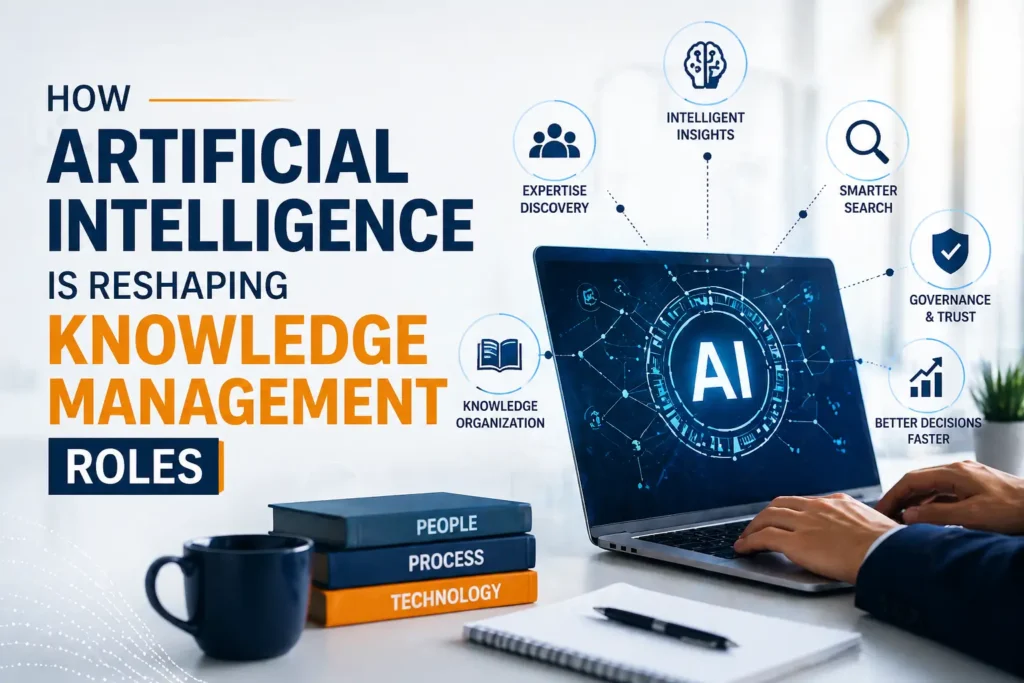
The rise of Artificial Intelligence is forcing organizations to rethink how knowledge is created, governed, discovered, and applied. As a result, Knowledge Management roles are being reshaped in ways that are both strategic and immediate.
This is not simply about automation replacing manual tasks.
It is about elevating the value of KM professionals who understand how enterprise knowledge actually works.
The organizations that recognize this shift early will build stronger internal intelligence systems. Those that do not may invest heavily in AI while neglecting the knowledge foundations AI depends on.
AI Does Not Replace Knowledge Management
There is a common misconception that AI tools can solve knowledge problems on their own. If a chatbot can answer questions, summarize documents, and search internal systems, some assume traditional KM functions become less relevant.
The opposite is often true.
AI performs best when the underlying knowledge environment is healthy. That means content is current, sources are trusted, terminology is consistent, ownership is clear, and information can be interpreted in context.
If internal knowledge is fragmented, duplicated, outdated, or poorly governed, AI will inherit those weaknesses.
It may respond quickly.
It may also respond incorrectly.
That is why Knowledge Management roles are becoming more critical, not less.
The Shift From Content Custodian to Knowledge Strategist
In many organizations, KM professionals were historically positioned as administrators of content platforms or maintainers of taxonomies.
Those responsibilities still matter, but they are no longer enough.
AI is shifting the KM role toward strategic orchestration. KM leaders are increasingly expected to shape how knowledge assets support automation, decision-making, employee productivity, and customer experience.
This includes questions such as:
- Which knowledge sources should AI systems trust?
- How should sensitive knowledge be governed?
- What metadata improves retrieval quality?
- How can tacit expertise be captured before it is lost?
- Where are the highest-friction knowledge bottlenecks?
- How should humans validate AI-generated outputs?
These are not IT questions alone.
They are KM questions with enterprise consequences.
New KM Responsibilities Emerging in the AI Era
As AI adoption expands, several Knowledge Management responsibilities are becoming more prominent.
Knowledge Quality Management
Many organizations are discovering that poor content quality becomes highly visible once AI starts using internal information.
Old policies, duplicate documents, inconsistent procedures, and abandoned pages may have been tolerated when few people used them. Once surfaced by AI, they create confusion quickly.
KM professionals are increasingly responsible for improving knowledge quality at scale. This includes lifecycle governance, version control, ownership models, and trust signals that help users know what is reliable.
Taxonomy and Semantic Structure
AI systems rely on relationships between concepts, terms, categories, and context.
A strong taxonomy is no longer just helpful for navigation. It is foundational for retrieval, recommendations, entity recognition, and more accurate responses.
Knowledge Management specialists who understand classification, metadata, and semantic structure are becoming strategically valuable.
What once looked administrative now powers intelligent systems.
Expertise Capture
AI can summarize documented knowledge, but undocumented expertise remains a major risk.
Organizations still depend on experienced employees whose judgment, pattern recognition, and practical know-how live mostly in their heads. When they leave, retire, or change roles, valuable capability can disappear.
KM professionals are increasingly tasked with capturing tacit knowledge in forms AI and humans can reuse, such as playbooks, decision trees, case libraries, interview-based insights, and expert networks.
Human-in-the-Loop Governance
As AI becomes embedded into workflows, governance becomes essential.
Who reviews outputs? How are errors corrected? When should AI be trusted, and when should human expertise take priority? How are sensitive topics handled?
Knowledge Management teams are well positioned to help design these operating rules because they already understand trust, authority, source quality, and organizational behavior.
Search and Discovery Experience
Traditional enterprise search often frustrated employees. AI is raising expectations dramatically.
Users now expect conversational answers, personalized discovery, summarized guidance, and contextual recommendations.
KM roles are evolving toward experience design, ensuring people can access the right knowledge in the right format at the right moment.
This is a major shift from managing repositories to enabling intelligent discovery.
How KM Careers Are Changing
For Knowledge Management professionals, AI is creating both pressure and opportunity.
Routine administrative work may decline. Manual tagging, basic content triage, and repetitive publishing tasks can increasingly be automated.
At the same time, demand is growing for higher-value capabilities such as:
- Knowledge architecture
- Governance design
- Prompt and retrieval strategy
- Change leadership
- Community intelligence
- Expertise mapping
- Cross-functional facilitation
- Trust and quality assurance
- AI readiness planning
In practical terms, the KM profession is moving up the value chain.
Professionals who adapt can become strategic advisors rather than back-office operators.
Why Soft Skills Matter Even More Now
Ironically, as AI advances, human skills become more important.
Many knowledge problems are not technical. They involve incentives, politics, culture, trust, and behavior. Employees may hesitate to share expertise. Leaders may resist governance. Teams may maintain duplicate systems for local control.
AI cannot resolve these tensions on its own.
Knowledge Management professionals who can influence stakeholders, build communities, facilitate collaboration, and create psychological safety will remain highly valuable.
Technology changes quickly.
Human systems change slowly.
That gap needs skilled leadership.
Common Mistakes Organizations Are Making
Some organizations are rushing into AI without involving KM expertise. This creates predictable problems.
They deploy AI on unmanaged content. They ignore ownership of knowledge assets. They assume search quality will fix itself. They fail to distinguish between authoritative knowledge and noise. They underestimate adoption behavior.
The result is often disappointing trust, weak usage, and reputational risk internally.
Another mistake is treating KM as obsolete because AI can summarize documents. Summarization is useful, but it is not the same as governance, sensemaking, learning design, or expertise transfer.
AI can accelerate knowledge work.
It does not replace the discipline of Knowledge Management.
What Smart Organizations Are Doing Instead
More mature organizations are aligning AI strategy with KM strategy.
They are auditing knowledge sources before deploying AI assistants. They are improving taxonomy and metadata. They are clarifying ownership of critical content. They are investing in communities of practice to capture evolving expertise. They are defining review processes for high-risk outputs.
Most importantly, they are involving Knowledge Management leaders early.
They understand that AI success depends less on the model alone and more on the quality of the organizational knowledge ecosystem surrounding it.
What KM Professionals Should Learn Now
Knowledge Management professionals do not need to become machine learning engineers to stay relevant.
But they should understand how AI interacts with knowledge systems.
Useful areas to build competence include:
- Retrieval-augmented generation concepts
- Metadata and ontology design
- Responsible AI governance
- Prompt workflows for enterprise use
- Knowledge graph fundamentals
- Content lifecycle automation
- AI-assisted search experience
- Measurement of knowledge effectiveness
Combining traditional KM expertise with AI literacy will be a powerful career advantage.
The Future Role of KM
The next generation of Knowledge Management will look different from the last.
Less time will be spent manually organizing static repositories.
More time will be spent designing living knowledge ecosystems where humans and AI work together. Systems will surface expertise faster, convert experience into reusable assets, and help organizations learn continuously.
That future requires professionals who understand both technology and human behavior.
In other words, it requires modern KM leaders.
Read: Why AI Needs Knowledge Management to Deliver Real Business Value
Final Thought
Artificial Intelligence is not making Knowledge Management less important. It is exposing how important it always was.
The companies that benefit most from AI will not simply have better tools.
They will have stronger knowledge foundations, clearer governance, healthier sharing cultures, and leaders who know how to turn information into capability.
That is where the future of Knowledge Management now sits.
Join our community for KM expert sessions, workshops, and newsletter updates