Most Knowledge Management Failures Begin Long Before Employees Stop Using the System
Large enterprises rarely fail at collecting information.
They fail at controlling what happens after the collection begins.
This distinction explains why many global organizations spend millions on collaboration platforms, enterprise portals, document management systems, and AI-powered search tools, yet employees still struggle to locate reliable knowledge efficiently. Repositories continue expanding while discoverability declines. Teams create duplicate documentation because they cannot trust existing sources. Critical expertise becomes buried under outdated files, abandoned project spaces, disconnected wikis, and fragmented communication channels.
Over time, the organization experiences something far more dangerous than information overload.
It experiences repository chaos.
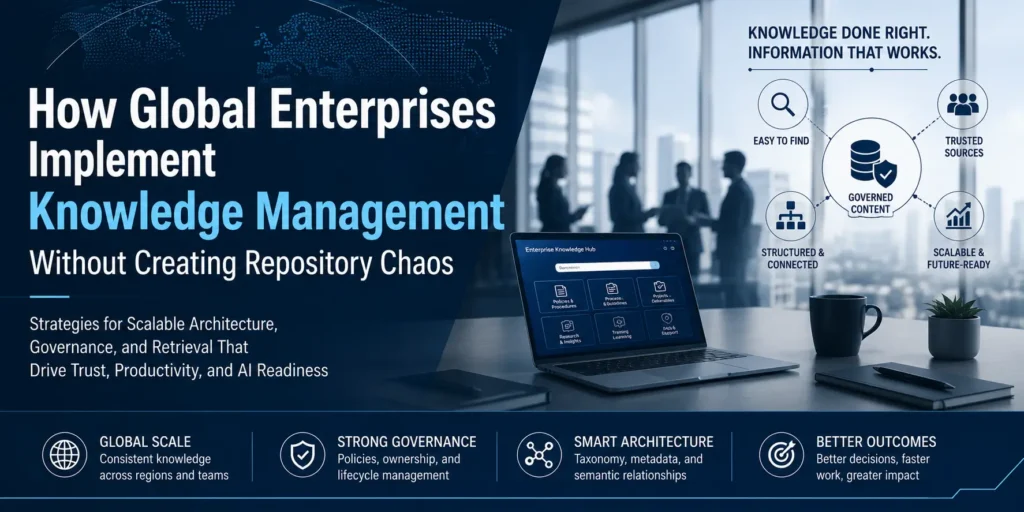
This problem has become one of the defining operational failures of modern enterprise knowledge management. The issue is not simply excessive content volume. The deeper issue is the absence of architectural discipline governing how organizational knowledge is created, structured, validated, retrieved, and retired over time.
Many enterprises do not recognize the seriousness of this problem early enough because repository chaos develops gradually. A collaboration platform initially improves accessibility. Teams begin creating documentation rapidly. Departments launch their own workspaces. Project repositories multiply. Regional teams customize structures independently. Different business units introduce separate naming conventions, metadata models, workflows, and governance practices.
At first, this expansion appears productive.
Then retrieval quality begins collapsing.
Employees stop trusting enterprise search because results become inconsistent. Multiple versions of the same document circulate simultaneously. Important operational knowledge becomes impossible to distinguish from outdated material. Teams rely increasingly on personal networks instead of official systems because locating reliable information requires too much effort.
The organization eventually reaches a point where knowledge technically exists everywhere while usable knowledge becomes increasingly difficult to find.
This is the stage where many knowledge management initiatives quietly lose credibility inside enterprises.
Global organizations that avoid this outcome approach knowledge management very differently. They do not treat KM as a documentation initiative or collaboration exercise. They treat it as operational infrastructure requiring governance, architectural consistency, retrieval discipline, and long-term structural control.
That difference changes everything.
High-Performing Enterprises Design Knowledge Systems Before Scaling Content
One of the most common mistakes in enterprise knowledge management is allowing repositories to expand before establishing architectural foundations. Organizations become excited about collaboration capabilities and content creation speed without fully considering how the environment will function after millions of documents accumulate across regions, departments, and business units.
The consequences often remain hidden during the early phases of implementation because smaller repositories appear manageable. Employees can still navigate systems manually. Teams remember where content lives. Search environments remain relatively clean.
Complexity accelerates later.
Global enterprises that succeed with knowledge management rarely begin with technology alone. They begin with structure. Before scaling repositories, they define how knowledge should behave operationally across the organization. This includes governance ownership, taxonomy logic, metadata strategy, lifecycle policies, authority models, retrieval behavior, and contextual relationships between different knowledge domains.
The distinction is critical.
Most failing KM environments are content-driven. Successful enterprise KM environments are architecture-driven.
In architecture-driven organizations, repositories are designed around discoverability and operational usability rather than uncontrolled accumulation. Content structures reflect how employees actually retrieve knowledge during work rather than how departments prefer storing documents independently.
This requires deeper organizational thinking than many companies initially anticipate.
Knowledge management at enterprise scale is not fundamentally a technology challenge. It is an organizational design challenge.
Repository Chaos Usually Begins With Departmental Fragmentation
One of the earliest indicators of future repository disorder appears when departments begin managing knowledge independently without enterprise-wide architectural alignment.
This pattern exists in many organizations. Human resources develops one taxonomy structure. Legal maintains separate naming standards. Operations uses different metadata conventions. Engineering builds isolated documentation environments. Regional offices customize structures independently based on local preferences.
Over time, the enterprise unintentionally creates multiple disconnected knowledge ecosystems operating inside the same organization.
This fragmentation creates enormous long-term consequences.
Employees searching across systems encounter inconsistent terminology, duplicate concepts, conflicting classifications, and unclear authority structures. Search engines struggle to interpret relationships between content because metadata lacks standardization. AI retrieval systems surface contradictory outputs because repositories evolved without governance consistency.
Many enterprises mistakenly believe these are search problems.
In reality, they are architectural problems.
Global organizations that maintain retrieval quality at scale understand that knowledge architecture cannot become entirely decentralized. While business units require flexibility, the enterprise itself still needs structural coherence governing how knowledge is classified, validated, linked, and retrieved.
This does not mean forcing rigid uniformity across every department. Mature organizations recognize that different operational functions require different knowledge behaviors. Engineering documentation differs fundamentally from legal governance content or customer support knowledge bases.
The key difference is that high-performing enterprises establish enterprise-level architectural principles while allowing controlled local adaptation.
This balance between governance consistency and operational flexibility is one of the defining characteristics separating mature knowledge environments from chaotic ones.
Search Failure Is Usually a Symptom of Poor Knowledge Architecture
Employees often describe repository problems using the language of search frustration.
They say they cannot find documents. They complain that search results are irrelevant. They lose trust in enterprise portals because outdated content appears alongside authoritative information. They stop relying on official systems altogether because retrieval becomes unreliable.
Organizations frequently respond by purchasing better search technology.
This rarely solves the core issue.
Enterprise search reflects the quality of the knowledge architecture beneath it. Search systems cannot fully compensate for fragmented repositories, inconsistent metadata, duplicate documentation, weak governance, or unclear authority structures.
This is one reason global enterprises increasingly invest in knowledge architecture before investing aggressively in AI-driven retrieval systems. They recognize that retrieval quality depends heavily on structural integrity.
Modern enterprise knowledge environments require significantly more sophistication than traditional repository models provided. Search is no longer based purely on keywords or file locations. AI-powered retrieval increasingly depends on semantic relationships, contextual relevance, metadata consistency, authority scoring, permission structures, and operational intent understanding.
When repositories evolve chaotically, retrieval intelligence weakens rapidly.
This issue becomes even more serious in AI environments. Large language models and enterprise copilots depend heavily on retrieval quality. If repositories contain conflicting procedures, outdated policies, duplicate operational guidance, or fragmented contextual information, AI systems inherit those weaknesses automatically.
The organization may blame the AI.
The underlying problem usually began years earlier inside the repository architecture itself.
Successful Enterprises Govern Knowledge Like a Living Operational System
One of the largest misconceptions in knowledge management is the belief that repositories become successful once content is uploaded. In reality, knowledge environments require continuous operational management similar to any other enterprise infrastructure system.
Knowledge decays over time.
Policies become outdated. Processes evolve. Organizational structures change. Technologies shift. Regulatory environments transform. Operational priorities move rapidly across global enterprises. Without governance discipline, repositories begin accumulating informational residue from previous operational eras.
This creates one of the most dangerous conditions inside enterprise KM systems: obsolete knowledge that still appears trustworthy.
Employees often cannot easily distinguish between current and outdated operational guidance. AI systems struggle even more because historical content may still appear structurally valid despite losing business relevance.
Global enterprises that maintain healthy knowledge ecosystems understand that governance is not a one-time administrative activity. It is a continuous operational function.
Mature organizations establish lifecycle ownership models where knowledge assets possess defined accountability structures. Content is reviewed systematically rather than indefinitely preserved. Authoritative sources remain clearly identifiable. Redundant material is consolidated aggressively. Obsolete information is archived intentionally instead of remaining mixed with active operational knowledge.
This level of governance discipline requires organizational maturity because repository cleanup rarely receives executive attention until retrieval quality deteriorates severely.
The strongest enterprises avoid reaching that stage altogether.
The Most Valuable Enterprise Knowledge Often Never Enters the Repository
One of the reasons repository chaos becomes so dangerous is because organizations often compensate for weak systems through human dependency.
Employees stop trusting repositories and begin relying on people instead.
Certain individuals become informal knowledge hubs inside the organization. Teams message experienced employees directly because locating reliable information through official systems takes too long. Operational continuity depends increasingly on personal memory, historical familiarity, and undocumented expertise rather than governed knowledge environments.
This creates hidden operational fragility.
When experienced employees leave, organizations discover that significant portions of institutional intelligence existed outside formal systems entirely. The repository contains documents but not necessarily understanding. Important context remains trapped inside conversations, relationships, meetings, and tacit expertise accumulated over years.
Global enterprises with mature KM strategies recognize this risk early.
Instead of treating repositories as passive storage environments, they integrate knowledge capture directly into operational workflows. Lessons learned, decision rationale, contextual insights, and expertise transfer mechanisms become embedded into project execution rather than postponed as optional documentation exercises after work concludes.
This operational integration is critical because knowledge management fails when employees perceive it as additional administrative labor disconnected from business execution.
Successful enterprises reduce friction between work and knowledge capture.
That difference determines whether repositories evolve into living organizational memory systems or stagnant digital archives.
AI Is Forcing Enterprises to Rethink Repository Design Entirely
Artificial intelligence is fundamentally changing how organizations think about enterprise knowledge environments. Traditional repositories were designed primarily for human navigation. Employees manually searched systems, interpreted documents, validated sources, and reconstructed context independently.
AI systems interact with knowledge differently.
Modern enterprise AI depends on structured retrieval environments capable of delivering contextual, authoritative, machine-consumable information dynamically. This means repository design now affects not only employee productivity but also AI reliability itself.
Many organizations are discovering that legacy repository structures are poorly suited for AI-driven environments. Fragmented taxonomies, inconsistent metadata, duplicate content, and weak contextual relationships reduce retrieval precision dramatically.
As a result, enterprises are beginning to redesign knowledge architecture around retrieval intelligence rather than static storage logic.
This shift represents one of the most important transitions occurring inside knowledge management today.
The future enterprise repository will not function primarily as a document warehouse. It will function as an intelligent operational memory system capable of supporting both human cognition and machine reasoning simultaneously.
That requires significantly higher levels of governance maturity, contextual structuring, and architectural discipline than many organizations currently possess.
Global Enterprises That Succeed With KM Think Long Term
One of the defining differences between successful and unsuccessful knowledge management initiatives is time horizon.
Organizations that fail often pursue rapid repository expansion without fully considering long-term operational sustainability. Initial adoption metrics appear strong because employees upload large quantities of content quickly. Leadership interprets repository growth as evidence of KM success.
Years later, the environment becomes increasingly difficult to govern.
Successful global enterprises approach knowledge management differently. They recognize that repositories eventually become part of organizational infrastructure. Decisions made during early implementation stages shape retrieval quality, governance complexity, AI readiness, and operational usability years into the future.
This changes how mature organizations design KM strategies.
They prioritize structural clarity over rapid accumulation. They invest heavily in governance before repository expansion accelerates. They establish ownership models early. They align taxonomy structures with operational workflows rather than departmental politics. They continuously evaluate retrieval behavior instead of measuring success purely through content volume.
Most importantly, they understand that knowledge management is not fundamentally about storing information.
It is about preserving organizational intelligence in a form that remains discoverable, trustworthy, contextual, and operationally useful over time.
That distinction becomes increasingly important as enterprises move deeper into the AI era.
The Future of Knowledge Management Depends on Controlling Complexity
The modern enterprise generates knowledge faster than any previous generation of organizations. AI accelerates content creation further. Collaboration tools multiply continuously. Operational complexity expands across global teams, platforms, workflows, and regulatory environments.
Without architectural discipline, repository chaos becomes inevitable.
This is why leading enterprises increasingly view knowledge management as a strategic capability rather than administrative support. They recognize that organizational intelligence depends not only on creating knowledge but also on controlling complexity as knowledge environments scale.
The future of enterprise KM will belong to organizations capable of balancing accessibility with governance, flexibility with consistency, and rapid knowledge creation with long-term structural integrity.
That balance is extraordinarily difficult to achieve.
But it increasingly determines whether enterprises operate with intelligence or informational disorder.
The organizations succeeding today understand something many companies still overlook. Repository chaos is not created by excessive information alone.
It is created when information grows faster than knowledge architecture.
Join our community for KM expert sessions, workshops, and newsletter updates.