Organizations are moving fast with AI. New tools are being deployed, copilots are integrated into workflows, and leadership expects measurable business impact. Yet in many cases, the results feel underwhelming. Outputs are inconsistent, adoption is uneven, and trust remains fragile.
The underlying issue is not the AI itself. It is the absence of a strong knowledge foundation.
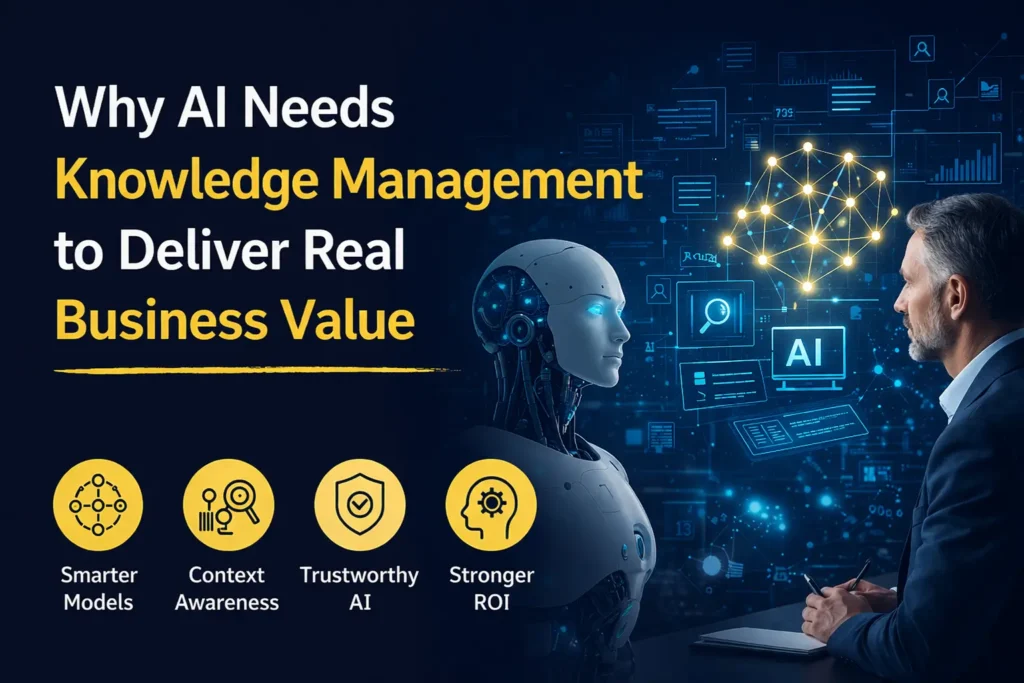
Knowledge management for AI is what determines whether AI produces meaningful outcomes or simply automates confusion. AI systems do not generate intelligence independently. They rely on the knowledge they can access, interpret, and reuse. When that knowledge is fragmented or unreliable, AI reflects those same weaknesses at scale.
In simple terms, AI needs structured, high-quality knowledge to deliver real business value. Without it, organizations invest in powerful tools that cannot perform consistently.
This article explains why knowledge management for AI is essential, what most organizations misunderstand, and how you can build the foundation required to make AI actually work.
What Is Knowledge Management for AI
Knowledge management for AI is the practice of capturing, organizing, maintaining, and making organizational knowledge accessible so that AI systems can use it effectively. It includes explicit knowledge such as documents and databases, as well as tacit knowledge embedded in employee experience.
This is not a supporting function. It is a core capability.
AI systems depend on knowledge to generate accurate responses, provide recommendations, and support decisions. Without structured knowledge, AI lacks context. It may produce outputs, but those outputs will be incomplete or inconsistent.
A well-managed knowledge system ensures that AI can retrieve relevant information, understand relationships between concepts, and deliver responses that align with business reality.
Many organizations treat AI as a layer on top of existing systems. In practice, AI behaves more like a mirror. It reflects the state of your knowledge ecosystem. If your knowledge is disorganized, AI will amplify that disorder. If your knowledge is structured and reliable, AI becomes a powerful enabler of performance.
This is why knowledge management for AI should be treated as a foundational investment, not a secondary consideration.
Why AI Cannot Deliver Value Without Strong Knowledge
AI systems are designed to process information and generate outputs. But the quality of those outputs depends entirely on the inputs they receive.
When knowledge is incomplete, AI fills gaps with assumptions. When knowledge is inconsistent, AI produces conflicting answers. When knowledge is outdated, AI delivers outdated recommendations.
This directly impacts business value. Decision-makers cannot rely on outputs that lack consistency or accuracy. Employees will not adopt systems they do not trust.
In many organizations, knowledge exists in silos. Critical insights are stored in emails, personal files, or undocumented conversations. AI systems cannot access this knowledge. As a result, they operate on partial information.
This creates a disconnect. The organization knows more than the AI can use.
The consequence is clear. AI appears capable but fails to deliver meaningful impact. The issue is not computational power. It is knowledge accessibility and quality.
Organizations that recognize this invest in structuring their knowledge before scaling AI. They ensure that the system has access to validated, comprehensive information. Only then can AI generate outputs that drive real decisions and outcomes.
The Difference Between Data, Information, and Knowledge
A common misconception is that data alone is enough to power AI. This assumption leads to heavy investment in data infrastructure while knowledge systems remain underdeveloped.
Data represents raw facts. Information organizes those facts into patterns. Knowledge adds context, interpretation, and experience.
AI systems can process data efficiently. But without knowledge, they struggle to provide meaningful insights.
For example, a dataset might show a decline in customer satisfaction. Knowledge explains why the decline occurred, what actions were taken, and what solutions proved effective. This context is essential for decision-making.
In enterprise environments, knowledge often resides in people rather than systems. Lessons learned from projects, expert judgments, and operational insights are rarely captured in structured formats.
Organizations like Microsoft and IBM have invested heavily in bridging this gap. Their AI capabilities are supported by curated knowledge systems that provide context alongside data.
Understanding this distinction is critical. Data enables analysis. Knowledge enables action. AI requires both, but it depends on knowledge to deliver business value.
How Knowledge Quality Impacts AI Performance
AI performance is directly tied to knowledge quality. This relationship is often underestimated.
High-quality knowledge is accurate, consistent, current, and well-structured. When AI systems access such knowledge, they produce reliable outputs. Users can trust the system, and adoption increases.
Low-quality knowledge creates the opposite effect. Errors, inconsistencies, and outdated information lead to unreliable outputs. Trust declines quickly.
Trust is not a minor factor. It determines whether AI becomes part of daily workflows or remains an unused tool.
Inconsistent knowledge is particularly damaging. If different sources provide different answers, AI systems struggle to resolve conflicts. This results in unpredictable outputs.
Knowledge governance addresses this challenge. Clear ownership, validation processes, and regular updates ensure that knowledge remains reliable.
Organizations that invest in knowledge quality see measurable improvements in AI performance. Outputs become more accurate. Response times improve. Decision-making becomes more confident.
The link between knowledge quality and AI performance is direct and unavoidable. Improving one improves the other.
Real World Example How the World Bank Uses Knowledge to Support AI and Decision Making
The World Bank has long recognized knowledge as a strategic asset. Its operations depend on insights from global projects, policy research, and field experience.
To manage this complexity, the organization developed structured knowledge systems that capture and organize expertise across regions and domains. Communities of practice, knowledge repositories, and lessons learned platforms play a central role.
These systems are not static. Knowledge is continuously updated, validated, and shared. This ensures that decision-makers have access to current and relevant information.
As AI capabilities are introduced, this knowledge foundation becomes even more valuable. AI systems can draw from curated knowledge rather than fragmented data sources.
The result is more reliable analysis and better-informed decisions. The organization can scale insights across projects, reducing duplication and improving outcomes.
The World Bank’s approach demonstrates a key principle. AI delivers value when it is built on structured, trusted knowledge. Without that foundation, scaling intelligence across a global organization would be far more difficult.
What Organizations Must Build to Make AI Work
To enable AI to deliver real business value, organizations need to focus on building strong knowledge systems. This requires deliberate effort across several areas.
Knowledge capture is the starting point. Critical insights from projects, decisions, and expert experiences must be documented. Without capture, knowledge remains inaccessible.
Structuring knowledge is equally important. Taxonomies, metadata, and standardized formats allow AI systems to interpret information effectively.
Accessibility ensures that knowledge can be used. Enterprise search and integrated platforms make it easier for both humans and AI to find relevant information.
Governance maintains quality. Assigning ownership, defining review cycles, and establishing standards prevent knowledge from becoming outdated or inconsistent.
Culture supports sustainability. Employees must be encouraged to share knowledge and contribute to the system. Without cultural alignment, even well-designed systems fail.
Organizations like Siemens and Chevron have demonstrated that combining these elements leads to stronger decision-making and improved operational performance.
AI benefits directly from these investments. It becomes more accurate, more reliable, and more valuable to the business.
The Strategic Shift Toward Knowledge First AI
Many organizations begin their AI journey with a technology-first mindset. They focus on tools, models, and automation capabilities. Knowledge is considered later.
This approach limits outcomes.
A more effective strategy is to adopt a knowledge-first perspective. This means prioritizing the quality, structure, and accessibility of knowledge before scaling AI.
In a knowledge-first organization, AI enhances existing capabilities. It accelerates access to information, supports decision-making, and improves efficiency.
In a technology-first organization without strong knowledge systems, AI struggles to deliver consistent value.
The shift requires leadership commitment. It involves aligning knowledge management with business strategy and integrating it into AI initiatives from the beginning.
Organizations that make this shift position themselves for long-term success. They build systems that can adapt, learn, and improve over time.
AI does not replace knowledge management. It depends on it.
CONCLUSION
AI has the potential to transform how organizations operate, but it cannot do so in isolation. Its effectiveness depends entirely on the knowledge it can access and use.
Knowledge management for AI is what turns potential into performance. It ensures that information is accurate, structured, and accessible. It builds the trust required for adoption and the consistency required for decision-making.
Organizations that invest in knowledge systems see AI deliver real business value. Those that do not continue to struggle, regardless of the tools they deploy.
The path forward is clear. Before expanding AI initiatives, focus on strengthening your knowledge foundation. That is where meaningful results begin.