The $47 Million Question No Executive Is Asking
A senior engineer spends eighteen months solving a complex technical problem. The solution saves the company three million dollars annually. The engineer retires. The problem recurs eighteen months later. A new team spends another eighteen months solving it again. No one knew the first engineer had already documented the solution in a folder no one ever opened.
This scenario is not hypothetical. It happens thousands of times every day across Global 2000 organizations. The problem is rarely technology. The problem is not lack of documentation. The problem is knowledge hoarding. Smart, capable, well intentioned employees deliberately withhold what they know. Not because they are malicious. Because they are human.
After three decades of research across hundreds of organizations, a consistent and uncomfortable truth has emerged. The vast majority of knowledge management failures are not technical failures. They are behavioral failures. Employees hide knowledge for reasons that make perfect sense to them. And until leaders understand those reasons, no knowledge management system will ever deliver its promised return.
This is the definitive analysis of knowledge hoarding in the modern enterprise. It synthesizes thirty years of peer reviewed research with findings from 2024 and 2025. It moves beyond platitudes about culture to expose the precise mechanisms, costs, and remedies for the most expensive behavior no one is talking about.
Part One: Defining the Beast
What Knowledge Hoarding Is (And What It Is Not)
Knowledge hoarding is often confused with knowledge hiding, but the distinction is critical. Knowledge hiding refers to the deliberate concealment of specific knowledge that has been explicitly requested by another person. A colleague asks for help with a formula. The expert knows the formula but says they do not. That is knowledge hiding.
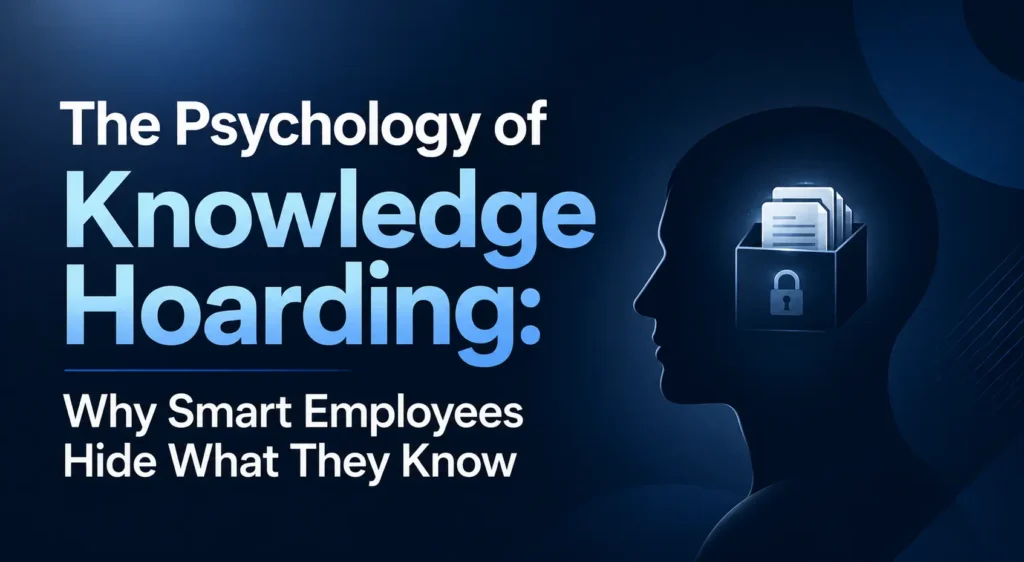
Knowledge hoarding is different. It involves the passive accumulation of knowledge without any specific request being made. The employee simply does not share. They do not say no. They never get asked. The knowledge sits in their head, on their hard drive, in their email archive, or on their personal network drive. It is accessible in theory. It is invisible in practice.
A 2025 study focusing on explicit knowledge concealment identified that employees who imitate misunderstanding of colleagues’ requests are more likely to demonstrate concealment behavior, driven by fear of losing influence and concerns about information confidentiality. The passive hoarder does not even reach that stage. The knowledge never enters the request channel at all.
The Three Faces of Knowledge Hiding
When hoarding becomes active hiding in response to a request, researchers have identified three distinct forms, each with different predictors and consequences.
Playing dumb occurs when an employee pretends not to have the requested knowledge or claims not to understand the question. It is the most socially acceptable form of hiding because it preserves the relationship while avoiding the request. The knowledge seeker walks away believing the expert simply could not help. The expert keeps their valuable knowledge to themselves.
Evasive hiding is more active deception. The employee pretends to provide the requested knowledge but does so incompletely, inaccurately, or so generally that it provides no real value. This form has been shown to be the most damaging to workplace relationships and most likely to trigger future retaliation from the knowledge seeker.
Rationalized hiding occurs when the employee refuses to share but provides what they believe is a reasonable justification. The justification may be legitimate, such as protecting confidential information or complying with legal restrictions. Or it may be self serving, such as claiming the knowledge is not relevant when it clearly is. The 2025 study on moral disengagement found that knowledge owners rationalize withholding information using cognitive strategies such as euphemistic labeling, moral justification, and distortion of consequences, aligning their hiding behavior with their personal and organizational values.
Distinguishing Hoarding from Healthy Boundaries
Not all withholding is pathological. A 2025 IGI Global study argued that knowledge hiding exists along a knowledge management spectrum and is not inherently negative. It can shift between counterproductive and productive forms depending on context. A knowledge owner may deliberately withhold information to protect confidentiality, public interest, or national security.
The critical question is not whether withholding occurs. The critical question is whether the withholding serves the organization’s legitimate interests or the employee’s narrow self interest at the organization’s expense. An employee protecting trade secrets from a competitor is exercising appropriate discretion. An employee hiding a process improvement from their own team to preserve their perceived indispensability is hoarding.
A 2025 integrated review of 155 peer reviewed articles found that the field has moved beyond treating knowledge hiding as purely negative. The authors call for identifying positive outcomes apart from the established negative consequences, asking what kind of knowledge hiding exists, to what extent it is beneficial, and what outcomes are detrimental.
Part Two: The Scale of the Problem
How Widespread Is Knowledge Hoarding?
The short answer is that knowledge hoarding is universal. Every organization has it. Every employee does it to some degree. The question is not whether hoarding exists but how much damage it is causing.
Research on counterproductive knowledge behaviors has documented that the tendency to conceal knowledge is a fundamental aspect of human behavior, not an aberration. Knowledge hiding and knowledge sharing may exist along the same knowledge management spectrum, with most employees moving between both behaviors depending on context, relationship, and perceived risk.
A 2024 PwC survey of 19,500 workers across the Asia Pacific region found that more than half of respondents were worried about their job security due to technology driven changes. In Vietnam, 65 percent reported feeling uneasy about workplace transformations. Only 52 percent expressed strong confidence in their job prospects over the next twelve months. RMIT researchers directly link this job insecurity to increased knowledge hiding behavior, noting that workers may intentionally withhold information from colleagues to appear more indispensable or valuable.
A 2024 dissertation surveying 285 knowledge management professionals across Belgium, Germany, Italy, the United Kingdom, and the United States found that participants were not only aware of but also actively engaged in knowledge hiding, knowledge hoarding, and knowledge sharing behaviors in their workplaces.
The Forty Seven Million Dollar Question
What does knowledge hoarding actually cost? The answer is both precise and horrifying.
A 2025 study on corporate digital accumulation found that without clear data strategies, digital repositories become inefficient, incurring high financial and non financial costs and hindering knowledge creation and retrieval. Unlike visible physical hoarding, corporate digital accumulation often goes unnoticed until critical needs arise.
The productivity cost is staggering. Microsoft’s 2025 Work Trend Index reported an average of 117 emails and 153 Teams messages every weekday, with 40 percent of employees already checking mail before 6:00 AM. Tagging a median knowledge worker salary of 80,000, the hidden cost of digital clutter approaches 8,000 of value per person per year.
Then there is the cost of duplicated effort. When knowledge is hidden, teams recreate what already exists. A 2025 analysis estimated that for a company of 10,000 employees, the annual productivity loss from digital waste exceeds $9 million annually.
Workplace inefficiencies cost an estimated $85 billion annually across the global economy according to a 2025 report, with fragmented digital experiences driving much of that waste.
But these numbers measure only the inefficiency cost. They do not measure the innovation cost, the attrition cost, or the opportunity cost of decisions made without access to the organization’s full knowledge base.
The Ripple Effect on Teams and Innovation
The damage does not stop at individual productivity. Knowledge hoarding destroys team dynamics and organizational innovation.
Research on knowledge hiding climate has demonstrated that knowledge hiding reduces job performance, decreases the quality of decision making, and impedes mutual exchange. When employees refuse to share knowledge, collaboration is hindered, innovation stalls, and productivity declines. The result is duplicated efforts, wasted resources, and missed opportunities.
A 2025 systematic review on knowledge hiding and creativity found that the concept was first introduced by Connelly in 2012 and has since been shown to harm innovation across multiple contexts. The review emphasizes two essential elements of knowledge hiding: the intentional nature of the act and the demand for knowledge.
A 2025 study examining the relationship between knowledge hiding and team performance found that knowledge hiding significantly negatively affects team performance. The study identified that mastery climate positively moderates the relationship while performance climate negatively moderates it, suggesting that team culture dramatically influences whether hoarding thrives or withers.
Research on top management team knowledge hiding found that it has a significant negative impact on enterprise innovation performance. When leaders hide knowledge, the effect cascades throughout the organization.
Part Three: Why Smart Employees Hide
The Rationality of Hoarding
The most important insight in knowledge hoarding research is also the most uncomfortable. Knowledge hoarding is often perfectly rational. The employee who withholds knowledge is not irrational. They are responding rationally to the incentives and constraints they face.
A 2025 RMIT analysis identified four primary drivers of knowledge hiding. First is distrust. When employees feel their colleagues do not have their best interests in mind, they are less likely to share valuable insights. If a team member has previously experienced their ideas being stolen or misused, they become reluctant to share in future discussions.
Second is lack of organizational commitment. Employees who lack commitment to their organization prioritize personal interests over collective goals. A sales representative who feels undervalued might withhold leads or strategies that could help the team succeed, believing their own success is more important than the team’s performance.
Third is employee characteristics. Individuals with high levels of psychological entitlement feel their knowledge is too valuable to share. A senior employee refuses to mentor a junior colleague, believing sharing their expertise would diminish their own status. Conversely, employees with low self efficacy might fear that sharing their knowledge could expose their limitations.
Fourth is competitive organizational culture. An organizational culture that emphasizes competition over collaboration exacerbates knowledge hiding. In a tech startup where developers are pitted against each other for bonuses, sharing code solutions becomes a disadvantage.
The Role of Mistrust and Abusive Leadership
Distrust is the single strongest predictor of knowledge hiding. Research has consistently shown that distrust in colleagues, in leaders, and in the organization itself drives withholding behavior.
A 2025 study on abusive supervision and coworker directed knowledge hiding found a significant positive relationship between abusive supervision and knowledge hiding, with a correlation of 0.39 (p < 0.01). Knowledge hiding becomes a passive form of resistance to perceived mistreatment. When employees experience abusive supervision, they hide knowledge from coworkers as a way of pushing back against a system they perceive as unfair.
The 2024 study on tacit and explicit knowledge hiding found that distrust is the fundamental driver of knowledge hiding, stemming from three key factors: rationalized hiding, evasive hiding, and playing dumb. The latter two, evasive hiding and playing dumb, are particularly detrimental because they foster a cycle of mutual distrust within the workplace. One act of hiding triggers suspicion, which triggers another act of hiding, and the spiral accelerates.
A 2025 systematic literature review analyzed 155 peer reviewed articles and identified that the predominant theories used to explain knowledge hiding include conservation of resource theory, social exchange theory, psychological ownership theory, social identity theory, social learning theory, and the theory of planned behavior. Each theory illuminates a different mechanism. Conservation of resource theory suggests employees withhold knowledge to protect their personal resources. Social exchange theory suggests hiding occurs when employees perceive the exchange relationship as unfair. Psychological ownership theory suggests employees hoard knowledge they feel belongs to them personally.
The Psychological Mechanisms of Self Protection
Beyond rational calculation, knowledge hiding is driven by deep psychological mechanisms that employees may not consciously recognize.
The 2025 study on moral disengagement found that employees use specific cognitive strategies to justify their hiding behavior. Euphemistic labeling allows them to call hiding something else, such as protecting privacy or maintaining focus. Moral justification allows them to frame hiding as the right thing to do. Displacement of responsibility allows them to blame organizational policies or leadership directives. When displacement of responsibility occurs, employees rationalize that they are simply following orders or complying with requirements, not making an active choice to hide.
Interestingly, the same study found that displacement of responsibility was a significant negative predictor of knowledge hiding. This counterintuitive finding suggests that when organizations implement knowledge transparency policies and programs such as whistleblowing that promote personal responsibility, they can recenter employees’ moral actions and reduce hiding behavior.
The 2025 Journal of Business Research study on creativity and knowledge hiding found that individual creativity positively predicts psychological entitlement, which in turn relates to knowledge hiding. Highly creative employees who compare themselves to others develop a sense of entitlement that manifests as withholding behavior. Psychological entitlement and knowledge hiding then impede team innovation. The creative star who feels too valuable to share is actually damaging the team’s collective creativity.
Digital Hoarding as a Modern Manifestation
In the digital age, knowledge hoarding has taken new forms. Digital hoarding refers to the accumulation of digital assets, including documents, photos, emails, apps, and more, often without clear purpose.
A 2025 study on corporate digital accumulation found that organizations hoard data because they are trying to collect customer insights, boost efficiency, and inform business strategy. Yet without clear data strategies, these repositories become inefficient, incurring high financial and nonfinancial costs, and hindering knowledge creation and retrieval.
The hidden security risks are equally concerning. Old software that has not been used in two years, forgotten user accounts, and outdated systems create vulnerabilities. Every unused application and forgotten account is a potential doorway for cybercriminals.
The reasons for digital hoarding mirror those for knowledge hoarding. Fear of losing something valuable. Uncertainty about what might be needed in the future. Lack of clear policies for deletion. The cost of making decisions about what to keep and what to discard. Digital hoarding is not laziness. It is risk aversion in a different domain.
Part Four: The Organizational Consequences
The Innovation Kill Chain
Knowledge hoarding creates an innovation kill chain. Each link in the chain amplifies the damage of the previous one.
First, hidden knowledge prevents combination. Innovation rarely emerges from isolated insights. It emerges from the combination of different knowledge domains. When knowledge is hoarded, the combinatorial possibilities never materialize. The engineer who knows about a new material never meets the designer who could use it. The salesperson who understands a customer need never tells the product team.
Second, hidden knowledge creates redundant work. Teams unknowingly solve the same problems their colleagues solved months or years earlier. The cost of this duplication is measured in hours, weeks, and months of wasted effort.
Third, hidden knowledge degrades decision quality. Decisions made without access to the organization’s full knowledge base are systematically worse than decisions made with full access. The gap between available knowledge and used knowledge is the organization’s hidden liability.
Research on knowledge hiding climate has examined two specific outcomes: product innovation and firm performance. The evidence consistently shows that knowledge hiding climate negatively affects both. When hiding becomes normative across the organization, innovation slows and financial performance suffers.
The Toxic Culture Spiral
Perhaps the most insidious consequence of knowledge hoarding is its self reinforcing nature. Knowledge hoarding creates a toxic culture spiral that is extremely difficult to reverse.
When one employee hides knowledge, their colleagues notice. Trust erodes. When trust erodes, colleagues begin hiding knowledge in response. As more employees hide knowledge, the perception that hiding is normal and necessary grows. New employees observe the behavior of their peers and learn that hiding is how things work around here.
A 2025 dissertation on tacit and explicit knowledge hiding found that factors such as trust, sincerity, skillsets, and expertise significantly influence the decision making process of knowledge holders when considering sharing their knowledge. When these factors are absent or perceived as negative, the default becomes withholding rather than sharing.
The result is a workplace culture that discourages open communication and mutual support, ultimately leading to higher turnover rates and diminished employee morale. Over time, such practices foster a toxic workplace culture. The organization becomes one where knowledge is power, power is hoarded, and hoarding is survival.
The Cost of Silence
Amy Edmondson’s groundbreaking research on psychological safety at Harvard Business School provides the theoretical framework for understanding why silence is so costly. Psychological safety is the shared belief that a team is safe for interpersonal risk taking.
Edmondson’s research in healthcare settings found something counterintuitive. Higher performing teams often reported more errors, not fewer. The explanation was not that better teams made more mistakes. It was that better teams were more willing to talk about their mistakes.
When psychological safety is low, silence prevails. Employees do not share failures because they fear punishment. They do not ask questions because they fear looking incompetent. They do not offer ideas because they fear being dismissed. The knowledge that could prevent the next failure sits unspoken in the heads of people who know better.
Edmondson has noted that psychological safety is even more important when uncertainty is greater. The greater the uncertainty, the more knowledge intensive and complex the work is, and the larger the effect of psychological safety on performance. In other words, the organizations that most need knowledge sharing are the ones where it is most difficult to achieve.
A 2025 Harvard Business Review article co authored by Edmondson addressed six misconceptions about psychological safety. It does not mean being nice to avoid arguments. Being candid and offering constructive feedback are important for improvement. It does not mean that all ideas must be supported. Leaders can and should consider everyone’s input while making their own decisions. It does not mean protection from accountability. Leaders can still address mistakes. And it cannot be implemented only through policy. Psychological safety is built in a group, interaction by interaction.
The implications for knowledge hoarding are direct. Employees who do not feel psychologically safe will hide knowledge. They will not admit what they do not know. They will not share what they have learned. They will not ask for help. The cost of silence is measured in preventable failures, missed opportunities, and slow death by a thousand paper cuts.
Part Five: The Management Countermeasures
What Research Says Actually Works
After documenting the problem and its consequences, the question becomes what leaders can actually do about it. Research from 2023 through 2025 has identified several management strategies that demonstrably reduce knowledge hiding behavior.
A 2023 study published in Knowledge Management Research and Practice investigated the impact of six management strategies on knowledge hiding behaviors. The strategies examined were reducing chain of command, developing informal interaction, implementing incentive policy, easy performance appraisal, encouraging higher interdependency, and open space workstations. Data was collected from 457 employees in software companies.
The results were striking. With the exception of reducing chain of command, all management strategies and the psychological contract played a significant role in reducing knowledge hiding behaviors. Developing informal interaction, implementing incentive policy, easy performance appraisal, and psychological contracts had the most consistent contributions.
A systematic literature review identified that knowledge sharing practices designed to reduce organizational motivations for hiding are based on HR practices including recruitment, training, and mentoring, and organizational structure including teamwork, interdependence between tasks, job rotation, knowledge mapping, best practices, and communities of practice.
Incentives That Actually Work
Incentive design is one of the most powerful levers for reducing knowledge hoarding, but it is also one of the most misunderstood.
A 2025 study on incentive rewards for knowledge sharing developed a model showing that incentive rewards motivate knowledge workers to share their knowledge and contribute to a firm’s central knowledge base. The optimal sharing reward increases with the level of KM systems and decreases with the probability of a worker staying in the firm, the probability of a culturally unfit worker being identified, and the probability of a worker being culturally fit on the labor market. In simple terms, reward sharing more when your KM systems are mature, and reduce rewards when retention risk is high or cultural fit is uncertain.
However, a 2024 study on pay for individual performance and knowledge sharing found a more complex relationship. Using self determination theory, the study found that pay for individual performance has an inverted U shaped effect on employee intrinsic motivation, which in turn influences knowledge sharing. Moderate levels of individual performance pay stimulate knowledge sharing. High levels reduce it by undermining intrinsic motivation and triggering competitive hoarding.
In the United States, approximately 95 percent of employers have implemented some type of pay for individual performance, but little is known about how this reward system influences knowledge sharing. The research reveals that PFIP can both enhance individuals’ recognition of their work and abilities while also potentially evoking feelings of having their autonomy compromised. The informational aspect of rewards bolsters motivation. The controlling aspect undermines it.
Non monetary rewards also matter. Research on online collaboration communities has examined how non monetary reward systems such as badges, titles, and recognition affect remote members’ motivations to contribute. These social rewards can be effective when they signal genuine appreciation rather than performative acknowledgment.
A 2025 study examining why some rewards fail to motivate knowledge sharing found that employees’ attitudes and leadership’s knowledge of employees’ preferences are critical factors. A reward that the employee does not value will not change behavior regardless of its size.
Psychological Safety as Infrastructure
Creating psychological safety is not a soft skill. It is operational infrastructure for knowledge sharing.
Edmondson and Kerrissey offer practical tips for building psychological safety. Emphasize the importance of organizational goals. Ironically, talking less about psychological safety and more about the goal and the context and why everyone’s input matters is the first step in building psychological safety.
Model curiosity rather than certainty. Ask questions. Admit what you do not know. When leaders demonstrate vulnerability, they give permission for others to do the same.
Frame failures as learning opportunities rather than accountability events. Edmondson’s research found that teams that reported more errors were actually higher performing because they were more willing to talk about mistakes. The error reporting itself was a sign of health.
Creating psychological safety may not be easy, and practicing it may not be comfortable, but the pace of change and the level of uncertainty in the business environment make frank, data driven conversations more valuable than ever.
Structural Interventions
Beyond culture and incentives, structural changes can reduce knowledge hoarding by making hiding more difficult and sharing more natural.
Encouraging higher interdependency between team members creates natural pressure to share. When success depends on collaboration, withholding becomes costly to the hoarder themselves.
Implementing easy performance appraisal processes reduces the anxiety that drives hiding. When evaluations are transparent, predictable, and fair, employees spend less energy protecting themselves and more energy contributing.
Developing informal interaction opportunities builds the relationships that facilitate sharing. Knowledge is more likely to flow through trusted networks than formal channels.
Knowledge mapping identifies who knows what across the organization, making hoarding more visible and sharing more targeted.
Communities of practice create safe spaces for knowledge exchange around specific domains. In a community of peers, the competitive pressure that drives hiding is reduced.
The fsQCA analysis from the 2023 study found that all management strategies and psychological contract play their role in different causal recipes while influencing knowledge hiding behaviors. There is no single solution. Effective knowledge sharing cultures emerge from multiple, interacting interventions tailored to the specific organizational context.
Part Six: The Productivity Paradox
When Hiding Is Actually Helpful
No discussion of knowledge hoarding would be complete without acknowledging that sometimes, withholding knowledge is not only acceptable but necessary.
The 2025 IGI Global study argued that knowledge hiding exists along a knowledge management spectrum and can shift toward productive or constructive behavior. A knowledge owner may deliberately withhold information to protect confidentiality, public interest, or national security.
Trade secrets, personally identifiable information, pending patent applications, merger and acquisition discussions, and legal privileged communications are all categories of knowledge that should not be freely shared. An employee who shares this knowledge broadly is not a generous collaborator. They are a security risk.
The challenge for organizations is distinguishing between productive withholding that serves legitimate organizational interests and counterproductive hoarding that serves only the employee’s narrow self interest. The distinction often comes down to the question: who benefits?
If withholding benefits the organization by protecting sensitive information, it is appropriate. If withholding benefits only the employee by preserving their perceived indispensability, it is hoarding.
A 2025 integrated review of knowledge hiding research explicitly calls for identifying the positive outcomes apart from the established negative consequences, asking what kind of knowledge hiding exists, to what extent it is beneficial, and what outcomes are detrimental to organizations.
The Risk of Overcorrection
The impulse to eliminate all knowledge withholding is understandable but dangerous. Organizations that overcorrect risk creating a different set of problems.
If every employee feels obligated to share everything with everyone, two negative consequences emerge. First, information overload becomes unmanageable. The signal to noise ratio collapses. Second, sensitive information inevitably leaks. The organization that cannot keep its own secrets cannot protect its own interests.
The goal is not maximum sharing. The goal is optimal sharing. Knowledge should flow freely when flow creates value and be contained appropriately when containment protects value. The governance challenge is calibrating the boundary.
Research on knowledge hiding climate has examined the role of HR practices as antecedents of firm knowledge hiding. The study found that firm level interventions affect the overall climate for hiding or sharing, not just individual behavior. This suggests that organizations can manage the boundary between productive withholding and counterproductive hoarding through systematic HR policies.
Part Seven: The Future of Knowledge Behavior
How AI Is Changing the Equation
Artificial intelligence is transforming the knowledge hoarding landscape in ways that are still being understood.
On one hand, AI has the potential to reduce knowledge hoarding by making knowledge more visible and accessible. When a well implemented AI system can surface relevant knowledge from across the organization without requiring individuals to share proactively, the hoarder’s power is diminished. The knowledge in their head becomes less valuable because the organization has other ways of accessing what they know.
On the other hand, AI may increase knowledge hoarding by intensifying job insecurity. The 2024 PwC survey found that more than half of workers are worried about their job security due to technology driven changes. If employees believe AI will eventually replace them, their incentive to hoard knowledge as a form of job protection increases.
A 2025 study on knowledge hiding in the context of remote work and electronic monitoring found that the perception of monitoring influences hiding behavior. When employees feel watched, they may hide knowledge as a form of resistance. The relationship between technology and hiding is complex and context dependent.
Edmondson has noted that psychological safety becomes even more important as AI transforms work. The greater the uncertainty, the more important psychological safety becomes for performance. AI introduces massive uncertainty. The organizations that navigate AI transitions successfully will be those where employees feel safe sharing what they know and admitting what they do not know.
The emergence of AI generated content also introduces a new form of digital hoarding. A 2025 study on AI work waste found that so called workslop has infiltrated companies and is weakening collaboration and lowering productivity in unexpected ways. For a company of 10,000 employees, the annual productivity loss from AI generated waste exceeds $9 million.
The Research Frontier
The academic literature on knowledge hiding continues to evolve rapidly. Several frontiers are particularly relevant for practitioners.
First, researchers are moving beyond treating knowledge hiding as purely dyadic to examining triadic and extended contexts. Knowledge hiding does not occur in isolation. It occurs in networks of relationships. Understanding how hiding spreads through networks will inform more effective interventions.
Second, researchers are exploring the positive outcomes of knowledge hiding. The field is moving toward a more nuanced understanding that distinguishes between destructive hoarding and protective withholding. This distinction will enable more targeted governance.
Third, researchers are examining the role of leadership styles, climate, and organizational culture as external functional behaviors that influence knowledge hiding. These external factors help explain when and where knowledge hiding occurs and suggest levers for intervention.
Fourth, researchers are calling for a deeper psychological understanding of the cognitive mechanisms that knowledge owners engage when deliberately withholding information. Understanding the cognitive processes behind hiding will enable more precise countermeasures.
Part Eight: A Strategic Framework for Leaders
Diagnosing Your Organization’s Hoarding Profile
Before intervening, leaders must diagnose. Not all hoarding looks the same, and not all hoarding responds to the same interventions.
Start with observation. Where in the organization does knowledge stop flowing? Between which teams, roles, or levels is communication most guarded? Are new hires left to figure things out on their own? Do experienced employees seem to work in isolation rather than collaboration?
Move to measurement. Anonymous surveys can assess perceptions of psychological safety, trust in colleagues, and the frequency of observed hoarding behavior. The research on knowledge hiding has validated multidimensional measures that distinguish between playing dumb, evasive hiding, and rationalized hiding.
Finally, analyze your incentive systems. Are employees rewarded for individual performance in ways that punish sharing? Does your performance appraisal process create winners and losers in ways that encourage hoarding? Are the formal incentives aligned with the informal culture?
The Four Lever Framework
Based on the research reviewed, leaders have four levers for reducing knowledge hoarding.
The first lever is structural. Increase interdependency between roles so that withholding knowledge becomes costly to the hoarder. Implement knowledge mapping to make expertise visible. Create communities of practice where sharing is the norm.
The second lever is psychological. Build psychological safety systematically. Emphasize goals over rules. Model vulnerability and curiosity. Frame failures as learning opportunities. Edmondson’s research suggests that psychological safety is built interaction by interaction, not through policy mandates.
The third lever is incentive. Design reward systems that encourage sharing without triggering competitive hoarding. Use moderate levels of individual performance pay combined with team based recognition. Ensure that rewards are actually valued by the employees receiving them. Avoid creating zero sum competitions where one person’s gain is another’s loss.
The fourth lever is cultural. Shift from a competition culture to a collaboration culture explicitly. Address distrust directly by increasing transparency and fairness. Celebrate sharing publicly. Make hoarding visible without creating punishment dynamics that drive hiding further underground.
The Governance Challenge
The ultimate challenge for leaders is governance. Knowledge must flow in some directions and stop in others. The organization needs a clear framework for distinguishing between productive withholding and counterproductive hoarding.
This framework must address three questions. What knowledge should be shared broadly? What knowledge should be shared selectively? And what knowledge should not be shared at all?
The answers depend on industry, regulatory context, and competitive position. A pharmaceutical company faces different knowledge governance challenges than a software startup or a law firm. The framework must be tailored to the specific organization.
But the process of answering these questions is itself valuable. When an organization has a clear, transparent, and legitimate framework for knowledge governance, employees understand when sharing is expected and when withholding is required. The ambiguity that drives defensive hoarding is reduced.
Research on the role of HR practices as antecedents of firm knowledge hiding suggests that firm level interventions affect the overall climate for hiding or sharing. Governance is not just an individual issue. It is an organizational design issue.
The Personal Responsibility Dimension
The 2025 IGI Global study found that displacement of responsibility was a significant negative predictor of knowledge hiding. When employees could blame organizational policies or leadership directives for their behavior, hiding actually increased. When organizations implemented knowledge transparency policies and programs such as whistleblowing that promoted personal responsibility, hiding decreased.
This finding has profound implications. Knowledge hoarding cannot be solved by policy alone. In fact, policy may make it worse if employees use policy as justification for hiding. The solution requires creating conditions where employees take personal responsibility for sharing.
Personal responsibility emerges when employees believe three things. First, that sharing is expected of them as part of their role. Second, that sharing will not harm them. Third, that sharing makes a difference. When these conditions exist, hiding becomes less attractive not because it is punished but because it feels wrong.
The psychological mechanisms of moral disengagement that enable hiding are weakened when personal responsibility is high. Employees who see themselves as responsible for the organization’s success have a harder time justifying withholding knowledge. The cognitive strategies of euphemistic labeling and moral justification lose their power when the employee cannot escape their own agency.
The Bottom Line
Knowledge hoarding is not a technology problem. It is not a documentation problem. It is a human problem. Smart employees hide what they know because the systems they work in make hiding the rational choice. They fear job loss, competitive pressure, and the loss of perceived value. They distrust colleagues, leaders, and the organization. They have learned that sharing does not pay and that hoarding protects.
The cost of this behavior is staggering. Billions of dollars in wasted productivity. Countless hours of duplicated effort. Innovation that never happens. Decisions that could have been better. Failures that could have been prevented.
But the problem can be solved. Not through technology alone. Not through policy mandates. Through the systematic, patient work of redesigning the conditions under which employees decide whether to share or hide.
The research is clear on what works. Build psychological safety interaction by interaction. Design incentives that reward sharing without triggering competition. Increase interdependence so that hoarding is costly. Create transparency around who knows what. Develop governance frameworks that distinguish legitimate withholding from counterproductive hoarding. And above all, create the conditions where employees take personal responsibility for the organization’s knowledge, not because they are forced to, but because it is the right thing to do.
The organizations that solve knowledge hoarding will not have the most sophisticated technology. They will have the most sophisticated understanding of human behavior. They will recognize that knowledge is not a thing to be managed. It is a relationship to be cultivated. And they will invest accordingly.
For the rest, the cost of silence will continue to mount. The $47 million question is not whether your organization can afford to solve knowledge hoarding. The question is whether it can afford not to.
The research is settled. The evidence is clear. The only remaining question is action.
Join our community for KM expert sessions, workshops, and newsletter updates.