
Community of practice strategy?
Communities of Practice are an important component of many Knowledge Management (KM) programmes – because knowledge is created, learned, shared, understood and practised when people work together or come together to collaborate, or talk about and show their work to their peers. They’re engines of capability, value and performance.
To be a community strategist one has to be a student, teacher, coach, designer and builder of communities and community interventions; and of the community of practice phenomenon itself.
As such, community strategists are also likely to be leaders in the community focused on communities as a subject – the one that brings together community enablers, managers and interested members to continuously improve our knowledge and performance in community enablement itself.
What a community is, has and does
To start with it really helps to open up our understanding of communities by using business analysis frameworks we know well – like business systems architecture (remembering the essential socio-technical nature of communities). For example, we understand the fundamental kinds of things that communities do (even though at surface level they do these things in different ways and to different degrees), and the fundamental kinds of components they have:
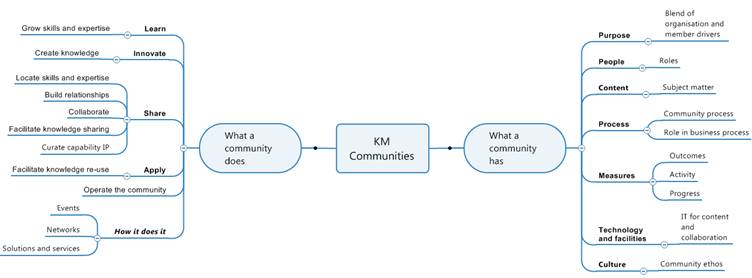
Models like these give us perspectives for analysing and appreciating different communities; for comparing and assessing and diagnosing them. They also give us templates for future community-building.
Degrees of difference in communities of practice
Even though at the fundamental level communities can all be described by these frameworks, in their details they vary greatly. For example, some are more purposeful and focused, some more exploratory; some more socially oriented, some built around curating tangible IP … amongst many other dimensions of variation, for example:
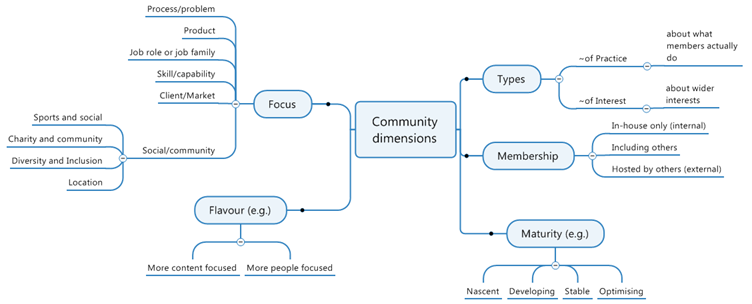
Navigating the emergent pattern
So, what you can find in an organisation is the total space of all potential communities is occupied by an emergent set of cross-cutting communities that vary in all the different dimensions that they can (type, focus, flavour, maturity and so on):

Community of practice strategists, then, think about and act on these kinds of considerations in order to spot where and how to intervene to optimise the effectiveness of communities individually, collectively and as a KM strategy:
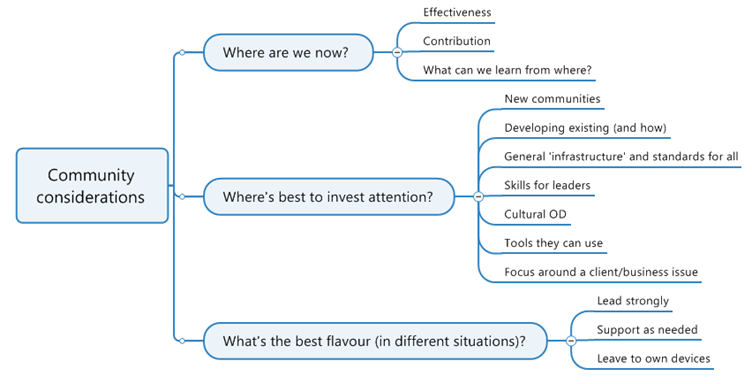
How we intervene
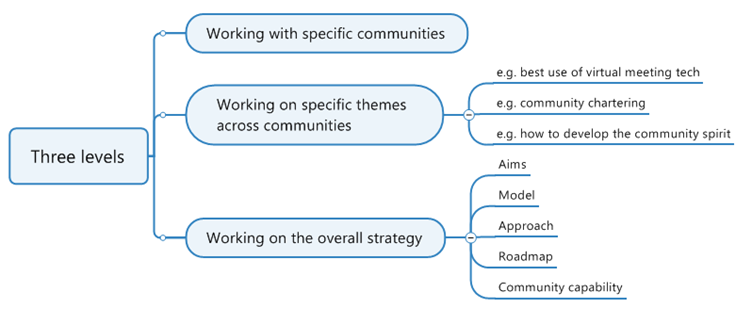
Community strategists can intervene at different levels in order to improve matters. For example:
- refining their overall community enablement capability, strategy, model and approach; or
- providing solutions and interventions to help all communities with specific areas such as how to best use virtual meeting IT, or how to charter a community or develop ‘community spirit’; or
- working closely with specific communities as a coach and consultant, perhaps because of the opportunity or strategic importance of those communities vs. others.
The last word – working with or within the communities themselves
Whatever we’re doing, though, it’s always best when it’s done close to (or with or within) communities themselves and engaged with real business and member issues rather than purely intellectual problems. Just as in communities, the learning is always best and most productive when done with practitioners, within their practice, where they are.
Author

Robert Taylor spent half of his career as a big firm KM consultant, and half as an in-house KM expert, including two periods as Head of Knowledge at different firms. He’s the co-inventor of a US patented methodology for communities of practice, author, speaker and co-founder of a KM Forum. He now consults as AIxKM.co.uk at the intersection of AI and KM.