
The Strategic Shift That Knowledge Management Can No Longer Ignore
For more than three decades, knowledge management has been largely defined by a single objective: ensuring that organizational knowledge does not disappear. The discipline emerged from a legitimate concern that valuable expertise, hard-earned lessons, and institutional experience were being lost through employee turnover, organizational restructuring, and the natural passage of time. In response, organizations invested heavily in repositories, document management systems, intranets, knowledge bases, lessons learned databases, and collaboration platforms. The prevailing assumption was straightforward. If knowledge could be captured and stored effectively, it would remain available for future use.
This assumption shaped the development of modern knowledge management. It influenced technology investments, governance frameworks, organizational processes, and even how KM success was measured. Organizations celebrated the growth of repositories, the volume of documents uploaded, and the number of lessons learned captured. Entire KM programs were built around the principle that preserving knowledge was the central challenge.
Yet a growing body of evidence suggests that the fundamental problem facing organizations today is no longer knowledge loss. The problem is knowledge invisibility.
Most large organizations are not suffering from a lack of knowledge. They possess enormous quantities of information, expertise, experience, and intellectual capital. The challenge is that much of this knowledge remains difficult to locate, connect, and apply. Valuable expertise is hidden within teams. Critical lessons are buried inside repositories. Historical decisions disappear into archives. Innovative practices remain confined to local business units. In many organizations, employees spend less time creating knowledge than they do searching for it.
This reality requires a reassessment of one of the discipline’s most deeply embedded assumptions. Storage remains important, but it is no longer the strategic bottleneck. Discovery has become the defining challenge of knowledge management in the twenty-first century.
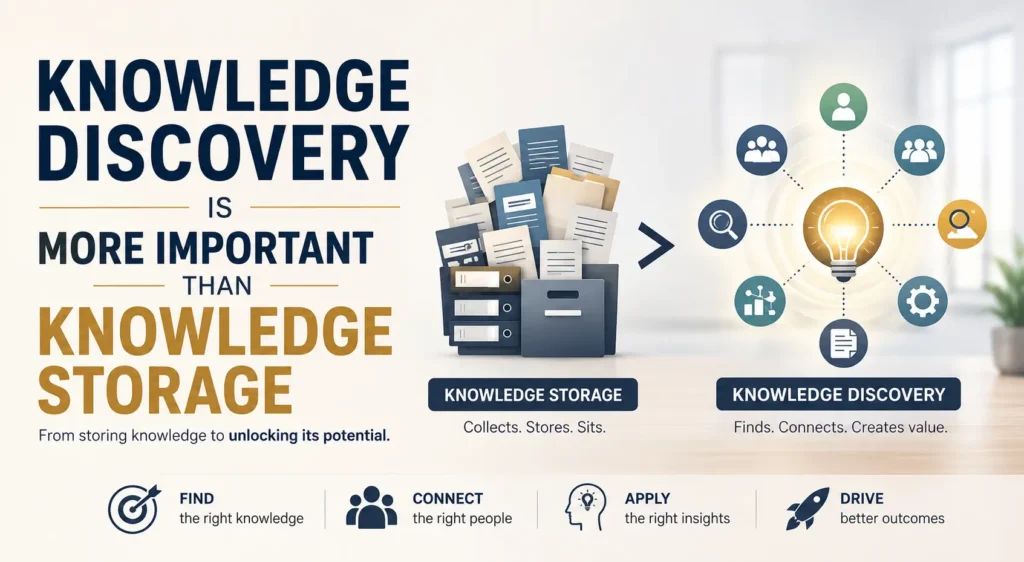
Table of Contents
Why Knowledge Management Became Obsessed With Storage
To understand why discovery is emerging as a strategic priority, it is necessary to revisit the intellectual foundations of knowledge management. Early KM initiatives were heavily influenced by concerns about organizational memory, intellectual capital, and knowledge retention. Researchers such as Ikujiro Nonaka emphasized the importance of transforming tacit knowledge into explicit knowledge, while practitioners focused on preventing expertise from disappearing when employees left the organization.
The business logic was compelling. Organizations invest significant resources developing knowledge through projects, operations, customer interactions, and innovation activities. Allowing that knowledge to disappear represents a direct loss of organizational capability. Capturing and storing knowledge therefore appeared to be a rational investment.
The challenge is that successful knowledge capture creates an entirely different problem. Every document added to a repository increases the complexity of the knowledge environment. Every lesson learned database becomes more difficult to navigate as it expands. Every new collaboration platform introduces additional information streams. Over time, organizations accumulate vast quantities of content without necessarily improving their ability to use it.
The result is a paradox that many KM leaders now recognize. Organizations have become highly effective at storing knowledge while remaining surprisingly ineffective at finding it.
This phenomenon is not unique to knowledge management. Similar patterns can be observed across digital ecosystems. The value of search engines emerged not because information was scarce on the internet but because information became overwhelmingly abundant. Recommendation systems became important not because consumers lacked choices but because they had too many. In both cases, discovery became more valuable than additional content creation.
Knowledge management is experiencing a comparable transition. The challenge is no longer building larger repositories. The challenge is helping people discover relevant knowledge at the moment they need it.
The Discovery Crisis Hidden Inside Enterprise Knowledge Systems
One of the most expensive inefficiencies in modern organizations is not the loss of knowledge but the failure to recognize knowledge that already exists.
Consider a common scenario within large enterprises. A project team spends months developing a solution to a complex operational problem. The solution is successful, documented, and stored within the organization’s knowledge repository. Several years later, another team in a different business unit encounters a remarkably similar challenge. Unaware that a solution already exists, they invest substantial time and resources solving the same problem from scratch.
From a traditional perspective, the organization appears to have managed knowledge effectively. The original solution was documented. The lessons learned were captured. The knowledge was stored.
Yet the organization still incurred unnecessary costs because the knowledge was never discovered.
This distinction is critical. Knowledge management has historically focused on preserving knowledge assets. Discovery focuses on activating those assets.
Knowledge that cannot be discovered might as well not exist from the perspective of decision-makers. A document buried within a repository creates no value. An expert whose capabilities are unknown cannot contribute to strategic decisions. A lesson learned that never influences future actions represents unrealized organizational potential.
This issue becomes even more significant when viewed at enterprise scale. Large organizations often contain thousands of specialists, decades of accumulated experience, and millions of knowledge assets. The challenge is not generating knowledge. The challenge is navigating a landscape where valuable insights are dispersed across people, systems, departments, and time.
The most significant knowledge risks facing many organizations today are therefore not associated with loss but with invisibility.
From Knowledge Scarcity to Knowledge Abundance
Many knowledge management practices were developed during an era in which knowledge scarcity represented the dominant concern. Information was difficult to access, expertise was concentrated within small groups, and organizational memory was vulnerable to disruption. Under those conditions, storage created significant value.
Today’s environment is fundamentally different.
Organizations generate unprecedented volumes of information through digital operations, collaboration technologies, enterprise systems, and increasingly through artificial intelligence. Every project produces documentation. Every meeting generates records. Every business process creates data. Every collaboration platform contributes to the growing body of organizational content.
The consequence is a transition from knowledge scarcity to knowledge abundance.
Abundance changes the economics of knowledge management. When knowledge is scarce, the priority is preservation. When knowledge is abundant, the priority becomes discovery.
This distinction is more than semantic. It represents a fundamental shift in strategic focus.
Knowledge abundance creates new organizational challenges. Employees face information overload. Decision-makers struggle to identify relevant expertise. Valuable insights become buried beneath large volumes of routine content. Search results produce hundreds of potential sources without indicating which ones matter most. In such environments, possessing knowledge is less important than being able to identify, interpret, and apply it effectively.
The organizations that thrive in knowledge-rich environments are not necessarily those with the largest repositories. They are the organizations that have developed superior discovery capabilities.
Why Knowledge Discovery Is Different From Search
One of the reasons organizations underestimate the importance of knowledge discovery is that it is frequently confused with search. The two concepts are related, but they are not synonymous. Search is a technological function. Discovery is an organizational capability.
Search assumes that users know what they are looking for. An employee enters keywords, receives a list of results, and selects the most relevant document. This model works reasonably well when the knowledge requirement is clearly defined and the desired information is already known. A procurement specialist searching for a policy document or a project manager looking for a specific template can often retrieve the necessary content through conventional search mechanisms.
Knowledge discovery operates at a fundamentally different level. It addresses situations in which individuals do not know what knowledge exists, where that knowledge resides, who possesses relevant expertise, or how previous experiences may relate to their current challenge. Discovery is concerned not only with locating information but also with revealing connections, context, expertise, and organizational memory that would otherwise remain hidden.
This distinction becomes particularly important when organizations face novel or complex challenges. Consider an executive team evaluating expansion into a new market. The most valuable knowledge may not reside within a market analysis report. It may exist in the experience of a regional manager who navigated similar challenges years earlier, in lessons learned from a failed acquisition, or in informal networks that understand local regulatory dynamics. A traditional search engine may retrieve documents related to market entry. Knowledge discovery seeks to uncover the broader ecosystem of knowledge that informs decision-making.
The difference can be understood through a simple observation. Search retrieves what is known. Discovery reveals what is unknown.
For knowledge leaders, this distinction has significant implications. Investments in search technology alone do not necessarily improve organizational discovery capabilities. Many organizations have implemented increasingly sophisticated search platforms while continuing to struggle with expertise visibility, knowledge reuse, and organizational learning. The issue is not the quality of search algorithms. The issue is that some of the most valuable organizational knowledge cannot be found through document retrieval alone.
Discovery Beyond Documents
One of the most enduring misconceptions in knowledge management is the tendency to equate knowledge with content. Documents, reports, presentations, policies, and databases are undoubtedly important knowledge assets, but they represent only a portion of the knowledge landscape within an organization.
Some of the most valuable knowledge exists in forms that are difficult to document completely. Experienced professionals develop judgment through years of practice. Project leaders recognize patterns that are invisible to less experienced colleagues. Technical experts learn how to navigate ambiguity, manage exceptions, and respond to unexpected situations. These capabilities often emerge through experience rather than formal instruction.
This distinction reflects the long-standing conversation within knowledge management regarding tacit and explicit knowledge. While explicit knowledge can be documented and stored, tacit knowledge remains deeply connected to experience, context, and human interpretation. Despite decades of KM practice, organizations continue to struggle with the challenge of making tacit knowledge accessible.
The problem is often framed as a knowledge capture issue. In reality, it is frequently a discovery issue.
Organizations do not necessarily need to convert every piece of tacit knowledge into documentation. In many cases, the more practical objective is ensuring that employees can identify and connect with the individuals who possess that expertise. This is why expertise location is emerging as one of the most strategically important areas within modern knowledge management.
When an engineer encounters an unfamiliar technical challenge, the most valuable asset may not be a document. It may be a conversation with someone who has solved a similar problem before. When a project team enters a new market, the most useful knowledge may reside within individuals who understand local conditions rather than within formal reports. When executives confront uncertainty, contextual understanding often proves more valuable than historical documentation alone.
Discovery therefore extends beyond content management. It includes expertise discovery, relationship discovery, and context discovery. Organizations that focus exclusively on repositories risk overlooking the human dimension of knowledge that frequently drives the highest-value decisions.
Discovery Across Organizational Boundaries
Knowledge discovery also plays a critical role in overcoming one of the oldest challenges in organizational management: silos.
Large organizations are often structured around functions, regions, business units, and specialized domains. While these structures support operational efficiency, they can also fragment knowledge. Valuable insights remain confined within teams. Expertise becomes localized. Lessons learned fail to travel beyond their point of origin.
Over time, organizations begin to resemble collections of knowledge islands rather than integrated learning systems.
This fragmentation creates substantial costs. Similar problems are solved repeatedly. Innovations spread slowly. Strategic initiatives encounter avoidable obstacles because previous experiences are not visible to decision-makers. Knowledge exists, but organizational structures limit its discoverability.
The challenge becomes even more pronounced in multinational organizations where expertise is distributed across geographies, cultures, and time zones. An effective solution developed in one region may remain entirely unknown elsewhere. Valuable knowledge may cross fewer organizational boundaries than executives assume.
Leading organizations increasingly recognize that discovery is not simply an information management challenge. It is a network challenge.
The objective is to increase the visibility of knowledge flows across organizational boundaries. This involves creating mechanisms that help employees identify relevant expertise, connect seemingly unrelated experiences, and surface knowledge that would otherwise remain isolated within specific communities.
In this sense, discovery becomes a capability that supports organizational learning at scale. It enables knowledge generated in one part of the enterprise to create value elsewhere, transforming local experience into enterprise-wide intelligence.
Discovery Across Time and Organizational Memory
Knowledge discovery is not only about connecting people and information across the organization. It is also about connecting the present to the past.
One of the most significant yet underappreciated challenges facing organizations is organizational forgetting. Decisions are made without awareness of previous decisions. Projects repeat mistakes that were identified years earlier. Strategic initiatives encounter obstacles that have already been documented elsewhere in the enterprise.
The problem is rarely that organizations lack historical knowledge. The problem is that historical knowledge remains disconnected from current activities.
This is where organizational memory becomes closely linked to knowledge discovery.
Organizational memory refers to the accumulated experiences, decisions, lessons, and insights that shape how an organization understands itself and its environment. In theory, repositories, archives, and lessons learned systems preserve this memory. In practice, preservation alone is insufficient. Memory only becomes valuable when it can be rediscovered and applied in relevant contexts.
An organization may possess decades of institutional knowledge, yet still repeat avoidable mistakes if that knowledge remains inaccessible during decision-making. The existence of memory does not guarantee learning. Discovery serves as the bridge between stored experience and current action.
This perspective suggests that organizational memory should not be viewed primarily as an archival function. It should be viewed as a discovery function. The objective is not merely to preserve the past but to ensure that the past remains visible when it matters most.
As organizations confront increasing complexity, workforce turnover, and accelerating technological change, the ability to rediscover relevant historical knowledge may become one of the most important dimensions of organizational resilience.
Artificial Intelligence Is Exposing the Discovery Problem
The emergence of generative AI has created a peculiar moment for the knowledge management profession. For years, KM leaders struggled to convince organizations that knowledge quality, governance, metadata, and organizational memory were strategic concerns. Suddenly, artificial intelligence has elevated these issues from operational considerations to executive priorities.
Yet one of the most important lessons emerging from enterprise AI deployments is that artificial intelligence does not solve knowledge management problems. It exposes them.
Many organizations initially approached AI as a technology initiative. The expectation was that large language models, enterprise copilots, and conversational assistants would provide seamless access to organizational knowledge. Employees would ask questions in natural language and receive accurate, context-rich answers. The vision appeared compelling. However, as implementation efforts progressed, a recurring pattern emerged. Organizations discovered that the effectiveness of AI was constrained by the discoverability of their knowledge.
The challenge was not the intelligence of the model. The challenge was the condition of the underlying knowledge ecosystem.
Repositories contained duplicate content. Metadata standards varied across business units. Expertise remained disconnected from formal knowledge systems. Historical decisions lacked sufficient context. Valuable knowledge existed across dozens of platforms with limited interoperability. In many cases, AI systems simply reflected the fragmentation already present within the organization.
This observation has important implications for the future of knowledge management. For decades, organizations could tolerate fragmented knowledge environments because employees often compensated through personal networks, experience, and informal communication channels. Artificial intelligence does not possess these advantages. AI systems depend on discoverable knowledge structures. They require clear relationships between content, expertise, context, and organizational memory.
As a result, many organizations are learning that successful AI adoption depends less on model sophistication and more on knowledge discoverability.
This represents a profound shift in perspective. Historically, knowledge management was often positioned as a support function that enabled operational efficiency and organizational learning. In the age of AI, discoverable knowledge increasingly becomes foundational infrastructure. Without it, even the most advanced AI systems struggle to deliver meaningful business value.
The Difference Between Information Retrieval and Knowledge Discovery
Much of the current discussion surrounding AI focuses on information retrieval. Enterprise search platforms, retrieval-augmented generation systems, and conversational interfaces are designed to retrieve relevant information in response to user queries. While these capabilities are valuable, they should not be confused with knowledge discovery.
Information retrieval answers questions.
Knowledge discovery reveals possibilities.
This distinction may appear subtle, but it represents one of the most significant challenges facing AI-enabled organizations. A retrieval system can identify documents related to a topic. A discovery system can uncover expertise that was previously unknown, identify relationships between seemingly unrelated projects, reveal emerging patterns across organizational activities, and surface knowledge that decision-makers were not actively seeking.
In other words, retrieval is reactive. Discovery is exploratory.
Consider how breakthrough innovations often emerge within organizations. Rarely do they result from employees searching for a predefined answer. More often, innovation occurs when individuals connect ideas from different domains, recognize patterns across experiences, or identify opportunities hidden within existing knowledge assets. These outcomes depend on discovery rather than retrieval.
The distinction is becoming increasingly relevant as organizations integrate AI into decision-making processes. If AI systems are designed solely to retrieve information, they risk reinforcing existing assumptions and knowledge structures. Discovery-oriented systems, by contrast, have the potential to reveal previously unseen connections and opportunities.
This is why the future of knowledge management cannot be reduced to better search interfaces. The challenge is creating environments in which knowledge can be discovered, connected, and interpreted in new ways.
Knowledge Graphs and the Future of Organizational Discovery
One of the most promising developments in this area is the growing interest in knowledge graphs. While often discussed as a technical concept, knowledge graphs represent a fundamentally different way of thinking about organizational knowledge.
Traditional repositories store knowledge as discrete assets. Documents exist independently. Databases contain records. Repositories organize content into categories and folders. While these structures support storage, they often struggle to represent the complex relationships that give knowledge its meaning.
Knowledge graphs approach the problem differently. Rather than focusing primarily on individual assets, they focus on relationships.
People are connected to projects.
Projects are connected to decisions.
Decisions are connected to outcomes.
Outcomes are connected to lessons learned.
Lessons learned are connected to future initiatives.
This relational perspective more closely reflects how knowledge actually functions within organizations. Valuable insights rarely emerge from isolated pieces of information. They emerge from understanding connections between people, experiences, contexts, and events.
For KM leaders, the significance of knowledge graphs extends beyond technology architecture. They represent an evolution from repository-centric knowledge management toward relationship-centric knowledge management. The emphasis shifts from storing knowledge objects to revealing knowledge networks.
This shift aligns closely with the broader movement toward discovery-oriented organizations. The objective is no longer simply to preserve information. It is to make relationships visible.
As AI systems become increasingly dependent on contextual understanding, these relational structures are likely to become even more important. The organizations that can effectively map and navigate their knowledge networks may gain significant advantages in learning, innovation, and decision-making.
Discovery as an Enterprise Capability
Perhaps the most important implication of this discussion is that knowledge discovery should no longer be viewed as a feature of technology platforms. It should be viewed as an enterprise capability.
Capabilities differ from tools. A search engine is a tool. Discovery is the ability of an organization to identify, connect, and mobilize relevant knowledge regardless of where that knowledge resides.
Developing this capability requires more than technology investment. It requires attention to governance, culture, architecture, organizational design, and leadership priorities. It involves creating environments where expertise is visible, knowledge flows across boundaries, historical experience remains accessible, and connections can emerge between seemingly unrelated domains.
Organizations that excel at discovery often display common characteristics. They make expertise visible. They encourage knowledge sharing across silos. They invest in organizational memory. They design systems around relationships rather than repositories. Most importantly, they recognize that knowledge becomes valuable only when it influences action.
The implications extend far beyond knowledge management. Discovery affects innovation, decision quality, operational effectiveness, risk management, and organizational resilience. In many respects, it determines how effectively an organization can convert intellectual capital into business value.
This is why discovery is increasingly emerging as a strategic capability rather than a technical consideration. As information volumes continue to grow and organizational complexity increases, the ability to discover relevant knowledge may become one of the most important differentiators between organizations that learn and organizations that merely accumulate information.
Rethinking Knowledge Management Metrics
If knowledge discovery is becoming more strategically important than knowledge storage, then many of the metrics traditionally used to evaluate KM performance deserve reconsideration.
For years, organizations measured knowledge management success through indicators that reflected storage activity. Metrics such as repository size, document counts, lessons learned submissions, content contributions, and page views became common measures of progress. These indicators were useful during an era when the primary challenge involved capturing and preserving organizational knowledge. They provided evidence that knowledge assets were being created and retained.
However, these measures reveal relatively little about whether knowledge is influencing organizational performance.
A repository containing one million documents may appear impressive from a storage perspective, yet it says little about whether employees can locate relevant knowledge when making decisions. Similarly, a lessons learned database may continue to expand while the organization repeatedly encounters the same problems. The existence of knowledge assets should not be confused with the utilization of knowledge assets.
As knowledge management evolves toward a discovery-oriented model, organizations may need to shift their attention toward different questions.
How quickly can employees identify relevant expertise?
How often are existing solutions reused rather than recreated?
How effectively does organizational memory inform current decisions?
How easily can knowledge move across business units?
How rapidly can emerging insights be discovered and shared?
These questions focus on knowledge activation rather than knowledge accumulation.
This shift mirrors developments in other disciplines. Data management has increasingly moved beyond data collection toward data utilization. Digital transformation initiatives are evaluated based on business outcomes rather than technology deployments. Similarly, knowledge management must increasingly demonstrate its contribution to decision quality, innovation, organizational learning, and operational performance.
The future of KM measurement may therefore focus less on what organizations possess and more on what organizations can discover.
For knowledge leaders, this transition is significant because it reframes the purpose of knowledge management itself. KM is not ultimately about managing content. It is about improving organizational capability. Discovery provides a more direct connection between knowledge assets and business outcomes than storage metrics alone.
Implications for Knowledge Leaders
The rise of knowledge discovery has important implications for how KM leaders think about strategy, investment, and organizational priorities.
First, it requires moving beyond repository-centric thinking. Repositories remain essential components of the knowledge ecosystem, but they should no longer serve as the primary focus of KM strategy. The critical question is not how much knowledge can be stored. The critical question is how effectively knowledge can be discovered and applied.
Second, discovery requires greater attention to expertise visibility. Many organizations possess sophisticated content management capabilities while lacking effective mechanisms for identifying who knows what. As knowledge becomes increasingly specialized and distributed, expertise location will become as important as document retrieval. The future of knowledge management is likely to involve connecting people to expertise as frequently as connecting people to content.
Third, KM leaders must view organizational memory as an active capability rather than a passive archive. Historical knowledge creates value only when it informs current decisions. This requires designing systems that surface relevant experience at the point of need rather than merely preserving it for future reference.
Fourth, discovery demands closer alignment between knowledge management and artificial intelligence initiatives. Many organizations continue to treat these as separate domains. In practice, they are becoming increasingly interconnected. The effectiveness of enterprise AI depends heavily on the discoverability, quality, and contextual richness of organizational knowledge. Knowledge leaders therefore have a unique opportunity to shape the foundations upon which future AI capabilities will depend.
Finally, discovery requires a broader view of organizational knowledge itself. Knowledge is not simply content. It exists within relationships, experiences, decisions, networks, and communities. Effective discovery strategies must therefore encompass both technological and human dimensions of knowledge.
This shift represents an important evolution for the profession. For many years, knowledge management was associated primarily with repositories and content governance. In the coming decade, it may become increasingly associated with organizational intelligence, expertise visibility, and knowledge-driven decision-making.
Key Takeaway
The history of knowledge management can be understood as a series of responses to changing organizational challenges. In its early stages, the discipline focused on preserving knowledge because knowledge loss represented a significant risk. Organizations needed mechanisms to capture expertise, document experience, and retain institutional memory. Storage was therefore a strategic priority.
That challenge has not disappeared. Organizations must still preserve critical knowledge assets, maintain organizational memory, and protect intellectual capital. Storage remains a necessary foundation of effective knowledge management.
What has changed is the nature of the bottleneck.
Today’s organizations operate in environments characterized by information abundance rather than information scarcity. They possess more content, more data, more expertise, and more institutional knowledge than at any point in history. Yet despite this abundance, employees frequently struggle to find what they need. Valuable expertise remains hidden. Lessons learned are forgotten. Knowledge assets remain underutilized.
The challenge is no longer whether knowledge exists.
The challenge is whether knowledge can be discovered.
This distinction will increasingly define the future of the discipline. Organizations that continue to focus primarily on storing knowledge may find themselves accumulating assets that generate limited value. Organizations that invest in discovery capabilities will be better positioned to connect expertise, accelerate learning, improve decision-making, and unlock the full potential of their intellectual capital.
The next generation of knowledge management will not abandon storage. It will build upon it. But its primary objective will be different.
Rather than asking how knowledge can be preserved, knowledge leaders will increasingly ask how knowledge can be made visible.
That shift, from preservation to discoverability, may prove to be one of the most important developments in the future of knowledge management.