
Google has introduced Notebooks within Gemini, a new capability that allows users to organize documents, research materials, notes, and project information directly inside the AI platform. The move represents another step in Google’s effort to combine conversational AI with structured knowledge management.
The announcement builds on the success of NotebookLM, Google’s AI-powered research and note-taking environment. By bringing notebook functionality into Gemini, Google is creating a more unified workspace where users can store information, ask questions, generate insights, and interact with knowledge without switching between multiple tools.
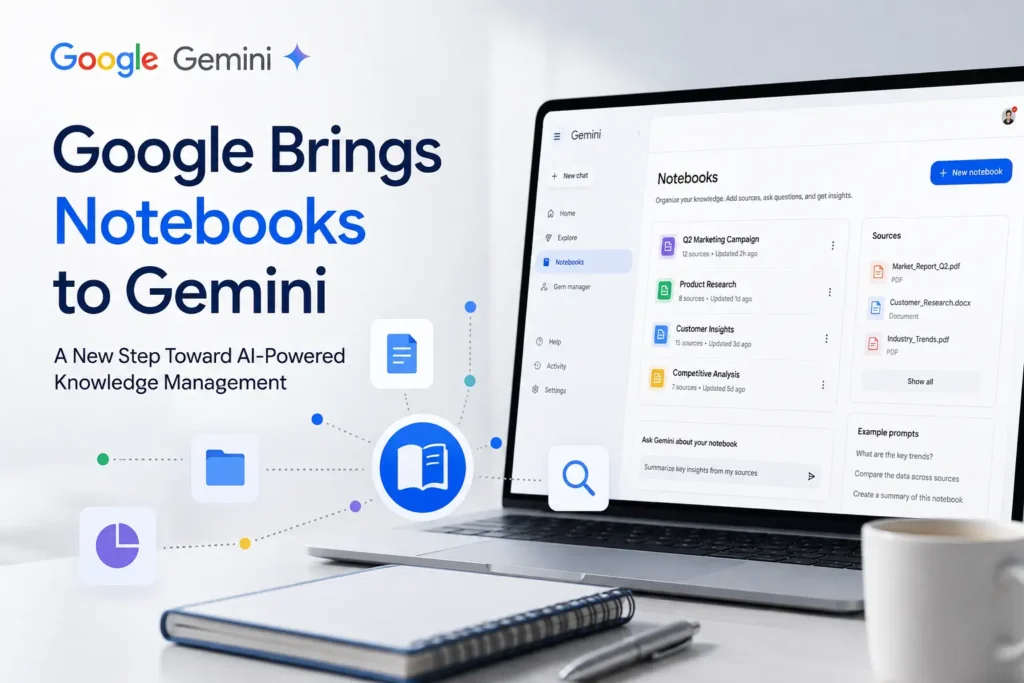
What Google Announced
The new Notebooks feature allows Gemini users to create dedicated knowledge spaces for projects, topics, and research initiatives. Users can upload files, organize information, and use Gemini to analyze and work with the content.
Rather than treating conversations as isolated interactions, notebooks provide persistent context. This means users can return to a project, continue discussions, and access previously uploaded information without rebuilding context from scratch.
The feature brings capabilities commonly associated with knowledge management systems into a mainstream AI platform.
Why This Matters for Knowledge Management
For years, organizations have struggled with a common challenge: information is often stored in multiple locations while valuable knowledge remains difficult to discover and apply.
Traditional knowledge repositories were designed to capture and organize content. While these systems remain important, they frequently require employees to search for information and interpret results themselves.
AI-powered notebooks introduce a different model.
Instead of simply retrieving documents, users can interact directly with their knowledge assets. Questions can be answered using uploaded sources, summaries can be generated instantly, and insights can be extracted from large collections of information.
This shifts the focus from information retrieval to knowledge understanding.
The Growing Convergence of AI and Knowledge Management
The introduction of notebooks inside Gemini reflects a broader trend across the technology industry. Enterprise software vendors are increasingly combining AI assistants, enterprise search, and knowledge management capabilities into unified platforms.
Organizations are moving beyond the idea of storing information in repositories. The emerging goal is to create intelligent environments where knowledge can be discovered, connected, and applied more effectively.
As AI systems gain stronger reasoning and contextual understanding capabilities, knowledge management platforms are evolving into knowledge intelligence platforms.
Google’s latest development highlights this transformation.
Potential Benefits for Organizations
Organizations exploring AI-enabled knowledge management may find several advantages in this approach.
Persistent project knowledge can reduce the need to repeatedly provide context to AI systems. Teams can maintain collections of documents, meeting notes, research findings, and operational knowledge in a single environment.
Knowledge workers may also spend less time searching for information and more time interpreting insights. This can improve productivity, support decision-making, and help organizations make better use of existing knowledge assets.
The ability to combine human expertise with AI-assisted analysis is likely to become an increasingly important capability across knowledge-intensive industries.
Analysis
Google’s introduction of Notebooks within Gemini is more significant than a product enhancement. It signals a continuing shift in how technology companies view knowledge management.
Historically, knowledge management focused on capturing and storing information. Today’s AI-driven environments place greater emphasis on understanding, synthesis, and knowledge discovery.
The convergence of Gemini and notebook-based knowledge environments suggests that future knowledge platforms will be judged less by the volume of content they contain and more by their ability to help people derive meaningful insights from that content.
For knowledge management professionals, this development reinforces an important trend. The future of KM is unlikely to be defined by repositories alone. Instead, it will increasingly center on intelligent systems that help people discover, connect, and apply knowledge in context.
As AI becomes embedded within everyday knowledge workflows, organizations that invest in high-quality, well-governed knowledge assets will be better positioned to realize the benefits of these emerging capabilities.