
Modern enterprises are investing billions of dollars in digital transformation, artificial intelligence, analytics platforms, enterprise search, collaboration technologies, automation systems, and knowledge management initiatives. Across boardrooms and strategy meetings, executives frequently discuss becoming data-driven, AI-enabled, customer-centric, and digitally mature. Yet beneath these conversations lies a more fundamental objective that is rarely discussed directly.
Organizations do not invest in technology because they want more technology.
They invest because they want to become more intelligent.
This distinction may appear obvious at first, but it reveals one of the most important misunderstandings in modern management. Most enterprises focus heavily on the tools that support intelligence while paying far less attention to the nature of intelligence itself. As a result, organizations often accumulate enormous quantities of data, information, reports, dashboards, documents, and AI-generated outputs without significantly improving their ability to learn, adapt, make decisions, or respond effectively to change.
The consequence is visible everywhere. Companies possess sophisticated analytics capabilities yet continue making avoidable strategic mistakes. Organizations deploy advanced AI systems while employees struggle to locate reliable knowledge. Teams generate more information than ever before while decision-makers report increasing levels of uncertainty. Knowledge repositories expand continuously while institutional memory weakens.
These contradictions expose a deeper issue.
Most organizations have become highly effective at managing information but far less effective at developing enterprise intelligence.
Understanding this difference may be one of the most important challenges facing modern knowledge management.
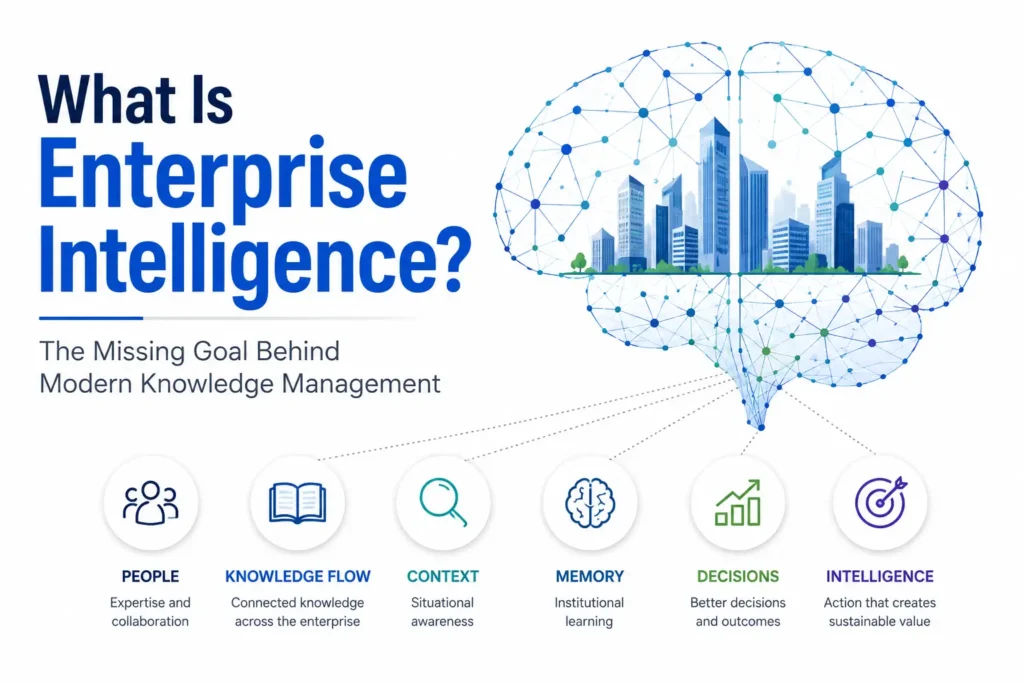
Why Information Does Not Automatically Create Intelligence
One of the most persistent assumptions in business is that more information leads to better decisions. This belief has shaped management thinking for decades and has influenced countless investments in reporting systems, business intelligence platforms, analytics tools, and knowledge repositories.
Reality is considerably more complex.
Information and intelligence are not the same thing.
Information describes what is known. Intelligence determines how effectively that knowledge can be used.
An organization may possess detailed market research, customer data, operational metrics, historical reports, lessons learned documents, and sophisticated dashboards. Yet if that information cannot be interpreted within the appropriate context, connected to prior experience, transformed into organizational learning, and applied effectively to future decisions, intelligence remains limited.
This distinction explains why organizations with access to similar information often achieve dramatically different outcomes.
The difference is rarely information availability.
The difference is intelligence capability.
Enterprise intelligence emerges when organizations can transform distributed knowledge into coordinated action consistently over time. It reflects an organization’s ability to understand changing conditions, interpret signals accurately, learn from experience, preserve institutional memory, connect expertise across boundaries, and make increasingly effective decisions despite complexity and uncertainty.
This capability cannot be purchased as software.
It cannot be implemented through a single platform.
And it cannot be created simply by accumulating more information.
Enterprise intelligence is an organizational capability that emerges from the interaction of knowledge, people, processes, governance, technology, memory, and learning systems working together.
Defining Enterprise Intelligence
Enterprise intelligence can be understood as the collective ability of an organization to sense, understand, learn, adapt, and make effective decisions using its available knowledge and experience.
Unlike business intelligence, which focuses primarily on data analysis and reporting, enterprise intelligence encompasses the broader organizational capability to transform knowledge into action.
Unlike artificial intelligence, which focuses on machine-driven analysis and automation, enterprise intelligence focuses on how the organization itself behaves as an intelligent system.
Unlike knowledge management, which focuses on capturing, organizing, and enabling access to knowledge, enterprise intelligence focuses on the outcomes that knowledge creates.
This distinction is important because enterprise intelligence exists above many of the disciplines that organizations often treat separately.
Data contributes to intelligence.
Information contributes to intelligence.
Knowledge contributes to intelligence.
Analytics contribute to intelligence.
Artificial intelligence contributes to intelligence.
Knowledge management contributes to intelligence.
But none of these elements represent intelligence on their own.
Enterprise intelligence emerges when these components function together in ways that continuously improve organizational understanding, decision quality, learning capability, and adaptive performance.
It is therefore possible for an organization to possess substantial knowledge while remaining unintelligent operationally.
Likewise, it is possible for organizations with fewer resources to outperform larger competitors because they learn faster, adapt more effectively, preserve knowledge more successfully, and convert insights into action more consistently.
Enterprise intelligence is not defined by what an organization knows.
It is defined by what an organization can do with what it knows.
The Evolution From Data to Enterprise Intelligence
Much of modern management thinking has been shaped by the progression from data to information and from information to knowledge. While this model remains useful, it often stops too early.
Organizations increasingly recognize that knowledge itself is not the final objective.
The true objective is intelligence.
Data represents raw observations.
Information organizes those observations into meaningful structures.
Knowledge adds understanding, context, and interpretation.
Enterprise intelligence emerges when knowledge influences action and improves organizational behavior over time.
This distinction explains why knowledge management is becoming increasingly strategic in modern enterprises.
Historically, many organizations treated KM primarily as a repository function. Knowledge was captured, documented, categorized, and stored. Success was often measured through repository size, content volume, or participation metrics.
These measures tell us very little about intelligence.
An organization may possess millions of documents while continuing to make poor decisions repeatedly. Conversely, an organization with relatively modest knowledge assets may demonstrate extraordinary intelligence through effective learning, strong institutional memory, high-quality decision-making, and rapid adaptation.
The difference lies not in information volume but in intelligence capability.
Enterprise intelligence therefore represents the highest stage of organizational knowledge maturity. It reflects the organization’s ability to transform what it knows into what it does.
The Five Foundations of Enterprise Intelligence
Although enterprise intelligence emerges from complex interactions across the organization, five foundational capabilities appear repeatedly within high-performing enterprises.
The first is knowledge itself. Organizations cannot become intelligent without reliable knowledge assets. Employees require access to expertise, operational experience, institutional understanding, customer insights, and strategic information that support decision-making across the enterprise.
The second foundation is context. Knowledge without context often produces poor decisions because information gains meaning only when interpreted within specific operational circumstances. High-performing organizations excel at preserving not only knowledge but also the conditions, assumptions, and reasoning surrounding that knowledge.
The third foundation is organizational memory. Enterprises that cannot remember effectively cannot learn effectively. Institutional memory allows organizations to preserve lessons, understand historical decisions, avoid repeated mistakes, and maintain continuity despite workforce changes and organizational transformation.
The fourth foundation is knowledge flow. Intelligence depends heavily on how effectively knowledge moves across organizational boundaries. Expertise trapped within silos rarely contributes to enterprise-wide intelligence. High-performing organizations design systems that allow knowledge to move rapidly and reliably between people, teams, departments, and operational environments.
The fifth foundation is decision quality. Knowledge creates value only when it influences action. Enterprise intelligence ultimately reveals itself through better decisions, improved adaptability, reduced uncertainty, stronger execution, and continuous organizational learning.
These five foundations work together as a system.
Weakness in any one area limits the organization’s overall intelligence capability regardless of investments made elsewhere.
Why Enterprise Intelligence Is Becoming More Important Than Digital Transformation
For much of the past decade, digital transformation dominated management discussions. Organizations focused on cloud migration, automation, customer experience modernization, process digitization, and platform consolidation. More recently, AI transformation has emerged as a dominant strategic priority.
Yet both trends risk overlooking a fundamental reality.
Digital transformation is not the goal.
AI transformation is not the goal.
Technology modernization is not the goal.
The goal has always been organizational intelligence.
Technology matters because it can improve how organizations learn, understand, decide, and adapt. If technological investments fail to strengthen these capabilities, transformation efforts often generate limited strategic value regardless of implementation success.
This explains why some organizations achieve remarkable results from relatively modest technology investments while others struggle despite enormous spending. The determining factor is often whether technology strengthens enterprise intelligence or simply increases operational complexity.
Many organizations digitized processes without improving learning.
Others automated workflows without improving decision-making.
Some deployed AI without strengthening knowledge quality or institutional memory.
Technology improved efficiency while intelligence remained unchanged.
Enterprise intelligence provides a more useful strategic lens because it focuses attention on the capability organizations ultimately seek to develop. Instead of asking whether new systems are technologically advanced, leaders can ask whether those systems improve organizational understanding, learning, adaptability, and decision quality.
This shift changes how transformation itself is evaluated.
Enterprise Intelligence and Knowledge Management
Perhaps the most important implication of enterprise intelligence is what it reveals about the true purpose of knowledge management.
For years, KM struggled with an identity challenge. Many organizations viewed it as a documentation function, repository initiative, collaboration program, or content management activity. While these activities remain important, they often obscure the larger purpose of the discipline.
Knowledge management is not ultimately about repositories.
It is about intelligence.
The purpose of KM is to create the conditions necessary for enterprise intelligence to emerge.
Knowledge management provides the infrastructure that supports organizational learning. It enables expertise discovery, institutional memory preservation, knowledge flow, contextual understanding, governance consistency, and decision support. These capabilities contribute directly to enterprise intelligence because they improve the organization’s ability to learn from experience and act effectively under changing conditions.
This perspective elevates the strategic importance of KM significantly.
Instead of measuring success through content creation or repository usage alone, organizations can evaluate knowledge management based on its contribution to enterprise intelligence.
Does the organization learn faster?
Does institutional memory improve?
Do employees locate expertise more efficiently?
Does decision quality improve?
Does knowledge move effectively across boundaries?
Can the organization adapt more successfully to change?
These questions provide a far more meaningful assessment of KM impact than traditional usage metrics alone.
Why AI Is Not Enterprise Intelligence
The rise of artificial intelligence has created tremendous excitement across industries, but it has also introduced significant confusion regarding the nature of organizational intelligence.
Many executives assume AI automatically creates intelligence.
It does not.
Artificial intelligence can process information, generate content, identify patterns, summarize knowledge, and support decision-making. These capabilities are valuable. However, enterprise intelligence remains fundamentally broader than machine intelligence.
AI can accelerate intelligence.
It cannot replace it.
Enterprise intelligence depends on knowledge quality, contextual understanding, institutional memory, governance structures, organizational learning, leadership judgment, cultural dynamics, and collective decision-making capabilities. AI operates within these environments rather than independently from them.
This distinction explains why some organizations achieve substantial value from AI while others struggle. The determining factor often lies not in model sophistication but in the health of the underlying knowledge ecosystem.
Organizations with fragmented repositories, weak governance, poor organizational memory, and disconnected knowledge flows often experience disappointing AI outcomes because the intelligence foundations supporting AI remain underdeveloped.
Conversely, organizations with strong knowledge systems frequently achieve superior results because AI amplifies existing intelligence capabilities.
AI is therefore best understood as an intelligence accelerator rather than an intelligence creator.
Enterprise intelligence remains an organizational capability that emerges through the interaction of people, knowledge, systems, governance, and learning processes working together.
The Future Enterprise Will Be Designed Around Intelligence
The next generation of successful organizations will increasingly distinguish themselves not through access to information but through their ability to transform knowledge into coordinated action under conditions of complexity.
This shift is already underway.
Competitive advantage is becoming less dependent on information possession because information itself has become abundant. What remains scarce is the ability to learn continuously, preserve institutional memory, connect expertise, understand context, adapt quickly, and make effective decisions at scale.
These capabilities define enterprise intelligence.
Organizations that understand this shift will approach knowledge management differently. They will view repositories as infrastructure rather than objectives. They will prioritize knowledge flow over information accumulation. They will invest in organizational memory alongside technology modernization. They will measure learning capability alongside productivity metrics. They will recognize that AI delivers value only when supported by healthy knowledge ecosystems.
Most importantly, they will understand that intelligence is not a technology outcome.
It is an organizational capability.
The future enterprise will not be defined by how much information it possesses.
It will be defined by how intelligently it uses that information to learn, adapt, decide, and act.
That is the true goal behind knowledge management.
And increasingly, it may become the defining competitive advantage of the AI era.