Most organizations believe they have a knowledge management strategy because they own collaboration platforms, enterprise search tools, document repositories, or AI-powered assistants. Yet when employees attempt to locate trusted expertise, transfer operational knowledge, or reuse institutional learning, the gaps become immediately visible.
Critical knowledge remains trapped inside teams. Lessons learned disappear after projects end. Employees recreate work that already exists elsewhere in the organization. Senior leadership invests heavily in digital transformation initiatives while institutional knowledge continues to fragment across disconnected systems.
This is not a technology problem alone.
It is usually a maturity problem.
Mature knowledge management strategies are fundamentally different from fragmented knowledge initiatives. They are designed as enterprise capabilities, not isolated projects. They align operational knowledge, organizational learning, governance, culture, technology, and decision-making into a connected system that evolves continuously as the business grows.
Organizations with mature KM strategies do not treat knowledge as passive content sitting inside repositories. They treat knowledge as operational infrastructure that directly influences execution speed, innovation capacity, employee effectiveness, customer outcomes, and long-term resilience.
The difference between immature and mature KM environments is rarely visible through software alone. It becomes visible through organizational behavior.
In mature organizations, employees know where trusted knowledge exists. Expertise flows across departments. Lessons learned influence future decisions. Knowledge survives workforce transitions. AI systems produce more reliable outputs because enterprise information is structured and governed properly.
The most advanced organizations in sectors such as consulting, energy, pharmaceuticals, aerospace, financial services, engineering, and technology have recognized something increasingly important in the modern economy.
Enterprise performance is deeply connected to enterprise knowledge maturity.
Behind those successful KM environments, seven foundational elements consistently appear.
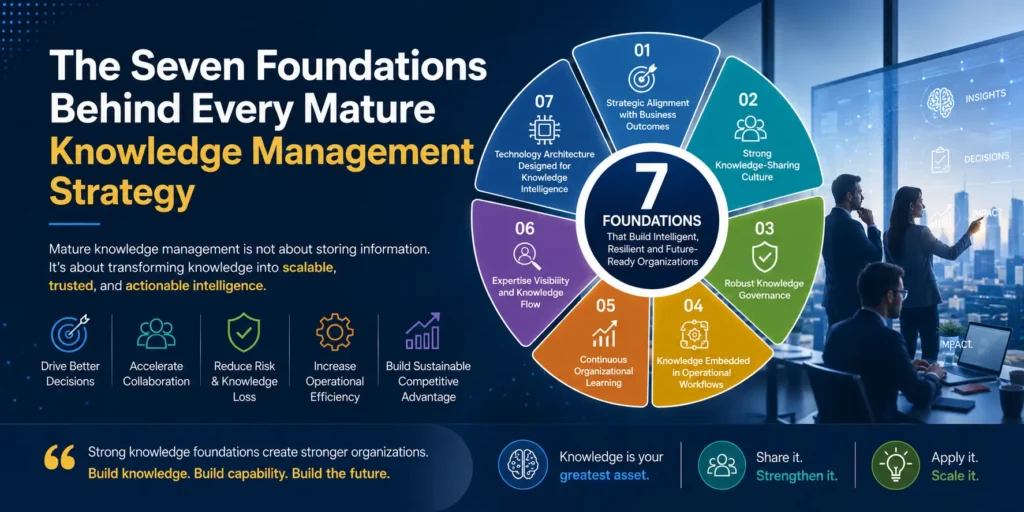
Table of Contents
- Foundation One: Strategic Alignment Between Knowledge and Business Outcomes
- Foundation Two: A Strong Knowledge-Sharing Culture
- Foundation Three: Structured Knowledge Governance
- Foundation Four: Knowledge Embedded Into Operational Workflows
- Foundation Five: Continuous Organizational Learning
- Foundation Six: Expertise Visibility and Knowledge Flow
- Foundation Seven: Technology Architecture Designed for Knowledge Intelligence
- Why These Foundations Matter More in the AI Era
- Final Thoughts
Foundation One: Strategic Alignment Between Knowledge and Business Outcomes
One of the most common reasons knowledge management programs fail is because they operate independently from business strategy.
Many KM initiatives begin with good intentions but quickly become disconnected from operational priorities. Teams focus heavily on documentation activity, repository growth, or content migration projects without clearly linking those efforts to measurable business value.
Mature KM strategies operate differently.
Knowledge initiatives are tightly connected to organizational objectives such as operational efficiency, innovation acceleration, customer experience improvement, risk reduction, regulatory compliance, workforce scalability, or AI transformation readiness.
This alignment changes how knowledge management is perceived internally.
Instead of being viewed as an administrative support function, KM becomes recognized as a strategic business capability.
Consider global consulting firms. Their competitive advantage depends heavily on how effectively expertise moves across geographies, practices, and client engagements. A mature KM strategy directly supports revenue generation because consultants can rapidly reuse intellectual capital, industry insights, delivery frameworks, and lessons learned from prior projects.
The same principle applies within pharmaceutical organizations, where research knowledge, compliance documentation, and scientific collaboration directly influence speed-to-market and regulatory accuracy.
In engineering and energy sectors, operational knowledge management affects safety, maintenance reliability, and project execution quality.
Mature organizations understand that knowledge strategy must be anchored to enterprise priorities rather than positioned as a standalone information initiative.
This strategic alignment also strengthens executive sponsorship.
Senior leadership rarely invests seriously in KM because employees need “better documentation.” They invest when knowledge capabilities improve measurable business performance.
That distinction separates mature KM environments from tactical content-management programs.
Foundation Two: A Strong Knowledge-Sharing Culture
Technology alone cannot create a mature knowledge organization.
Many enterprises deploy sophisticated platforms only to discover employees continue storing information locally, withholding expertise, or bypassing official systems entirely.
The problem is cultural.
Knowledge management maturity depends heavily on whether organizations encourage knowledge-sharing behaviors consistently across leadership, operations, and team structures.
In immature environments, knowledge often becomes associated with individual value or positional security. Employees may hesitate to share expertise because specialized knowledge provides influence, job protection, or organizational visibility.
This creates structural silos.
Mature knowledge cultures operate differently. Knowledge sharing becomes normalized as part of professional responsibility and organizational contribution.
Employees understand that expertise gains greater value when operationalized across the enterprise rather than protected within isolated teams.
This cultural maturity does not emerge accidentally.
Leadership behavior plays a decisive role.
Organizations with advanced KM practices often have executives and senior managers who actively reinforce collaborative learning, transparency, mentoring, and cross-functional knowledge exchange.
These organizations also recognize that culture cannot depend solely on slogans encouraging collaboration.
Employees must see clear operational incentives.
If performance systems reward only individual achievement while ignoring knowledge contribution, employees naturally prioritize personal output over institutional learning.
Mature KM organizations design structures that reinforce collaborative behaviors. This may include recognition systems, expertise visibility, internal communities of practice, collaborative project reviews, or operational frameworks that integrate knowledge-sharing directly into workflows.
Importantly, mature cultures also tolerate learning transparency.
Employees feel comfortable discussing mistakes, operational failures, and lessons learned without excessive fear of blame. This creates environments where institutional intelligence grows continuously rather than remaining hidden behind defensive organizational behaviors.
In highly regulated or operationally complex industries, this openness becomes especially valuable because lessons learned directly affect risk management and operational resilience.
Knowledge-sharing culture is not soft organizational theory. It is operational infrastructure.
Foundation Three: Structured Knowledge Governance
One of the clearest indicators of KM immaturity is uncontrolled information growth.
Many organizations accumulate enormous volumes of content without clear ownership, validation processes, taxonomy standards, lifecycle management, or quality governance.
Over time, repositories become increasingly unreliable.
Employees lose confidence in enterprise knowledge systems because they encounter outdated documentation, duplicated content, conflicting procedures, or low-quality information. Once trust declines, adoption collapses.
Mature KM strategies place strong emphasis on governance.
Governance defines how knowledge is created, reviewed, maintained, categorized, archived, secured, and distributed across the organization.
This foundation becomes especially important in large enterprises operating across multiple business units, geographies, or regulatory environments.
Without governance, enterprise knowledge environments become chaotic.
Mature organizations establish clear ownership models for critical knowledge assets. Subject matter experts, operational leaders, compliance teams, and knowledge managers all play defined roles in maintaining information quality and integrity.
Taxonomy design also becomes central.
A mature KM environment requires consistent classification structures that allow employees to discover relevant knowledge efficiently. Poor taxonomy creates fragmented search experiences where valuable expertise remains effectively invisible.
This challenge has become even more significant in AI-enabled environments.
AI systems depend heavily on structured, governed knowledge ecosystems. Poorly organized enterprise information reduces AI accuracy, weakens retrieval quality, and increases operational risk.
Leading enterprises increasingly recognize governance as essential to AI readiness.
Governance maturity also extends beyond documentation.
Advanced organizations define standards for expertise management, lessons learned processes, metadata structures, retention policies, access controls, and content lifecycle workflows.
These practices may appear operationally invisible from the outside, but they fundamentally determine whether enterprise knowledge systems remain trusted over time.
Trust is one of the most overlooked dimensions of KM maturity.
Employees will only rely on enterprise knowledge systems if they believe the information is accurate, current, and operationally reliable.
Governance creates that trust.
Foundation Four: Knowledge Embedded Into Operational Workflows
One of the biggest weaknesses in immature KM environments is separation between knowledge systems and operational execution.
Employees are expected to leave their workflows, search disconnected repositories, interpret fragmented information, and manually apply knowledge independently.
This creates friction.
When knowledge access requires excessive effort, employees often bypass formal systems entirely and rely on informal networks instead.
Mature KM strategies reduce this friction by embedding knowledge directly into operational workflows.
Knowledge becomes integrated into the places where employees already work.
This includes collaboration platforms, service management systems, customer operations environments, engineering workflows, project delivery platforms, and AI-driven support systems.
The objective is not merely information availability.
The objective is contextual knowledge delivery.
For example, advanced customer support environments surface relevant troubleshooting guidance, historical case knowledge, and operational recommendations directly within support workflows.
Engineering organizations integrate lessons learned, technical standards, and design knowledge into project execution environments.
Healthcare systems increasingly embed clinical knowledge into decision-support workflows rather than forcing practitioners to search external repositories manually.
This operational integration dramatically improves knowledge usability.
Mature organizations recognize that knowledge management succeeds when knowledge becomes frictionless.
This principle also reshapes how enterprises think about enterprise search.
Traditional keyword search systems often fail because they require employees to know exactly what they are searching for. Mature organizations increasingly invest in semantic search, contextual discovery, expertise mapping, and AI-enhanced retrieval systems that align knowledge delivery with operational context.
Workflow integration also supports scalability.
As organizations grow, employees cannot depend exclusively on tribal knowledge or informal guidance networks. Embedded knowledge systems create operational consistency across distributed teams and complex business environments.
This becomes particularly important in hybrid work models where spontaneous knowledge transfer occurs less naturally than in traditional office environments.
Foundation Five: Continuous Organizational Learning
Many organizations capture knowledge occasionally. Mature organizations institutionalize learning continuously.
This distinction is critical.
Immature KM strategies often focus heavily on static repositories without creating systems that continuously generate, refine, and operationalize new organizational knowledge.
As a result, institutional learning remains inconsistent.
Mature knowledge organizations treat learning as an ongoing enterprise process rather than an occasional documentation activity.
Lessons learned are systematically captured after projects, operational incidents, customer engagements, or strategic initiatives. More importantly, those insights influence future decisions and operational improvements.
This feedback loop defines maturity.
Many organizations conduct retrospectives or project reviews, but the resulting insights rarely influence broader enterprise operations. Knowledge remains localized rather than becoming institutionalized.
Advanced organizations solve this by creating structured learning mechanisms.
Communities of practice allow expertise to evolve collaboratively across functions. Cross-functional reviews identify recurring operational patterns. Knowledge networks connect specialists across global teams. Continuous improvement processes transform operational experience into reusable intelligence.
This capability becomes increasingly important in volatile business environments where adaptation speed determines competitiveness.
Organizations that learn slowly struggle to respond effectively to market disruption, technological shifts, regulatory change, or operational risk.
Mature KM strategies strengthen organizational adaptability because institutional learning compounds over time.
This is one reason why many leading enterprises increasingly position KM alongside innovation, transformation, and operational excellence functions.
Knowledge management is not simply about preserving what organizations already know.
It is about accelerating how organizations learn.
Foundation Six: Expertise Visibility and Knowledge Flow
One of the most underestimated challenges in large organizations is expertise invisibility.
Critical knowledge often exists inside the enterprise, but employees cannot easily identify who possesses it.
This creates major operational inefficiencies.
Teams duplicate research because they cannot locate internal specialists. Employees spend excessive time navigating organizational hierarchies searching for expertise. Valuable institutional intelligence remains isolated within departments or geographic regions.
Mature KM strategies actively address expertise discoverability.
These organizations understand that effective knowledge management is not limited to documents, repositories, or databases. Human expertise remains one of the most valuable knowledge assets within any enterprise.
Advanced organizations create systems that improve expertise visibility across the business.
This may include expertise directories, skills intelligence platforms, internal knowledge networks, AI-enhanced expert discovery systems, or collaborative communities connecting specialists globally.
The objective is to strengthen knowledge flow across organizational boundaries.
This capability becomes increasingly important in multinational enterprises where expertise may exist across multiple regions, business units, or operational domains.
Knowledge flow also affects innovation capacity.
Many breakthrough ideas emerge when expertise from different disciplines intersects. Mature KM environments create stronger conditions for those intersections to occur naturally.
Organizations such as IBM, Accenture, Siemens, and other globally distributed enterprises have historically invested heavily in cross-functional knowledge networks precisely because innovation depends on knowledge mobility.
Knowledge flow also reduces dependency risks.
When expertise remains concentrated within small groups or individual employees, operational resilience weakens. Mature organizations distribute institutional intelligence more broadly, reducing vulnerability associated with workforce turnover or organizational restructuring.
This foundation becomes especially significant as enterprises confront aging workforces and increasing retirement-related knowledge loss.
Expertise visibility is not simply about collaboration efficiency.
It is about protecting organizational capability.
Foundation Seven: Technology Architecture Designed for Knowledge Intelligence
Technology is not the starting point of KM maturity, but it remains a critical foundation.
The difference is that mature organizations design technology ecosystems around knowledge intelligence rather than isolated content storage.
Immature environments often accumulate disconnected tools over time. Employees navigate multiple repositories, collaboration platforms, document systems, intranets, and databases without unified discovery experiences.
This fragmentation weakens knowledge accessibility.
Mature organizations increasingly focus on integrated knowledge architectures.
Their systems connect structured and unstructured knowledge, operational workflows, expertise networks, enterprise search capabilities, governance frameworks, and AI systems into more cohesive ecosystems.
The role of AI is accelerating this transformation significantly.
Enterprise leaders are now rethinking KM architectures to support retrieval-augmented generation systems, semantic search environments, intelligent assistants, knowledge graphs, and contextual knowledge delivery.
This evolution is changing how organizations conceptualize knowledge itself.
Traditional KM environments focused heavily on storage and retrieval. Modern knowledge architectures focus increasingly on intelligence amplification.
The objective is no longer simply finding documents.
The objective is delivering trusted knowledge contextually, rapidly, and intelligently across enterprise operations.
This shift requires substantial architectural maturity.
Organizations must address interoperability, metadata quality, governance alignment, content structure, security controls, access management, and semantic consistency across systems.
Mature organizations also recognize that technology adoption depends heavily on user experience.
Employees will not engage consistently with enterprise knowledge systems if those systems feel slow, fragmented, or operationally disconnected.
Usability matters enormously.
The strongest KM architectures often become nearly invisible operationally because knowledge flows naturally within existing work environments.
That seamlessness reflects maturity.
Why These Foundations Matter More in the AI Era
Artificial intelligence has elevated the importance of knowledge management dramatically.
Many organizations initially viewed AI primarily as an automation technology. Increasingly, enterprises are recognizing that AI performance depends heavily on knowledge maturity.
Poorly governed knowledge environments create unreliable AI outputs.
Fragmented content reduces retrieval accuracy. Weak taxonomy structures limit contextual understanding. Inconsistent metadata reduces discoverability. Low-trust repositories increase hallucination risk.
Organizations with mature KM foundations possess a major strategic advantage.
Their enterprise knowledge environments are already structured, governed, and operationally integrated. This creates stronger conditions for successful AI deployment.
In many ways, AI is exposing knowledge maturity gaps that already existed inside organizations.
Enterprises that ignored governance, taxonomy, knowledge quality, or expertise visibility are now discovering those weaknesses directly affect AI effectiveness.
This is one reason why KM leadership is becoming increasingly strategic within large organizations.
Knowledge management is evolving from an internal operational function into a foundational capability supporting enterprise intelligence.
Final Thoughts
Mature knowledge management strategies are not defined by software platforms, documentation volume, or isolated knowledge initiatives.
They are defined by how effectively organizations transform knowledge into operational capability.
The seven foundations behind mature KM environments, strategic alignment, knowledge-sharing culture, governance, workflow integration, continuous learning, expertise visibility, and intelligent technology architecture, operate together as interconnected systems.
Weakness in one area eventually affects the others.
Organizations that succeed in knowledge management understand that maturity is not achieved through a single platform deployment or transformation project. It emerges through sustained organizational design, leadership commitment, operational discipline, and continuous adaptation.
This matters more than ever.
Modern enterprises face increasing complexity, workforce transitions, distributed operations, regulatory pressure, and AI-driven transformation simultaneously. In this environment, organizational knowledge becomes one of the most valuable strategic assets companies possess.
The organizations that outperform competitors over the next decade will not necessarily be those with the largest information repositories.
They will be the enterprises capable of turning knowledge into coordinated intelligence at scale.