AI has changed how we search for information and interact with knowledge. Across countless businesses, employees have become accustomed to asking questions in natural language and receiving answers in seconds. Whether they are using internal co-pilots, chatbots, or publicly available AI tools, the increasing expectation is that knowledge should be easily accessible and quick to attain.
This shift is creating new opportunities for organisations, but it’s also exposing some familiar problems.
AI can make it faster to find information, but that doesn’t always mean that the information it provides is accurate. Artificial intelligence can only work with the information that it has access to. If underlying knowledge is outdated, duplicated, or poorly maintained, AI may surface inconsistent or incorrect content, increasing the risk of employees making decisions based on inaccurate guidance.
This is not a reason for businesses to resist AI. If anything, it highlights why effective knowledge management matters more than ever.
Why is the way that we search for knowledge changing?
People naturally gravitate towards convenience. Traditional search functions often rely on users knowing exactly where information is stored or which keywords to use in order to find it, but AI has changed that experience.
Employees can ask AI systems questions in the same way that they would ask a colleague. This conversational approach feels intuitive and removes much of the friction that has historically frustrated users.
For many organisations, this is leading to better access to information and faster responses. Customer service agents can resolve queries faster, while new employees are able to find guidance without relying as heavily on their colleagues.
While these are meaningful improvements, the ease of accessing information should not be confused with the quality of the information itself.
What happens when AI retrieves the wrong information?
Most organisations have accumulated large volumes of information over many years. It’s not uncommon to find outdated procedures and duplicate documents hidden away in shared drives, intranets, and disconnected repositories. Many teams may already be aware of these issues, often finding that employees struggle to locate the most up-to-date information and determine which source should be trusted.
AI systems can amplify these challenges is not deployed correctly. An AI assistant may present a policy that was superseded six months ago, retrieve duplicate content containing conflicting guidance, or even surface information that was never formally approved.
This can result in employees making poor decisions with greater confidence because the answer arrived quickly and appeared authoritative.
Why is knowledge management becoming more important?
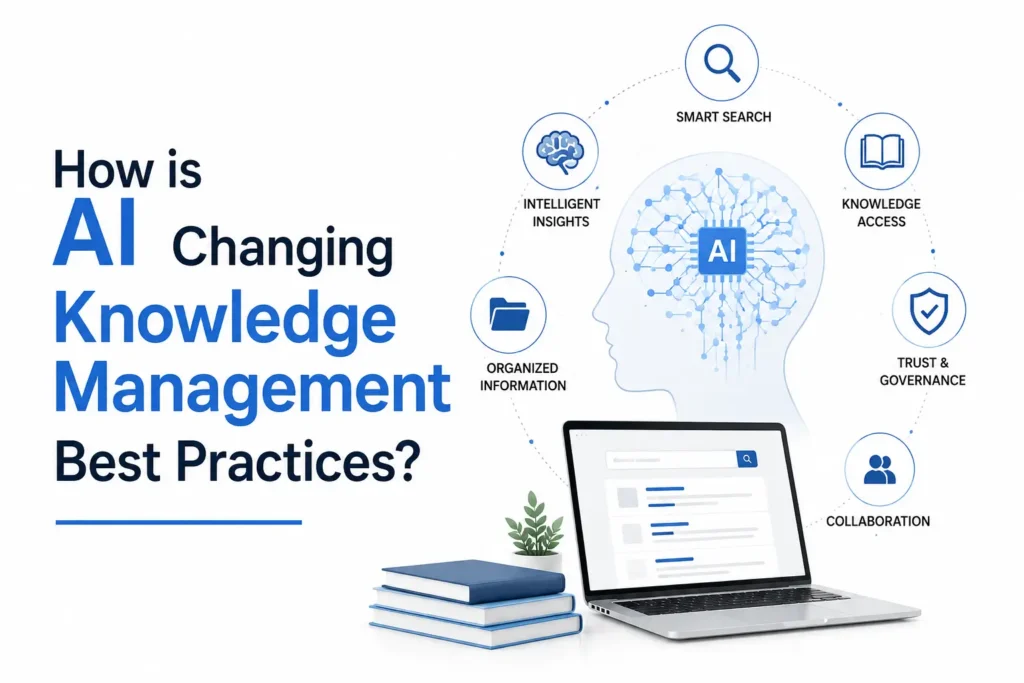
There is sometimes an assumption that AI will replace traditional knowledge management, but in reality, the opposite is true. As organisations introduce AI-powered tools, the need for structured, governed, and well-maintained knowledge becomes increasingly important. AI depends on the existence of reliable knowledge. Without it, the quality of responses suffers.
Good knowledge management means understanding which content should exist, who owns it, how it is reviewed, and when it should be retired. These practices may not attract the same attention as generative AI, but they provide the foundations that allow AI to deliver meaningful value.
Knowledge management should give organisations confidence that the answers they’re being provided are reflective of their current policies, procedures, and expertise. Without that confidence, the risks begin to outweigh the benefits.
Are new questions around trust beginning to emerge?
As AI becomes more embedded within organisations, questions about trust are becoming increasingly important. Employees and leaders want to know where information was sourced, whether it’s up-to-date, who it was approved by, and when it was last reviewed. These are the fundamental questions behind a reliable knowledge management system.
In highly regulated industries, customer-facing environments and operational settings, being able to explain and justify information is often just as important as being able to access it quickly.
Trust cannot be generated by AI alone, but it can be built through clear ownership, governance and confidence in the underlying knowledge.
What role will knowledge management play in the future?
Knowledge management is becoming more important as AI adoption accelerates. Organisations need access to knowledge that is validated, properly maintained, and shared, helping to ensure that AI systems are working with trusted content rather than outdated information or disconnected repositories.
Knowledge management as we know it may be evolving, but the principles remain remarkably consistent. Knowledge needs owners. Content requires review. Expertise needs to be captured before it disappears. Lessons need to be shared.
AI may have changed how knowledge is being handled, but proper management still determines whether that knowledge can be trusted.
What should organisations focus on next?
Many businesses are understandably interested in the possibilities that AI has to offer. However, the organisations that are likely to benefit most may not be those with the most sophisticated AI tools, but those who have invested in the quality, structure, and governance of their knowledge.
AI has the potential to transform access to information, but it works best when it sits on top of a strong knowledge foundation.
In many ways, AI is not replacing knowledge management, but reminding organisations why knowledge management has always mattered.