
Rapid technological transformation, the expansion of knowledge-based economies, intensified competition in global markets, and the increasing complexity of business environments have made knowledge and innovation the most critical factors for organizational success and sustainability. In such conditions, physical assets alone are no longer sufficient to create competitive advantage, and organizations must increasingly focus on intangible assets, particularly knowledge and learning capabilities. Organizations that can systematically identify, store, share, and apply existing knowledge while simultaneously strengthening their ability to create new knowledge are better equipped to respond to environmental changes and maintain long-term competitiveness.
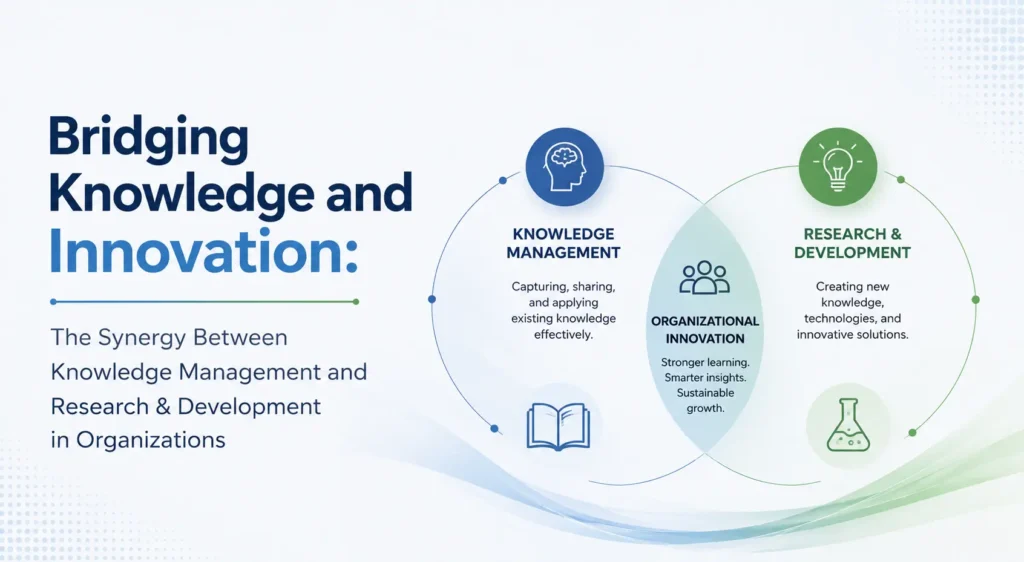
In this context, Knowledge Management (KM) and Research & Development (R&D) systems serve as two complementary and strategic mechanisms that play a central role in building innovative and learning-oriented organizations. Knowledge management focuses on the effective utilization of existing organizational knowledge and enables organizations to maximize the value of employee experience and intellectual capital. In contrast, research and development is primarily responsible for generating new knowledge, developing technologies, and creating innovative solutions to organizational challenges.
When these two systems operate independently and without structured interaction, organizations often face issues such as duplication in research activities, waste of financial and human resources, loss of tacit knowledge, and reduced innovation effectiveness. Therefore, establishing a systematic and sustainable connection between knowledge management and research and development is not merely a managerial choice but a strategic necessity for modern organizations.
The Concept and Objectives of Knowledge Management
Knowledge management is an integrated set of processes, methods, tools, and managerial strategies designed to identify, create, organize, store, share, and apply knowledge across the organization. The purpose of KM is to transform dispersed knowledge embedded in employees’ minds, documents, databases, and organizational processes into an integrated and accessible organizational asset.
Organizational knowledge generally exists in two primary forms. Explicit knowledge refers to knowledge that can be documented, stored, and formally transferred through reports, procedures, databases, and technical documents. Tacit knowledge, on the other hand, is rooted in employees’ experiences, insights, judgment, and skills. This type of knowledge is more difficult to transfer and typically requires human interaction and social learning.
One of the most important objectives of knowledge management is preventing knowledge loss and organizational forgetting. In many organizations, valuable knowledge disappears when employees leave or are transferred. By documenting experiences and building organizational memory, KM helps prevent such losses. Another key objective is facilitating organizational learning and improving decision-making. When knowledge is systematically accessible, managers and employees can make decisions based on evidence and prior experiences, reducing the likelihood of repeated mistakes.
Improving productivity and reducing duplication are also core objectives of KM systems. Access to existing knowledge allows employees to build upon previous experiences instead of starting from scratch, leading to more efficient use of organizational resources. Furthermore, KM plays a significant role in supporting innovation and solving complex organizational problems. Innovation often emerges from combining different forms of knowledge and facilitating collaboration among individuals—conditions that knowledge management actively supports. By transforming individual knowledge into organizational assets, KM reduces dependency on specific individuals and ensures knowledge continuity. Without such a system, even the most advanced R&D activities may fail to produce sustainable and organization-wide outcomes.
The Concept and Role of Research & Development (R&D)
Research and development is one of the fundamental pillars of scientific, technological, and economic progress in organizations. It plays a central role in fostering innovation and strengthening competitive capabilities. R&D consists of planned and goal-oriented activities aimed at generating new knowledge, improving products and services, developing technologies, and responding to current and future organizational needs.
R&D activities are generally categorized into three main levels. Basic research focuses on generating scientific knowledge without necessarily having immediate practical applications, yet it lays the foundation for future technological advancements. Applied research seeks to solve specific organizational problems and connect scientific knowledge with real business needs. Development activities focus on transforming research outputs into applicable products, processes, or services.
Despite the importance of R&D, many organizations fail to fully utilize its outcomes. In many cases, knowledge generated through research projects remains confined to technical reports and is not effectively integrated into organizational processes. This issue is often rooted in weaknesses in knowledge capture, transfer, and sharing—areas directly linked to the absence or inefficiency of knowledge management systems.
The Necessity of Integrating Knowledge Management and R&D
The necessity of integrating KM and R&D arises from their complementary roles in creating, preserving, and utilizing organizational knowledge. Without this integration, organizations are more likely to experience wasted resources, reduced innovation capability, and the loss of valuable tacit knowledge.
Preventing Knowledge Loss and Redundant Researc: One of the primary reasons for connecting KM and R&D is to avoid duplication of research efforts and costly redundancies. In organizations lacking effective knowledge management systems, researchers may unknowingly repeat previous studies or follow identical research paths. This not only wastes time and resources but can also reduce employee motivation. Knowledge management systems help prevent this issue by documenting research projects, storing lessons learned, and creating accessible knowledge repositories.
Transforming Individual Knowledge into Organizational Knowledge: A significant portion of the knowledge generated through R&D activities is tacit in nature and remains in the minds of researchers and experts. If these individuals leave the organization, a substantial amount of intellectual capital may be lost. A structured relationship between KM and R&D enables organizations to extract, document, and transfer tacit knowledge, turning it into a sustainable organizational asset.
Enhancing Innovation Effectiveness: Innovation becomes more effective when it builds upon accumulated organizational knowledge. By providing access to previous experiences, successes, and failures, knowledge management helps R&D units pursue more focused and less risky innovation paths. As a result, innovations become not only more creative but also more aligned with organizational goals and strategies.
Accelerating Organizational Learning: The interaction between KM and R&D facilitates the rapid dissemination of research outcomes throughout the organization. This enables organizations to learn continuously from every research project and apply those lessons to future activities. Accelerated organizational learning enhances adaptability and improves responsiveness to environmental and market changes.
The Role of Knowledge Management in Improving R&D Performance
Knowledge management can function as a strategic infrastructure for research and development systems. One of its most important contributions is informational support. By providing researchers with access to knowledge resources, technical reports, scientific articlesexperiences, KM enables research activities to build upon reliable and updated knowledge.
Additionally, KM facilitates collaboration and teamwork by creating platforms for interaction among researchers and multidisciplinary teams. Such interactions encourage idea exchange and foster interdisciplinary innovation.
Knowledge management also preserves the organizational memory of R&D by documenting lessons learned, failures, and project achievements. This ensures that valuable experiences remain accessible to future generations of researchers. Furthermore, KM improves research-related decision-making by helping managers identify research directions that are more effective and aligned with organizational strategies.
The Role of R&D in Enriching Knowledge Management Systems
Research and development plays a critical role in enriching and sustaining organizational knowledge management systems. Without continuous knowledge creation, KM efforts become limited to reproducing existing knowledge, reducing the organization’s capacity for innovation and competitiveness.
R&D activities contribute not only to the development of new technologies and products but also to the creation of new processes, methods, and standards that can be documented and integrated into organizational knowledge repositories. These outputs become especially valuable when organizations seek to preserve and develop scientific and technological experiences over time.
The outputs of R&D include technical knowledge, innovative technologies, problem-solving models, and organizational innovations that form the foundation of organizational knowledge bases. Technical knowledge developed through R&D projects can later be utilized across different organizational units. Likewise, new technologies enhance organizational competitiveness and open new pathways for solving complex problems.
Moreover, R&D activities generate tacit knowledge through practical experience and interdisciplinary collaboration. This tacit knowledge is among the organization’s most valuable intellectual resources. When properly documented and transferred, it becomes an integral part of the organization’s knowledge management system and supports future decision-making and innovation efforts.
Without an active and dynamic R&D system, knowledge management gradually becomes limited to documenting old experiences and reproducing existing knowledge. Organizations lacking effective R&D capabilities often face stagnation in innovation, declining employee motivation, and an inability to respond to rapid environmental changes. Therefore, the effectiveness and sustainability of KM systems are directly linked to the vitality and performance of R&D activities.
In essence, research and development serves not only as a source of new knowledge but also as a driving force for organizational transformation and learning. Its complementary relationship with KM enables organizations to simultaneously leverage existing knowledge and create new capabilities, leading to sustainable competitive advantage.
Challenges in Linking Knowledge Management and R&D
One major challenge is employee resistance to knowledge sharing, often driven by concerns about losing power or organizational status. In addition, the absence of a collaborative and learning-oriented organizational culture can hinder effective interaction between KM and R&D systems.
Weak information technology infrastructure is another critical barrier, as inadequate tools can limit effective knowledge storage and transfer. Furthermore, a lack of alignment between R&D objectives and KM strategies, as well as excessive focus on short-term research outcomes, can weaken the integration of these two systems.
Strategies for Strengthening the Relationship Between KM and R&D
To create effective synergy between knowledge management and research and development, organizations should develop integrated strategies for knowledge and innovation so that the objectives of both systems align within a common direction.
Establishing specialized knowledge repositories for R&D pr, and previousojects enables systematic storage and retrieval of research knowledge. Encouraging researchers to document and share knowledge through incentive systems can also significantly improve knowledge transfer.
In addition, leveraging modern KM technologies and linking performance evaluation systems to knowledge-sharing and research activities are among the key strategies for strengthening the relationship between KM and R&D.
Conclusion
In today’s competitive and knowledge-driven environment, organizations must effectively create, manage, and utilize knowledge to achieve sustainable growth and long-term success. Research and development serves as the primary source of new knowledge generation, while knowledge management provides the mechanisms for transferring, preserving, and utilizing that knowledge throughout the organization.
Establishing a systematic and strategic connection between these two systems not only prevents knowledge loss and resource waste but also enhances innovation capability, improves organizational performance, and creates sustainable competitive advantage. Therefore, integrating knowledge management and research and development should be recognized as a strategic priority for all knowledge-based organizations.
Explore More from the Author:
- Implementing the Knowledge Café at the NATIONAL IRAN GAS COMPANY (NIGC): An Experiential Approach to Interactive Knowledge Management
- When Culture Leads: The Hidden Force Behind Knowledge Management
- Turning Ugly Ducklings into Knowledge Champions
- Knowledge Champions Cup: Driving Engagement and Learning through Gamified Knowledge Management
- Knowledge Governance: The Missing Layer in Knowledge Management Programs
- Knowledge Management: An Infinite Game
Author

I am a Knowledge Management consultant and instructor, currently serving as a Board Member and Senior Project Manager at DANA KM Consulting Group, a leading KM consulting firm in Iran.
Drawing on over 15 years of hands-on experience, I help organizations transform KM strategies into practical systems that drive collaboration, innovation, and continuous learning. Over the years, I have contributed as a consultant to more than 100 KM projects, implementing effective techniques and solutions that have enhanced organizational knowledge performance.
Internationally, I have completed professional development programs in management consulting and hold a Productivity Specialist certification from the Asian Productivity Organization (APO).
Since 2019, I have been the Editor-in-Chief of the “DANA Knowledge Management and Innovation Journal,” which has published over 40 issues, promoting thought leadership and best practices in the KM community. In addition, since 2023, I have served as the Executive Secretary of the Knowledge Management Excellence Award in Iran, a national initiative that assesses and recognizes outstanding KM practices across organizations.