Enterprise knowledge management has a persistent problem: organizations often possess the information employees need, but finding the right information at the right time remains difficult. Policies, procedures, project reports, technical documentation, customer records, and lessons learned may be spread across multiple systems. Even when the information exists, employees may struggle to locate it because they do not know the exact words used in the original document or the system where it is stored.
Semantic search for enterprise knowledge management offers a different approach. Rather than relying exclusively on matching the words in a search query with words in a document, semantic search aims to identify information based on meaning, context, and conceptual relationships. This allows employees to ask questions using their own language and discover relevant knowledge even when the source material uses different terminology.
The implications extend beyond search technology. When organizations make knowledge easier to discover and apply, they create opportunities to improve collaboration, reduce duplicated work, preserve organizational knowledge, and support enterprise AI. Semantic search does not solve every knowledge management problem, but it changes how people interact with the knowledge their organizations already possess.
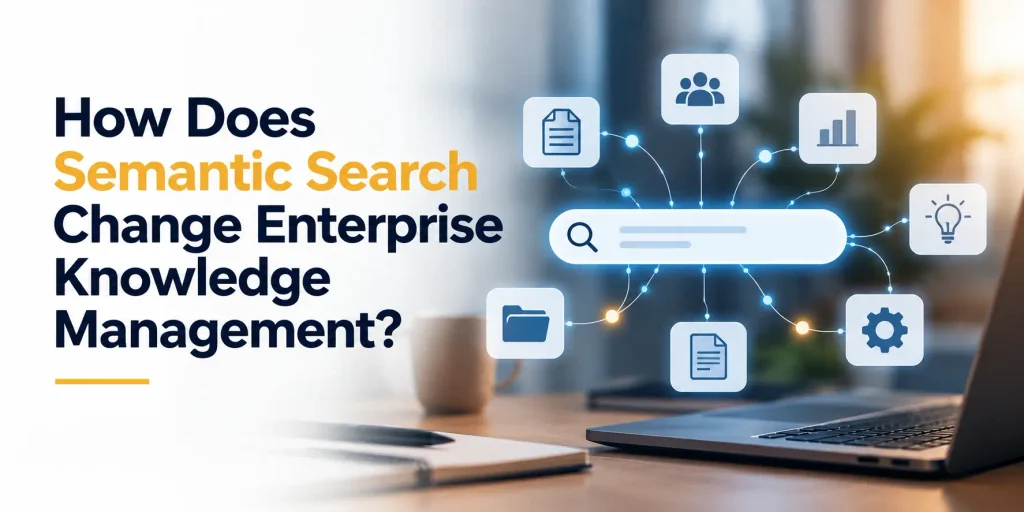
What Is Semantic Search in Enterprise Knowledge Management?
Semantic search is an information retrieval approach that uses language understanding and, in many implementations, machine learning to identify results that are conceptually relevant to a user’s query. Traditional keyword search focuses primarily on matching terms, whereas semantic search attempts to interpret what the user means.
For example, an employee might search for “how to prevent customer churn” even though the organization’s documents discuss “customer retention strategies.” A keyword-based system may struggle if the two expressions do not overlap sufficiently. A semantic search system may recognize the conceptual relationship and retrieve the relevant material.
This distinction becomes especially important in large organizations where different departments use different terminology to describe similar processes, problems, and outcomes. The finance team may use language that differs from the terminology used by sales, operations, or engineering, even when they are discussing related business activities.
According to Google Cloud’s explanation of semantic search, semantic search focuses on the contextual meaning and intent behind a query rather than relying solely on literal keyword matches. In enterprise knowledge management, this capability can help bridge the gap between how employees ask questions and how organizational information is written.
Why Does Traditional Enterprise Search Struggle?
Traditional enterprise search remains useful for finding documents containing specific words, identifiers, names, or phrases. It can work particularly well when users know the document title, the exact terminology, or a distinctive phrase contained in the source.
However, knowledge discovery becomes more complicated when employees know what they want to accomplish but do not know how the relevant information has been described.
Consider an employee trying to find guidance on transferring expertise before a senior specialist retires. The organization may have relevant material under terms such as succession planning, knowledge retention, expert interviews, critical knowledge, or workforce transition. Searching only for “transfer expertise” may not reveal every useful resource.
This is not simply a search interface problem. It reflects a broader knowledge management challenge in which organizational knowledge is described inconsistently, distributed across repositories, and often disconnected from the language employees use in their daily work.
Semantic search can reduce this terminology gap by identifying conceptual relevance. However, it does not automatically resolve missing documents, contradictory policies, outdated content, or knowledge that has never been captured. Those problems still require sound knowledge management practices.
How Does Semantic Search Work?
Many modern semantic search systems use machine learning models to convert text into numerical representations called embeddings. These representations capture aspects of the meaning of words, sentences, or documents, allowing the system to compare the conceptual similarity between a user’s query and indexed content.
During indexing, the system processes the available content and creates representations that can be searched later. When an employee submits a query, the system represents the query in a comparable way and retrieves content whose representations are sufficiently similar. Depending on the implementation, additional ranking methods may then assess which results are most relevant.
For example, an employee might ask, “Why are new team members repeating mistakes made on previous projects?” The underlying knowledge may include project retrospectives, lessons-learned reports, onboarding materials, and incident records. Semantic retrieval can help identify documents related to the underlying problem even when those documents do not contain the exact wording of the question.
As described in Microsoft’s documentation on vector search, vector search supports similarity-based retrieval across conceptually related content, including cases where the wording differs. Vector search is one common way to implement semantic retrieval, although semantic search can also involve other language understanding and ranking techniques.
The important distinction is that the system is attempting to find relevant information rather than simply locating repeated words.
How Does Semantic Search Change Knowledge Discovery?
The most significant contribution of semantic search to knowledge management is its potential to move employees beyond locating documents toward discovering relevant knowledge.
Traditional search often produces a list of documents that employees must open, compare, interpret, and evaluate themselves. Semantic search can improve the relevance of that initial list, helping users find information that addresses their actual question rather than merely containing matching terminology.
Consider an operations manager investigating repeated delivery delays. Relevant knowledge might be distributed across incident reports, supplier reviews, process documentation, customer complaints, and previous improvement projects. The manager may not know which departments created these records or which terms were used to describe the problem.
Semantic search can help connect these sources by identifying related concepts and retrieving potentially useful evidence from different repositories. Employees can then investigate patterns, compare previous responses, and apply lessons from earlier experiences.
This does not mean that search technology independently understands the organization’s entire operational context. Retrieval quality depends on the available content, the indexing approach, the query, and the ranking mechanisms. Nevertheless, it can make previously difficult-to-find knowledge more accessible.
What Is the Difference Between Semantic Search and Keyword Search?
Keyword search and semantic search address related but different retrieval needs. Keyword search is particularly effective when a user knows the precise terms, names, codes, or phrases required to locate information. Semantic search is useful when the wording of the query differs from the wording of the source.
For example, searching for a specific policy number is a strong use case for exact matching. Searching for “how can our team retain critical expertise when experienced employees leave?” may benefit from semantic retrieval because the relevant documents could use terminology such as knowledge continuity, expert knowledge capture, or retirement-related knowledge loss.
Neither approach is universally superior. Semantic systems may miss exact identifiers or retrieve conceptually similar documents that do not answer the question. Keyword systems may miss relevant content when terminology differs. Enterprise environments often benefit from combining both approaches.
Microsoft’s Azure AI Search documentation describes hybrid search as combining vector and keyword search in the same request. Such architectures can preserve the precision of lexical matching while improving the discovery of conceptually related content.
For knowledge management, this combination is often more practical than replacing existing search mechanisms entirely.
How Does Semantic Search Support AI-Powered Enterprise Search?
Semantic search can provide an important retrieval capability for AI-powered enterprise search. Employees increasingly expect to ask questions in natural language instead of navigating through multiple repositories or learning the internal terminology of each department.
When semantic retrieval is integrated into enterprise search, the system can identify relevant information across indexed sources and rank results according to their relationship to the query. Depending on the architecture, the results may include documents, relevant passages, summaries, or source references.
This becomes particularly useful when employees need to understand a topic that spans multiple business functions. A question about improving customer onboarding, for example, may involve sales documentation, implementation procedures, support records, and customer feedback.
Semantic retrieval can help bring those sources into the same discovery process. Employees can then evaluate the information and determine which findings are applicable to their situation.
The value is not simply that the search interface becomes conversational. It is that the organization can make knowledge from different systems easier to discover without requiring every employee to know where each piece of information resides.
However, enterprise search still needs appropriate access controls, source attribution, content freshness, and reliable indexing. A system that retrieves information effectively but exposes restricted content or promotes outdated policies creates new risks rather than solving existing problems.
What Role Does Semantic Search Play in RAG?
Retrieval-augmented generation, commonly known as RAG, combines information retrieval with generative AI. A RAG system retrieves relevant external information and supplies it to a language model as context before the model generates an answer.
Semantic search can serve as part of the retrieval layer in a RAG architecture. When an employee asks a question, the system can use semantic similarity to identify relevant passages from organizational knowledge. Those passages can then be supplied to the language model to help ground its response in the retrieved material.
For example, an employee might ask which security procedure applies to a particular business scenario. Semantic retrieval can help locate relevant sections of the organization’s security documentation even when the question uses different wording. The language model can then formulate an answer using the retrieved context.
This relationship is important, but semantic search and RAG are not the same thing. Semantic search retrieves information based on meaning. RAG uses retrieved information as context for generation. A system can use semantic search without generating answers, and a RAG system can use keyword search, hybrid retrieval, or other retrieval methods.
The quality of the final answer depends on more than the retrieval technology. If the system retrieves incomplete, outdated, or irrelevant content, the language model may still produce a misleading response. Semantic search can improve the retrieval process, but it cannot independently guarantee factual accuracy.
Why Does Semantic Search Matter for Organizational Knowledge Retention?
Organizations frequently lose valuable knowledge when experienced employees leave, teams reorganize, or projects conclude without capturing lessons that could benefit future work. Even when the knowledge has been documented, it may remain difficult to find because the original context is missing or the information is stored in an unfamiliar location.
Semantic search can make documented organizational experience easier to rediscover. A team planning a new implementation could search for the challenges encountered in similar projects, even if previous reports use different terminology. A newly appointed manager could discover earlier decisions and lessons relevant to a current business problem.
This creates opportunities to strengthen organizational memory and reduce the repeated effort involved in solving familiar problems.
However, semantic search cannot retrieve expertise that has never been captured. Tacit knowledge, professional judgment, and experience often require interviews, mentoring, communities of practice, retrospectives, and other knowledge management practices before they can become accessible through a search system.
The most effective approach combines knowledge capture with retrieval. People help create and validate the knowledge, while semantic search can help future employees discover and reuse it.
What Are the Limitations of Semantic Search?
Semantic search can improve relevance, but it does not eliminate the fundamental challenges of enterprise knowledge management.
One limitation is ambiguity. The same term can have different meanings across finance, law, engineering, operations, and other disciplines. A query about “capital,” for example, may refer to financial resources, a city, or a grammatical concept. The system needs sufficient context to distinguish between these meanings.
Another limitation is content quality. If an organization maintains contradictory policies, outdated procedures, or incomplete documentation, semantic search may retrieve relevant-looking material without identifying which source should be trusted.
Semantic search can also struggle with exact identifiers, unusual terminology, highly specialized abbreviations, and queries that require precise filtering. For these use cases, keyword matching, metadata filters, and structured data retrieval may be essential.
There are also practical considerations involving indexing costs, latency, data privacy, permissions, and evaluation. Organizations need to test whether the system retrieves useful evidence for real employee questions rather than assuming that a sophisticated retrieval model will automatically improve outcomes.
These limitations reinforce an important principle: better search is not a substitute for better knowledge management. Search technology must operate within a reliable knowledge environment.
How Can Organizations Implement Semantic Search for Knowledge Management?
Organizations should begin by identifying the knowledge discovery problems they want to solve. Common examples include employees struggling to find internal procedures, support teams repeating previously solved work, project teams overlooking earlier lessons, or specialists spending too much time answering questions that have already been documented.
The next step is to identify the relevant knowledge sources and assess their quality. Documents should have clear ownership, useful metadata, appropriate permissions, and sufficient context to support retrieval. Outdated and duplicate content should be addressed where possible, particularly when multiple versions could provide conflicting answers.
Organizations can then evaluate retrieval technologies against realistic questions. A useful evaluation set should include exact-term queries, questions expressed in unfamiliar language, synonyms, ambiguous terms, cross-departmental topics, and queries requiring specific document versions.
Performance should be assessed using measures such as retrieval relevance, whether the correct source appears among the results, whether critical information is missed, response latency, and user satisfaction. If the system generates answers, organizations should also assess source grounding and answer accuracy.
Finally, semantic search should be treated as an evolving capability rather than a one-time implementation. Employee language changes, organizational content changes, and new knowledge sources become available. Regular evaluation helps ensure that the system continues to support real knowledge needs.
How Should Organizations Measure the Value of Semantic Search?
The value of semantic search should be measured through its effect on knowledge work, not simply the number of searches performed.
Organizations can examine whether employees find relevant information more consistently, whether fewer searches end without useful results, and whether employees spend less time locating authoritative documents. They can also assess whether support teams repeat fewer previously solved investigations and whether project teams reuse existing knowledge more frequently.
For AI-enabled applications, additional measures may include retrieval accuracy, the proportion of answers supported by appropriate sources, the frequency of outdated information being retrieved, and whether permission restrictions are consistently respected.
These measures should be tied to a clear baseline and a specific use case. An improvement in search relevance does not automatically translate into better business outcomes. The real benefit occurs when employees can use the retrieved knowledge to make better decisions, solve problems more effectively, and avoid unnecessary duplication of work.
The Future of Semantic Search in Enterprise Knowledge Management
Semantic search is becoming an important component of the broader enterprise AI ecosystem. Its role extends beyond helping employees find documents because it can also support AI assistants, RAG applications, knowledge discovery workflows, and systems that connect information across organizational boundaries.
As these applications develop, knowledge management professionals will need to pay closer attention to how organizational knowledge is structured, maintained, governed, and made accessible to AI systems. Retrieval technology can make information easier to discover, but organizations still need to determine which knowledge is authoritative, who owns it, and how it should be used.
The opportunity is to create a more connected relationship between organizational knowledge and everyday work. Rather than expecting employees to know exactly where information resides or how it has been described, organizations can use semantic search to help bridge the gap between a business question and the knowledge that may answer it.
That shift makes semantic search more than a technical enhancement. It can become an important capability within a broader knowledge management strategy.
Final Thoughts
Semantic search changes enterprise knowledge management by improving how people discover information that is relevant to their questions, even when their wording differs from the terminology used in organizational documents. It can help connect knowledge across repositories, support knowledge reuse, improve enterprise search, and provide a retrieval foundation for RAG and AI assistants.
However, semantic search cannot independently resolve poor content quality, missing expertise, conflicting information, weak governance, or inappropriate access. Its effectiveness depends on the knowledge environment in which it operates and the way the organization evaluates and maintains the system.
The most important opportunity is therefore not to replace traditional enterprise search with a more sophisticated technology. It is to combine appropriate retrieval methods with strong knowledge management practices so that organizational knowledge becomes easier to discover, trust, and apply.
The organizations that benefit most from semantic search will be those that treat knowledge discovery as both a technology capability and a knowledge management responsibility.
Sources
- Google Cloud. What Is Semantic Search?. An explanation of semantic search, contextual meaning, and the distinction between keyword-based and semantic retrieval.
- Microsoft Learn. Vector Search in Azure AI Search. Technical documentation covering vector retrieval, similarity search, and hybrid approaches that combine keyword and vector search.
- Microsoft Learn. Semantic Ranking in Azure AI Search. Documentation explaining semantic reranking, query relevance, captions, and the limitations of semantic ranking.