Artificial intelligence can produce an answer that reads like an expert explanation, follows a logical structure, and sounds entirely convincing while getting important facts wrong. In an organization, that is more than a technical inconvenience. An incorrect interpretation of an internal policy, an outdated compliance requirement, or an invented product specification can influence decisions, create operational problems, and undermine trust in enterprise AI.
The problem is often discussed as an AI model limitation. Large language models generate responses based on learned patterns and the context available to them, rather than independently verifying every statement against an authoritative source. But focusing exclusively on the model overlooks another important part of the problem: the knowledge environment in which the AI operates.
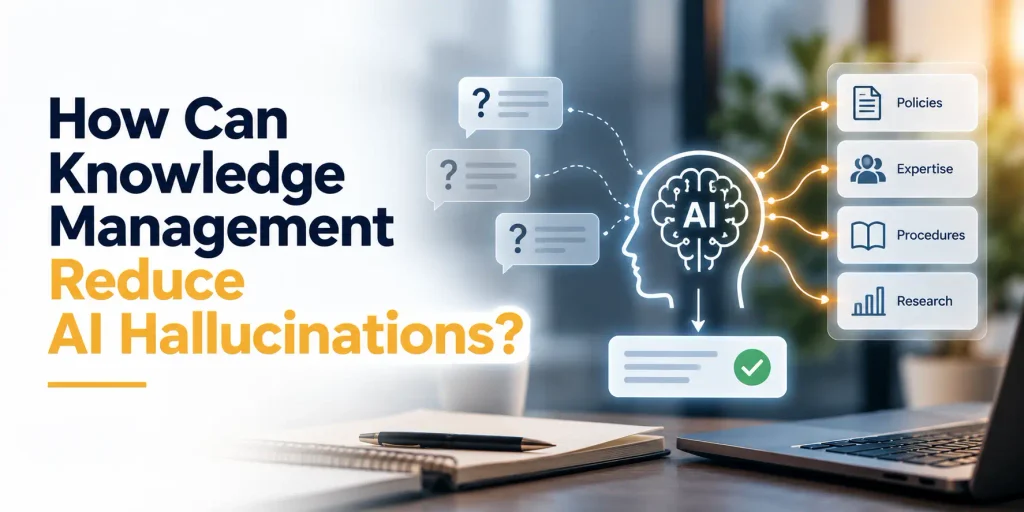
Knowledge management can help reduce AI hallucinations by improving the quality, accessibility, context, and governance of the information AI systems use. Through reliable knowledge sources, effective retrieval, clear ownership, and continuous validation, organizations can make it easier for AI to produce answers grounded in evidence rather than unsupported assumptions.
This does not mean that knowledge management can eliminate hallucinations. Even a well-designed system can retrieve the wrong information, misinterpret a source, or generate an unsupported conclusion. The opportunity is to address the knowledge-related causes of unreliable answers and establish processes that make errors less likely and easier to detect.
Why Does AI Hallucinate When Organizational Knowledge Already Exists?
One of the most frustrating enterprise AI problems occurs when an organization already possesses the correct answer, yet its AI assistant produces something inaccurate.
Imagine an employee asking an AI assistant about the company’s current travel reimbursement policy. The organization has a documented policy, but several versions exist across its intranet, shared drives, and departmental folders. One document contains the latest rules, another reflects an earlier policy, and a third includes informal guidance that was never formally approved.
The AI system may retrieve the wrong version, combine information from multiple documents, or generate an answer that does not accurately reflect any single source. The response may still sound authoritative because the language model is capable of producing fluent explanations.
The underlying problem is not necessarily a lack of information. It is a failure to establish which information is relevant, current, and authoritative.
This distinction matters because enterprise knowledge is rarely as organized as organizations assume. Information accumulates over time. Employees create local copies, departments maintain separate repositories, and important decisions are recorded in different formats. Ownership becomes unclear, and outdated content remains accessible long after it should have been retired.
When AI is introduced into this environment, existing weaknesses can affect the answers it produces. Knowledge management provides the practices needed to address those weaknesses at their source.
What Is the Connection Between Knowledge Management and AI Hallucinations?
Knowledge management and AI reliability are connected through the information available to a model, the way that information is retrieved, and the context in which it is interpreted.
A language model may lack access to current organizational information. It may also receive incomplete evidence, encounter conflicting sources, or be asked to answer a question that the available knowledge cannot support. These situations create different risks, and each requires a different response.
Knowledge management helps establish the conditions under which organizational information can be used reliably. It identifies important knowledge, improves content quality, establishes ownership, organizes information, and defines how knowledge should be reviewed and maintained.
For an AI application, these practices influence what information can be retrieved and how confidently the system should respond.
Consider the difference between two enterprise knowledge environments. In the first, employees have uploaded thousands of documents without consistent metadata, version control, or ownership. In the second, authoritative sources are identified, important information is reviewed regularly, permissions are enforced, and conflicting content is investigated.
The AI model may be identical in both environments, but the second gives the retrieval system a much stronger foundation.
This is why AI reliability should not be treated as the responsibility of model developers alone. It also depends on how organizations manage the knowledge they make available to AI.
How Does Retrieval-Augmented Generation Help Reduce AI Hallucinations?
Retrieval-augmented generation, commonly known as RAG, is one of the most important approaches for connecting generative AI with external knowledge.
Instead of relying only on information learned during training, a RAG system retrieves relevant information from selected sources and supplies it to the language model as context for generating an answer.
Suppose an employee asks which approval is required before sharing confidential information with an external partner. A RAG-enabled assistant can retrieve the relevant information security policy, identify the applicable requirements, and use that content to formulate a response.
This gives the model evidence that is specific to the organization and can be updated independently of the model’s training.
Research published by Meta on grounding language models with RAG demonstrated how retrieval from a domain-specific knowledge base can improve responses to factual questions. More broadly, RAG research has established retrieval grounding as an important way to address knowledge gaps, although it does not eliminate all forms of hallucination.
The distinction is important for knowledge management. RAG is a technical mechanism for accessing knowledge, while knowledge management helps ensure that the knowledge being accessed is worth trusting.
A retrieval system cannot reliably compensate for a repository containing contradictory policies, poorly maintained documentation, or information that has never been validated. RAG can reduce dependence on a model’s unsupported internal knowledge, but its effectiveness still depends on retrieval quality and the reliability of the sources.
Why Does Knowledge Quality Matter More Than the Volume of Information?
Organizations often assume that an AI assistant will become more useful if it has access to more documents. In practice, increasing the volume of available information does not necessarily improve answer quality.
A repository containing duplicate files, obsolete procedures, contradictory instructions, and poorly documented decisions may create more opportunities for retrieval errors. If several sources appear relevant but disagree with one another, the system needs a reliable way to distinguish between them.
This is where knowledge quality becomes critical.
A well-managed knowledge environment should identify authoritative sources, distinguish current content from archived material, and provide enough context for users and AI systems to understand what a document represents. Information should have clear ownership, and content that no longer reflects organizational practice should be reviewed or retired.
For example, an organization may have a current employee expense policy alongside an older handbook and several departmental guides. Rather than simply making all these documents searchable, the organization should establish which source governs the process and update or clearly label the others.
This is not glamorous technical work, but it directly affects the reliability of AI-supported knowledge retrieval.
The objective should not be to feed AI the largest possible collection of information. It should be to make the right knowledge available, in the right context, with a clear indication of its authority.
How Can Knowledge Governance Reduce AI Hallucinations?
Knowledge governance establishes who is responsible for organizational knowledge, how it is approved, how it changes, and how it should be used.
These responsibilities become especially important when AI systems can retrieve information and distribute answers at scale.
An organization needs to know who owns its critical policies, who can approve changes, how frequently important content should be reviewed, and what happens when two authoritative sources disagree. Without these arrangements, even an advanced AI system may struggle to determine which information should guide its responses.
Governance also needs to address access permissions. An AI assistant should not reveal confidential information simply because the information exists in an indexed repository. Retrieval systems must respect the permissions associated with the underlying sources.
Another important consideration is traceability. When an AI system answers a question about a company procedure, users should be able to identify the source supporting the answer whenever the application and use case allow it. This makes it easier to verify claims, investigate errors, and correct the underlying knowledge.
Knowledge governance cannot guarantee that every generated statement will be correct. It can, however, establish the controls needed to make information more reliable and errors more manageable.
How Do Metadata and Taxonomy Improve AI Answer Accuracy?
Metadata and taxonomy are often treated as administrative tasks within knowledge management. For AI systems, they can provide important context that influences retrieval.
Metadata describes information through attributes such as its subject, owner, publication date, version, department, status, and intended audience. Taxonomy provides a structured way to classify knowledge and connect related concepts.
Consider a company with several documents about customer data protection. Some describe technical security controls, others explain contractual obligations, and another outlines employee responsibilities. A search system that treats all these documents as interchangeable may retrieve information that is related to the query but unsuitable for the specific question.
Useful metadata can help distinguish the documents by subject, authority, audience, and applicability. A well-designed taxonomy can also connect related concepts that different teams describe using different terminology.
These structures do not automatically make an AI model understand every relationship correctly. They improve the information available to the retrieval and ranking components, making it easier to identify appropriate sources.
For knowledge management teams, this creates a practical priority. Metadata and taxonomy should be designed around real knowledge needs, not merely around the structure of a repository. The aim is to help people and AI systems distinguish between information that looks similar but serves different purposes.
Can Knowledge Graphs Help Reduce AI Hallucinations?
Some knowledge cannot be represented adequately by treating every document as an isolated source. Enterprise questions frequently depend on relationships between people, products, processes, systems, decisions, and events.
Knowledge graphs represent entities and the relationships between them in a structured form. This can help AI applications retrieve connected facts and understand relationships that may be difficult to establish from isolated text passages.
For example, an organization investigating a product failure may need to connect the affected product version with a previous engineering decision, a known defect, a corrective action, and a related support procedure. A knowledge graph can represent these relationships explicitly, potentially helping the retrieval process identify a more complete body of evidence.
Research presented at the 2024 Conference of the North American Chapter of the Association for Computational Linguistics examined how knowledge graphs can help reduce hallucinations in large language models. The survey describes approaches that use structured knowledge to support factual grounding and improve reasoning.
However, knowledge graphs are only as dependable as the information and relationships they contain. Incorrect facts, missing relationships, or outdated entries can introduce their own problems. They should therefore be maintained through appropriate knowledge governance and validation.
For enterprise knowledge management, knowledge graphs are most useful when relationships between pieces of knowledge matter as much as the documents themselves.
Why Should AI Be Allowed to Say It Does Not Know?
One of the most important controls against hallucination is giving an AI system a reliable way to recognize when the available evidence is insufficient.
Many organizational questions have straightforward answers. Others depend on missing context, an exception to a policy, a recent decision, or information that has not yet been documented. A system that always attempts to provide a definitive response may fill these gaps with unsupported assumptions.
Knowledge management can help by defining which sources are authoritative and identifying the boundaries of the available knowledge. AI applications can then be designed to distinguish between a question supported by retrieved evidence and one that requires clarification, further research, or human review.
Imagine an employee asking whether a particular contractual exception has been approved. If the knowledge repository contains the standard policy but no record of the exception, the system should not infer that approval exists. It should explain that the available sources do not establish the answer and direct the employee to the appropriate authority.
This behaviour is particularly important for compliance, finance, human resources, legal operations, and other areas where an unsupported answer can create material consequences.
A useful enterprise AI assistant is not one that always has an answer. It is one that can communicate what the available evidence supports and recognize when that evidence is inadequate.
How Should Organizations Measure Whether Hallucinations Are Decreasing?
Organizations need to evaluate AI reliability using realistic questions and verifiable evidence rather than relying on the fluency of generated responses.
A useful evaluation process begins with a set of representative questions drawn from actual business needs. These should include questions with clear answers, questions involving conflicting documents, questions requiring the latest version of a policy, and questions for which the available knowledge does not contain a sufficient answer.
Each response can then be evaluated against the authoritative sources. Reviewers should determine whether the system retrieved the appropriate evidence, represented it accurately, made unsupported claims, and acknowledged gaps when necessary.
It is also important to distinguish retrieval errors from generation errors. A system may fail because it retrieved the wrong document, because the correct information was missing, or because the language model misrepresented evidence that was retrieved correctly. Each failure points to a different corrective action.
Knowledge management teams can help investigate these patterns and improve the underlying content, metadata, ownership, and governance. AI and engineering teams can then refine retrieval, ranking, prompts, and model behaviour.
This creates a continuous improvement cycle in which real failures inform changes to both the knowledge environment and the AI application.
A Practical Framework for Reducing AI Hallucinations Through Knowledge Management
Organizations do not need to begin by redesigning every repository or implementing the most sophisticated AI architecture. A more effective starting point is to focus on one important business use case and establish a reliable knowledge foundation for it.
First, identify the questions the AI system is expected to answer and the decisions those answers may influence. Then identify the authoritative knowledge sources required to support those questions.
Next, review the sources for accuracy, completeness, duplication, conflicting versions, and clear ownership. Establish appropriate metadata, access permissions, and review processes. Implement retrieval that can locate relevant evidence, and configure the AI application to present sources and acknowledge insufficient evidence where appropriate.
Finally, test the system using real questions, including difficult cases in which information is ambiguous or missing. Record failures, investigate their causes, and update the knowledge environment or technical implementation accordingly.
This approach treats reliability as an ongoing responsibility rather than a feature that can be switched on during deployment.
It also gives knowledge management a clear role in enterprise AI implementation. KM professionals can help determine which knowledge should be available, how it should be governed, how it can be retrieved, and how its quality should be evaluated over time.
Final Thoughts
AI hallucinations are often described as a problem that future models will eventually solve. Improvements in model capability will continue to matter, but organizations should not assume that a more capable model will automatically resolve weaknesses in their own knowledge environments.
An AI system can only use the evidence made available to it, and that evidence may be incomplete, outdated, contradictory, or inappropriate for the question being asked. Reliable enterprise AI therefore requires more than a powerful language model. It requires dependable knowledge sources, effective retrieval, clear governance, and mechanisms for checking whether generated answers are supported by evidence.
Knowledge management contributes to each of these areas. It helps organizations identify what they know, establish which sources can be trusted, preserve important context, and maintain the information on which AI applications depend.
The goal is not to promise hallucination-free AI. It is to reduce avoidable errors, make unsupported claims easier to identify, and establish a system in which people can verify important answers.
The most reliable enterprise AI will not come from model intelligence alone. It will also depend on the quality of the organizational knowledge behind it.
Sources
- Karakurt and Akbulut, Applied Sciences, 2026. Retrieval-Augmented Generation (RAG) and Large Language Models (LLMs) for Enterprise Knowledge Management and Document Automation: A Systematic Literature Review. This review examines RAG applications in enterprise knowledge management and discusses hallucination mitigation, data privacy, retrieval, and deployment challenges. Read the research.
- Fang et al., Meta AI Research, 2024. Ingest-And-Ground: Dispelling Hallucinations from Continually-Pretrained LLMs with RAG. This research explores grounding language models in domain-specific knowledge to improve factual responses. Read the research.
- Agrawal et al., NAACL 2024. Can Knowledge Graphs Reduce Hallucinations in LLMs? A Survey. This research reviews methods for using structured knowledge graphs to improve factual grounding and reduce hallucinations. Read the research.