A few days ago, while scrolling through LinkedIn, I came across a post by Dr. Mohammad Reza Salehi, a renowned infectious disease specialist, announcing the Third Monthly Grand Round at Imam Hospital. The session focused on a 59-year-old patient presenting with hemoptysis. While the clinical topic itself was outside my field, one phrase immediately caught my attention: Grand Rounds.
At first, I wondered why the organizers had chosen this term instead of “scientific meeting,” “clinical conference,” or “case presentation.” Was it simply another name for a medical seminar, or did it represent something fundamentally different?
Curiosity led me to explore the history and philosophy behind Grand Rounds. The more I learned, the clearer it became that Grand Rounds are far more than educational meetings. They represent one of the oldest and most successful examples of knowledge management in practice—long before concepts such as tacit knowledge, knowledge sharing, lessons learned, or communities of practice became familiar to organizational scholars.
This realization inspired an important question: Is Grand Rounds exclusively a medical practice, or can its underlying principles be applied across industries?
Hospitals are not the only organizations that face complex problems requiring expert judgment. Industrial companies, engineering firms, refineries, power plants, mining organizations, and large infrastructure projects also encounter challenging situations where valuable experience is generated every day. Yet much of that experience disappears once the immediate problem has been solved.
Perhaps the medical community has been practicing an effective form of organizational learning for more than a century without calling it “knowledge management.” If so, there may be valuable lessons for every knowledge-intensive organization.
What Are Grand Rounds?
In medical education, Rounds refer to the routine visits that physicians make to hospitalized patients together with residents, interns, and medical students. These visits are not only intended to assess the patient’s condition but also to teach clinical reasoning, discuss treatment options, and develop professional judgment through real cases.
Grand Rounds take this concept a step further.
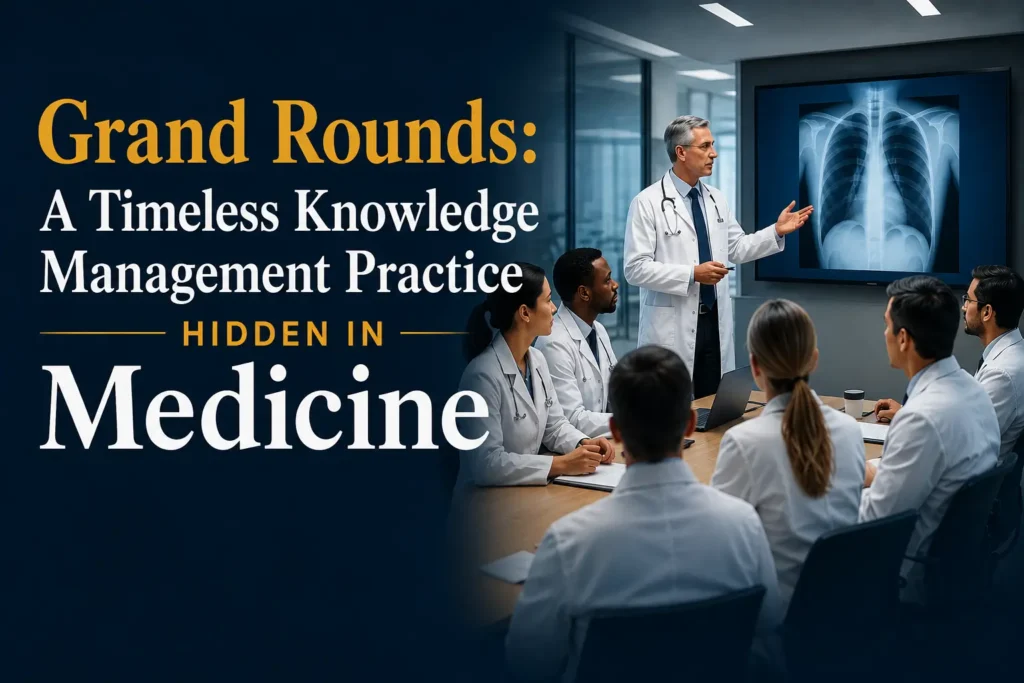
Instead of focusing on routine patient care, Grand Rounds bring together physicians, specialists, faculty members, residents, and students to examine a particularly significant clinical case. The selected case is usually unusual, complex, or educationally valuable. Participants review the patient’s history, diagnostic findings, treatment decisions, and outcomes before engaging in a structured discussion from multiple professional perspectives.
Unlike traditional lectures, Grand Rounds revolve around a real problem rather than theoretical content. Every discussion is grounded in an authentic case, making learning practical, interactive, and experience-driven.
Historically, Grand Rounds emerged in European teaching hospitals during the nineteenth century. Distinguished physicians brought students to patients’ bedsides because they believed medicine could not be mastered through textbooks alone. Over time, these bedside discussions evolved into formal educational sessions that remain a cornerstone of continuing medical education in hospitals around the world.
One of the most distinctive characteristics of Grand Rounds is their ability to transfer tacit knowledge. Participants learn far more than clinical facts; they observe how experienced specialists think, analyze uncertainty, weigh alternatives, and make difficult decisions. This type of professional judgment is rarely captured in books or clinical guidelines, yet it is essential for developing expertise.
Today, Grand Rounds are widely used not only in medicine but also in nursing, pharmacy, radiology, rehabilitation, and healthcare management. Across all these disciplines, the underlying philosophy remains the same: transforming individual experience into collective professional knowledge through structured discussion of real-world cases.
Beyond Medical Education: Grand Rounds as a Knowledge Management Practice
At first glance, Grand Rounds appear to be another educational activity in which physicians gather to discuss diagnosis and treatment. However, when viewed through the lens of knowledge management, they reveal something much more significant. Rather than functioning as a conventional teaching session, Grand Rounds represent a sophisticated mechanism for organizational learning one that enables knowledge to be created, shared, challenged, and refined through collective experience rather than simply transmitted from expert to learner. This perspective is directly supported by the source article’s analysis of Grand Rounds as a knowledge management approach.
The fundamental distinction between Grand Rounds and traditional training lies in their purpose. Most educational programs are designed to transfer established knowledge. An instructor presents prepared material, while participants absorb information. Grand Rounds, by contrast, are centered on a real problem that rarely has a single correct answer. A complex case is presented, alternative interpretations are explored, assumptions are questioned, and participants collectively build a deeper understanding of the situation. Learning emerges through dialogue rather than instruction.
This collaborative process allows every participant to learn, regardless of experience level. Junior professionals gain insight into expert reasoning, while senior specialists benefit from perspectives offered by colleagues from different disciplines. Instead of reinforcing existing knowledge, the discussion often generates new understanding that would not have emerged through individual analysis alone.
Perhaps the greatest strength of Grand Rounds is their ability to make tacit knowledge visible. Organizations often invest heavily in documenting procedures, standards, and best practices, yet much of what distinguishes experts cannot easily be written down. Professional judgment, intuition developed over years of experience, subtle observations, and the reasoning behind difficult decisions frequently remain locked within individuals.
During Grand Rounds, this hidden expertise becomes accessible. An experienced physician may explain why one treatment option was preferred over another despite identical clinical guidelines. A radiologist may point out a subtle imaging pattern recognized only through years of practice. Participants do not merely learn what decision was made—they learn how experts think while making that decision. This transformation of personal experience into shared organizational knowledge represents one of the most valuable outcomes of the process.
Another defining characteristic of Grand Rounds is interdisciplinary collaboration. Complex challenges rarely fit neatly within the boundaries of a single specialty. A difficult clinical case may require input from surgeons, pulmonologists, radiologists, pathologists, and other specialists, each contributing a unique perspective. As these viewpoints converge, participants develop a more comprehensive understanding of the problem and often identify solutions that would have remained invisible within a single discipline.
Equally important is the learning culture that Grand Rounds create. Their purpose is not to identify blame or defend previous decisions but to examine the reasoning behind actions and extract lessons for future practice. This creates a psychologically safe environment where professionals can openly discuss uncertainty, acknowledge mistakes, and critically evaluate difficult decisions. Such an atmosphere is essential for organizational learning because knowledge sharing depends on trust as much as expertise.
From a knowledge management perspective, Grand Rounds therefore represent far more than an educational meeting. They form a continuous cycle in which real experiences are analyzed collectively, tacit knowledge is surfaced through discussion, multiple perspectives are integrated into richer understanding, and valuable insights become organizational assets rather than remaining individual memories. In other words, Grand Rounds transform isolated experiences into shared knowledge that improves future decision-making across the entire professional community.
Grand Rounds: Where Multiple Knowledge Management Practices Converge
Although Grand Rounds are traditionally viewed as a medical educational activity, they can also be understood as a comprehensive knowledge management practice. Unlike many KM initiatives that focus on a single technique, Grand Rounds naturally integrate several well-established knowledge management approaches into one structured process. This integration is one of the key reasons why the model has remained effective for more than a century. The following analysis reflects the source article’s breakdown of Grand Rounds through a knowledge management perspective.
Storytelling Through Real Cases
Every Grand Round begins with a story. A physician presents the complete journey of a patient from the first symptoms and diagnostic uncertainties to treatment decisions and clinical outcomes. Rather than presenting isolated facts, the presenter reconstructs the sequence of events, including critical decisions, unexpected developments, and occasionally even mistakes.
From a knowledge management perspective, this is much more than case reporting. It is storytelling, one of the most effective methods for transferring tacit knowledge. Stories preserve context, explain why decisions were made, and capture the complexity of real-life situations far better than procedures or technical documentation. Participants remember experiences because they understand the narrative behind them.
Making Tacit Knowledge Explicit
One of the greatest challenges in knowledge management is capturing what experts know but rarely articulate.
Grand Rounds provide a natural environment for this process. As experienced clinicians explain why they selected one diagnosis over another or why they deviated from standard protocols in a particular situation, they reveal the reasoning developed through years of professional experience.
Questions from colleagues further encourage experts to explain assumptions that would otherwise remain unspoken. In knowledge management terminology, this represents the externalization of tacit knowledge—transforming personal judgment into explicit knowledge that others can learn from and apply.
Peer Learning and Collective Intelligence
Grand Rounds also function as a form of structured peer assist. Instead of relying on a single expert, professionals from different specialties contribute their perspectives to the same case. Each participant examines the problem through a different lens, often identifying risks, opportunities, or interpretations that others may have overlooked.
The objective is not to defend individual opinions but to improve collective understanding. Through constructive dialogue, the quality of decisions increases because knowledge is pooled rather than isolated.
A Living Community of Practice
Another important characteristic of Grand Rounds is their continuity.
They are not isolated meetings but recurring gatherings of professionals who share a common domain of expertise and regularly learn from one another. Over time, these repeated interactions create a community of practice, where participants develop common language, shared experiences, trusted relationships, and collective professional identity.
Such communities become powerful mechanisms for continuous organizational learning because knowledge flows naturally through ongoing interaction rather than formal training alone.
Learning From Cases—and Creating Lessons Learned
Grand Rounds are also a classic example of case-based learning. Instead of discussing hypothetical scenarios, participants analyze authentic cases with all their complexity and uncertainty. This approach narrows the gap between theory and practice and helps professionals develop stronger analytical and decision-making skills.
However, the value of Grand Rounds extends beyond the individual session. The insights generated during discussions can be documented, synthesized, and reused when similar situations arise in the future. In this way, individual experiences evolve into Lessons Learned that strengthen the organization’s collective memory and improve future performance.
Viewed as a whole, Grand Rounds combine storytelling, tacit knowledge transfer, peer learning, communities of practice, case-based learning, and lessons learned within a single recurring process. Rather than depending on sophisticated technology or formal knowledge repositories, they rely on structured dialogue around real experiences. Their long-standing success demonstrates an enduring principle of knowledge management: organizations learn most effectively when people come together to reflect on authentic challenges, question assumptions, and transform experience into shared knowledge.
From Hospital Cases to Industrial Challenges: Can Grand Rounds Work Beyond Healthcare?
At first glance, Grand Rounds may appear to belong exclusively to hospitals and medical schools. After all, they revolve around clinical cases, patient care, and multidisciplinary healthcare teams. However, if we look beyond the medical context, the underlying philosophy is remarkably universal: organizations learn best when professionals come together to analyze real experiences rather than hypothetical scenarios. This idea forms the foundation for applying the Grand Rounds concept to industrial and project-based organizations.
Every day, industrial organizations generate valuable experiences. Equipment failures, production interruptions, safety incidents, project delays, contractual disputes, quality issues, engineering innovations, and operational successes all represent complex situations that require expert judgment and collaborative decision-making. Each of these events is, in essence, a case—just as worthy of collective analysis as a challenging medical case.
Unfortunately, many organizations fail to capitalize on these opportunities for learning. Once a problem has been solved or a project has been completed, attention quickly shifts to the next operational priority. Valuable experience may be documented in a technical report or entered into a lessons learned database, but these records often remain archived rather than actively discussed, interpreted, and integrated into organizational knowledge.
This is where the philosophy of Grand Rounds offers a compelling alternative.
Instead of treating reports as the final step in the learning process, organizations can transform significant operational events into structured learning sessions. The objective is not simply to review what happened but to understand why decisions were made, what alternatives were considered, which assumptions proved correct or incorrect, and what insights should guide future actions.
Consider a refinery where an unexpected compressor failure results in several hours of production downtime. A conventional response might involve preparing a technical failure report and implementing corrective actions before closing the incident. A Grand Rounds-inspired approach would go much further.
Representatives from operations, maintenance, instrumentation, process engineering, reliability, safety, planning, and procurement would meet to examine the event from multiple perspectives. Rather than focusing solely on the technical failure, the discussion would explore contributing organizational factors, decision-making processes, communication challenges, preventive measures, and broader operational implications. By integrating these diverse viewpoints, the organization develops a far richer understanding of the incident than any single department could achieve independently.
The same principle applies to project-based organizations.
Large engineering and construction projects frequently encounter design modifications, procurement delays, contractual conflicts, coordination problems, and schedule overruns. Traditionally, project reviews emphasize reporting outcomes and documenting lessons learned at the project’s conclusion. While valuable, these reports rarely capture the reasoning, negotiations, uncertainties, and real-time decisions that shaped the project’s outcome.
A Grand Rounds-style session would invite project managers, engineers, contract specialists, planners, client representatives, and other key stakeholders to revisit a significant project challenge together. Through structured dialogue, participants would examine not only what happened but also how decisions evolved, which trade-offs were made, and what practical insights should inform future projects.
Importantly, Grand Rounds should not be limited to failures or crises. Successful projects often contain equally valuable knowledge. Understanding why one team completed a project ahead of schedule, achieved exceptional safety performance, reduced costs through innovation, or improved operational efficiency can generate best practices that benefit the entire organization.
Adopting Grand Rounds outside healthcare does not mean copying the medical model. Industrial organizations do not need patient cases; they already possess their own “cases” in the form of projects, operational challenges, technical failures, innovations, customer issues, and strategic decisions. What matters is preserving the core principles: selecting meaningful real-world experiences, encouraging open interdisciplinary discussion, creating a psychologically safe environment, and transforming individual experience into organizational knowledge.
As organizations increasingly compete through knowledge rather than physical assets alone, their ability to learn faster than competitors becomes a critical advantage. Grand Rounds offer a practical framework for achieving this goal not through sophisticated technology, but through disciplined conversation, collaborative reflection, and the systematic conversion of experience into knowledge. More than a century of success in healthcare suggests that this timeless approach has significant potential far beyond the walls of hospitals.
Conclusion: A Century-Old Practice with a Future Beyond Medicine
For more than a century, Grand Rounds have been an integral part of medical education and professional development. Their enduring success lies not in sophisticated technology or formal knowledge systems, but in a simple yet powerful principle: people learn most effectively by collectively reflecting on real experiences. Throughout this process, individual expertise is transformed into shared understanding, professional judgment becomes visible, and each significant case contributes to the collective knowledge of the organization. This conclusion is consistent with the source article’s final reflections on Grand Rounds and their relevance to knowledge management.
From a knowledge management perspective, Grand Rounds demonstrate that effective organizational learning requires much more than documenting procedures or storing lessons learned in databases. Knowledge becomes valuable when it is discussed, challenged, interpreted, and connected with the experiences of others. Real learning occurs through dialogue, reflection, and collaboration not simply through documentation. Many industrial organizations have already invested considerable effort in establishing lessons learned repositories, knowledge bases, and other KM initiatives. While these tools remain important, they often capture only the outcomes of experience rather than the reasoning, judgment, and contextual understanding that produced those outcomes. Grand Rounds offer a complementary approach by focusing on the conversations that bring experience to life and reveal the tacit knowledge behind critical decisions.
Perhaps the greatest lesson that industry can learn from medicine is that every significant event whether a technical failure, a successful project, a safety incident, an innovation, or a complex managerial decision—has the potential to become a powerful learning opportunity. Instead of allowing these experiences to fade into organizational memory, they can be transformed into structured discussions that strengthen collaboration, accelerate learning, and improve future decision-making.
Organizations increasingly compete through their ability to learn faster than others. In this environment, Grand Rounds provide more than an educational format; they offer a practical framework for building a learning organization where experience is continuously converted into organizational knowledge.
Healthcare has demonstrated the effectiveness of this approach for generations. The question is no longer whether Grand Rounds work—it is whether organizations outside medicine are ready to adopt the same philosophy and unlock the learning potential hidden within their own daily experiences.
Author

I am a Knowledge Management consultant and instructor, currently serving as a Board Member and Senior Project Manager at DANA KM Consulting Group, a leading KM consulting firm in Iran.
Drawing on over 15 years of hands-on experience, I help organizations transform KM strategies into practical systems that drive collaboration, innovation, and continuous learning. Over the years, I have contributed as a consultant to more than 100 KM projects, implementing effective techniques and solutions that have enhanced organizational knowledge performance.
Internationally, I have completed professional development programs in management consulting and hold a Productivity Specialist certification from the Asian Productivity Organization (APO).
Since 2019, I have been the Editor-in-Chief of the “DANA Knowledge Management and Innovation Journal,” which has published over 40 issues, promoting thought leadership and best practices in the KM community. In addition, since 2023, I have served as the Executive Secretary of the Knowledge Management Excellence Award in Iran, a national initiative that assesses and recognizes outstanding KM practices across organizations.