In recent years, many organizations have made significant investments in the field of knowledge management, allocating substantial financial, human, and technological resources to this area. However, a review of practical experiences and the actual outcomes of projects reveals that a considerable portion of these efforts has failed to generate sustainable and lasting results. In many cases, after a costly implementation phase, knowledge management systems either stagnated or failed to demonstrate the expected impact on organizational performance.
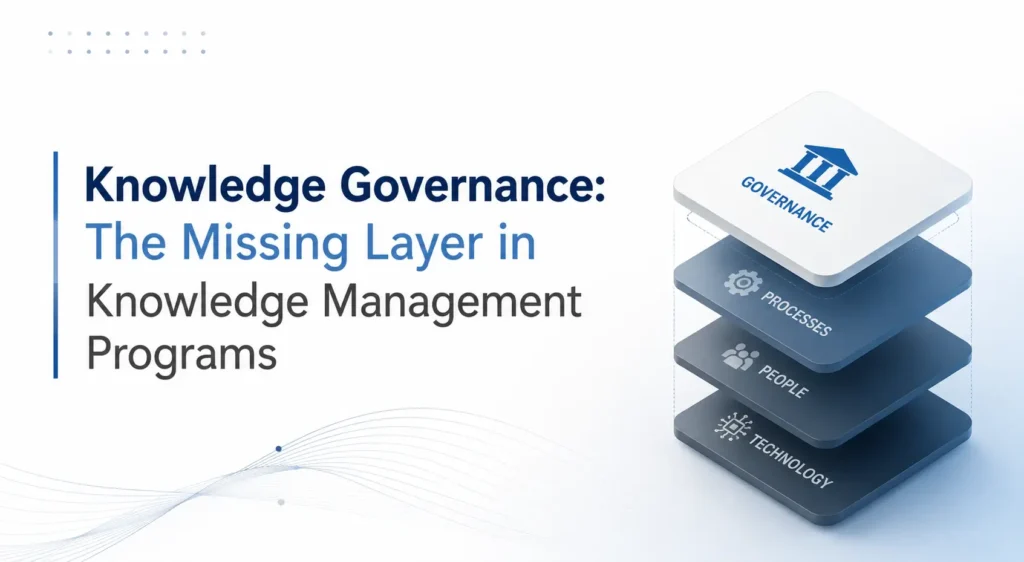
An analysis of this situation shows that the issue is not merely related to tools, technologies, or even organizational culture. Rather, the root cause lies in the absence of “knowledge governance” — a strategic and often overlooked layer responsible for directing, policymaking, monitoring, and aligning knowledge-related activities with the organization’s strategic objectives. Without this layer, knowledge management initiatives often remain fragmented, temporary, and ineffective.
Drawing on the consulting experiences of Dana Knowledge Management Consulting Group in designing and implementing knowledge management systems across various organizations, this article attempts to provide a practical and clear understanding of the concept of knowledge governance.
The Hidden Gap in Knowledge Management Programs
Throughout more than a decade of professional activity in the field of knowledge management, I have repeatedly encountered organizations that have made considerable investments in this domain and have seemingly taken significant and commendable steps. These organizations usually enter the field seriously and implement a range of well-known knowledge management practices — initiatives that on paper indicate a relatively mature level of capability. They have launched knowledge management software, conducted knowledge extraction activities, and implemented various knowledge management techniques.
In many cases, operational indicators also suggest progress: the number of documented lessons learned has increased, interactive sessions have been held, and users have become active within knowledge systems. Yet, when speaking with senior executives, one common concern consistently emerges:
“We still do not see the tangible impact of knowledge management on organizational results.”
This gap between “high activity” and “low perceived value” is one of the most common yet hidden challenges in knowledge management programs. On the surface, everything appears to be functioning, but at the strategic level, knowledge management has not yet become a lever for improving organizational performance, agility, innovation, or competitive advantage. As a result, senior management support gradually declines, and knowledge management risks becoming a ceremonial or purely technology-driven initiative.
Our field observations and consulting experiences at Dana Group indicate that the main issue in many of these organizations is not a lack of tools, weak software platforms, or even unmotivated employees. The root cause lies in a deeper and less visible layer: the absence of knowledge governance.
Without governance, even professionally executed knowledge management activities tend to suffer from several common issues:
– Knowledge priorities are not aligned with the organization’s strategic priorities.
– Knowledge-related responsibilities and authorities are unclear and unstable.
– The business value created through knowledge initiatives is not measured.
– Knowledge-related decisions are made in isolated and uncoordinated ways.
As a result, knowledge management becomes a collection of fragmented, project-based, and sometimes merely symbolic activities. While these activities may be operationally useful and even appreciated by specialized departments, they do not necessarily create strategic value, improve high-level decision-making, or strengthen organizational competitive advantage. In other words, “knowledge” is produced and s
tored, but “governed knowledge” — knowledge capable of becoming a driver of competitive advantage — never truly emerges.
At this point, organizations require a paradigm shift. Traditional knowledge management has mainly focused on operational questions such as:
– How can we collect knowledge?
– How can we increase knowledge sharing?
– How can we keep users active in knowledge systems?
These questions remain important, but for organizations seeking higher levels of knowledge management maturity, they are no longer sufficient. The turning point occurs when the level of inquiry evolves and the focus shifts from “knowledge operations” to “knowledge governance.” The more mature and decisive question becomes:
“How can knowledge be directed, governed, and controlled at the organizational level so that it becomes a sustainable competitive advantage?”
Entering this question means entering the realm of knowledge governance — the missing link ignored in many knowledge management initiatives and one of the main reasons behind the gap between investments made and expected results. Organizations that make this conceptual transition in a timely manner can elevate knowledge management from a supporting activity to a strategic organizational capability.
What Is Knowledge Governance?
Based on practical experiences across diverse projects and organizations, knowledge governance is far more than a set of policies, guidelines, or formal structures. Many organizations assume that having a portal, a lessons learned repository, or expert committees is sufficient. In reality, the core issue is the ability to direct and control the flow of knowledge in alignment with the organization’s strategic objectives.
From this perspective, knowledge governance can be defined as:
“Creating a systematic, transparent, and accountable mechanism for decision-making, prioritization, monitoring, and accountability regarding the organization’s knowledge assets.”
This definition includes several key components repeatedly proven essential through practical experience:
Systematic Structure:Systematic governance means that knowledge-related decisions and activities are structured and documented. In many organizations, knowledge activities are carried out in an ad hoc or subjective manner, with no clear process for setting priorities or defining implementation paths. A systematic approach ensures that all activities are conducted within a clear and standardized framework and that no critical activity is overlooked.
Transparency: Transparency ensures clarity regarding who makes decisions about knowledge-related matters, under what authority, and based on which criteria. Without transparency, responsibilities become ambiguous and decisions fragmented. Transparency also increases trust among employees and managers and reduces organizational conflicts.
Accountability: Accountability is the missing link in many knowledge management programs. It ensures that every knowledge-related decision and action can be evaluated and reported. Without accountability, activities are merely performed without any guarantee that they contribute meaningfully to strategic organizational goals. Accountability creates a feedback loop that supports continuous improvement of knowledge processes.
To simplify the concept for senior executives and create a more practical understanding, the distinction can be summarized as follows:
– Knowledge management means doing knowledge activities.
– Knowledge governance means ensuring that knowledge activities are done correctly.
This distinction may seem simple, but its practical implications are significant.
Many organizations perform knowledge activities effectively: documenting experiences, forming communities of practice, establishing knowledge portals or repositories, and producing training content. However, when these activities are implemented without a governance framework, they may not align with strategic goals, organizational resources may not be allocated optimally, and the real value of generated knowledge may never be measuredor monitored.
Put simply, if knowledge management is the engine that produces and circulates knowledge within the organization, then knowledge governance is the steering wheel, compass, and dashboard of that engine. An engine without steering and navigation may operate powerfully, but it may fail to reach the right destination or consume resources inefficiently. Knowledge governance is what directs the engine, ensures that organizational energy is spent toward real objectives, and creates tangible impact on competitive advantage.
Signs of the Absence of Knowledge Governance
Based on consulting experiences, several recurring symptoms clearly indicate weak or nonexistent knowledge governance:
– Knowledge activities are not linked to specific strategic objectives.
– No clear ownership exists for critical knowledge domains.
– Knowledge-related reporting is absent at executive and board levels.
– The departure of experts causes severe operational disruptions.
– Knowledge investments are fragmented and based on personal preferences.
– Knowledge-related indicators are not included in managerial performance evaluations.
If an organization exhibits more than three of these symptoms, it can reasonably be concluded that a serious governance gap exists. In such circumstances, knowledge activities may still occur, but they are not aligned with strategic goals and fail to generate sustainable organizational impact.
Key Requirements for Implementing Knowledge Governance
Based on implementation experiences across various organizations, several critical requirements consistently emerge for successful knowledge governance.
Clear Knowledge Ownership One of the most fundamental requirements is clear ownership of knowledge domains. One of the first questions I ask at the beginning of projects is: “Who owns each critical knowledge domain in your organization?”
This simple yet essential question quickly reveals the organization’s governance maturity level. In many organizations, the answer is unclear or no specific person or unit has been formally assigned responsibility for knowledge domains.
Practical experience shows that organizations with clearly assigned knowledge ownership achieve much better alignment between knowledge activities and strategic objectives.
Establishing a Knowledge Steering Council, No sustainable governance system can exist without a cross-functional and centralized governing body. A Knowledge Steering Council acts as the backbone of governance and ensures that knowledge activities are coordinated with organizational strategy.
An effective council should include:
– Business leaders rather than solely IT representatives.
– Real decision-making authority.
– Regular meetings with actionable outcomes.
– Direct linkage to the organization’s strategic plan.
Without such a body, knowledge initiatives often remain fragmented, temporary, and ineffective.
Practical Lessons from Experience, Field experiences across numerous projects have highlighted several practical lessons repeatedly proven effective:
Governance Must Start from Senior Management, Knowledge governance is not merely an operational initiative. Without direct involvement and commitment from senior leadership, knowledge activities tend to become fragmented and lose strategic relevance.
Focus on Critical Knowledge, Experience shows that managing the most critical 20% of organizational knowledge often generates more than 80% of the real value of knowledge management. Attempting to cover all knowledge domains equally often disperses resources and reduces impact.
Bring Knowledge Reports into Executive Meetings, Whenever knowledge management reports were presented at executive or board levels, organizations became significantly more serious about knowledge initiatives. This direct link between knowledge and strategic decision-making strengthens organizational commitment.
Demonstrate Tangible Value Quickly, Projects that deliver fast and measurable results gain trust from managers and employees alike, creating momentum for more complex and long-term initiatives.
Never Underestimate Organizational Culture, More than half of failed knowledge management programs collapse because of cultural barriers rather than technological weaknesses. Even the best systems and processes fail without employee participation, ownership, and motivation.
Conclusion
If I were to summarize years of experience in knowledge management in a single sentence, I would say:“Many organizations have knowledge management, but only a few truly have knowledge governance.”
This distinction separates organizations that merely collect knowledge from those that strategically leverage knowledge for sustainable competitive advantage.
Knowledge governance is not a short-term project or a tactical activity; it is a strategic organizational capability. It enables organizations to direct knowledge toward the right objectives, define priorities, measure value creation, and maximize the return on knowledge investments.
Practical experience consistently shows that successful knowledge management depends on three critical factors:
– Executive commitment and support
– Clear ownership of knowledge
– Effective governance mechanisms
Without these three elements, knowledge may be produced and collected, but it will fail to create strategic impact.
Knowledge governance is the layer that bridges fragmented knowledge activities and real organizational value. Organizations that build this bridge at the right time can transform their knowledge management programs into sustainable, effective, and value-creating systems — systems capable of turning knowledge into a genuine source of competitive advantage.
Explore More from the Author:
- Implementing the Knowledge Café at the NATIONAL IRAN GAS COMPANY (NIGC): An Experiential Approach to Interactive Knowledge Management
- When Culture Leads: The Hidden Force Behind Knowledge Management
- Turning Ugly Ducklings into Knowledge Champions
- Knowledge Champions Cup: Driving Engagement and Learning through Gamified Knowledge Management
- Effective Leadership in Knowledge Management; Lessons from Alex Ferguson
Author

I am a Knowledge Management consultant and instructor, currently serving as a Board Member and Senior Project Manager at DANA KM Consulting Group, a leading KM consulting firm in Iran.
Drawing on over 15 years of hands-on experience, I help organizations transform KM strategies into practical systems that drive collaboration, innovation, and continuous learning. Over the years, I have contributed as a consultant to more than 100 KM projects, implementing effective techniques and solutions that have enhanced organizational knowledge performance.
Internationally, I have completed professional development programs in management consulting and hold a Productivity Specialist certification from the Asian Productivity Organization (APO).
Since 2019, I have been the Editor-in-Chief of the “DANA Knowledge Management and Innovation Journal,” which has published over 40 issues, promoting thought leadership and best practices in the KM community. In addition, since 2023, I have served as the Executive Secretary of the Knowledge Management Excellence Award in Iran, a national initiative that assesses and recognizes outstanding KM practices across organizations.