
Sir Alex Ferguson, a name synonymous in world football history with success, leadership, and the courage to make difficult decisions, is one of the greatest football managers of all time. He led Manchester United for 27 years and during this period transformed the club from a good football team into one of the most powerful and sustainable sports organizations in the world. Ferguson is recognized not only for the number of titles and leagues he won, but also for his extraordinary ability to manage people, lead teams, and make decisions in critical moments. Like a strategic leader in the real world, he viewed every player as a unique asset and used their skills, experiences, and even personal characteristics to create collective harmony and superiority within the team.
Ferguson’s reputation is also tied to his ability to make instant decisions during high-pressure matches; from the historic 1999 UEFA Champions League final to dramatic Premier League seasons, he consistently demonstrated that the combination of experience, individual understanding of players, and real-time analysis of situations is the secret behind successful leadership. His focus on team culture, motivation, continuous learning, and the development of individual talents made Manchester United not merely a winning football club, but also a classic example of successful organizational and knowledge-driven management in sports.
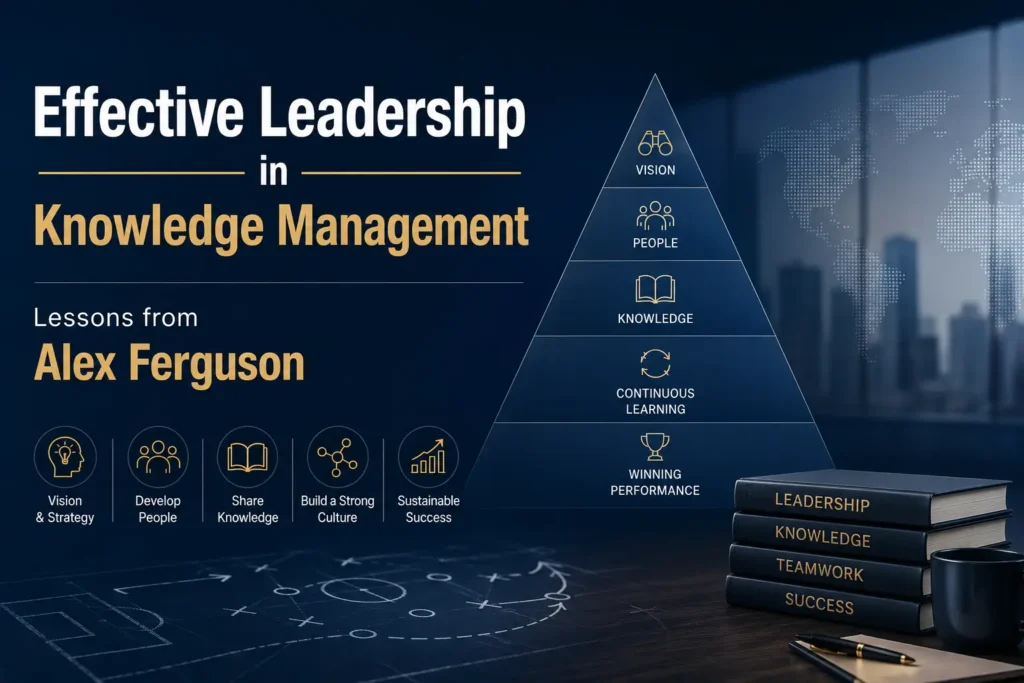
The Importance of Leadership in Knowledge Management
Leadership in knowledge management is one of the most critical factors behind organizational success. Leaders must not only manage the flow of knowledge within organizations, but also strengthen a culture of knowledge sharing and continuous learning. The book Leading: Learning from Life and My Years at Manchester United by Sir Alex Ferguson and Michael Moritz provides a practical example of effective leadership that can be extended to knowledge management concepts.
Knowledge management goes beyond collecting and storing information; this process requires the conscious guidance of knowledge and experience throughout the organization. Knowledge becomes valuable when it can create real impact on organizational decision-making and performance, and this is almost impossible without capable leaders. Knowledge-oriented leaders act as bridges that transform individuals’ tacit knowledge into explicit knowledge and transfer it throughout the organization. Knowledge-oriented leaders are responsible for the following:
Identifying Existing and Valuable Knowledge
In organizations, not all information matters; rather, the important part is the knowledge that can enable strategic decision-making and improve organizational performance. This includes employees’ experiences, technical skills, innovations, and successful operational methods. Leaders must be able to extract this knowledge from scattered data and raw information. For example, in a manufacturing company, the experience of an engineer with many years of production planning expertise can help improve processes and reduce errors, but without a knowledge-oriented leader, this experience may never become organizational knowledge.
Facilitating Knowledge Sharing
Valuable knowledge can only be effective when it is shared. If successful experiences and innovations remain limited to a single individual or group, the organization cannot fully utilize its potential. Leaders must provide mechanisms and tools for knowledge sharing, such as internal meetings, knowledge bases, or collaborative networks. For example, an information technology organization can use internal systems to document project experiences so that other teams can learn from both mistakes and successes.
Creating Motivation for Learning and Innovation
Knowledge sharing happens when individuals feel secure and valued. Knowledge-oriented leaders strengthen motivation for learning by appreciating employees’ contributions, rewarding innovation, and creating supportive environments. For example, when managers give employees who provide innovative solutions the opportunity to present their ideas in organization-wide meetings, not only is that person’s knowledge transferred, but the culture of learning within the organization is also reinforced.
Using Past Experiences for Strategic Decision-Making
Leaders must document both successful experiences and failures so that in critical situations or during strategic decision-making they can act faster and with greater accuracy. This process reduces risk, improves efficiency, and enables organizations to learn from past experiences. For example, in a bank, analyzing previous projects when designing a new product can reduce the risk of failure and ensure that managerial decisions are based on real knowledge rather than assumptions.
Lessons from Alex Ferguson’s Book
Sir Alex Ferguson, the legendary manager of Manchester United, shares his 27 years of leadership experience in the book Leading. He demonstrates that successful leadership is not limited to match tactics and game management; it also includes guiding talents, making strategic decisions, creating motivation, and shaping organizational culture.
One of Ferguson’s most remarkable characteristics was his ability to identify talent, manage individual and team relationships, and transform players’ personal experiences into collective advantages. These characteristics align precisely with the objectives of knowledge management within organizations. Organizations seeking to transform knowledge into a competitive advantage can draw inspiration from Ferguson’s practical approaches and experiences.
Four Dimensions of Alex Ferguson’s Leadership from a Knowledge Management Perspective
1. Guiding and Leading the Team
Ferguson always emphasized that successful team leadership is not merely about tactics and discipline during matches, but about understanding individuals, valuing experiences, and transforming them into collective knowledge. He believed that every player represented a valuable source of knowledge and experience; from young players with enthusiasm and creativity to experienced players capable of making the right decisions in critical moments.
Throughout the book, Ferguson emphasizes that one of the key reasons for his success was his ability to “listen and observe carefully”; not only listening to what players said, but also observing how they worked, trained, and reacted during matches. In knowledge management, this is referred to as “identifying tacit knowledge”; the experiences, decision-making methods, and skills that exist in individuals’ minds and can create competitive advantage when integrated into teamwork. Ferguson explains that he learned to benefit from others’ suggestions and feedback; for example, one of his assistants showed him that sometimes he should observe training sessions from a distance to better recognize patterns of collaboration and player behavior, rather than directly intervening in the training itself. This approach enabled him to make better tactical and educational decisions.
- Connection with Knowledge Management: Organizational leaders must also be able to identify individuals’ tacit knowledge, guide it, and align it with organizational goals. Tacit knowledge includes personal experiences, problem-solving methods, and individual decision-making styles that, if consciously discovered and documented, can be transformed into explicit knowledge and become usable throughout the organization.
- Practical Example: At Manchester United, Ferguson used active listening and careful observation to better understand individuals. He did not rely solely on statistics and results, but paid attention to the way players performed, worked, and behaved during training sessions and matches in order to discover their hidden strengths and potential. This approach can also be implemented in knowledge-oriented organizations through mentoring systems, feedback sessions, and the documentation of personal experiences so that valuable employee experiences become organizational knowledge and improve collective performance.
2. Decision-Making in Crisis Situations
Ferguson repeatedly demonstrated that difficult and timely decisions were the main reason behind Manchester United’s superiority in critical competitions. He believed that in times of crisis, leaders must combine past knowledge and experiences in order to make strategic decisions. In Leading, Ferguson explains that one of the keys to his success was his ability to make rapid decisions based on continuous observation of team performance and analysis of opponents’ tactics.
A famous historical example of this approach is the 1999 UEFA Champions League final. In this match, Manchester United was trailing Bayern Munich in the final minutes of the game. Ferguson changed tactics and brought fresh players onto the field, pushing the team into a more attacking style of play. Within a few minutes, Manchester United scored two crucial goals and won the match. This timely decision, grounded in past experiences, demonstrated his ability to combine players’ tacit knowledge with real-time analysis of the match situation.
- Connection with Knowledge Management: Crisis decision-making requires the use of data, past experiences, and continuous environmental analysis. Knowledge management systems enable organizations to document successful experiences and failures and make them accessible to everyone so that decisions can be made more quickly and with fewer errors during crises. Just as Ferguson combined experiences from previous matches, understanding of players’ strengths and weaknesses, and opponents’ tactics, organizations can also use data analysis and collective knowledge to make better strategic decisions.
- Practical Example: Whenever a key player was injured or the flow of the match changed unexpectedly, Ferguson would review previous player performances and analyze opponents’ tactics before making changes to the lineup or tactical system. Similarly, in organizations, knowledge-based decision-making during project, market, or operational crises is conducted based on past experiences and collected data in order to reduce risk.
3. Building a Winning Organizational Culture
Ferguson believed that a positive, competitive, and supportive team culture significantly increased members’ motivation, commitment, and performance. He understood that short-term success could not be sustained without a strong culture, collaboration, and team cohesion. In Leading, he repeatedly emphasizes the importance of communicating a collective message to players and coaching staff and explains that individual achievements are valuable only when they contribute to the success of the entire team.
For example, after winning the 2007–2008 Premier League title, Ferguson repeatedly reminded players during team meetings that team success must take priority over personal success, and that players should use their individual experiences and skills to improve the entire team. He also emphasized that team culture should be supportive and should allow the sharing of ideas and experiences.
By organizing match analysis sessions, individual and group feedback meetings, and discussions about tactics and performance, Ferguson created an environment in which players were not afraid of making mistakes and could freely share their knowledge and experiences. This approach also helped new players integrate more quickly into the team and use their experiences in alignment with collective goals. Ferguson believed that a positive, competitive, and supportive team culture increased members’ motivation and commitment, and that short-term success would not last without a strong culture.
- Connection with Knowledge Management: Creating a culture of continuous learning and knowledge sharing is the key to utilizing the full capacity of an organization. Employees must feel that their knowledge is valuable and that they can share it without fear.
- Practical Example: Ferguson created an environment in which players and coaching staff could share ideas and experiences, both during training sessions and in match analyses. This is similar to knowledge-oriented organizations that build active learning cultures through internal networks, continuous meetings, and communities of practice. Even newly joined players, by observing this culture, quickly began sharing their experiences with other team members.
4. Managing Individual Talent
Ferguson viewed each player as an individual with unique knowledge, capabilities, and skills, and he consistently tried to direct these abilities toward the benefit of the team. He believed that collective team success could only be achieved through the development and optimal use of individual talents.
In Leading, Ferguson explains that his precise understanding of players’ individual characteristics, strengths, weaknesses, and unique performance styles enabled him to make the best tactical and training decisions. A clear example is Wayne Rooney. Ferguson knew that Rooney possessed exceptional physical power and creativity in attacking positions. By designing individual training sessions, personalized tactics, and situations in which these characteristics could benefit the team, he succeeded in transforming Rooney’s individual potential into a collective advantage.
In addition, Ferguson helped other players develop their abilities in different team roles so that individual skills would strengthen coordination and overall team performance.
- Connection with Knowledge Management: Managing individual talent is equivalent to identifying individuals’ tacit knowledge, developing it, and providing opportunities for its sharing and transfer to others. Knowledge-oriented leaders must document, teach, and facilitate the sharing of individual abilities and experiences so that personal knowledge and capabilities become organizational value. This process increases productivity, innovation, and collective decision-making power.
- Practical Example: Ferguson strengthened and transferred players’ experiences and skills to the team through private meetings, individual coaching, and specialized training sessions. Even players operating outside their specialized positions received training that allowed them to apply their specific skills in different team situations. This is similar to the approach of knowledge-oriented organizations that, through mentoring systems, communities of practice, and knowledge development programs, transform individual capabilities and experiences into operational and strategic organizational knowledge and elevate the overall performance of the team or organization.
Conclusion
The book Leading shows us that effective leadership is not limited to managing activities; rather, it involves consciously guiding individuals, making the right decisions, creating a positive organizational culture, and developing individual talents. These four dimensions are directly aligned with the concepts of knowledge management within organizations and can serve as an operational framework for knowledge-oriented organizations.
Just as Ferguson, through leading Manchester United, achieved continuous and sustainable success, organizational leaders can also create innovation, improve performance, and build long-term competitive advantage through conscious knowledge management, talent identification and development, and the creation of a culture of learning and knowledge sharing. Ferguson’s practical experiences, especially in managing tacit knowledge, strategic decision-making during crises, and shaping a winning team culture, provide a realistic and reliable model for managers and knowledge-oriented leaders.
In other words, Ferguson’s lessons extend far beyond the football field: any organization capable of collectively managing knowledge, experience, and individual talents has the potential to become an innovative and successful organization.
Explore More from the Author:
- Implementing the Knowledge Café at the NATIONAL IRAN GAS COMPANY (NIGC): An Experiential Approach to Interactive Knowledge Management
- When Culture Leads: The Hidden Force Behind Knowledge Management
- Turning Ugly Ducklings into Knowledge Champions
- Knowledge Champions Cup: Driving Engagement and Learning through Gamified Knowledge Management
Author

I am a Knowledge Management consultant and instructor, currently serving as a Board Member and Senior Project Manager at DANA KM Consulting Group, a leading KM consulting firm in Iran.
Drawing on over 15 years of hands-on experience, I help organizations transform KM strategies into practical systems that drive collaboration, innovation, and continuous learning. Over the years, I have contributed as a consultant to more than 100 KM projects, implementing effective techniques and solutions that have enhanced organizational knowledge performance.
Internationally, I have completed professional development programs in management consulting and hold a Productivity Specialist certification from the Asian Productivity Organization (APO).
Since 2019, I have been the Editor-in-Chief of the “DANA Knowledge Management and Innovation Journal,” which has published over 40 issues, promoting thought leadership and best practices in the KM community. In addition, since 2023, I have served as the Executive Secretary of the Knowledge Management Excellence Award in Iran, a national initiative that assesses and recognizes outstanding KM practices across organizations.