The Enterprise AI Revolution Began With the Wrong Assumption
The modern enterprise entered the AI era with extraordinary optimism. Executives saw large language models generate software code, summarize research, automate writing, answer questions conversationally, and produce insights in seconds that previously required hours of human effort. The excitement was understandable. For many organizations, artificial intelligence appeared to represent the next major operational leap after cloud computing and digital transformation.
But something unexpected happened when enterprises attempted to move AI beyond demonstrations and into real operational environments.
The systems struggled.
Not because the models lacked intelligence. Not because the algorithms failed fundamentally. The real problem was more uncomfortable and far more revealing. AI systems were entering organizations whose knowledge environments had been deteriorating quietly for years.
The excitement around AI initially created the illusion that enterprises were preparing to deploy intelligence at scale. In reality, many organizations were attempting to build advanced reasoning systems on top of fragmented, poorly governed, structurally weak knowledge ecosystems.
This distinction changes the entire conversation around enterprise AI.
For nearly two decades, knowledge management existed in an unusual position inside global organizations. Leaders acknowledged its importance rhetorically, but very few treated it as core operational infrastructure. KM initiatives were often positioned as collaboration programs, documentation efforts, or information-sharing initiatives rather than strategic systems governing organizational intelligence itself.
During that period, enterprise content expanded uncontrollably. Repositories multiplied across departments. Collaboration platforms fragmented information further. SharePoint environments became increasingly chaotic. Critical knowledge spread across documents, chats, inboxes, tickets, dashboards, wikis, recordings, and disconnected workflows. Organizations accumulated enormous quantities of information while losing structural coherence.
Human employees compensated for these weaknesses more effectively than leadership realized.
Experienced workers knew where reliable knowledge existed. They understood which systems were trustworthy and which contained outdated information. They navigated political structures, identified hidden experts, reconstructed missing context, and filtered organizational noise using intuition developed through years of operational exposure.
Artificial intelligence cannot compensate in the same way.
The moment enterprises attempted to operationalize AI systems internally, the hidden weaknesses inside their knowledge environments became visible with startling clarity.
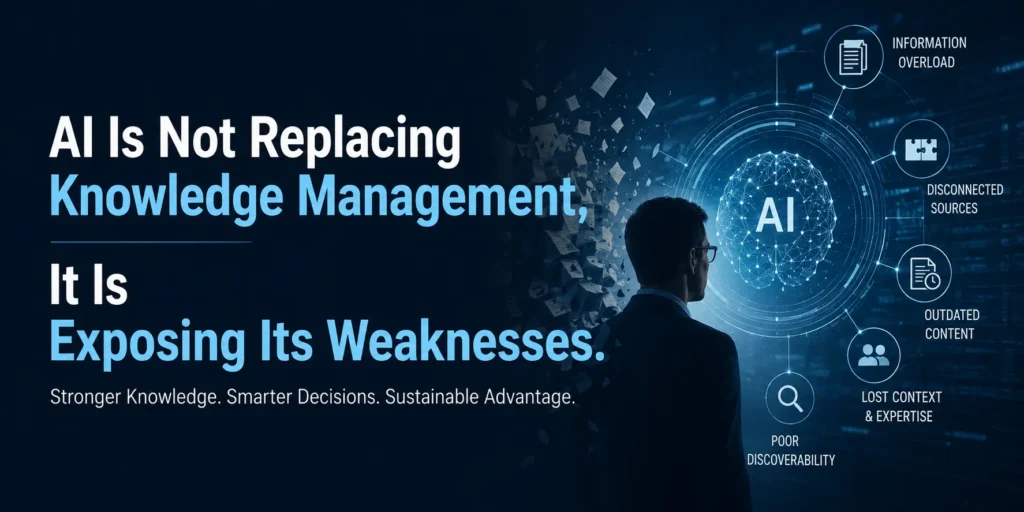
AI is not replacing knowledge management.
It is exposing how fragile enterprise knowledge architecture became while organizations were distracted by information accumulation.
Most Enterprises Built Storage Ecosystems Instead of Knowledge Ecosystems
One of the largest misconceptions inside modern organizations is the belief that information quantity equals organizational intelligence. This assumption shaped enterprise technology strategy for years.
Companies invested aggressively in storage capacity, collaboration platforms, document repositories, and content migration projects while paying far less attention to discoverability, contextual relationships, retrieval quality, metadata governance, or operational usability.
The result was predictable.
Enterprises became extraordinarily good at storing information and surprisingly poor at operationalizing knowledge.
This distinction matters enormously in the AI era.
A company may possess millions of files and still fail to deliver reliable answers to employees efficiently. Entire departments often recreate work that already exists elsewhere because discoverability collapsed under informational sprawl. Teams repeatedly revisit decisions because institutional reasoning disappeared inside fragmented systems. Employees spend substantial portions of their workday searching, validating, cross-checking, and reconstructing knowledge manually.
These inefficiencies accumulated gradually over time, which made them easy to normalize.
Most executives never saw the full operational cost because knowledge friction rarely appears as a single measurable event. It emerges as delayed decisions, duplicated effort, slower onboarding, meeting overload, repeated mistakes, and increasing dependency on specific individuals who quietly become the living memory of the organization.
AI exposed these structural weaknesses immediately because artificial intelligence depends heavily on retrieval quality and contextual integrity.
A language model can generate remarkably sophisticated outputs, but enterprise reliability depends on whether the system can access trustworthy, relevant, contextualized knowledge at the right moment. When repositories contain duplicate information, conflicting procedures, outdated policies, fragmented taxonomies, and inconsistent metadata, AI systems inherit those weaknesses instantly.
This explains why many organizations experienced a sharp divide between public AI demonstrations and internal enterprise deployments.
Public demonstrations operate within highly optimized environments. Enterprise reality is far messier.
Enterprise Search Quietly Became One of the Most Important Problems in Knowledge Management
For years, enterprise search remained one of the most underestimated operational failures inside large organizations. Employees accepted poor search experiences as part of corporate life because they had little alternative.
Workers searched across multiple systems simultaneously. They opened dozens of documents hoping to locate accurate information. They messaged colleagues for clarification because repositories could not provide trusted answers efficiently. In many enterprises, employees relied more heavily on human networks than official knowledge systems.
This became one of the defining characteristics of weak knowledge architecture. Information technically existed, but discoverability deteriorated to the point where retrieval itself became operational labor.
Artificial intelligence intensified the visibility of this problem dramatically.
The effectiveness of enterprise AI systems depends heavily on retrieval precision. Large language models may sound intelligent conversationally, but inside operational environments they still require access to authoritative enterprise knowledge. When retrieval systems surface outdated documentation, contradictory policies, or contextually irrelevant information, AI outputs become unreliable quickly.
This is one reason many organizations are now realizing that enterprise search is no longer a secondary productivity tool. It has become central to organizational intelligence itself.
Modern knowledge management is shifting away from repository-centric thinking toward retrieval-centric architecture. The future of KM will increasingly revolve around contextual discoverability, semantic relationships, authority models, workflow alignment, and intelligent knowledge delivery.
This is a major philosophical shift.
For years, organizations focused primarily on preserving information. The AI era is forcing them to recognize that retrieval quality matters more than repository volume.
The enterprises succeeding with AI are often not the organizations possessing the largest information stores. They are the organizations possessing the clearest knowledge structures.
AI Is Revealing the Enterprise Memory Crisis
One of the most important consequences of weak knowledge management has remained largely invisible for decades. Organizations have been losing institutional memory at massive scale while barely recognizing the long-term consequences.
Modern enterprises generate extraordinary amounts of operational intelligence every year. Teams solve complex problems, navigate crises, negotiate difficult trade-offs, recover from failures, improve processes, and develop nuanced expertise through direct experience. Yet much of this knowledge disappears shortly after it is created.
The organization retains documents while losing reasoning.
This difference is profound.
Most enterprises preserve outputs more effectively than context. They archive presentations while losing the discussions that shaped them. They retain final decisions while losing the strategic tensions behind those decisions. They document processes while failing to preserve the operational judgment required to execute them effectively.
Over time, organizations begin repeating the same mistakes because institutional memory weakens faster than operational complexity grows.
AI systems exposed this weakness because they cannot retrieve intelligence that was never structurally preserved.
A model may summarize existing documentation elegantly, but it cannot reconstruct forgotten reasoning buried inside meetings, chats, inboxes, or undocumented expertise. It cannot infer operational context that disappeared during workforce turnover. It cannot fully replicate the judgment of experienced professionals whose knowledge existed primarily through years of accumulated situational exposure.
This issue is becoming increasingly dangerous as enterprises experience accelerating workforce transitions. Senior employees retire. Organizational restructuring increases. Remote work reduces informal knowledge transfer. Expertise fragments across distributed systems and transient collaboration environments.
Many organizations are now confronting a deeply uncomfortable reality. Some of their most critical operational intelligence exists almost entirely inside human memory rather than enterprise systems.
That is not merely a knowledge management issue anymore.
It is a strategic business risk.
Tacit Knowledge Remains the Most Difficult Form of Enterprise Intelligence
The AI boom created a widespread belief that organizational expertise would soon become infinitely scalable. Many executives assumed advanced models would automatically absorb, replicate, and operationalize human knowledge at unprecedented speed.
Reality proved more complicated.
Some of the most valuable knowledge inside enterprises has never existed in structured form at all. It exists inside judgment, intuition, contextual awareness, negotiation experience, historical understanding, political navigation, and pattern recognition developed over years of operational exposure.
This is tacit knowledge, and despite extraordinary advances in artificial intelligence, it remains one of the most difficult forms of enterprise intelligence to preserve effectively.
Experienced professionals often recognize subtle risks long before systems reveal obvious signals. Senior leaders interpret ambiguity using institutional understanding accumulated through years of context. Engineers identify anomalies instinctively because they understand operational history deeply rather than because formal documentation explained every scenario.
Most organizations underestimated how much of their operational capability depended on this invisible layer of expertise.
AI exposed the problem because enterprises realized their repositories contained information but not necessarily understanding.
The distinction matters enormously.
Information can be stored relatively easily. Expertise is far more difficult to operationalize because it depends on contextual interpretation rather than static content alone.
The organizations that succeed in the next decade will likely be those that recognize tacit knowledge as strategic infrastructure rather than informal organizational residue.
Knowledge Governance Is Becoming AI Governance
One of the most important structural shifts occurring inside enterprises today is the convergence between knowledge governance and AI governance.
Historically, these disciplines operated separately. Knowledge governance focused on taxonomy, metadata, retention policies, lifecycle management, and content standards. AI governance focused on ethics, explainability, compliance, transparency, and model behavior.
That separation is collapsing rapidly.
AI systems depend directly on the quality of enterprise knowledge environments. If organizational repositories contain outdated policies, duplicated content, inconsistent terminology, fragmented authority structures, or weak governance controls, AI systems inherit those weaknesses automatically.
This means many AI failures are not fundamentally model failures at all.
They are governance failures originating inside enterprise knowledge architecture.
Organizations are beginning to recognize that trustworthy AI requires trustworthy knowledge ecosystems. Retrieval integrity, contextual relevance, source authority, lifecycle discipline, and metadata consistency are becoming foundational requirements for enterprise AI reliability.
This changes the role of knowledge management dramatically.
KM is no longer simply supporting organizational learning or information sharing. It is increasingly becoming part of the infrastructure layer governing enterprise intelligence itself.
The Future of Knowledge Management Will Be Defined by Context
The traditional model of knowledge management focused heavily on content accumulation. Success was often measured through repository size, document growth, contribution volume, or collaboration metrics.
Those measurements are becoming increasingly insufficient.
The future of enterprise knowledge management will revolve less around content volume and more around contextual intelligence.
Context determines whether knowledge becomes operationally useful. A policy without workflow relevance creates confusion. Documentation without authority clarity weakens trust. Lessons learned without retrieval precision become archival clutter rather than strategic assets.
Artificial intelligence is accelerating this realization because contextual weakness directly affects system reliability.
Modern enterprises increasingly require knowledge systems capable of understanding operational relevance, user intent, workflow state, organizational authority, and situational context dynamically. Knowledge environments are evolving from passive repositories into intelligent delivery ecosystems where timing, relevance, permissions, and contextual precision determine value.
This represents one of the most important transformations occurring in knowledge management today.
The discipline is moving away from static information storage toward active orchestration of organizational intelligence.
Knowledge Management Is Entering Its Most Important Era
For years, knowledge management struggled to gain sustained executive attention because its failures appeared gradual rather than catastrophic. Organizations normalized knowledge inefficiencies because the consequences accumulated slowly across daily operations instead of appearing as visible system outages.
Artificial intelligence changed that permanently.
The AI era is exposing the structural condition of organizational intelligence with unprecedented clarity. Enterprises are beginning to recognize that knowledge architecture is not administrative overhead. It is foundational infrastructure supporting decision-making, operational continuity, institutional memory, intelligent retrieval, workflow execution, and increasingly, machine reasoning itself.
The irony is impossible to ignore.
Many predicted artificial intelligence would reduce the importance of knowledge management.
Instead, AI is making knowledge management more strategically important than at any previous point in enterprise history.
But the discipline itself must evolve beyond repository management and passive documentation culture. The future belongs to organizations capable of building intelligent knowledge ecosystems where retrieval precision, contextual continuity, governance discipline, organizational memory, and operational intelligence function as integrated infrastructure.
The enterprises that understand this shift early will build advantages that competitors struggle to replicate.
Not because they adopted AI faster.
Because they understood that enterprise intelligence has always depended on knowledge architecture, long before artificial intelligence arrived to expose its weaknesses.
Join our community for KM expert sessions, workshops, and newsletter updates.