The modern enterprise does not suffer from lack of information. It suffers from fragmentation, inconsistency, and inability to transform information into usable organizational knowledge. Over the last decade, companies have invested heavily in collaboration platforms, document repositories, intranets, and digital workplace systems. Yet employees continue to spend large portions of their time searching for answers, recreating existing work, or depending on informal networks to solve operational problems.
This disconnect reveals a deeper issue. Most organizations still approach the knowledge management process as a storage problem rather than a knowledge flow problem. They focus on collecting documents instead of enabling knowledge to move intelligently across people, systems, and workflows.
The rise of artificial intelligence has intensified this challenge. AI systems depend on structured, contextual, and reliable knowledge to deliver meaningful outputs. Organizations with weak knowledge management processes often discover that AI amplifies confusion instead of improving clarity. Search becomes noisy, recommendations lose relevance, and employees stop trusting the system altogether.
This is why the knowledge management process is evolving. In the AI era, knowledge management is no longer limited to capturing and storing information. It now involves structuring knowledge for discoverability, enabling semantic understanding, and ensuring that expertise can flow continuously across operational environments.
Organizations that understand this shift are building systems where knowledge becomes an active operational capability rather than a passive archive.
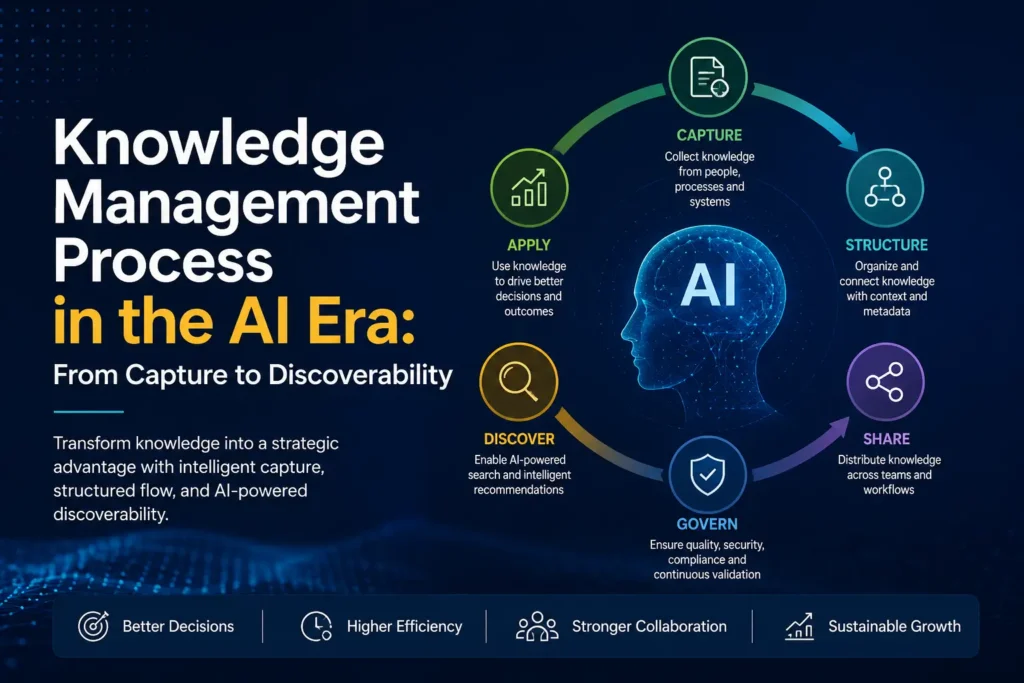
Rethinking the Knowledge Management Process
Traditional knowledge management models were designed around repositories. The objective was straightforward: collect knowledge, organize it into categories, and make it accessible through search. For many organizations, this approach created the illusion of progress because content volumes increased rapidly. Repositories grew, documentation expanded, and digital systems became more sophisticated.
Operationally, however, many of these systems underperformed.
Employees rarely think in terms of repositories. They think in terms of tasks, decisions, and immediate business problems. A support engineer troubleshooting a failure does not want hundreds of loosely related documents. A project manager facing delivery delays needs contextual guidance that can be applied quickly. Knowledge only becomes valuable when it is discoverable within the context of execution.
This distinction is reshaping the entire knowledge management process. The focus is shifting away from static storage and toward dynamic knowledge flow. Knowledge must move continuously across systems, teams, and operational scenarios without creating friction.
The AI era accelerates this transition because AI systems function best when knowledge is structured around meaning rather than isolated files. Organizations are increasingly recognizing that discoverability, context, and semantic relationships are now central to effective knowledge management.
The First Breakdown: Knowledge Capture Without Context
Most knowledge management processes begin with capture, yet this is also where many systems begin to fail.
Organizations often treat capture as a retrospective administrative activity. Employees complete projects, resolve incidents, or make strategic decisions, and only afterward are they expected to document lessons learned. By that point, much of the reasoning, situational understanding, and decision context has already disappeared.
The result is shallow documentation. Systems contain outputs but not operational understanding.
This becomes especially problematic in environments where tacit knowledge plays a major role. Tacit knowledge includes judgment, pattern recognition, troubleshooting intuition, and experience-based reasoning that cannot be fully captured through standard documentation alone.
For example, a senior engineer resolving a complex infrastructure issue may instinctively recognize patterns based on years of operational exposure. The final resolution may be documented, but the thinking process behind the solution often remains invisible. Future teams may replicate the steps without understanding the underlying conditions that made the solution effective.
Modern knowledge management processes are beginning to address this gap by embedding capture directly into workflows. Knowledge is captured during execution rather than after completion. Collaboration systems, operational platforms, and AI-assisted documentation tools increasingly support real-time contextual capture, preserving not just what happened but why decisions were made.
This evolution matters because AI systems require context-rich knowledge to generate reliable outputs. Without contextual depth, even advanced retrieval systems struggle to distinguish between superficially similar but operationally different scenarios.
Read: How AI Is Transforming Knowledge Capture in Large Organizations
Why Discoverability Has Become More Important Than Storage
One of the most significant changes in the knowledge management process is the growing importance of discoverability.
Historically, organizations measured KM success through content accumulation. More documents meant more knowledge. Today, that assumption is breaking down. Large repositories frequently create operational friction because employees cannot efficiently locate what is relevant.
The challenge is not simply search performance. It is semantic understanding.
Traditional search systems operate through lexical matching. They retrieve documents containing keywords that resemble user queries. This approach fails when terminology varies across teams or when users cannot articulate their needs precisely.
In enterprise environments, this problem appears constantly. Different departments describe the same concepts using different language. Valuable knowledge becomes trapped behind inconsistent terminology, disconnected systems, or weak metadata structures.
AI-driven discoverability changes this dynamic by shifting search from keyword retrieval toward intent interpretation.
Modern AI systems analyze:
- contextual relationships
- semantic meaning
- behavioral patterns
- operational relevance
Instead of retrieving documents that merely contain matching terms, AI systems attempt to surface knowledge that aligns with the user’s actual objective.
This transition fundamentally changes the knowledge management process. Knowledge must now be structured not only for storage but also for machine interpretation.
Organizations are increasingly investing in:
- semantic taxonomy
- metadata frameworks
- knowledge graphs
- contextual linking structures
These systems create relationships between concepts, enabling AI to interpret knowledge environments more intelligently.
Organizations like Google have demonstrated how semantic understanding dramatically improves discoverability by connecting information through relationships rather than isolated content.
The implication for enterprise KM is profound. Discoverability is no longer a secondary feature. It is becoming the operational center of the knowledge management process.
The Shift From Knowledge Repositories to Knowledge Flow
Another major transformation occurring in the AI era is the movement from repository-centric KM toward flow-centric KM.
Traditional systems assumed knowledge would remain relatively stable after being documented. Modern operational environments do not function this way. Knowledge changes continuously because workflows, technologies, regulations, and business conditions evolve constantly.
As a result, organizations are beginning to treat knowledge as a living operational asset rather than static content.
Knowledge flow focuses on how expertise moves:
- across teams
- between systems
- through workflows
- during decision-making
This perspective changes how knowledge management processes are designed.
Instead of asking:
“Where should this document be stored?”
Organizations increasingly ask:
“How should this knowledge move through operational environments?”
This shift produces several important changes.
Knowledge becomes embedded directly into workflow systems rather than isolated inside repositories. Collaboration tools surface contextual knowledge during execution. AI systems proactively recommend expertise based on tasks and behavioral signals. Discoverability becomes integrated into operational activity instead of requiring separate search behavior.
Organizations like Microsoft increasingly integrate knowledge delivery into platforms such as Teams and enterprise workflow environments because usability depends heavily on contextual access.
Knowledge management succeeds when employees do not experience it as a separate activity.
Semantic Structures Are Reshaping Enterprise KM Architecture
The increasing role of AI has exposed a critical weakness in many enterprise knowledge environments: most knowledge lacks semantic structure.
Traditional KM architectures were designed around folders, categories, and document hierarchies. These structures are insufficient for AI-driven discoverability because they do not adequately represent meaning or relationships.
Semantic structures organize knowledge through interconnected concepts rather than isolated files.
This includes:
- entity relationships
- contextual metadata
- knowledge graphs
- ontology frameworks
- semantic taxonomy
These structures allow AI systems to understand how knowledge relates across operational domains.
For example, a customer issue may connect to:
- technical documentation
- previous incidents
- product architecture
- regulatory requirements
- expert contacts
Without semantic relationships, these knowledge assets remain fragmented. With semantic architecture, systems can surface interconnected insights dynamically.
This capability becomes increasingly important as organizations scale. Large enterprises generate knowledge across multiple business units, operational environments, and geographic regions. Semantic structures provide the connective layer that allows knowledge to remain coherent across complexity.
The future of the knowledge management process will depend heavily on semantic architecture because AI systems require structured meaning to deliver accurate recommendations and contextual retrieval.
Governance and Trust in the AI Era
AI introduces another major challenge into the knowledge management process: trust.
Employees will only rely on AI-enhanced knowledge systems if outputs are perceived as reliable. This creates pressure on organizations to improve governance, validation, and content quality.
Weak governance creates serious problems in AI environments. Outdated or inaccurate knowledge can spread quickly when surfaced automatically through recommendations or conversational AI systems.
The consequences extend beyond usability. In operational environments, unreliable knowledge directly affects decision quality, customer experience, and organizational risk.
This is why governance is evolving from administrative oversight into operational quality control.
Modern governance models increasingly focus on:
- ownership accountability
- validation workflows
- freshness monitoring
- contextual reliability
- trust scoring mechanisms
Organizations are beginning to recognize that AI does not reduce the importance of governance. It increases it.
At the same time, governance cannot become excessively restrictive. Enterprise KM systems fail when contribution becomes bureaucratic and slow. The challenge is maintaining reliability without reducing knowledge flow.
This balance between trust and agility will define the next generation of enterprise knowledge management processes.
The Operational Future of Knowledge Management
The future knowledge management process will look fundamentally different from traditional KM systems.
Knowledge environments are becoming:
- real-time
- AI-assisted
- semantically connected
- workflow-embedded
- context-aware
Search itself is evolving into intelligent retrieval. Employees increasingly expect systems to anticipate needs rather than simply respond to queries.
At the same time, organizational knowledge is becoming less document-centric and more relationship-centric. Meaning emerges through connections between systems, workflows, expertise, and operational activity.
This transition also changes the role of employees inside KM systems. Workers are no longer simply contributors or consumers of knowledge. They become participants in continuously evolving knowledge ecosystems where every interaction strengthens or reshapes the environment.
The organizations that adapt successfully will not necessarily have the largest repositories. They will have the strongest operational knowledge flow.
Final Perspective
The knowledge management process is undergoing a structural transformation in the AI era. What once centered on storage and documentation now revolves around discoverability, context, semantic understanding, and operational integration.
This shift is not primarily technological. It reflects a deeper recognition that knowledge only creates value when it moves effectively across systems, people, and decisions.
Organizations that continue treating KM as static repository management will struggle with fragmentation, low adoption, and declining trust. Those that redesign the knowledge management process around discoverability and intelligent flow will build environments where knowledge becomes continuously usable, adaptable, and operationally relevant.
The future of enterprise knowledge management will not be defined by how much information organizations store. It will be defined by how intelligently knowledge can be captured, connected, discovered, and applied at scale.
Join our community for KM expert sessions, workshops, and newsletter updates