Enterprise knowledge management systems rarely fail because organizations lack technology. Most companies already have platforms, repositories, collaboration tools, and large volumes of documented information. The real breakdown happens somewhere else. Knowledge fails when systems cannot support how people actually work, make decisions, and transfer expertise across the organization.
This is why many enterprise KM initiatives appear successful on the surface while underperforming operationally. Content exists. Platforms are active. Processes are documented. Yet employees still struggle to find reliable information, teams recreate solutions repeatedly, and critical expertise disappears when experienced individuals leave.
The problem is not the absence of knowledge. The problem is where knowledge breaks.
Understanding these failure points is essential because enterprise KM systems do not collapse suddenly. They deteriorate gradually through small structural weaknesses that compound over time. Trust declines, adoption decreases, and knowledge slowly disconnects from execution.
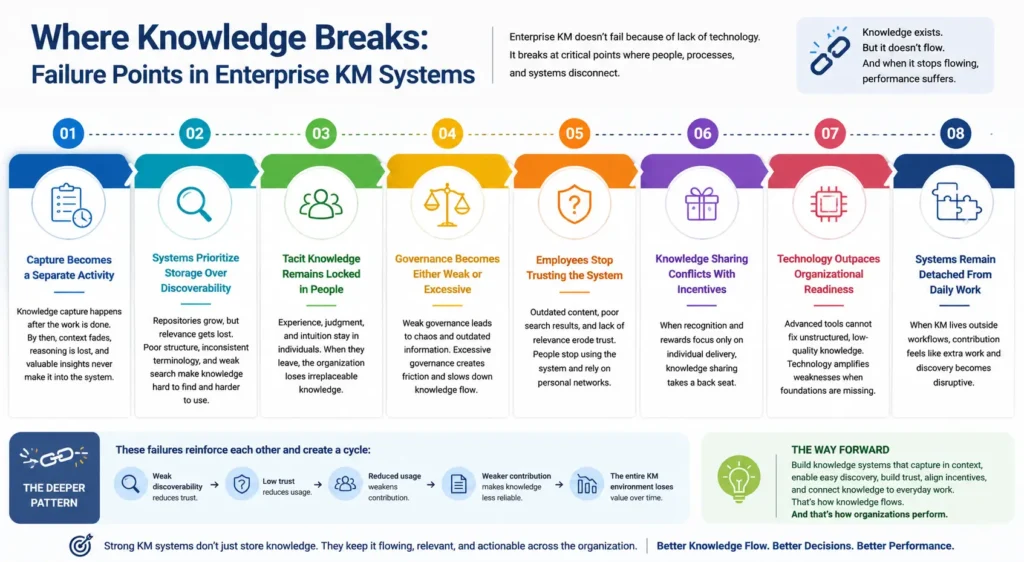
Knowledge Breaks When Capture Becomes a Separate Activity
One of the most common failure points in enterprise KM systems emerges at the moment knowledge is expected to be captured.
In many organizations, knowledge capture is treated as a secondary administrative task rather than part of operational work. Employees are expected to complete projects first and document insights later. By that stage, context has already faded. Important reasoning, decision paths, and situational details are lost.
This creates a pattern where repositories contain outputs without the thinking behind them. Teams may find documents, but they cannot fully understand how conclusions were reached or when those solutions are applicable.
High-performing organizations avoid this failure point by embedding knowledge capture directly into workflows. Knowledge is documented during execution, not after completion. The distinction is critical because real organizational knowledge is often contextual and time-sensitive.
When capture is disconnected from work, knowledge quality declines almost immediately.
Knowledge Breaks When Systems Prioritize Storage Over Discoverability
Many enterprise KM systems are designed primarily for storage. They focus on accumulating content rather than ensuring that knowledge can be found and applied efficiently.
Over time, organizations create massive repositories containing thousands of files, presentations, policies, and reports. Technically, the knowledge exists. Operationally, it becomes invisible.
Employees experience this problem daily. Search results return excessive information with little relevance. Different departments use inconsistent terminology. Valuable insights remain buried inside poorly structured documents.
This failure point becomes more severe as organizations scale. More content creates more noise, making discoverability increasingly difficult.
The underlying issue is architectural. Traditional KM systems organize knowledge around documents rather than meaning and relationships. As a result, employees must already know what they are looking for before they can find it.
Organizations improving discoverability are shifting toward semantic structures and AI-driven retrieval systems that interpret context and intent rather than relying solely on keyword matching.
Without discoverability, knowledge management becomes archival rather than operational.
Knowledge Breaks When Tacit Knowledge Remains Locked in People
Explicit knowledge is relatively easy to document. Tacit knowledge is not.
This represents one of the deepest structural weaknesses in enterprise KM systems. Organizations frequently capture procedures, reports, and frameworks while failing to capture judgment, experience, and situational expertise.
Tacit knowledge often exists in:
- decision-making patterns
- troubleshooting intuition
- negotiation experience
- contextual understanding developed over years
When experienced employees leave, this knowledge leaves with them.
The damage is rarely immediate. Systems continue functioning temporarily because documented processes remain available. Over time, however, decision quality declines because organizations lose the invisible expertise that guided execution.
This failure point is particularly visible in consulting, engineering, operations, and leadership environments where expertise depends heavily on context and interpretation.
Organizations like McKinsey & Company mitigate this risk by combining repositories with expert networks and mentorship structures that enable tacit knowledge transfer directly between people.
Enterprise KM systems fail when they assume all knowledge can be converted into documentation.
Knowledge Breaks When Governance Becomes Either Weak or Excessive
Governance creates another major tension point in enterprise KM systems.
When governance is weak, repositories become chaotic. Content quality varies, duplication increases, and outdated information accumulates rapidly. Employees lose confidence in the system because they cannot determine what is accurate or current.
At the opposite extreme, excessive governance slows knowledge flow. Complex approval processes discourage contribution, updates take too long, and employees bypass formal systems entirely.
The challenge is balance.
Effective governance creates structure without restricting usability. It defines ownership, quality standards, and lifecycle management while still allowing knowledge to move quickly across the organization.
Organizations often underestimate how sensitive KM systems are to governance friction. Even small delays in updating knowledge can reduce trust significantly, especially in fast-moving operational environments.
Knowledge systems must remain reliable without becoming bureaucratic.
Knowledge Breaks When Employees Stop Trusting the System
Trust is one of the least discussed yet most important dimensions of enterprise knowledge management.
Employees continuously evaluate whether a KM system is worth relying on. This evaluation happens through repeated daily interactions. If users frequently encounter outdated content, incomplete context, or irrelevant search results, trust begins to erode.
Once trust declines, behavioral patterns change quickly.
Employees stop checking the system first. They rely on personal contacts instead. Teams begin recreating knowledge independently because existing information feels unreliable. Eventually, the KM platform becomes a passive repository that exists formally but is operationally ignored.
This failure point is dangerous because it develops quietly. Usage metrics may still appear healthy while actual dependency on the system decreases.
Trust in enterprise KM systems depends on three factors:
- reliability of knowledge
- consistency of discoverability
- relevance within operational contexts
Without trust, even technically advanced systems lose value.
Knowledge Breaks When Knowledge Sharing Conflicts With Incentives
Enterprise culture strongly influences KM effectiveness.
In many organizations, employees are rewarded primarily for execution speed, individual expertise, or output metrics. Knowledge sharing receives little direct recognition. This creates a structural conflict where contributing knowledge feels secondary to immediate delivery.
As a result, knowledge becomes localized within teams or individuals.
This problem becomes particularly visible in high-performance environments where expertise creates professional leverage. Employees may hesitate to share insights because specialized knowledge increases their strategic value inside the organization.
The issue is rarely intentional resistance. More often, it is a consequence of organizational incentives that unintentionally discourage knowledge flow.
Organizations with mature KM practices align contribution with recognition. Knowledge sharing becomes integrated into operational expectations rather than treated as optional collaboration.
Without incentive alignment, enterprise KM systems struggle to sustain participation over time.
Knowledge Breaks When Technology Outpaces Organizational Readiness
Many organizations implement advanced KM platforms expecting technology to solve structural knowledge problems automatically.
This creates another critical failure point.
AI-powered search, intelligent recommendations, and knowledge automation systems can significantly improve KM capabilities, but only when underlying knowledge quality is strong. If repositories contain fragmented, outdated, or poorly structured information, advanced technology amplifies inconsistency rather than solving it.
Organizations frequently mistake platform sophistication for KM maturity.
The reality is more demanding. Effective KM systems require:
- structured knowledge architecture
- clear taxonomy
- governance discipline
- contextual metadata
- operational integration
Without these foundations, technology creates complexity without improving usability.
Organizations such as Microsoft succeed because knowledge systems are integrated deeply into workflows and supported by strong information structures, not simply because advanced tools exist.
Technology accelerates KM maturity only after foundational weaknesses are addressed.
Knowledge Breaks When Systems Remain Detached From Daily Work
One of the clearest indicators of KM failure is separation between knowledge systems and operational workflows.
Employees should not need to pause work to “do knowledge management.” Knowledge should appear naturally within execution environments.
When systems exist outside workflows:
- contribution feels burdensome
- discovery becomes disruptive
- adoption decreases steadily
This is why modern enterprise KM is moving toward embedded knowledge environments where knowledge surfaces contextually within collaboration tools, operational platforms, and workflow systems.
Organizations increasingly recognize that usability determines sustainability.
Knowledge management succeeds when knowledge becomes part of how work happens, not an additional layer placed on top of work.
The Deeper Pattern Behind Enterprise KM Failure
Most enterprise KM failure points share a common characteristic. They are not purely technological problems. They emerge from misalignment between systems, behavior, workflows, and organizational structure.
Knowledge breaks when:
- systems ignore human behavior
- governance restricts flow
- discoverability weakens
- trust declines
- incentives discourage sharing
- expertise remains isolated
These failures reinforce each other. Weak discoverability reduces trust. Low trust reduces usage. Reduced usage weakens contribution. Over time, the entire KM environment becomes increasingly disconnected from operational reality.
This explains why many enterprise KM initiatives struggle despite large investments.
The challenge is not simply managing information. It is maintaining knowledge as a living operational capability.
Final Perspective
Enterprise KM systems do not fail because organizations lack knowledge. They fail because knowledge stops moving effectively across people, systems, and decisions.
Understanding where knowledge breaks is the first step toward building stronger knowledge environments. Organizations that recognize these structural failure points are better positioned to create KM systems that remain usable, trusted, and operationally relevant over time.
The future of enterprise knowledge management will not be defined by how much knowledge organizations store. It will be defined by how reliably knowledge flows, adapts, and supports execution at scale.
Join our community for KM expert sessions, workshops, and newsletter updates