Many organizations are rushing to adopt Artificial Intelligence. Internal copilots are being piloted. Search experiences are being reimagined. Customer support teams are testing AI assistants. Executives are asking when productivity gains will appear.
Yet a large number of these initiatives run into the same problem.
The AI is ready.
The content is not.
This is one of the least discussed realities in enterprise transformation. Companies often assume AI value comes primarily from choosing the right model, vendor, or interface. In practice, the quality of enterprise content frequently determines whether AI becomes useful, unreliable, or ignored.
If policies are outdated, documents duplicated, terminology inconsistent, ownership unclear, and knowledge scattered across disconnected systems, AI will surface those weaknesses quickly. Instead of creating confidence, it can create noise at scale.
That is why preparing enterprise content for AI readiness has become a strategic priority.
Organizations that treat content as infrastructure will gain faster returns from AI. Those that neglect it may spend heavily while struggling to achieve trust, adoption, or measurable business impact.
AI Depends on the Quality of What It Can Access
Most enterprise AI use cases rely on access to internal knowledge.
This may include process documentation, standard operating procedures, product information, customer policies, legal guidance, technical manuals, project archives, training materials, knowledge bases, and collaboration content.
When users ask an AI assistant a question, the system often retrieves relevant content, interprets it, summarizes it, and presents an answer. If the source material is weak, the answer is weakened before it is even generated.
This creates a critical shift in mindset.
For years, poor content hygiene was often tolerated because employees worked around it. They knew which colleague to ask. They relied on informal networks. They ignored outdated folders. They memorized which documents not to trust.
AI removes that buffer.
Once machine systems begin using enterprise knowledge at scale, content quality becomes immediately visible.
What AI Readiness Really Means
AI readiness is often framed as a technology issue involving infrastructure, security, integrations, and model selection.
Those elements matter, but content readiness is equally important.
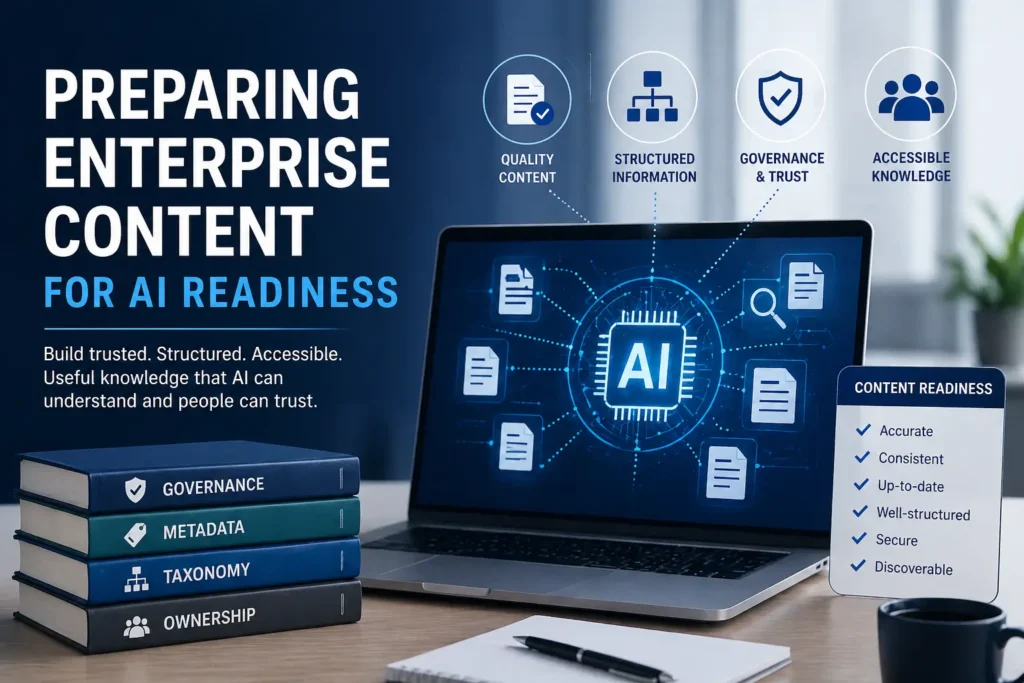
Preparing enterprise content for AI readiness means ensuring that internal knowledge is trustworthy, structured, current, accessible, governed, and meaningful enough for both humans and machines to use effectively.
It means asking practical questions such as:
- Can the organization identify authoritative sources?
- Are outdated documents still competing with current ones?
- Is ownership of critical content clear?
- Do different departments use conflicting terminology?
- Can systems distinguish draft material from approved guidance?
- Is sensitive content properly classified?
- Can employees trust the answers AI provides?
Without strong answers to these questions, AI initiatives often produce uneven results.
Why Many Organizations Struggle
Most enterprises did not design their content ecosystems for AI.
They evolved over years through mergers, rapid growth, platform changes, local team preferences, and shifting leadership priorities. The result is usually a complex landscape of shared drives, intranets, cloud folders, collaboration tools, ticketing systems, wikis, emails, and undocumented tribal knowledge.
Each environment may contain useful information.
Each may also contain duplication, inconsistency, and decay.
This is why AI projects sometimes appear promising during demonstrations but underperform in live environments. Demo environments are clean. Real enterprises are not.
Preparing enterprise content for AI readiness requires confronting that reality honestly.
Start With Content Discovery and Inventory
Before improving content, organizations need visibility.
Many companies do not fully know what knowledge assets they hold, where they reside, who owns them, or how current they are. That lack of visibility creates risk and slows progress.
A content discovery effort should map major repositories, business-critical knowledge sources, unmanaged content zones, and high-value domains such as HR policy, finance procedures, product documentation, customer support knowledge, and technical operations.
The goal is not to catalog every file ever created.
The goal is to identify the content that matters most to business performance and AI use cases.
For example, if an organization wants an internal AI assistant for employee support, HR and IT service knowledge may be priority domains. If the goal is sales enablement, product and pricing knowledge may come first.
AI readiness becomes manageable when linked to clear use cases.
Establish Authoritative Sources
One of the most common enterprise content problems is competing truth.
Multiple versions of the same process exist. Old templates circulate. Regional teams maintain separate guidance. Employees are unsure which source is current.
Humans can sometimes navigate this ambiguity.
AI struggles when truth is fragmented.
Organizations need clear authoritative sources for critical knowledge domains. That means deciding which repository, owner, or workflow represents the approved version of information.
When an AI system retrieves answers, it should be anchored to trusted sources rather than the loudest or most duplicated content.
This is not merely technical governance.
It is operational trust design.
Clean Up Outdated and Redundant Content
Many repositories accumulate years of abandoned material. Old policy drafts remain searchable. Retired project files continue to appear in results. Duplicate content multiplies across systems.
This creates confusion for employees and poor signal quality for AI.
Content cleanup is often unglamorous work, but strategically valuable. Removing obsolete material, archiving low-value content, consolidating duplicates, and retiring unmanaged pages improves both human findability and machine retrieval quality.
The objective is not minimalism for its own sake.
It is reducing noise so relevance can rise.
Organizations that skip cleanup often discover that AI spends too much time interpreting content that should no longer exist.
Improve Structure, Metadata, and Taxonomy
AI can work with unstructured content, but structured environments usually perform better.
Metadata helps systems understand document type, owner, status, business unit, region, confidentiality level, product line, lifecycle stage, and other useful signals. Taxonomy creates consistent categories and language across the enterprise.
This matters because retrieval quality often depends on context.
A policy document tagged as approved and current should rank differently from a draft note. A region-specific procedure should not automatically appear as global guidance. A retired product manual should not outrank current product content.
Strong metadata and taxonomy improve precision, trust, and governance simultaneously.
Many organizations once saw taxonomy as an administrative exercise.
In the AI era, it becomes a performance asset.
Clarify Ownership and Accountability
Content without ownership degrades quickly.
If no person or function is accountable for accuracy, review cycles, and relevance, information becomes stale. Once AI begins using it, stale content becomes scalable misinformation.
Every critical knowledge domain should have clear stewardship. Owners should know what they are responsible for, how often reviews occur, what triggers updates, and how feedback is handled.
Ownership also supports faster improvement. When users flag inaccurate AI responses, organizations need a path back to source correction.
Without accountable owners, errors linger.
Design for Human Trust
Even technically accurate AI can fail if users do not trust it.
Trust is influenced by transparency, consistency, and source credibility. Employees want to know where answers came from, whether guidance is approved, and when content was last updated.
Preparing enterprise content for AI readiness therefore includes designing trust signals into the experience.
This may involve visible source citations, ownership labels, approval status, timestamps, confidence indicators, and escalation paths when uncertainty exists.
Trust is not a branding issue.
It is a usability requirement.
Read: Why AI Needs Knowledge Management to Deliver Real Business Value
Address Sensitive and Restricted Content
Not all enterprise knowledge should be equally accessible.
Some content includes legal risk, personal data, commercial sensitivity, confidential strategy, or regulated information. AI readiness requires classification models and access controls that reflect these realities.
Organizations should determine:
- Which content can be used broadly
- Which content requires role-based access
- Which content should be excluded from certain AI use cases
- Which outputs need human review before action
Strong governance protects both the enterprise and user confidence.
Poor governance can slow adoption dramatically after a single visible failure.
Convert Tacit Knowledge Into Reusable Assets
A large share of enterprise intelligence does not live in documents.
It lives in experienced employees who know how exceptions are handled, which customers need special care, why past initiatives failed, or how to solve recurring issues quickly.
AI cannot access expertise that was never captured.
Preparing enterprise content for AI readiness should therefore include targeted knowledge capture. This might involve expert interviews, decision playbooks, case libraries, troubleshooting patterns, FAQs, recorded walkthroughs, and communities of practice.
The organizations that combine documented knowledge with captured expertise create a much richer foundation for AI.
Measure Content Readiness Like a Business Capability
Many companies track storage volume but not knowledge quality.
That approach is insufficient for AI-era operations.
More useful indicators include freshness of critical content, percentage of owned assets, duplicate rates, search success, unresolved knowledge gaps, trust scores, and usage of authoritative sources.
These measures help leaders understand whether enterprise knowledge is becoming more usable over time.
AI performance often mirrors content maturity.
If content improves, outcomes usually improve.
Common Mistakes to Avoid
Some organizations attempt enterprise AI while leaving content chaos untouched. Others over-focus on model selection while ignoring ownership. Some try to clean everything at once and lose momentum. Others underestimate the political challenge of standardizing terminology across functions.
Another common mistake is assuming technology teams alone should lead content readiness. While technology is essential, business owners, operations leaders, compliance teams, HR, customer support, and Knowledge Management professionals must also be involved.
Content is where work knowledge lives.
Its stewardship is cross-functional by nature.
What Smart Organizations Are Doing Now
More mature enterprises are taking a phased, use-case-led approach.
They identify high-value AI opportunities, then improve the specific content domains those use cases depend on. They establish governance early. They prioritize authoritative sources. They simplify taxonomy. They assign owners. They build trust through transparency.
They do not wait for a perfect enterprise-wide cleanup.
They improve the knowledge foundation where business value is closest.
This is often the fastest route to credible AI wins.
The Strategic Opportunity
Preparing enterprise content for AI readiness is not only a defensive exercise to prevent poor answers.
It is an opportunity to modernize how organizational knowledge works.
Many companies have tolerated fragmented content because the pain was distributed and hidden. AI changes the economics. Weak knowledge systems now create visible friction. Strong knowledge systems create scalable advantage.
Organizations that invest now can improve employee productivity, onboarding speed, customer consistency, decision quality, and future AI capability at the same time.
That is rare leverage.
Final Thought
The next generation of enterprise AI will not be defined only by smarter models.
It will be defined by smarter knowledge environments.
Preparing enterprise content for AI readiness means treating content not as administrative residue, but as strategic infrastructure. It means recognizing that every outdated document, unclear owner, conflicting process, and hidden expert affects the quality of machine intelligence.
The companies that win with AI will not simply ask better questions.
They will build better knowledge foundations for the answers.
Join our community for KM expert sessions, workshops, and newsletter updates