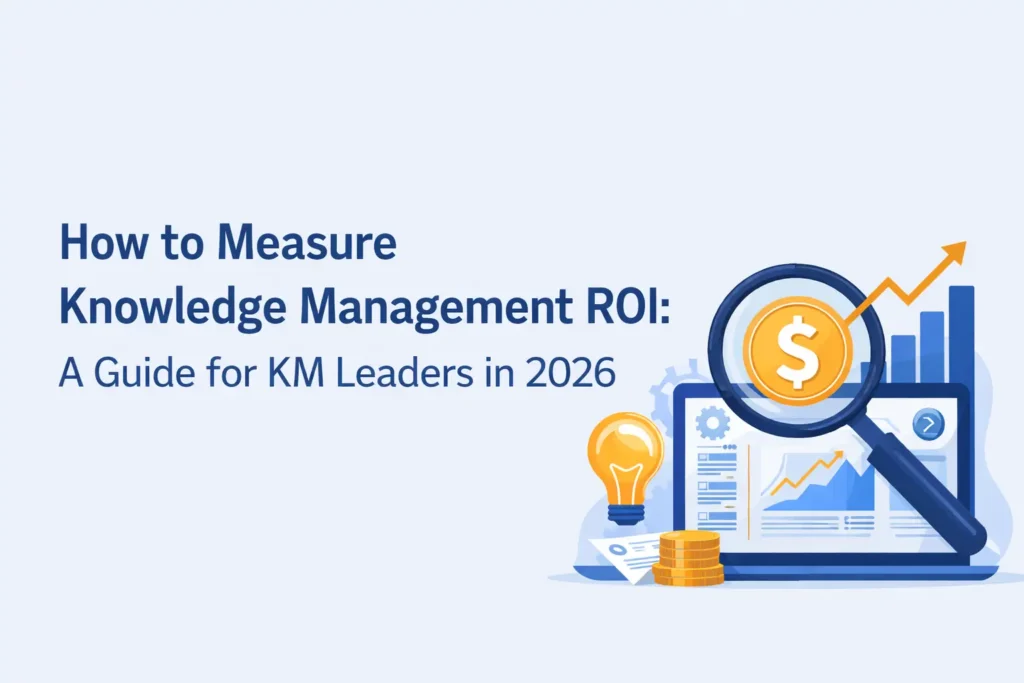
Knowledge management has evolved from a nice-to-have organizational initiative to a critical business function that directly impacts competitive advantage, employee productivity, and bottom-line profitability. Yet despite this recognition, many organizations struggle with a fundamental challenge: how to quantify and communicate the return on investment (ROI) of their KM initiatives to executive leadership.
The challenge is real. According to recent research from the American Productivity & Quality Center (APQC), organizations invest billions annually in knowledge management systems, yet fewer than 40% can articulate clear, measurable ROI metrics to justify these investments . This measurement gap creates a precarious situation where KM programs, despite delivering genuine value, remain vulnerable to budget cuts during economic downturns or organizational restructuring.
This comprehensive guide addresses this critical gap by providing KM leaders with practical frameworks, proven metrics, and real-world case studies for measuring and communicating KM ROI. Whether you’re justifying an initial KM investment, demonstrating the value of an existing program, or optimizing your current approach, this article will equip you with the tools and knowledge to build a compelling business case grounded in data.
Understanding the KM ROI Challenge
Before diving into measurement frameworks, it’s essential to understand why KM ROI measurement is uniquely challenging compared to other business investments.
The Intangibility Problem
Unlike manufacturing equipment or software licenses, knowledge assets are inherently intangible. You cannot physically point to “improved decision-making” or “faster problem-solving” the way you can point to a new production line. This intangibility makes it tempting to rely on soft metrics like user satisfaction or adoption rates, but these proxy measures often fail to convince financially-minded executives who want to see concrete business impact.
The Attribution Challenge
Knowledge management initiatives rarely operate in isolation. When productivity improves, it’s often the result of multiple factors: better tools, improved processes, staff training, market conditions, and yes, better knowledge management. Isolating the specific contribution of KM to overall business outcomes requires sophisticated analytical approaches that many organizations lack.
The Time Horizon Mismatch
KM benefits often materialize over extended periods. A comprehensive knowledge management system might take 18-24 months to deliver measurable ROI, while executive stakeholders often expect to see results within 6-12 months. This temporal mismatch can lead to premature judgments about program effectiveness.
The Business Case for KM ROI Measurement
Before investing in measurement infrastructure, it’s worth understanding why rigorous ROI measurement matters beyond simply justifying budgets.
Strategic Alignment
When you measure KM ROI systematically, you’re forced to articulate how knowledge management connects to specific business outcomes. This process naturally aligns KM initiatives with organizational strategy, ensuring that knowledge investments target areas with the highest business impact.
Continuous Improvement
Measurement data reveals which KM initiatives deliver the strongest returns and which underperform. This insight enables KM leaders to reallocate resources from low-impact activities to high-impact ones, continuously optimizing program effectiveness.
Stakeholder Confidence
Executives and board members make better decisions when supported by credible data. Demonstrating KM ROI with rigorous measurement builds confidence in the program, making it easier to secure ongoing funding and executive sponsorship.
Competitive Advantage
Organizations that effectively measure and optimize KM ROI gain a compounding advantage. They continuously improve their knowledge management practices based on data, while competitors operating without measurement frameworks stagnate.
Core KM ROI Metrics Framework
Effective KM ROI measurement requires a balanced portfolio of metrics that capture different dimensions of value creation. The following framework organizes these metrics into four categories:
1. Productivity Metrics
Productivity improvements represent one of the most direct and measurable forms of KM value. When employees spend less time searching for information or reinventing solutions, they have more time for high-value work.
Time Savings Metrics
The most straightforward productivity metric is time saved. Organizations can measure this through employee surveys, time tracking studies, or process analysis. For example, if a knowledge management system reduces the average time to resolve a customer support ticket from 45 minutes to 35 minutes, that’s a 22% improvement. Multiplied across thousands of support interactions annually, this translates to thousands of hours recovered.
To calculate productivity ROI from time savings:
Productivity ROI = (Hours Saved × Hourly Labor Cost) – KM Program Costs
A mid-sized financial services firm implemented a knowledge management system for its 200-person compliance team. Through process analysis, they determined that the system reduced average research time per compliance review from 3 hours to 2 hours. With an average fully-loaded hourly cost of $85 per compliance officer, this delivered annual time savings of:
(200 employees × 250 working days × 1 hour saved × $85) = $4.25 million in annual productivity gains
Against annual KM program costs of $800,000 (including software, maintenance, and staffing), this yielded an ROI of 431% in the first year.
Quality and Error Reduction
Beyond time savings, knowledge management systems improve work quality by ensuring employees access current, accurate information. This reduces errors, rework, and costly mistakes.
Manufacturing organizations particularly benefit from this metric. When technicians access standardized, current procedures through a knowledge management system rather than relying on outdated printed manuals or tribal knowledge, defect rates typically decline by 15-30%. In industries where defects carry significant costs (automotive, pharmaceuticals, aerospace), this quality improvement alone justifies substantial KM investments.
2. Revenue Impact Metrics
While productivity metrics capture cost savings, revenue impact metrics quantify how KM initiatives contribute to top-line growth.
Sales Velocity and Deal Size
Sales organizations benefit significantly from knowledge management systems that provide sales teams with competitive intelligence, customer insights, and proposal templates. Organizations with mature KM systems in sales typically see:
- 20-30% faster sales cycles (measured from initial contact to contract signature)
- 15-25% increase in average deal size (as sales teams access more comprehensive customer information and solution configurations)
- 10-15% improvement in win rates (through better competitive positioning and proposal quality)
A B2B software company with 150 sales professionals implemented an AI-powered knowledge management system providing instant access to competitive intelligence, customer case studies, and solution configurations. Within 12 months:
- Average sales cycle compressed from 120 days to 90 days
- Average deal size increased from $250,000 to $290,000
- Win rate improved from 28% to 32%
With an average contract value of $290,000 and annual sales target of $50 million, these improvements translated to:
- Faster cash conversion: 25% reduction in sales cycle meant cash arrived 30 days earlier on average
- Higher revenue: The improved win rate and deal size increased annual revenue by approximately $8 million
- Reduced sales costs: Faster cycles meant the same sales team could close more deals
Against KM program costs of $1.2 million annually, this represented an ROI of 567% from revenue impact alone.
Customer Retention and Lifetime Value
Knowledge management systems that improve customer support quality and reduce resolution times directly impact customer retention and lifetime value. Organizations typically see:
- 10-20% improvement in customer satisfaction scores (CSAT)
- 15-25% reduction in customer churn rates
- 20-30% increase in customer lifetime value
3. Innovation and Strategic Metrics
Some of the most valuable KM benefits are strategic in nature, contributing to innovation, competitive positioning, and long-term organizational resilience.
Time to Innovation
Knowledge management systems accelerate innovation by enabling teams to build on existing knowledge rather than starting from scratch. Organizations with mature KM systems typically bring new products to market 20-40% faster than competitors.
A pharmaceutical company with a comprehensive KM system for research data and methodology achieved:
- 18-month reduction in average drug development timeline (from 8 years to 6.5 years)
- 35% reduction in failed development projects (through better knowledge of what has and hasn’t worked)
- Ability to pursue 40% more research initiatives with the same R&D budget
While the financial impact of accelerated drug development is substantial, it’s also complex to calculate precisely. However, even conservative estimates show that bringing a single drug to market 18 months earlier can generate $500 million to $1 billion in additional revenue, depending on the drug’s market potential.
Competitive Intelligence and Market Response
Organizations with effective KM systems respond faster to competitive threats and market opportunities. This agility translates to competitive advantage and market share gains.
Knowledge Retention and Organizational Resilience
When experienced employees leave, organizations lose valuable knowledge. Effective KM systems capture and preserve this knowledge, reducing the impact of employee turnover. Organizations with mature KM systems experience:
- 30-50% faster onboarding of new employees
- 20-40% reduction in knowledge loss when key employees depart
- 15-25% improvement in organizational resilience during periods of high turnover
4. Risk Mitigation Metrics
KM systems reduce organizational risk by ensuring compliance, consistency, and institutional memory.
Compliance and Regulatory Risk
In regulated industries (financial services, healthcare, pharmaceuticals), knowledge management systems ensure consistent application of policies and procedures, reducing compliance violations and associated penalties.
A financial services firm with 5,000 employees across 50 branches implemented a KM system to ensure consistent application of regulatory requirements. This delivered:
- 85% reduction in compliance violations (from 200 violations annually to 30)
- $5 million annual reduction in regulatory fines and remediation costs
- Improved audit scores and regulator relationships
Business Continuity and Disaster Recovery
Knowledge management systems preserve critical organizational knowledge, enabling faster recovery from disruptions. Organizations with comprehensive KM systems recover from operational disruptions 40-60% faster than those without.
Implementing a KM ROI Measurement Program
Measurement frameworks are only valuable if they’re actually implemented. Here’s a practical approach to establishing KM ROI measurement in your organization:
Step 1: Define Your Measurement Objectives
Before implementing any metrics, clarify what you’re trying to measure and why. Are you trying to:
- Justify initial KM investment?
- Demonstrate ongoing value to secure continued funding?
- Optimize KM program allocation?
- Communicate KM impact to specific stakeholders?
Different objectives require different metrics. A measurement program designed to justify initial investment might emphasize productivity and cost savings, while a program designed to optimize allocation might emphasize comparative ROI across different KM initiatives.
Step 2: Select Your Metrics
Based on your measurement objectives and business context, select 4-6 core metrics that you’ll track consistently. Avoid the temptation to measure everything; a focused set of metrics is more credible and actionable than a comprehensive but overwhelming dashboard.
For most organizations, a balanced portfolio includes:
- One productivity metric (time savings or quality improvement)
- One revenue metric (sales velocity, customer retention, or deal size)
- One strategic metric (innovation speed, competitive response, or knowledge retention)
- One risk metric (compliance violations or business continuity)
Step 3: Establish Baselines
Before measuring improvement, establish clear baselines for your selected metrics. This requires:
- Historical data analysis (if available)
- Current state assessments (surveys, process analysis, time studies)
- Stakeholder interviews to understand current performance
Baseline establishment typically takes 2-4 weeks and is essential for credible ROI calculation.
Step 4: Implement Data Collection
Design data collection processes that are:
- Automated where possible: Use system logs, CRM data, and HR systems to automatically capture metrics
- Non-intrusive: Avoid measurement approaches that create significant burden on employees
- Consistent: Ensure measurement methodology remains consistent over time
- Validated: Periodically validate automated metrics against manual spot-checks
Step 5: Establish Governance and Review Cadence
Assign ownership for each metric, establish data quality standards, and establish a regular review cadence (typically monthly or quarterly). This ensures metrics remain credible and actionable.
Real-World Case Study: Global Manufacturing Organization
To illustrate how these principles work in practice, consider a global manufacturing organization with 8,000 employees across 12 facilities.
Challenge
The organization struggled with inconsistent manufacturing practices across facilities, leading to quality variations, safety incidents, and inefficient knowledge transfer when employees transferred between locations.
KM Initiative
The organization implemented a comprehensive knowledge management system that captured:
- Standard operating procedures for all manufacturing processes
- Best practices and lessons learned from each facility
- Safety protocols and incident documentation
- Troubleshooting guides for common equipment issues
Measurement Approach
The organization established a balanced measurement program tracking:
- Quality: Defect rates per million units produced
- Safety: Lost-time injury rate and near-miss incidents
- Efficiency: Production cycle time and equipment downtime
- Knowledge Transfer: Time to full productivity for transferred employees
Results (Year 1)
- Defect rates declined 22% (from 450 to 350 defects per million units)
- Lost-time injury rate declined 35% (from 8.2 to 5.3 per 200,000 hours worked)
- Production cycle time improved 18% (from 12 hours to 9.8 hours per unit)
- New employee time to full productivity reduced 40% (from 6 months to 3.6 months)
ROI Calculation
| Metric | Annual Impact | Calculation |
|---|---|---|
| Quality Improvement | $4.2M | 100,000 units × $42 cost per defect × 22% improvement |
| Safety Improvement | $2.8M | Reduced workers’ comp claims and incident costs |
| Efficiency Gains | $6.5M | 18% cycle time improvement × production volume × labor cost |
| Knowledge Transfer | $1.8M | 40% faster productivity × 200 new hires × annual salary |
| Total Annual Benefit | $15.3M | |
| KM Program Cost | $2.1M | Software, implementation, staffing |
| Year 1 ROI | 629% |
Common Pitfalls to Avoid
As you implement KM ROI measurement, avoid these common mistakes:
Pitfall 1: Measuring Only Easy Metrics
Organizations often measure only easily quantifiable metrics (like system adoption rates) while ignoring harder-to-measure but more valuable metrics (like decision quality or innovation speed). Resist this temptation. The most important metrics are often the hardest to measure, but they’re also the most valuable.
Pitfall 2: Attributing All Improvement to KM
When productivity improves after implementing a KM system, it’s tempting to attribute all improvement to the system. In reality, multiple factors contribute. Use control groups, statistical analysis, or conservative attribution assumptions to ensure your ROI calculations are credible.
Pitfall 3: Ignoring Negative ROI
Some KM initiatives deliver negative ROI. Rather than hiding these results, use them as learning opportunities. Understand why certain initiatives underperformed and adjust your approach accordingly.
Pitfall 4: Measuring Only Short-Term Impact
KM benefits often compound over time. A system that delivers 200% ROI in year one might deliver 400% ROI by year three as adoption deepens and organizational learning accelerates. Track long-term impact, not just initial returns.
Conclusion
Measuring knowledge management ROI is challenging but essential. Organizations that master this discipline gain three critical advantages: they can justify continued investment in KM initiatives, they can optimize KM program allocation based on data, and they can communicate KM value to stakeholders in language they understand and trust.
The frameworks and approaches outlined in this article provide a starting point. Your specific measurement program should be tailored to your organizational context, business objectives, and available data. Start with a focused set of metrics, implement them rigorously, and refine your approach based on what you learn.
In an era where knowledge is increasingly recognized as a critical competitive asset, organizations that can measure and optimize knowledge management ROI will outpace competitors who treat KM as a cost center rather than a strategic investment.
References
[1] American Productivity & Quality Center (APQC). (2025). “Key Measures and ROI for Knowledge Management.” Retrieved from https://www.apqc.org/resource-library/resource-collection/key-measures-and-roi-knowledge-management
[2] Bloomfire. (2025). “How to Measure the ROI of Knowledge Management.” Retrieved from https://bloomfire.com/blog/roi-knowledge-management/
[3] Market Logic Software. (2025). “How to Measure Knowledge Management ROI.” Retrieved from https://marketlogicsoftware.com/blog/how-measure-knowledge-management-roi/
[4] DevStark. (2025). “The Real ROI of AI in Knowledge Management.” Retrieved from https://www.devstark.com/blog/roi-ai-in-knowledge-management/
[5] Nakash, M., & Bouhnik, D. (2022). “Can Return on Investment in Knowledge Management Initiatives in Organizations Be Measured?” Aslib Journal of Information Management, 74(3), 417-440.
[6] Bose, R. (2004). “Knowledge Management Metrics.” Industrial Management & Data Systems, 104(6), 457-468.