AI knowledge management software uses artificial intelligence to capture, organize, and deliver organizational knowledge more efficiently. Modern AI knowledge platforms provide capabilities such as automated knowledge extraction, semantic search, and generative AI assistants that help employees quickly find relevant information. These technologies improve knowledge discovery, reduce information silos, and enable organizations to use their collective knowledge more effectively.
Knowledge has always been one of the most valuable assets within organizations. Companies invest enormous effort in creating documentation, research insights, operational procedures, and technical expertise. Yet much of this knowledge remains difficult to locate or use effectively.
Employees frequently spend significant time searching through documents, emails, and internal systems to find information that already exists. This challenge becomes even greater in large enterprises where knowledge is distributed across multiple teams, departments, and digital platforms.
AI knowledge management software is transforming how organizations address this problem. By applying artificial intelligence to knowledge repositories, modern knowledge platforms can automatically organize information, understand user intent, and deliver relevant insights in real time.
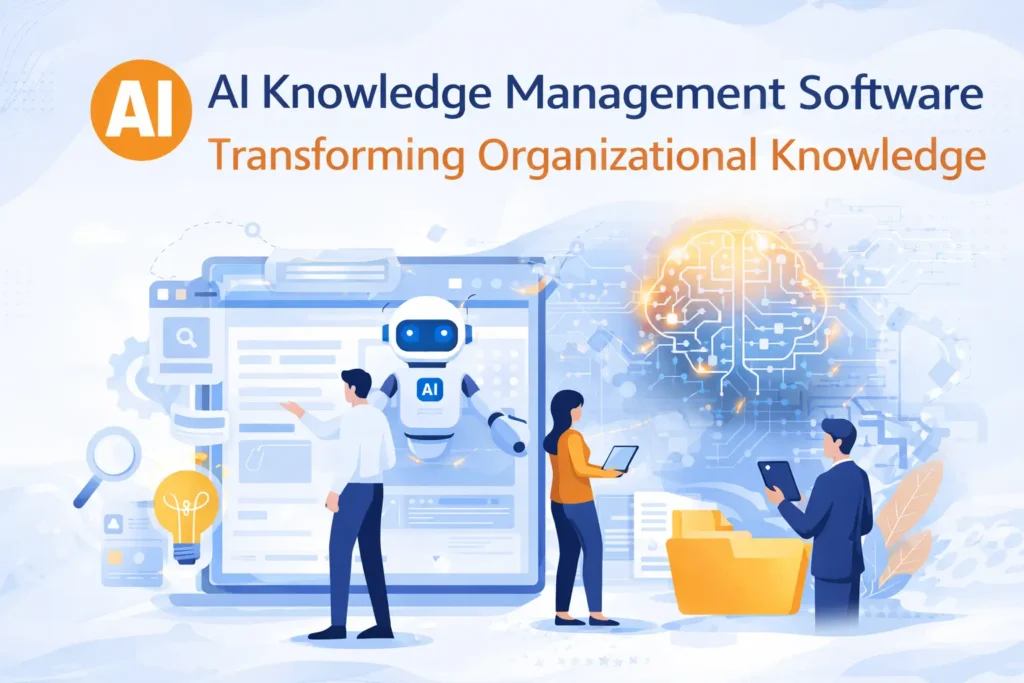
These capabilities allow organizations to unlock the full value of their knowledge assets and support faster decision making across the enterprise.
Read: 7 Knowledge Management Software Features Every Enterprise Needs
What Is AI Knowledge Management Software
AI knowledge management software refers to digital platforms that use artificial intelligence technologies to capture, organize, and deliver knowledge more intelligently.
Traditional knowledge management systems primarily relied on manual tagging and simple keyword searches. While these systems could store large volumes of information, they often struggled to deliver the right knowledge at the right time.
Artificial intelligence introduces several powerful capabilities that improve knowledge management systems.
AI algorithms can analyze documents, extract key information, and automatically classify knowledge assets. Natural language processing enables systems to understand questions posed in everyday language rather than requiring precise keyword searches.
Machine learning models can also identify patterns in how employees search for information and recommend relevant knowledge resources.
These capabilities significantly enhance knowledge discovery and improve the overall usability of enterprise knowledge platforms.
Why AI Is Transforming Knowledge Management
The volume of information created by modern organizations continues to grow rapidly. Teams generate new documentation, product information, research insights, and operational data every day.
Without intelligent systems to manage this information, knowledge quickly becomes fragmented across multiple repositories.
AI knowledge management software helps organizations address several critical challenges.
First, artificial intelligence improves knowledge discovery. Instead of forcing employees to search through multiple systems, AI platforms analyze content across repositories and deliver the most relevant results.
Second, AI automates knowledge organization. Rather than relying solely on manual classification, machine learning models can automatically tag and categorize information.
Third, AI enables proactive knowledge delivery. Systems can recommend relevant knowledge resources based on the user’s role, project context, or recent activity.
These capabilities reduce the time employees spend searching for information and improve the overall efficiency of knowledge-driven organizations.
Key Capabilities of AI Knowledge Management Platforms
Modern AI knowledge platforms offer a range of advanced capabilities that extend far beyond traditional document repositories.
Some of the most impactful capabilities include automated knowledge extraction, semantic search, and generative knowledge assistants.
Automated Knowledge Extraction
One of the most powerful features of AI knowledge management software is automated knowledge extraction.
Organizations often store knowledge across a wide range of content formats including documents, emails, presentations, videos, and technical reports. Extracting meaningful insights from this content manually can be extremely time consuming.
AI-powered systems use natural language processing and machine learning to analyze these documents and identify key information automatically.
For example, AI models can detect topics, summarize documents, identify important concepts, and extract relevant metadata.
This automated extraction process significantly reduces the effort required to organize knowledge repositories and ensures that valuable information becomes searchable and accessible.
AI Knowledge Discovery
Knowledge discovery refers to the ability to locate relevant information quickly within large knowledge repositories.
Traditional search systems often rely on keyword matching, which can produce incomplete or irrelevant results when users do not know the exact terms used in a document.
AI knowledge discovery systems use semantic search techniques to understand the meaning behind user queries.
For example, if an employee asks a question about resolving a technical issue, the system may retrieve documentation, troubleshooting guides, and previous support cases related to that topic.
Because AI systems understand relationships between concepts, they can deliver results that are far more relevant than traditional search tools.
This capability significantly improves the usability of knowledge repositories and ensures that employees can find the information they need when they need it.
Generative AI Knowledge Assistants
Generative AI is introducing a new way for employees to interact with knowledge systems.
Instead of searching through documents manually, employees can ask questions directly to AI knowledge assistants using natural language.
These assistants analyze organizational knowledge repositories and generate responses based on relevant documentation and insights.
For example, an employee may ask a question about company policies, product specifications, or operational procedures.
The generative AI assistant can synthesize information from multiple documents and deliver a clear response within seconds.
This conversational interface dramatically simplifies knowledge access and allows employees to retrieve information without navigating complex documentation systems.
Leading AI Knowledge Management Software Tools
Several knowledge management platforms are integrating artificial intelligence capabilities to improve knowledge discovery and collaboration.
Enterprise organizations increasingly adopt these tools to enhance productivity and knowledge sharing.
Some widely recognized platforms include Guru, Notion AI, Atlassian Intelligence for Confluence, and Bloomfire.
These platforms incorporate AI-powered search, automated tagging, and generative knowledge assistants that help employees interact with knowledge more effectively.
Each platform approaches AI knowledge management differently, but all aim to reduce information silos and make organizational knowledge easier to access.
Enterprise Benefits of AI Knowledge Management Software
Organizations adopting AI-powered knowledge management platforms experience several significant benefits.
First, employees gain faster access to information. Intelligent search and knowledge recommendations allow teams to locate relevant resources quickly.
Second, organizations reduce knowledge duplication. When employees can easily locate existing documentation, they are less likely to recreate information that already exists.
Third, AI systems preserve institutional knowledge. Valuable insights captured in documents and conversations remain accessible even as employees change roles or leave the organization.
Fourth, decision making improves. When employees have access to accurate knowledge resources, they can make more informed decisions and respond more effectively to business challenges.
These benefits demonstrate why AI knowledge management software is becoming a critical component of modern digital workplaces.
The Future of AI in Knowledge Management
Artificial intelligence will continue to play a growing role in knowledge management strategies.
Future AI knowledge platforms will likely incorporate more advanced capabilities such as predictive knowledge recommendations, automated knowledge summarization, and intelligent knowledge graphs.
These technologies will allow organizations to connect information across systems and reveal insights that were previously hidden within large knowledge repositories.
As AI continues to evolve, knowledge management platforms will become increasingly intelligent, proactive, and integrated with everyday workflows.
Organizations that adopt these technologies early will be better positioned to harness their collective knowledge and maintain a competitive advantage.