Knowledge management software features define how organizations capture, organize, and share institutional knowledge. Modern enterprise knowledge management software includes capabilities such as AI-powered search, taxonomy management, integrations, collaborative knowledge creation, and governance controls. These features help employees quickly find reliable information and reduce knowledge silos across the organization.
Knowledge management software features determine whether an organization can effectively capture and use its institutional knowledge. As enterprises grow, knowledge becomes fragmented across documents, collaboration tools, internal systems, and employee expertise. Without structured knowledge management platforms, employees spend valuable time searching for information that already exists.
Enterprise organizations rely on knowledge management software to organize knowledge, enable collaboration, and support better decision making. The right platform allows employees to locate relevant knowledge quickly while ensuring information remains accurate and governed.
However, not every platform offers the capabilities required for large organizations. Decision makers evaluating enterprise knowledge management software must focus on the features that support scalability, collaboration, governance, and intelligent knowledge discovery.
What Are Knowledge Management Software Features
Knowledge management software features are the core capabilities that allow organizations to capture, organize, and distribute knowledge effectively. These features enable employees to locate information quickly, collaborate across departments, and maintain reliable knowledge repositories that support daily operations and decision making.
Read: 10 Best Knowledge Management Software Platforms for Enterprises
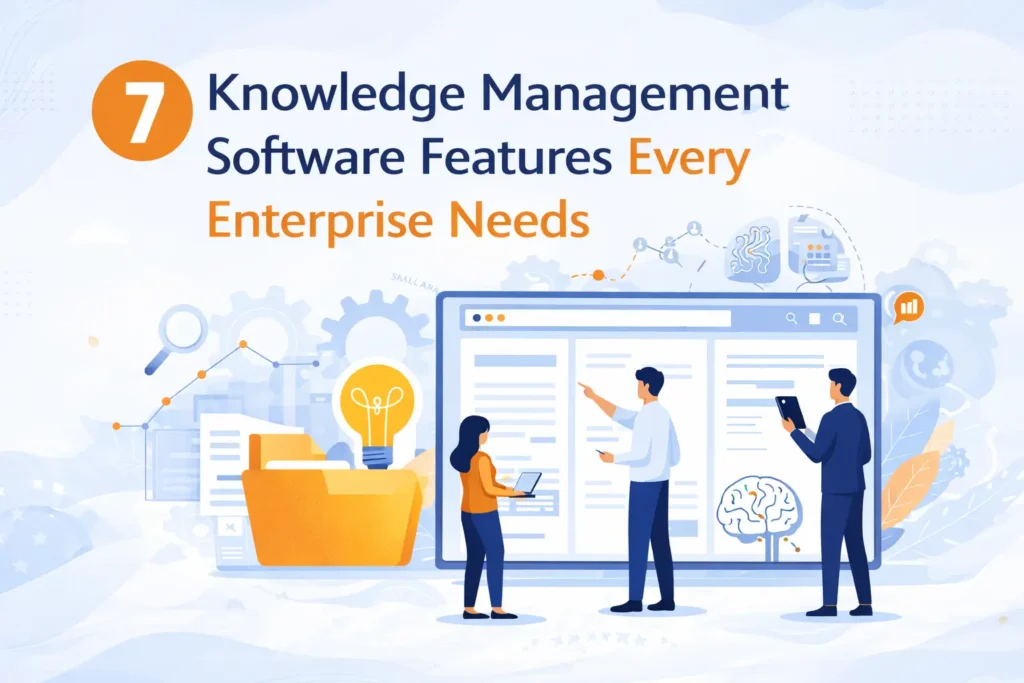
The following seven knowledge management software features represent the core capabilities that modern enterprises require when selecting a knowledge management system.
AI Powered Knowledge Search and Discovery
One of the most important knowledge management software features in modern platforms is intelligent search. Traditional keyword search often fails in enterprise environments because knowledge is stored across multiple repositories and content formats.
AI-powered search improves knowledge discovery by understanding context, intent, and semantic relationships between topics. Instead of relying on exact keyword matches, AI knowledge management software analyzes user queries and delivers relevant information even when wording differs.
For example, an employee searching for guidance on resolving a technical issue may receive results that include documentation, troubleshooting guides, internal discussions, and relevant training materials.
AI search engines can also recommend related knowledge based on user roles, previous searches, and project context. This capability significantly reduces the time employees spend searching for information.
Organizations implementing enterprise knowledge management software increasingly rely on AI-powered discovery tools to make knowledge more accessible across departments.
Structured Taxonomy and Knowledge Organization
Another critical capability of knowledge management platforms is the ability to structure information effectively. Without clear organization, knowledge repositories quickly become difficult to navigate.
Taxonomy management allows organizations to classify knowledge using categories, tags, and metadata. A well-designed taxonomy ensures that knowledge is organized in a way that aligns with how employees search for information.
For example, a global enterprise may structure knowledge according to departments, business processes, product lines, and geographic regions. This structured organization improves discoverability and ensures that knowledge remains logically grouped.
Knowledge management software that supports flexible taxonomy models allows organizations to adapt their classification structures as business needs evolve.
Effective taxonomy management is particularly important for enterprises that manage large knowledge repositories containing thousands of documents and knowledge assets.
Seamless Integration with Enterprise Systems
Modern organizations operate within complex digital ecosystems. Knowledge management software must integrate with the systems employees already use in their daily workflows.
Common integrations include collaboration tools, customer relationship management systems, project management platforms, and enterprise communication tools.
For example, knowledge management platforms often integrate with systems such as Microsoft Teams, Slack, Jira, Salesforce, and service management platforms.
These integrations ensure that knowledge is accessible within the tools employees already rely on. Instead of switching between multiple systems, employees can access relevant knowledge directly within their workflow environment.
This integration capability is one of the defining features of enterprise knowledge management software because it ensures that knowledge remains connected to operational processes.
Collaborative Knowledge Creation
Knowledge creation is rarely an individual activity. In most organizations, knowledge is created through collaboration between teams, departments, and subject matter experts.
Knowledge management platforms must support collaborative content creation through shared editing, commenting, and review workflows. Employees should be able to contribute expertise, refine documentation, and improve knowledge assets collectively.
Collaborative editing features allow multiple contributors to work on documentation simultaneously while maintaining version control.
For example, engineering teams may collaborate on technical documentation while product teams contribute product insights and support teams provide troubleshooting knowledge.
This collaborative environment encourages continuous improvement of knowledge assets and ensures that documentation reflects the collective expertise of the organization.
Knowledge Governance and Content Quality Control
Enterprise organizations require strong governance frameworks to ensure that knowledge remains accurate, reliable, and compliant with internal policies.
Knowledge management software must support governance mechanisms such as approval workflows, content ownership, and review cycles.
Content owners and subject matter experts should be responsible for maintaining specific knowledge assets. Governance workflows allow organizations to establish processes for reviewing and approving content before publication.
Version control also plays a critical role in governance. Employees must be able to track changes, access previous versions, and understand how knowledge has evolved over time.
These governance capabilities ensure that enterprise knowledge repositories remain trustworthy and that employees rely on accurate information when making decisions.
Advanced Analytics and Knowledge Insights
Understanding how knowledge is used within an organization is essential for improving knowledge management strategies.
Modern knowledge management platforms provide analytics capabilities that reveal how employees interact with knowledge assets.
Analytics dashboards may track metrics such as document usage, search queries, knowledge gaps, and content performance.
For example, organizations may identify frequently searched topics that lack sufficient documentation. These insights allow knowledge managers to prioritize the creation of new knowledge resources.
Analytics also help organizations measure the effectiveness of knowledge management initiatives by showing how knowledge usage improves productivity and reduces support requests.
Enterprise knowledge management software that provides actionable insights enables organizations to continuously refine their knowledge strategies.
Security and Access Control
Enterprise knowledge repositories often contain sensitive information such as internal procedures, product strategies, and proprietary research.
Knowledge management software must provide robust security controls that ensure knowledge is accessible only to authorized users.
Role-based access control allows organizations to define who can view, edit, or manage specific knowledge assets. Different departments may require different access levels depending on their responsibilities.
For example, financial documentation may be accessible only to finance teams, while technical documentation may be available to engineering teams.
Enterprise knowledge management platforms also support audit logs and activity tracking, allowing organizations to monitor how knowledge is accessed and modified.
These security features ensure that knowledge management systems protect sensitive information while still enabling knowledge sharing.
Why These Knowledge Management Software Features Matter
The effectiveness of a knowledge management system depends on the capabilities it provides. Organizations that invest in platforms with advanced knowledge management software features create environments where knowledge flows freely across teams.
Employees gain faster access to reliable information, collaboration improves, and institutional knowledge becomes a strategic asset rather than an overlooked resource.
As enterprises continue to embrace digital transformation, knowledge management platforms play a central role in supporting innovation and operational efficiency.
Organizations evaluating enterprise knowledge management software should focus on the features that enable intelligent discovery, structured knowledge organization, collaboration, and governance.
When these capabilities are implemented effectively, knowledge management software becomes one of the most valuable systems within the modern enterprise.
Frequently Asked Questions