Knowledge management and artificial intelligence are increasingly discussed together, often with the assumption that AI will finally solve long-standing KM challenges. Search will improve. Answers will be instant. Knowledge will become accessible to everyone.
Yet as organizations begin to integrate AI into knowledge systems, a more complex reality is emerging. AI does not simply enhance knowledge management. It changes the conditions under which knowledge is created, trusted, and applied. In doing so, it exposes weaknesses that many organizations had learned to work around rather than resolve.
Understanding the relationship between knowledge management and artificial intelligence requires moving beyond tools and capabilities. It requires examining how organizations remember, how judgment is exercised, and how responsibility is assigned when knowledge informs action.
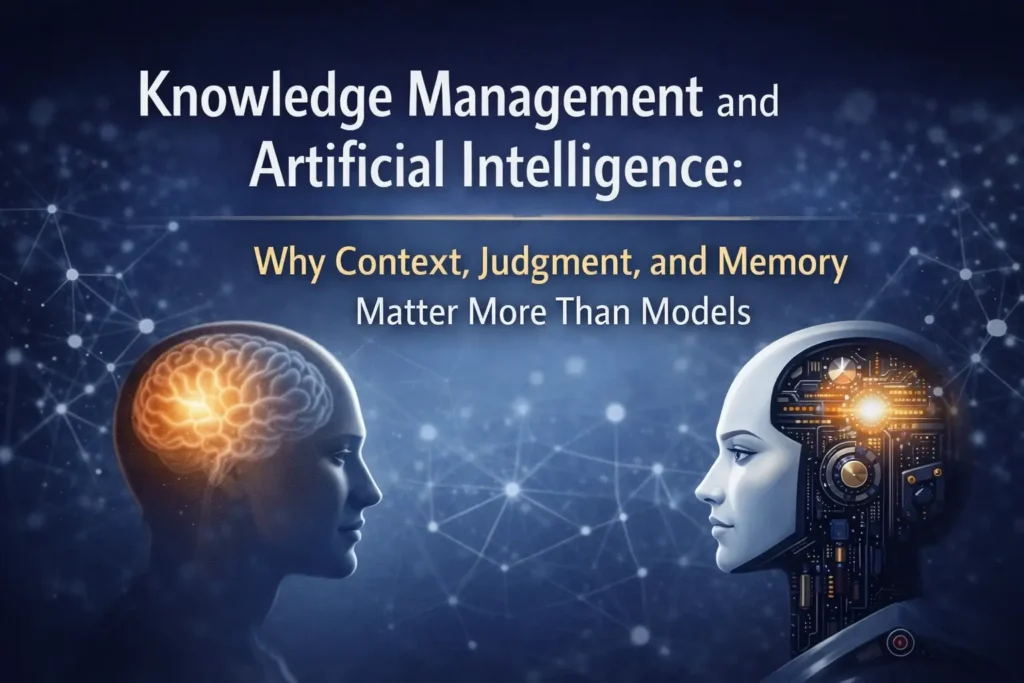
Why Knowledge Management Looks Different Once AI Enters the Organization
Traditional knowledge management systems were largely passive. They stored documents, supported retrieval, and relied on people to interpret what they found. Even when systems were poorly structured, experienced employees compensated by applying context, history, and professional judgment.
Artificial intelligence alters this balance. AI systems do not simply retrieve information. They summarize, synthesize, and recommend. They shape what users see first and how problems are framed. Over time, they influence decisions even when humans remain formally accountable.
This shift matters because AI systems operate on patterns, not organizational intent. They optimize for coherence and probability, not for institutional memory or ethical responsibility. When knowledge is presented fluently and confidently, it acquires authority, regardless of whether the underlying context is complete.
For knowledge management, this represents a structural change. Knowledge is no longer just accessed. It is operationalized.
The Risk of Treating Knowledge as Data
One of the most common mistakes organizations make when combining knowledge management and artificial intelligence is treating knowledge as a data problem. Content is ingested, vectorized, and made available for AI-driven interaction. From a technical perspective, the system works.
From an organizational perspective, something critical is lost.
Knowledge is not simply information. It is information interpreted within a specific context, shaped by experience, constraints, and past decisions. Much of what makes organizational knowledge valuable is tacit rather than explicit. It lives in explanations, exceptions, and stories about why something was done a certain way.
AI systems flatten this complexity. They extract patterns and remove friction. In doing so, they often remove the very signals that help people exercise judgment. The result is knowledge that appears usable but is increasingly detached from the conditions under which it should be applied.
This is not a failure of artificial intelligence. It is a failure of how knowledge is framed.
Read: Knowledge Management Trends in 2026: Navigating a New Frontier
Accuracy Is Not the Same as Trust
Discussions about AI and knowledge management often focus on accuracy. Are the answers correct? Are hallucinations minimized? Is the training data reliable?
Accuracy matters, but it is not sufficient.
Organizations do not fail because they occasionally access incorrect information. They fail because they act confidently on knowledge that should have been questioned. AI systems, by design, reduce friction. They produce fluent responses that discourage hesitation.
Trust, however, is built through transparency, not fluency. Users trust knowledge when they understand its source, its limits, and its relevance to their situation. They trust systems that reveal uncertainty rather than hiding it.
In AI-enabled knowledge environments, trust must be actively designed. This requires knowledge management to play a governance role, not just a curatorial one.
Institutional Memory as the Missing Layer
Institutional memory is often treated as a historical concern, something preserved for continuity or compliance. In the context of knowledge management and artificial intelligence, it becomes a control mechanism.
Institutional memory captures why decisions were made, not just what decisions were made. It preserves failed approaches alongside successful ones. It documents trade-offs, constraints, and exceptions. These elements are essential for judgment, yet they are precisely what AI systems tend to compress or discard.
When AI systems become the primary interface to organizational knowledge, there is a real risk that memory is replaced by narrative. The organization remembers the summary, not the struggle. Over time, this weakens learning and increases the likelihood of repeating mistakes.
Knowledge management must therefore protect institutional memory not as an archive, but as a living resource that informs current decisions.
Governance Is About Responsibility, Not Restriction
Governance is often resisted because it is associated with control and bureaucracy. In reality, governance in AI-enabled knowledge systems serves a different purpose. It clarifies responsibility.
When AI generates or synthesizes knowledge, questions arise that traditional KM never had to answer. Who is accountable for the output? Under what conditions should it be used? What happens when it is wrong?
These questions cannot be resolved through technical configuration alone. They require organizational agreement about authority, ownership, and risk.
Knowledge management provides the framework for these conversations. It defines what counts as authoritative knowledge, what is provisional, and what requires human judgment before action is taken. In this sense, KM becomes part of the organization’s governance and risk architecture.
Why Knowledge Management Becomes More Important, Not Less
There is a persistent narrative that artificial intelligence will reduce the need for knowledge management. In practice, the opposite is occurring.
As AI systems become more capable, the cost of poorly governed knowledge increases. Errors propagate faster. Assumptions become embedded in workflows. Decisions are made at scale.
Someone must decide what knowledge is appropriate for automation, what knowledge must remain mediated, and where judgment cannot be delegated. These decisions sit squarely within the domain of knowledge management.
KM professionals understand how knowledge is created, how it degrades, and how it is misused. In an AI-enabled organization, this understanding becomes strategic.
Designing Knowledge Systems That Can Live With AI
The goal is not to slow down artificial intelligence adoption. It is to design knowledge systems that can coexist with it responsibly.
This requires deliberate choices about what knowledge is surfaced automatically, how uncertainty is signaled, and where human intervention is required. It requires acknowledging that not all knowledge should be treated equally and that some forms of understanding cannot be reduced to patterns.
Organizations that succeed will not be those with the most advanced models. They will be those that respect the limits of automation and invest in the structures that preserve context and judgment.
Trust as the New Measure of KM Success
Traditional knowledge management metrics focused on volume, access, and reuse. In the era of artificial intelligence, these measures are no longer sufficient.
The central question becomes whether people trust the knowledge they receive. Trust determines whether systems are used thoughtfully or bypassed entirely. It shapes whether AI augments decision-making or undermines it.
Trust is not built through speed or sophistication. It is built through consistency, transparency, and restraint. Knowledge management plays a central role in establishing these qualities.
A More Mature Relationship Between KM and AI
Knowledge management and artificial intelligence are not competing disciplines. They address different dimensions of organizational intelligence. AI excels at pattern recognition and scale. KM excels at preserving meaning, memory, and responsibility.
Organizations that understand this distinction will design systems where AI supports inquiry rather than asserting authority, and where knowledge management ensures that context and judgment remain central.
The future of knowledge management is not threatened by artificial intelligence. It is clarified by it.
The question is whether organizations are willing to treat knowledge not as a technical asset, but as a shared responsibility.