Knowledge management trends in 2026 are no longer about improving intranets or organizing documents. They are shaping how organizations make decisions, reduce risk, and compete in complex digital environments. Enterprises are moving beyond static repositories toward dynamic knowledge ecosystems that convert distributed expertise into actionable insight.
Organizations that treat knowledge as an operational asset are seeing measurable gains in productivity, innovation, and speed. Those that continue to rely on fragmented systems are falling behind. The gap is becoming structural, not temporary.
This article examines the most important knowledge management trends in 2026 and what they mean for leaders responsible for strategy, operations, and digital transformation.
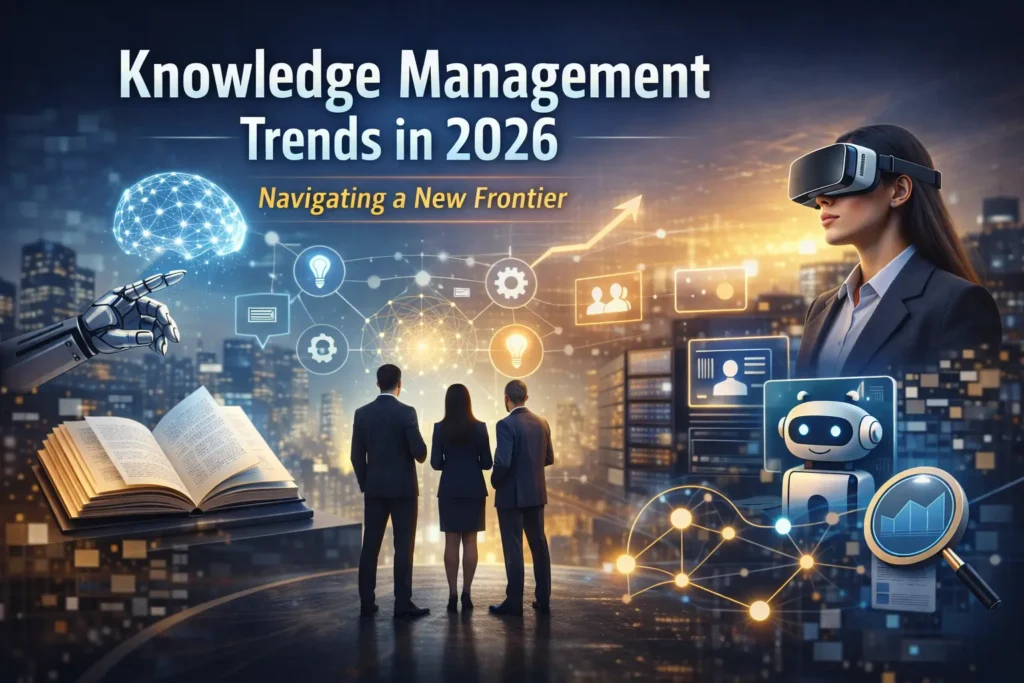
Table of Contents
- 1. AI-Ready Knowledge Foundations Are Becoming Mandatory
- 2. Knowledge Management Is Moving Into the Flow of Work
- 3. Hybrid Collaboration Is Redefining Knowledge Sharing
- 4. Capturing Tacit Knowledge Is Becoming a Strategic Priority
- 5. Knowledge Management Analytics Is Driving Better Decisions
- 6. Semantic Search Is Replacing Keyword-Based Search
- 7. Knowledge Graphs Are Connecting Enterprise Intelligence
- 8. Employee Experience Is Becoming a Core KM Objective
- 9. Knowledge Reuse Is Replacing Knowledge Creation
- 10. Measuring Knowledge Management ROI Is Now Essential
- Key Takeaways from Knowledge Management Trends 2026
- FAQs
1. AI-Ready Knowledge Foundations Are Becoming Mandatory
Artificial intelligence is now embedded across most modern knowledge management systems. However, the effectiveness of AI depends entirely on the quality of underlying knowledge assets.
Organizations are investing in structured content, taxonomy design, and governance frameworks to ensure AI systems produce reliable outputs. Poorly organized knowledge leads to inaccurate responses, while well-structured repositories enable AI to deliver precise and contextual answers.
Leading platforms such as Microsoft Viva and ServiceNow are already integrating AI copilots that surface knowledge directly within workflows. These systems reduce search time and improve decision-making efficiency across functions such as IT support, HR, and operations.
At the same time, governance is becoming critical. With regulations such as the EU AI Act, organizations must ensure transparency, explainability, and ethical use of AI-generated knowledge. New roles focused on AI governance within KM teams are beginning to emerge.
2. Knowledge Management Is Moving Into the Flow of Work
A major shift in knowledge management trends in 2026 is the integration of knowledge directly into daily workflows.
Employees no longer want to switch between systems to find information. Instead, knowledge must appear within the tools they already use. Integration with platforms such as Microsoft Teams, Slack, and CRM systems is now a baseline expectation.
For example, support teams receive automated knowledge suggestions while handling tickets, and sales teams access relevant documentation within their CRM. This reduces friction and increases adoption, which has historically been one of the biggest challenges in KM.
The organizations that succeed are those that eliminate the gap between work and knowledge access.
3. Hybrid Collaboration Is Redefining Knowledge Sharing
The shift to hybrid and distributed work has permanently changed how knowledge is created and shared.
Modern KM platforms are evolving into collaborative environments where employees co-create knowledge through shared documents, discussions, and real-time updates. Instead of static documentation, knowledge is continuously refined through interaction.
Communities of practice are also being redefined. These communities are becoming digital-first, often supported by AI that surfaces relevant insights, connects experts, and summarizes discussions.
However, technology alone is not sufficient. Organizations must actively build a culture of knowledge sharing, where contributions are recognized and encouraged.
4. Capturing Tacit Knowledge Is Becoming a Strategic Priority
One of the most critical knowledge management trends in 2026 is the focus on capturing tacit knowledge.
Tacit knowledge includes experience, intuition, and practical know-how that are rarely documented. As workforce mobility increases, organizations face a growing risk of losing this knowledge.
Modern KM approaches use lightweight methods to capture this information, including video recordings, voice notes, annotations, and collaborative discussions. AI is also being used to extract insights from meetings, emails, and workflows.
Organizations that systematically capture tacit knowledge are better positioned to maintain continuity, reduce onboarding time, and avoid repeated mistakes.
5. Knowledge Management Analytics Is Driving Better Decisions
Knowledge management is becoming increasingly data-driven.
Analytics capabilities now allow organizations to understand how knowledge is used, where gaps exist, and how content can be improved. Every search query, document interaction, and user behavior provides insights into knowledge effectiveness.
For example, repeated failed searches indicate missing content, while frequently accessed documents highlight high-value knowledge assets.
Advanced systems use AI to personalize knowledge delivery based on user roles, behavior, and context. This ensures that employees receive relevant information without manual searching.
6. Semantic Search Is Replacing Keyword-Based Search
Traditional keyword-based search is no longer sufficient for complex enterprise environments.
Semantic search, powered by natural language processing, enables users to ask questions in plain language and receive accurate, context-aware answers. These systems understand intent rather than relying on exact keyword matches.
For example, an employee can ask a question conversationally and receive a precise answer even if the wording does not match existing documentation.
This shift significantly improves user experience and reduces the time required to locate critical information.
7. Knowledge Graphs Are Connecting Enterprise Intelligence
Organizations are increasingly adopting knowledge graphs to connect data, documents, and expertise.
Knowledge graphs create relationships between concepts, enabling systems to understand how different pieces of information are linked. This allows for deeper insights and more accurate recommendations.
In industries such as pharmaceuticals and engineering, knowledge graphs are being used to accelerate research, identify patterns, and support innovation.
This approach moves KM beyond storage toward true enterprise intelligence.
8. Employee Experience Is Becoming a Core KM Objective
Knowledge management is now closely tied to employee experience.
Modern KM systems are designed to be intuitive, personalized, and accessible. Employees expect systems that deliver relevant knowledge quickly and without complexity.
Organizations are focusing on reducing friction by integrating knowledge into workflows, improving search capabilities, and providing AI-driven assistance.
Improved knowledge access leads to faster onboarding, reduced frustration, and higher overall productivity.
9. Knowledge Reuse Is Replacing Knowledge Creation
A key shift in knowledge management trends in 2026 is the emphasis on reuse rather than creation.
Organizations are recognizing that a significant amount of work is duplicated due to poor visibility of existing knowledge. By improving discoverability and accessibility, teams can build on existing insights instead of starting from scratch.
This reduces costs, accelerates project timelines, and improves consistency across the organization.
10. Measuring Knowledge Management ROI Is Now Essential
Knowledge management is no longer treated as a support function without measurable impact.
Organizations are now defining and tracking metrics that link KM to business outcomes. These include time saved, reduction in duplicate work, faster decision-making, and improved customer satisfaction.
For example, strong KM practices can significantly reduce the time employees spend searching for information, leading to measurable productivity gains.
Leaders are increasingly using dashboards to demonstrate the value of KM initiatives and secure continued investment.
Key Takeaways from Knowledge Management Trends 2026
Knowledge management in 2026 is defined by integration, intelligence, and measurable impact. Organizations are moving away from static systems toward dynamic, AI-enabled knowledge ecosystems.
The most important priorities include building structured knowledge foundations, integrating KM into workflows, capturing tacit expertise, and using analytics to continuously improve knowledge systems.
Leaders who align KM with business outcomes will see significant gains in efficiency, innovation, and competitive advantage.
FAQs
What are the key knowledge management trends in 2026
The key trends include AI integration, workflow-based knowledge delivery, semantic search, knowledge graphs, and increased focus on ROI and employee experience.
How is AI changing knowledge management
AI is enabling automation, personalization, and advanced analytics. It helps organizations deliver the right knowledge at the right time while reducing manual effort.
Why are knowledge management trends important
These trends directly impact productivity, decision-making, and innovation. Organizations that adopt modern KM practices gain a competitive advantage.
What industries benefit most from knowledge management
Industries such as healthcare, pharmaceuticals, consulting, IT services, and manufacturing benefit significantly due to their reliance on expertise and complex information.