Artificial intelligence has entered knowledge management through almost every available door.
It appears in enterprise search, knowledge bases, collaboration platforms, document management systems, customer support environments, learning platforms, meeting tools, and workplace assistants. Vendors increasingly describe their products as AI-powered, while organizations experiment with copilots, conversational search, automatic summarization, content generation, expertise identification, and retrieval-augmented generation.
The result is an expanding market of AI tools in knowledge management, but also considerable confusion.
The central question is no longer whether AI can support KM. It can. The more difficult question is where AI genuinely improves knowledge work and where it simply adds a new interface to an unresolved knowledge problem.
This distinction matters.
A chatbot connected to a poorly governed repository does not create a mature knowledge environment. Automatic summarization does not guarantee organizational learning. Semantic search does not solve unclear ownership. A generative AI assistant can produce a fluent answer while the underlying knowledge remains outdated, contradictory, incomplete, or stripped of important context.
AI tools should therefore be evaluated according to the knowledge problem they solve, not the sophistication of the model behind them.
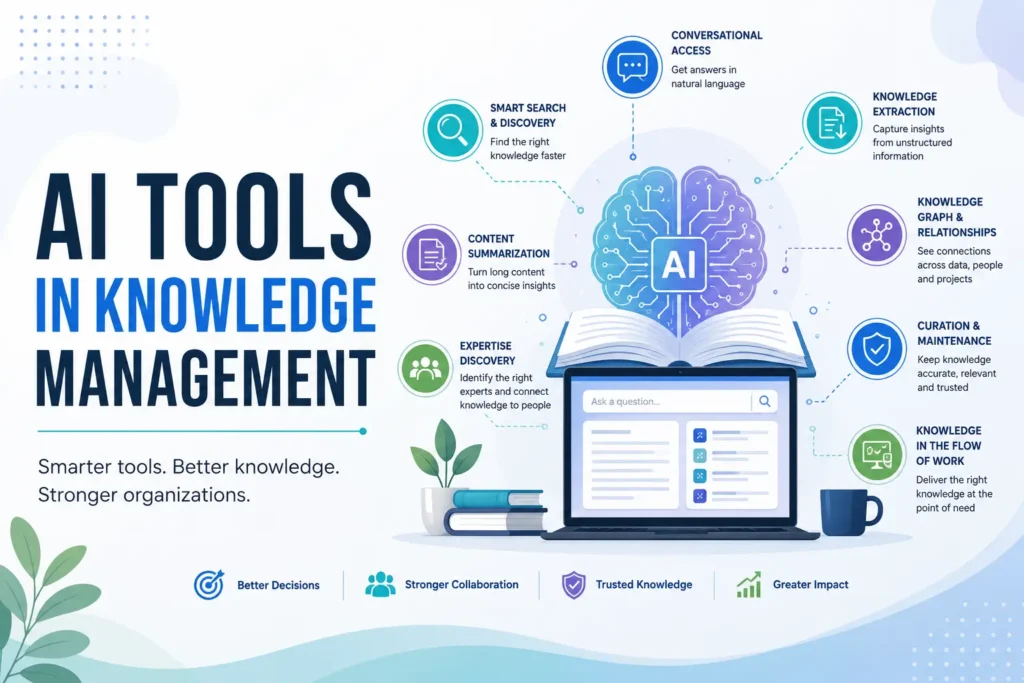
The most useful way to understand AI tools in knowledge management is not as a list of products. It is as a set of capabilities operating across the knowledge lifecycle. These capabilities include discovery and retrieval, conversational access, content processing, expertise discovery, knowledge extraction, relationship mapping, knowledge maintenance, workflow support, and organizational memory.
Each capability creates value under different conditions. Each also introduces limitations that KM leaders need to understand.
Table of Contents
- AI Is Changing the Interface to Organizational Knowledge
- AI-Powered Enterprise Search
- Conversational Knowledge Assistants and RAG
- AI for Knowledge Capture and Content Processing
- AI for Knowledge Organization and Metadata
- AI for Expertise Discovery
- Knowledge Graphs and GraphRAG
- AI for Knowledge Curation and Maintenance
- AI for Knowledge in the Flow of Work
- AI Agents and the Move from Answers to Actions
- Where AI Tools Still Fall Short
- Choosing AI Tools for Knowledge Management
- The Most Important AI Tool Is Still the Knowledge System Around It
AI Is Changing the Interface to Organizational Knowledge
For much of the history of enterprise knowledge management, the burden of discovery rested on the employee.
A person needed to know which repository to search, which terms to use, which document to trust, and how to interpret the material they found. Knowledge systems provided access, but the employee performed much of the work required to turn access into understanding.
AI is changing this relationship.
An employee can increasingly ask a question in natural language and receive a synthesized response based on multiple sources. Search systems can interpret meaning rather than relying only on exact keyword matches. Long documents can be summarized. Similar content can be clustered. Metadata can be suggested automatically. Relationships between concepts can be extracted from unstructured text.
These are meaningful advances.
APQC describes AI’s practical role in KM as supporting the capture, organization, and reuse of knowledge, with potential benefits for discovery, decision-making, and scalable knowledge transfer. This is a useful framing because it places AI inside KM processes rather than treating it as a replacement for the discipline.
The difference is important.
AI is powerful at processing scale. It can analyze more content than a human team could manually review, identify patterns across large information collections, and reduce the effort involved in repetitive knowledge tasks.
But KM addresses questions that AI alone cannot resolve.
Which knowledge is strategically important? Which source is authoritative? When should knowledge be retired? Who is accountable for accuracy? Which expertise should be consulted when sources conflict? What context is necessary before a lesson from one environment can be applied to another?
These remain organizational and knowledge management questions.
The most effective AI tools in knowledge management are therefore likely to be those that augment a well-designed knowledge system rather than attempt to substitute for one.
AI-Powered Enterprise Search
Search is one of the most mature areas in which AI can improve knowledge management.
Traditional enterprise search has often depended heavily on keyword matching. This creates obvious limitations. Employees do not always use the same terminology as the content they need. Different business units may use different language for similar concepts. A person may understand the problem but not know the vocabulary used by the expert who documented the solution.
Modern AI search approaches can combine several retrieval methods.
Lexical search remains useful when exact terms, product codes, policy names, error messages, or specific phrases matter. Semantic retrieval can identify content with similar meaning even when the exact words differ. Vector retrieval represents content numerically and can retrieve semantically related material. Hybrid approaches combine multiple retrieval signals rather than assuming one method is suitable for every question.
This matters because enterprise knowledge queries are heterogeneous.
A technician searching an exact fault code has a different retrieval need from a consultant asking for previous projects involving organizational restructuring. A compliance professional looking for the current version of a policy has a different need from a project team trying to understand what the organization has learned from several related initiatives.
The best search architecture depends on the knowledge task.
AI-powered search creates value when it improves relevance without removing traceability. Employees should still be able to understand where information came from, assess the authority of the source, and distinguish current guidance from historical material.
Search becomes dangerous when relevance is confused with truth.
A semantically similar document is not necessarily an authoritative document. A highly relevant passage may be obsolete. A frequently accessed source may still be wrong. AI can improve retrieval, but KM governance must determine which knowledge deserves trust.
Read: AI-Powered Knowledge Management: The Real State of Play in 2026
Conversational Knowledge Assistants and RAG
Conversational knowledge assistants are among the most visible AI tools in knowledge management.
Their appeal is obvious. Instead of searching through documents and assembling an answer manually, an employee asks a question and receives a direct response.
Many enterprise implementations use Retrieval-Augmented Generation, commonly known as RAG. In a RAG architecture, relevant information is retrieved from external knowledge sources and supplied as context to a language model before it generates a response. The purpose is to ground the answer in organizational knowledge rather than relying only on the model’s pretraining.
This architecture can significantly improve access to internal knowledge, particularly when users need synthesis across several sources.
However, RAG is frequently misunderstood as a complete KM solution.
It is not.
A retrieval pipeline cannot compensate indefinitely for poor source quality. If the source environment contains conflicting policies, obsolete procedures, duplicated documents, missing context, or weak permissions, the AI application inherits those problems.
The technical architecture may be sophisticated while the knowledge architecture remains weak.
For KM leaders, this creates a different set of priorities. Before asking whether an organization needs a conversational assistant, it is worth asking whether the underlying knowledge sources are ready to support one.
Are authoritative sources identifiable?
Is important content current?
Are access permissions reliable?
Can users inspect the evidence behind generated answers?
Is there a process for correcting inaccurate knowledge?
Are high-risk knowledge domains treated differently from low-risk informational content?
These questions determine whether a knowledge assistant becomes a trusted interface or simply a faster way to access uncertainty.
AI for Knowledge Capture and Content Processing
Knowledge capture has always been expensive.
Experienced professionals have limited time to document what they know. Project teams often complete lessons learned exercises after attention has already moved to the next priority. Valuable discussions occur in meetings and communities but are not converted into reusable knowledge.
AI can reduce some of this friction.
Speech recognition can create meeting transcripts. Language models can summarize discussions, identify decisions, extract action items, propose frequently asked questions, generate draft procedures, and identify recurring themes across large collections of text.
These capabilities can make knowledge capture more efficient, but they require careful distinction between capturing information and creating knowledge.
A transcript is not organizational knowledge simply because it has been stored.
A meeting summary may record what was said but miss why a decision was controversial. An automatically generated procedure may describe the normal process while failing to capture the exceptions an experienced practitioner considers obvious. A summary can compress information while removing precisely the contextual detail required for future judgment.
AI is particularly effective at producing a first draft of explicit knowledge.
Human expertise is still required to validate meaning, preserve context, identify exceptions, and determine whether the captured material is important enough to retain.
This suggests a more useful model for AI-assisted knowledge capture. AI performs extraction, transcription, clustering, and drafting. Knowledge owners review, contextualize, approve, and maintain.
The objective should be to reduce the burden on experts without pretending that expertise can be captured automatically in full.
AI for Knowledge Organization and Metadata
One of the less visible but potentially valuable uses of AI in KM is knowledge organization.
Large knowledge environments frequently suffer from inconsistent tagging, incomplete metadata, weak classification, and uncontrolled vocabulary. Manual metadata creation is difficult to sustain because contributors often see it as additional administrative work.
AI can assist by suggesting categories, identifying entities, extracting key concepts, detecting similar content, proposing metadata, and supporting automatic classification.
This capability matters because discovery depends heavily on context.
A document title alone rarely tells a system enough. Useful metadata may include business function, geography, product, process, project, knowledge owner, date, sensitivity, expertise domain, and lifecycle status.
AI can reduce the manual effort required to generate some of this context.
But automatic classification should not be treated as neutral.
Models classify according to patterns in the data and instructions they receive. Organizational terminology may be ambiguous. The same concept may have different meanings across functions. Sensitive content may require more conservative treatment. Taxonomy structures may reflect business decisions that cannot be inferred from document similarity alone.
The role of AI is therefore best understood as assisted organization rather than autonomous knowledge governance.
AI can suggest structure at scale. Humans remain responsible for determining whether that structure reflects the organization correctly.
AI for Expertise Discovery
Finding information and finding expertise are different knowledge problems.
A document can explain what happened. An experienced person can often explain why it happened, which conditions mattered, what was omitted from the documentation, and whether the lesson applies to a new situation.
This is why expertise discovery is one of the most important applications of AI in knowledge management.
Traditional expert directories depend heavily on self-declared profiles. Employees select skills, write biographies, and update their experience. These systems can be useful, but they often become incomplete or outdated.
AI creates the possibility of richer expertise signals.
With appropriate governance and permissions, systems can analyze evidence such as project participation, authored material, community contributions, publications, formal skills records, and other professional activity to identify potential expertise.
The word potential matters.
Activity is not the same as expertise. Writing frequently about a topic does not necessarily make someone an authority. Being included in many meetings does not demonstrate knowledge. Network centrality can indicate influence, coordination responsibility, or simply role design.
AI-based expertise discovery should therefore support human judgment rather than assign definitive expertise rankings.
The most useful system may not be one that claims to identify the single best expert. It may be one that reveals several relevant people and explains why each person may be relevant.
That approach supports discovery while preserving the complexity of expertise.
Knowledge Graphs and GraphRAG
Many organizational questions cannot be answered effectively by retrieving isolated passages.
Consider a question such as:
Which previous projects involved this technology, which experts worked on them, what risks were identified, and which lessons later influenced other initiatives?
The answer depends on relationships.
Documents, people, projects, decisions, risks, and outcomes must be connected.
This is where knowledge graphs become relevant.
A knowledge graph represents entities and the relationships between them. In a KM context, entities might include employees, projects, clients, products, processes, lessons, technologies, and decisions. Relationships provide context about how these elements are connected.
GraphRAG extends the retrieval concept by incorporating graph structures into the retrieval and generation process. Microsoft Research describes GraphRAG as combining text extraction, network analysis, LLM prompting, and summarization to support richer understanding of text datasets. The approach is particularly relevant where questions depend on relationships and patterns across a body of information rather than retrieval of a single matching passage.
This does not mean every organization needs GraphRAG.
For straightforward questions grounded in clear documents, conventional retrieval may be sufficient and simpler to operate. Graph-based approaches become more compelling when the knowledge problem is inherently relational.
KM leaders should therefore resist technology-first thinking.
The question is not whether knowledge graphs are advanced. The question is whether the organization’s knowledge problems require relationship-aware discovery.
AI for Knowledge Curation and Maintenance
Knowledge bases deteriorate when nobody maintains them.
Content becomes outdated. Multiple versions appear. Similar articles accumulate. Links break. Ownership changes. New information is added while old guidance remains available.
This creates a significant opportunity for AI-assisted curation.
AI tools can identify near-duplicate content, detect potentially outdated material, flag inconsistent statements, find broken relationships, suggest consolidation opportunities, and prioritize content for human review.
This may be one of the highest-value uses of AI in KM because maintenance has historically received less attention than creation.
Organizations are often enthusiastic about launching knowledge bases and less disciplined about maintaining them over several years. AI can help knowledge teams focus limited human attention where it is most needed.
But automated deletion or consolidation carries risk.
Two documents may appear semantically similar while serving different audiences or regulatory contexts. An old document may remain historically important even if it should no longer guide current practice. Conflicting sources may indicate an underlying governance issue rather than a simple duplication problem.
The strongest model is AI-assisted curation with accountable human ownership.
AI identifies candidates for review. Knowledge owners make lifecycle decisions.
AI for Knowledge in the Flow of Work
A knowledge tool creates limited value if employees must interrupt their work to use it.
This is why one of the most important developments in AI-enabled KM is contextual delivery.
Instead of requiring employees to search a separate knowledge system, AI can potentially surface relevant knowledge inside the workflow where a decision or action occurs.
A service agent may receive relevant guidance while handling a case. An engineer may see similar incidents during troubleshooting. A project leader may be shown previous initiatives, lessons, and experts during planning. A new employee may receive contextual explanations while completing unfamiliar tasks.
The value is not simply faster search.
It is reduced knowledge friction.
However, contextual delivery raises difficult design questions. Too many recommendations create noise. Poorly timed guidance becomes an interruption. Incorrect recommendations can reduce trust quickly.
Contextual KM therefore requires precision.
The system must understand enough about the task, user role, permissions, and current situation to determine what knowledge is genuinely useful.
The future of AI in KM may depend less on creating another destination and more on making knowledge available intelligently within existing work environments.
AI Agents and the Move from Answers to Actions
The next wave of AI tools in knowledge management is likely to move beyond answering questions.
AI agents are being designed to perform multi-step tasks, interact with tools, retrieve information, maintain context, and execute actions within defined boundaries.
For KM, this creates interesting possibilities.
An agent could assemble relevant background material before a project review. It could identify previous lessons related to a new initiative, locate potential experts, and prepare a briefing with sources. It could detect changes in policy documents and flag dependent knowledge articles for review. It could support community managers by identifying unanswered questions or recurring themes.
These applications are different from a chatbot answering one question at a time.
They move AI closer to knowledge work orchestration.
This also increases risk.
An incorrect answer is problematic. An incorrect action can be more consequential.
Agentic KM therefore requires clear boundaries, observability, permission controls, source traceability, escalation rules, and human accountability. The level of autonomy should depend on the risk of the task.
The useful question is not whether an AI agent can perform a KM activity.
It is whether the organization can verify, govern, and correct the activity when the agent is wrong.
Where AI Tools Still Fall Short
The current capabilities of AI are significant, but knowledge management leaders should avoid confusing fluency with understanding.
AI tools remain weak in several areas central to KM.
They do not automatically understand organizational politics. They may not recognize why an expert avoided documenting a sensitive lesson. They cannot reliably infer the full context behind a decision from incomplete records. They can identify patterns in recorded knowledge but cannot retrieve experience that was never captured or represented in accessible signals.
They also struggle with knowledge quality when authority is ambiguous.
If two sources disagree, a model can summarize the disagreement, but it cannot always determine which source should govern organizational action. That decision may depend on legal authority, operational responsibility, current policy, or contextual expertise.
Tacit knowledge presents another limitation.
AI can help experts articulate knowledge through interviews, prompts, transcription, and structured drafting. But it cannot fully extract judgment developed through years of practice simply by summarizing documents.
The distinction between information and expertise remains important.
AI tools can increase access to recorded knowledge. They can help reveal patterns in organizational information. They can support experts and reduce repetitive knowledge work.
They should not be treated as evidence that the human and social dimensions of KM have become obsolete.
Choosing AI Tools for Knowledge Management
The wrong starting question is:
Which AI tool should we buy?
The better starting question is:
Which knowledge problem are we trying to solve?
If employees cannot find authoritative documents, the priority may be search, retrieval, and content governance.
If knowledge is trapped in meetings and project conversations, the priority may be capture and structured extraction.
If teams repeatedly fail to locate internal expertise, expertise discovery may matter more than another chatbot.
If the organization needs to understand relationships across projects, people, technologies, and lessons, graph-based approaches may be relevant.
If employees can find knowledge but rarely use it, the real problem may be workflow integration rather than retrieval.
This problem-first approach prevents organizations from buying overlapping AI capabilities without addressing the underlying knowledge architecture.
KM leaders should also evaluate how a tool handles source traceability, permissions, knowledge ownership, lifecycle management, interoperability, feedback, and correction.
Accuracy alone is not enough.
An enterprise knowledge tool must operate within the organization’s governance environment.
The Most Important AI Tool Is Still the Knowledge System Around It
The discussion around AI tools in knowledge management often places too much attention on the visible interface.
The chatbot is visible.
The assistant is visible.
The generated answer is visible.
What remains less visible is the knowledge system underneath.
Reliable AI-enabled KM depends on content quality, information architecture, retrieval design, metadata, access controls, knowledge ownership, domain expertise, lifecycle governance, and user trust.
None of these disappear because the interface becomes conversational.
In fact, AI makes them more important.
When employees searched manually, they could inspect several documents and make their own judgments. When an AI system synthesizes those documents into one answer, the quality of the underlying knowledge environment becomes less visible to the user even as its influence becomes greater.
This is the central challenge for KM leaders.
The goal should not be to add AI to every knowledge process. The goal should be to identify where AI can reduce friction, improve discovery, support expertise, strengthen curation, and connect knowledge more effectively without weakening trust or accountability.
AI tools are changing knowledge management.
But the organizations that gain the most value will not be those with the largest collection of AI features.
They will be those that understand which knowledge problems require automation, which require better architecture, which require governance, and which still require people talking to people.
The future of AI in knowledge management will depend on getting those distinctions right.