Somewhere between 70% and 80% of knowledge management initiatives fail to meet their original objectives. Gartner has tracked this figure across enterprise technology implementations for years, and the KM field has not improved meaningfully on it despite decades of accumulated experience, billions invested in platforms, and growing executive awareness that knowledge is a strategic asset.
The failure rate is not the result of bad intentions. Organizations that invest in KM programs genuinely want them to work. The failure rate is the result of repeating the same structural mistakes, often while believing the approach this time is fundamentally different from previous attempts.
Understanding why knowledge management fails requires looking past the surface explanations that organizations typically adopt after a program disappoints. Poor adoption is blamed on culture. Low content quality is blamed on contributors. Declining usage is blamed on the platform. These explanations are not entirely wrong, but they consistently identify symptoms rather than causes, which is why the next initiative reproduces the same outcome.
This article identifies seven specific failure reasons that research and enterprise practice have established as the primary drivers of KM program collapse. Each one is structural, not motivational, which means each one is designable.
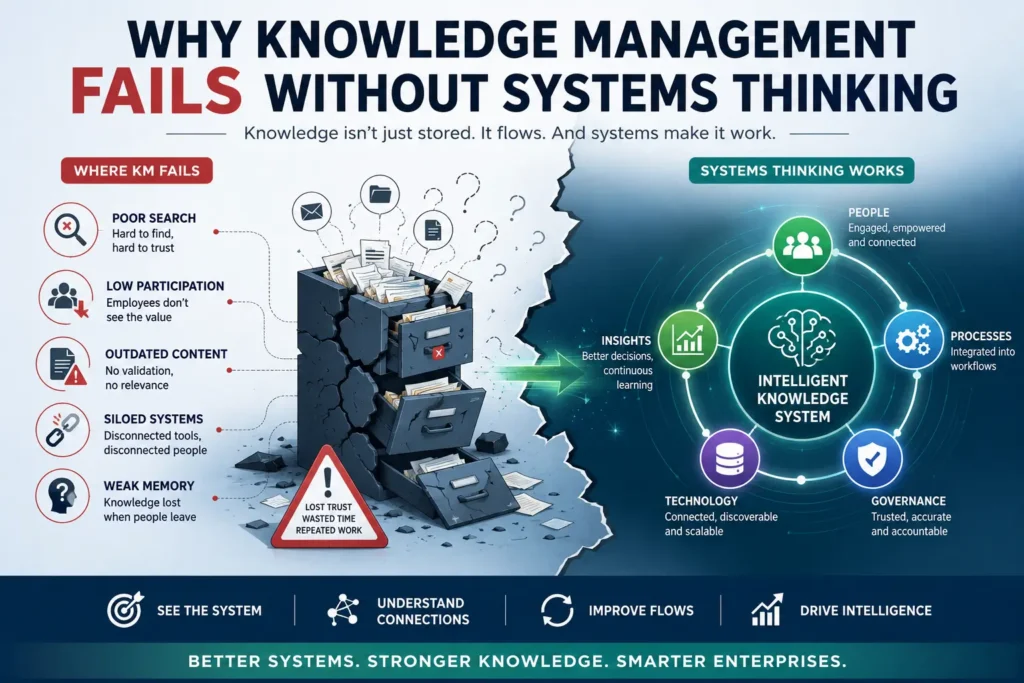
Table of Contents
- Failure Reason 1: Technology Selected Before Strategy Defined
- Failure Reason 2: Governance Treated as Optional Infrastructure
- Failure Reason 3: Knowledge Hoarding Is Structurally Rational
- Failure Reason 4: Knowledge Systems Disconnected from Workflow
- Failure Reason 5: Activity Metrics Replacing Outcome Metrics
- Failure Reason 6: Tacit Knowledge Systematically Neglected
- Failure Reason 7: Implementation Treated as an Event Rather Than a System
- The Pattern Connecting All Seven Failures
- Conclusion
- References
Failure Reason 1: Technology Selected Before Strategy Defined
The single most consistent predictor of KM program failure is the sequence of implementation decisions. Organizations that select a platform before defining what knowledge they need to manage, how it will be governed, and what business outcomes they expect to improve almost always struggle to demonstrate value within the first 18 months.
This pattern is well-documented. A survey by APQC found that organizations with a documented KM strategy before technology selection report significantly higher satisfaction with their KM outcomes than those that let platform capabilities drive program design. The difference is not the quality of the technology. It is the order of decisions.
When technology leads, the program inherits the platform’s structural assumptions. Knowledge gets organized the way the platform organizes it rather than the way the organization actually needs to use it. Taxonomy design reflects vendor templates rather than operational reality. Governance gets configured to match platform defaults rather than organizational requirements. The result is a technically functional system that does not fit how people work, which produces the adoption problems that are subsequently misattributed to culture.
The fix is straightforward in principle and consistently ignored in practice: define the knowledge strategy, governance model, and success metrics before evaluating a single platform. Technology selection should be the last major decision, not the first.
Failure Reason 2: Governance Treated as Optional Infrastructure
Knowledge base content degrades predictably without governance. Articles become outdated. Ownership becomes unclear. Quality standards diverge across departments. Search relevance deteriorates as volume grows faster than curation. Users encounter unreliable answers and stop trusting the system. Contribution rates fall. The cycle accelerates.
Research on enterprise content systems consistently finds that ungoverned knowledge bases lose operational credibility within 18 to 24 months of launch, regardless of initial content quality. This timeline is remarkably consistent across industries and organization sizes.
Most KM programs treat governance as a secondary concern to be addressed after adoption grows. This sequencing is backwards. Governance must be established before launch because it determines the quality conditions that drive adoption in the first place. A knowledge base that users trust generates contribution. A knowledge base that users distrust generates the abandonment that leadership subsequently interprets as a culture problem.
Effective governance specifies four things before any content is published: who owns each knowledge domain, what standards content must meet to be published, how frequently content is reviewed for accuracy, and what process retires content that is no longer valid. Organizations that establish these conditions at launch sustain knowledge quality. Organizations that defer governance to a later phase rarely implement it at all.
Failure Reason 3: Knowledge Hoarding Is Structurally Rational
Most KM failure analyses identify knowledge hoarding as a cultural problem. The systems-level analysis reveals something more uncomfortable: in most organizational incentive structures, knowledge hoarding is individually rational behavior.
An employee whose expertise is unique has job security, influence, and career leverage that a fully documented, easily accessible knowledge base eliminates. If performance reviews measure individual output rather than collective knowledge contribution, sharing expertise creates competitive disadvantage for the individual while creating value for the organization. Employees are not being selfish. They are responding predictably to the incentive environment they actually operate within.
This is why motivational campaigns, knowledge-sharing awareness programs, and appeals to collaborative values produce limited and temporary results. They ask individuals to act against their rational self-interest without changing the conditions that make self-interest and organizational interest diverge.
The structural fix requires connecting knowledge contribution to the things that actually drive career outcomes: performance evaluations, promotion criteria, and compensation. Organizations that make knowledge contribution a visible, measured, and rewarded component of professional advancement see sustained contribution rates. Organizations that treat it as a voluntary cultural behavior see contribution rates that peak during launch campaigns and decline steadily afterward.
Failure Reason 4: Knowledge Systems Disconnected from Workflow
McKinsey research found that knowledge workers spend an average of 1.8 hours per day, roughly 19% of the working week, searching for information they need but cannot find. A significant portion of that search time is spent navigating systems that require workers to leave their primary workflow environment to find knowledge.
This navigation cost is not trivial. Every additional step between a worker and the knowledge they need reduces the probability that they consult the knowledge system at all. Under time pressure, which characterizes most knowledge work environments, the informal shortcut of asking a colleague or searching personal files beats the formal system that requires opening another application, navigating a taxonomy, evaluating search results, and reading articles that may or may not address the specific situation.
Organizations that embed knowledge access directly into the tools where work happens, inside CRM systems when customer decisions are being made, inside project management platforms when delivery decisions are being made, inside communication tools when operational questions arise, see application rates three to four times higher than organizations that maintain separate knowledge portals requiring deliberate navigation.
The practical implication is that a knowledge system’s location matters as much as its content. A comprehensive, high-quality knowledge base that workers must deliberately navigate to will be used far less than a moderately complete knowledge layer embedded in the tools where decisions actually happen.
Failure Reason 5: Activity Metrics Replacing Outcome Metrics
KM programs that measure success through activity metrics, document upload rates, page views, search volumes, platform logins, and contribution counts, cannot demonstrate business value because activity metrics do not correlate reliably with business outcomes.
A knowledge base can show high upload rates while content quality deteriorates because contributors are submitting low-value documents to meet contribution targets. Search volume can increase while decision quality remains flat because workers are searching and not finding relevant answers. Login rates can remain steady while actual knowledge application declines because workers are logging in briefly and then resorting to informal alternatives.
Organizations that sustain KM investment over time measure outcomes that connect directly to business performance. Decision cycle time, the speed from problem identification to implemented decision, measures whether knowledge access is improving operational velocity. New employee ramp time measures whether knowledge transfer is accelerating capability development. Duplicate work rates, the percentage of effort spent solving problems already solved elsewhere in the organization, measure whether knowledge reuse is eliminating waste. These metrics require more effort to collect but they answer the question that justifies KM investment: is this improving how the organization performs?
The APQC 2026 KM research found that organizations connecting KM measurement to business outcomes sustain executive sponsorship and funding at significantly higher rates than those reporting primarily on platform activity.
Failure Reason 6: Tacit Knowledge Systematically Neglected
Explicit knowledge, the information that can be documented in procedures, policies, and reference materials, is the focus of most KM programs because it is the easiest knowledge to capture. Tacit knowledge, the judgment, pattern recognition, contextual expertise, and professional intuition that experienced practitioners develop over years, is where most organizational value actually resides and where most KM programs invest least.
Research on knowledge loss during organizational transitions consistently finds that tacit knowledge represents the majority of expertise that departs when experienced professionals leave. A practitioner with 15 years of domain experience carries decision frameworks, risk intuitions, relationship context, and situational judgment that cannot be captured by asking them to document their procedures.
Organizations that address tacit knowledge seriously use structured methodologies: knowledge elicitation interviews designed to surface reasoning patterns rather than process steps, apprenticeship structures where experienced practitioners work alongside successors with deliberate knowledge transfer objectives, communities of practice where peer interaction externalizes implicit knowledge through discussion and problem-solving, and decision documentation that captures why decisions were made rather than only recording what was decided.
Programs that focus exclusively on explicit knowledge documentation create comprehensive repositories of surface-level organizational knowledge while leaving the most valuable expertise entirely in individual minds where it remains vulnerable to departure, retirement, and reorganization.
Failure Reason 7: Implementation Treated as an Event Rather Than a System
The most persistent structural failure in knowledge management is treating the launch of a KM program as the primary organizational investment rather than the beginning of an ongoing management commitment.
A knowledge system launched without sustained governance, measurement, quality management, and continuous improvement will follow a predictable trajectory: strong initial engagement during the novelty phase, gradual decline as content ages and governance weakens, leadership disillusionment when usage metrics fall, eventual abandonment and replacement with a new platform that reproduces the cycle.
This pattern has been observed across industries and organization types with enough consistency that it represents a structural dynamic rather than a failure of individual programs. Organizations that sustain KM value over time treat it as an ongoing operational function with dedicated resources, regular performance reviews, explicit improvement cycles, and governance structures that adapt as the organization evolves.
The comparison to other organizational infrastructure is instructive. Finance functions are not launched and left to run without ongoing management. IT systems are not deployed and abandoned without maintenance and upgrade cycles. Customer service operations are not staffed once and expected to improve without continued investment. Knowledge management systems that are expected to deliver sustained value without sustained management investment will reliably fail to do so.
The Pattern Connecting All Seven Failures
Looking across these seven failure reasons, a common structural condition connects them. Each failure occurs when an organization treats knowledge management as a project with defined deliverables rather than as a system with ongoing dynamics.
Projects have launch dates, completion milestones, and budget allocations that end. Systems have feedback loops, governance structures, and management cycles that continue. Knowledge management requires system design, not project execution. The organizations that build KM programs capable of sustaining value over time are those that design the governance conditions, incentive structures, measurement frameworks, and continuous improvement cycles that keep the system functioning long after the implementation team has moved on to other priorities.
Peter Senge’s observation in The Fifth Discipline applies precisely here: “Today’s problems come from yesterday’s solutions.” Most KM failures are the direct consequence of implementation decisions that solved for visible short-term challenges while ignoring the structural dynamics that would produce deterioration over time.
Diagnosing which of these seven failure patterns applies to a specific organization is the prerequisite to designing an intervention that will actually change the outcome. Generic KM improvement initiatives that do not identify the specific structural failure driving current performance almost always reproduce the same results because the underlying system that produces failure remains unchanged.
Conclusion
Knowledge management fails at high rates not because organizations lack commitment or resources but because the structural conditions required for sustained KM success are consistently underinvested relative to the visible components: platform selection, content creation, and launch communications.
Governance, incentive alignment, workflow integration, tacit knowledge capture, outcome measurement, and ongoing management investment are less visible than a well-designed knowledge base interface. They are also the factors that determine whether that interface becomes a genuine organizational asset or an expensive archive that workers learn to work around.
Understanding why knowledge management fails is the prerequisite to building something that does not.
Related reading: Systems Thinking in Knowledge Management | How Knowledge Flows Across Complex Enterprises | Knowledge Management Strategy Framework
References
- Gartner Research. Enterprise Technology Implementation Success Rates. Gartner Group.
- APQC. (2026). Knowledge Management Priorities and Challenges Survey. APQC.
- McKinsey Global Institute. (2012). The Social Economy: Unlocking Value and Productivity Through Social Technologies. McKinsey and Company.
- Senge, P.M. (1990). The Fifth Discipline: The Art and Practice of the Learning Organization. Doubleday.
- Davenport, T.H. and Prusak, L. (1998). Working Knowledge: How Organizations Manage What They Know. Harvard Business School Press.