
Communities of practice have existed inside organizations long before enterprises formally recognized them as strategic assets. In many ways, they emerged naturally wherever groups of professionals shared expertise, solved recurring problems together, exchanged operational experience, and developed collective understanding around specialized domains. Engineers discussed technical failures, consultants exchanged client strategies, cybersecurity teams shared threat intelligence, and healthcare professionals refined treatment approaches through continuous collaboration.
These communities became one of the most important yet underestimated mechanisms for organizational learning.
Today, artificial intelligence is transforming how these communities function, how expertise flows across organizations, and how enterprise knowledge itself is created and operationalized. The age of AI is not eliminating communities of practice. In many respects, it is making them more important than ever before.
The reason is becoming increasingly clear inside modern enterprises. Artificial intelligence can process information at enormous scale, but organizations still depend heavily on human interpretation, contextual reasoning, operational judgment, and collaborative intelligence. Communities of practice remain one of the few environments where tacit knowledge, experiential learning, and collective problem-solving can evolve organically across organizational boundaries.
As enterprises accelerate AI adoption, communities of practice are entering a new phase. They are evolving from informal collaboration groups into strategic intelligence networks capable of shaping organizational learning, AI governance, innovation capability, and enterprise adaptability itself.
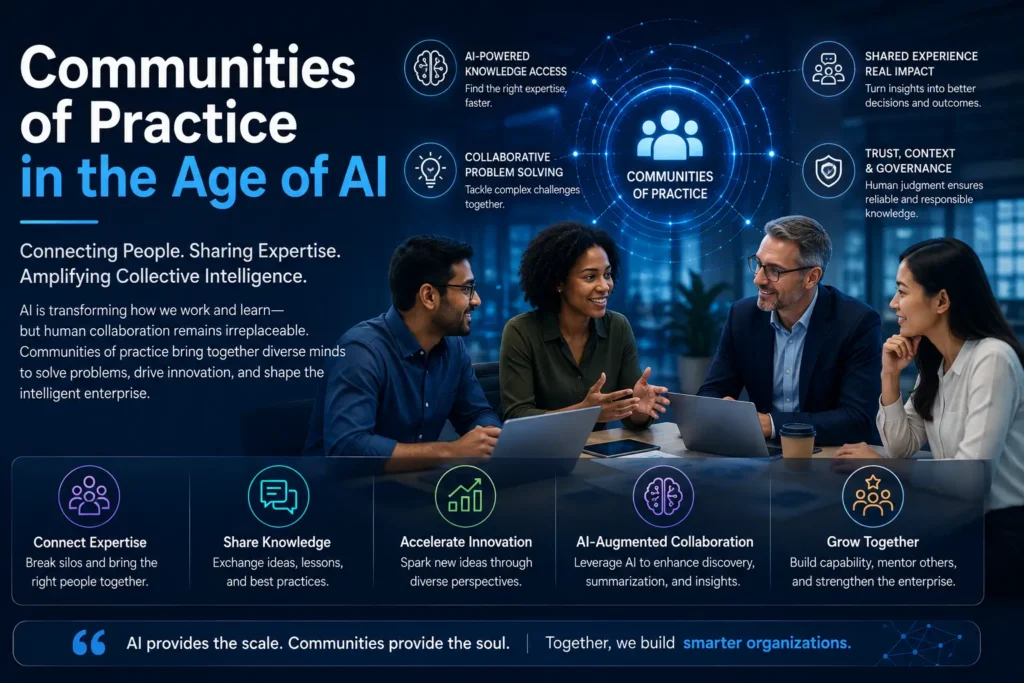
Why Communities of Practice Became Important in Modern Organizations
The rise of communities of practice reflected a broader realization that organizational knowledge rarely flows effectively through formal structures alone.
Traditional enterprises historically depended heavily on hierarchical information distribution. Knowledge moved through departments, reporting lines, training programs, manuals, procedures, and management structures. While these systems supported operational consistency, they often failed to capture the deeper forms of expertise that emerged through experience and collaborative interaction.
Many professionals learned far more from peers than from formal documentation.
An experienced engineer troubleshooting a system failure, a consultant navigating a politically sensitive client environment, or a project manager handling organizational resistance often relied on insights developed collectively through professional interaction rather than standardized process documents alone.
This type of knowledge is difficult to codify fully.
Communities of practice emerged because organizations realized that expertise develops socially as much as structurally. Shared experiences, recurring challenges, professional dialogue, mentorship, storytelling, and collaborative problem-solving created environments where organizational learning could evolve continuously.
Unlike formal departments, communities of practice were typically organized around shared expertise rather than organizational hierarchy. Their value came from collective intelligence, not reporting structures.
This distinction remains extremely important in the AI era.
The Shift From Information Scarcity to Knowledge Complexity
One of the biggest changes affecting communities of practice today is the transition from information scarcity toward information abundance.
Historically, professional communities often existed partly because access to expertise was limited. Employees depended on peer networks to locate knowledge, understand operational context, and solve complex problems.
Artificial intelligence is changing information access dramatically.
Large language models, enterprise search systems, retrieval platforms, and AI copilots are making information retrieval increasingly fast and conversational. Employees can now access summaries, explanations, documentation, and operational guidance almost instantly.
At first glance, this might appear to reduce the importance of communities of practice.
In reality, the opposite may be happening.
As information becomes easier to access, the real challenge shifts toward interpretation, contextual reasoning, judgment, governance, and operational application. Organizations are discovering that information alone does not create expertise. The ability to understand nuance, evaluate uncertainty, recognize organizational implications, and apply knowledge effectively still depends heavily on collaborative human intelligence.
Communities of practice increasingly function as environments where professionals collectively interpret complexity rather than simply exchange information.
This is a major shift.
The future value of professional communities may depend less on distributing information and more on helping organizations make sense of rapidly expanding intelligence environments.
Why AI Is Increasing the Importance of Tacit Knowledge
One of the most significant effects of artificial intelligence inside enterprises is the renewed importance of tacit knowledge.
Tacit knowledge refers to expertise developed through experience rather than formal documentation. It includes judgment, intuition, negotiation capability, troubleshooting instincts, operational awareness, and contextual understanding built gradually through exposure and practice.
AI systems are becoming highly effective at retrieving explicit knowledge. They can summarize documents, surface policies, generate recommendations, and retrieve historical information rapidly. However, enterprises are increasingly realizing that many important decisions still rely on forms of understanding that remain deeply human.
A cybersecurity analyst recognizing subtle behavioral anomalies, a legal advisor sensing negotiation risk, or a healthcare professional interpreting emotionally sensitive situations often relies on experiential reasoning that extends beyond structured information alone.
Communities of practice play a critical role in transferring this kind of expertise.
Through dialogue, mentoring, collaborative problem-solving, and shared operational experiences, professionals gradually develop contextual understanding that cannot easily be replicated through formal systems. AI may accelerate information access, but tacit expertise still evolves heavily through human interaction.
This is one reason communities of practice are becoming strategically important again.
The future enterprise may increasingly depend on environments where human expertise and machine intelligence reinforce one another rather than operate separately.
How AI Is Reshaping Professional Collaboration
Artificial intelligence is not only affecting knowledge access. It is also changing how professionals collaborate.
Historically, many communities of practice relied on physical proximity, scheduled meetings, internal forums, workshops, conferences, or informal professional networks. Digital transformation expanded these interactions through collaboration platforms, enterprise social networks, and virtual communities.
AI is now introducing another layer of transformation.
Modern collaborative environments increasingly include AI-assisted knowledge retrieval, semantic enterprise search, intelligent recommendations, automated summarization, expertise mapping, and conversational interfaces capable of supporting collective learning in real time.
This creates entirely new possibilities for organizational collaboration.
Communities of practice can now access organizational memory more effectively, identify relevant expertise faster, surface historical lessons dynamically, and connect operational insights across geographically distributed teams. AI systems may help professionals locate hidden expertise, detect emerging knowledge patterns, and accelerate cross-functional collaboration at scales previously difficult to achieve.
However, this transformation also introduces new risks.
Organizations may mistakenly assume that AI-assisted collaboration eliminates the need for human knowledge communities altogether. In reality, technology can support collaborative intelligence, but it cannot fully replace the trust, social learning, relationship-building, and experiential understanding that communities of practice generate organically.
The human layer remains essential.
Read: Unlocking the Power of Communities of Practice for Business and Individual Success
The Emergence of AI-Augmented Communities
One of the most important developments occurring today is the rise of AI-augmented communities of practice.
These communities increasingly operate inside intelligent digital environments where AI systems support professional learning and collaboration continuously. Instead of functioning solely through periodic meetings or static discussion forums, communities may now interact through intelligent knowledge ecosystems capable of surfacing relevant expertise, operational context, emerging trends, and organizational insights dynamically.
This changes how expertise flows inside organizations.
For example, AI systems may identify recurring operational challenges appearing across multiple departments and automatically surface relevant discussions from internal communities. They may recommend subject matter experts based on contextual relevance, connect employees facing similar issues, or generate knowledge summaries from collaborative interactions.
Communities themselves become more discoverable and operationally connected.
At the same time, AI may reduce some traditional barriers that limited knowledge-sharing environments in the past. Large enterprises often struggled with siloed expertise where valuable operational knowledge remained isolated within departments or geographic regions. Intelligent retrieval systems and semantic collaboration platforms increasingly allow organizations to connect expertise across distributed environments more effectively.
This could significantly expand the strategic influence of communities of practice inside global enterprises.
Why Communities Matter More in Distributed Work Environments
Remote and hybrid work models have intensified the importance of communities of practice in ways many organizations initially underestimated.
In traditional office environments, employees often gained tacit knowledge informally through observation, hallway conversations, spontaneous collaboration, and direct exposure to experienced professionals. Distributed work environments reduced many of those informal learning opportunities.
As a result, organizations began experiencing hidden knowledge transfer challenges.
New employees often struggled to absorb operational context. Junior professionals had fewer opportunities to observe experienced colleagues navigating complex situations. Informal expertise-sharing networks weakened in many distributed environments.
Communities of practice increasingly became one of the few structures capable of recreating collaborative learning at scale.
AI may help address some of these challenges by improving expertise discovery and knowledge retrieval, but organizations still require human-centered collaborative environments where employees can exchange experience, discuss ambiguity, and build professional judgment collectively.
The future workplace may depend heavily on intentionally designed knowledge communities capable of supporting learning continuity across distributed environments.
Why Governance and Trust Are Becoming Critical
As AI becomes more integrated into professional collaboration environments, governance and trust are becoming increasingly important concerns.
Communities of practice historically depended heavily on openness, shared learning, and collaborative transparency. AI introduces new questions involving knowledge ownership, content reliability, intellectual property, privacy, and operational accountability.
Organizations must now consider how AI-generated insights are validated, how collaborative knowledge is governed, and how professional trust is maintained inside increasingly automated environments.
This issue is especially important because communities often influence operational decision-making directly. If AI systems surface inaccurate recommendations, outdated practices, or misleading interpretations, organizational trust can deteriorate quickly.
Communities of practice may therefore become increasingly important not only for knowledge-sharing, but also for validating, governing, and contextualizing AI-assisted intelligence itself.
In many enterprises, human communities may ultimately function as governance layers for machine-generated knowledge.
The Future of Communities of Practice
Communities of practice are likely entering one of the most strategically important phases in their evolution.
The future enterprise will operate in environments defined by AI augmentation, information abundance, distributed workforces, semantic retrieval systems, intelligent automation, and rapidly evolving operational complexity. In these conditions, organizations will require structures capable of supporting continuous learning, contextual reasoning, collaborative intelligence, and adaptive expertise development.
Communities of practice are uniquely positioned to fulfill that role.
Future communities may increasingly operate as living intelligence networks embedded directly into enterprise workflows, AI systems, digital workplaces, and operational knowledge environments. They may help organizations interpret emerging risks, govern AI-assisted decisions, accelerate organizational learning, and preserve critical tacit expertise across workforce transitions.
Most importantly, they may become one of the few organizational structures capable of balancing machine intelligence with human judgment effectively.
Final Thoughts
Artificial intelligence is transforming how organizations create, retrieve, distribute, and operationalize knowledge across every major industry. Yet the deeper enterprises move into AI-driven environments, the more they are rediscovering the importance of collaborative human expertise.
Communities of practice were never simply discussion groups.
They were mechanisms for collective intelligence, tacit knowledge transfer, organizational learning, and professional evolution.
That role is becoming even more important in the age of AI.
As enterprises continue building increasingly intelligent systems, the organizations that succeed may not be those that automate knowledge most aggressively. They may be the organizations capable of combining AI-driven intelligence with strong human knowledge communities that preserve judgment, context, trust, and experiential learning at scale.
The future of enterprise knowledge will likely depend on both.