Knowledge management magic quadrant analysis helps organizations evaluate vendors based on execution capability and strategic vision. As knowledge management becomes central to enterprise productivity, decision-makers are increasingly relying on structured frameworks like the Gartner Magic Quadrant to guide platform selection.
In 2026, knowledge management is no longer limited to documentation systems. It sits at the intersection of AI, enterprise search, digital workplace, and customer experience. This makes understanding how vendors are positioned in the Magic Quadrant critical for CIOs, KM leaders, and digital transformation teams.
This guide explains how the knowledge management magic quadrant works, what the categories mean, and how to interpret vendor positioning to make better investment decisions.
Knowledge Management Magic Quadrant
What Is the Gartner Magic Quadrant in Knowledge Management
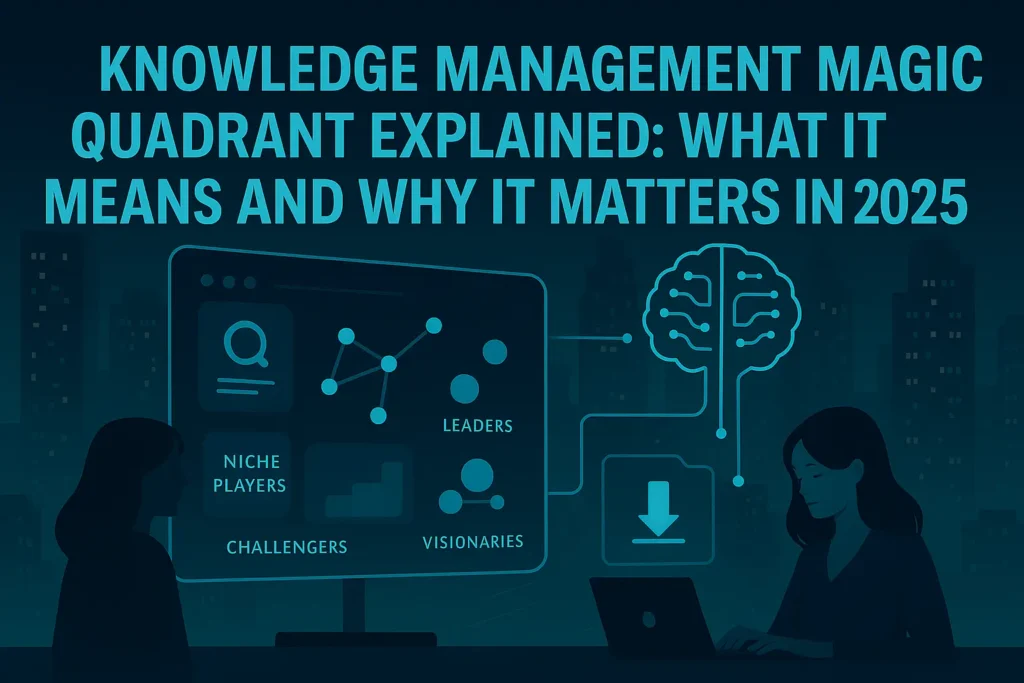
The Gartner Magic Quadrant is a widely recognized evaluation framework that assesses technology vendors based on two core dimensions: ability to execute and completeness of vision.
Ability to execute reflects how well a vendor delivers its product today. This includes product maturity, customer experience, support quality, scalability, and operational strength.
Completeness of vision measures how effectively a vendor understands market direction and innovates for the future. This includes product strategy, AI capabilities, ecosystem integration, and long-term roadmap.
Vendors are positioned in a four-quadrant matrix:
- Leaders represent vendors with strong execution and clear long-term vision
- Challengers demonstrate solid execution but limited innovation or future direction
- Visionaries focus on innovation but may lack enterprise maturity or scale
- Niche Players address specific use cases or markets with limited breadth
This structure allows organizations to quickly compare vendors based on both current performance and future potential.
Is There a Dedicated Knowledge Management Magic Quadrant
A standalone knowledge management magic quadrant is not always published annually. Instead, Gartner evaluates KM platforms across related categories where knowledge capabilities are embedded.
These include:
- Customer Service Knowledge Management
- Digital Experience Platforms
- Content Services Platforms
- Enterprise Search and AI-driven discovery
In 2026, knowledge management is increasingly evaluated as part of broader enterprise ecosystems that combine AI, automation, and workflow intelligence. This shift reflects how KM has evolved from a standalone function into a core business capability.
Why the Magic Quadrant Matters for Knowledge Management Strategy
The knowledge management magic quadrant is not just a vendor comparison tool. It plays a strategic role in how organizations evaluate and adopt technology.
It helps decision-makers validate vendor claims through independent analysis rather than relying on marketing narratives. It reduces complexity by narrowing down a large vendor landscape into a manageable shortlist. It also provides insights into market direction, highlighting how AI, automation, and analytics are shaping the future of KM.
For enterprise leaders, the Magic Quadrant often supports internal business cases, budget approvals, and long-term platform decisions. It provides a structured way to align technology investments with organizational goals.
Leaders vs Challengers vs Visionaries vs Niche Players
Understanding the four quadrants is essential before making any decision.
Leaders combine strong execution with a clear innovation roadmap. These vendors typically offer mature platforms, global reach, and advanced AI capabilities. Organizations looking for stability and scalability often prioritize this category.
Challengers deliver reliable solutions with proven execution. However, they may lag in innovation or emerging capabilities such as AI-driven knowledge automation. They are often suitable for organizations with stable and well-defined requirements.
Visionaries focus on innovation and emerging technologies. These vendors experiment with AI, automation, and new delivery models. While they may not yet have full enterprise maturity, they often shape future trends.
Niche Players specialize in specific industries or use cases. They can provide strong value in targeted scenarios but may lack the breadth required for large-scale enterprise deployments.
No single quadrant is universally better. The right choice depends on organizational size, complexity, and strategic priorities.
Top Knowledge Management Vendors in the Magic Quadrant Ecosystem
While exact positioning varies and is proprietary, several vendors consistently appear across KM-related Gartner evaluations and enterprise discussions.
ServiceNow
A dominant enterprise platform with strong workflow integration, AI-powered knowledge delivery, and deep IT service management capabilities.
Microsoft Viva and SharePoint
Integrated within the Microsoft ecosystem, these tools use AI to organize content, surface knowledge, and connect insights across Teams and enterprise applications.
Salesforce Knowledge
Part of the Service Cloud platform, offering AI-driven recommendations, contextual knowledge delivery, and strong customer support integration.
Atlassian Confluence
Widely used for internal knowledge sharing, particularly in product and engineering teams, with growing AI capabilities and ecosystem integrations.
Bloomfire
Known for usability and strong search capabilities, often preferred by mid-sized enterprises focused on engagement and knowledge sharing.
BMC Helix
Focused on IT service management with structured knowledge workflows and automation capabilities.
Zendesk
A customer support-focused platform with integrated knowledge base features, AI bots, and guided workflows.
Each of these vendors reflects different strengths aligned with specific use cases such as customer support, internal knowledge sharing, or enterprise-wide knowledge systems.
Comparison of Magic Quadrant Categories
| Category | Strength | Risk |
|---|---|---|
| Leaders | Proven execution, strong AI capabilities | Higher cost, complex implementation |
| Challengers | Reliable performance, stable solutions | Limited innovation |
| Visionaries | Advanced innovation, future-focused | Lack of maturity or scalability |
| Niche Players | Specialized solutions, industry focus | Limited functionality and ecosystem |
This comparison helps organizations align vendor selection with business requirements rather than relying on rankings alone.
How to Use the Magic Quadrant for KM Platform Selection
The knowledge management magic quadrant should be used as a starting point rather than a final decision tool.
Organizations should review detailed vendor reports, evaluate product demonstrations, and conduct pilot testing. It is critical to align vendor capabilities with specific use cases such as customer service, internal collaboration, or knowledge-driven decision-making.
Integration is another key factor. A knowledge management system must connect with existing tools such as CRM platforms, collaboration tools, and enterprise data systems.
Niche vendors should not be ignored. In many cases, they offer flexibility, cost advantages, and better alignment with specific industry needs.
Key Takeaways
The knowledge management magic quadrant reflects how the KM landscape is evolving toward integrated, AI-driven platforms.
Organizations must look beyond vendor positioning and evaluate how each solution aligns with their workflows, data ecosystem, and long-term strategy.
Leaders provide stability and scale, visionaries drive innovation, challengers offer reliability, and niche players deliver specialization. The right choice depends on context, not category.
FAQs
What is the knowledge management magic quadrant
The knowledge management magic quadrant is a framework used to evaluate vendors based on their execution capability and strategic vision, helping organizations compare solutions effectively.
How does Gartner evaluate knowledge management vendors
Gartner evaluates vendors using criteria such as product capability, innovation, market understanding, customer experience, and overall execution.
Who are the leaders in knowledge management tools
Vendors such as ServiceNow, Microsoft, and Salesforce are often considered leaders due to their strong capabilities, AI integration, and enterprise adoption.
Is the Magic Quadrant reliable for decision-making
The Magic Quadrant is a valuable starting point, but organizations should combine it with internal evaluation, testing, and alignment with business needs.
Read: Knowledge Management Trends 2026: 10 Trends Every Leader Should Watch
Subscribe to receive notifications for free webinars on Knowledge Management.