For years, enterprise intranets occupied an awkward position inside organizations. Leadership teams described them as digital workplaces, communication hubs, or employee experience platforms, yet many employees experienced them very differently. In practice, countless intranets became difficult-to-navigate repositories filled with outdated documents, fragmented announcements, disconnected tools, duplicated information, and search functions that rarely delivered meaningful results.
The problem was never the idea of the intranet itself.
The real problem was that most intranets evolved faster technologically than structurally. Organizations continued adding content, applications, workflows, and integrations without fundamentally redesigning how enterprise knowledge should be organized, governed, discovered, and operationalized.
Artificial intelligence is now forcing enterprises to rethink the role of the intranet completely.
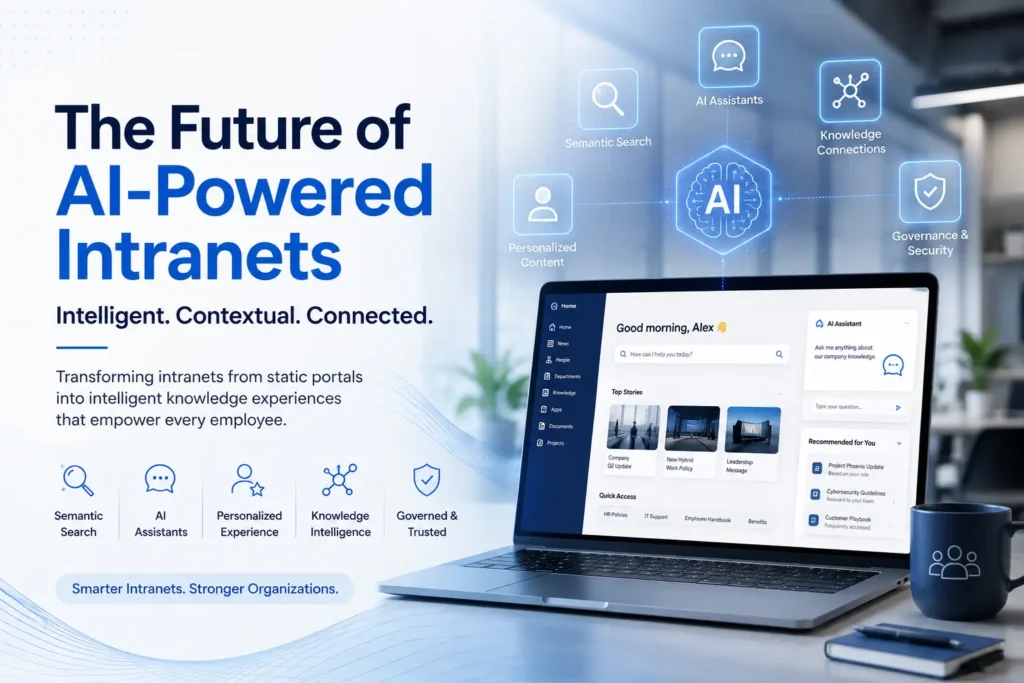
Modern AI-powered intranets are no longer evolving as static employee portals. They are becoming intelligent enterprise environments capable of understanding context, retrieving knowledge semantically, surfacing expertise dynamically, supporting workflow decisions, and delivering personalized information experiences at scale.
This transformation may become one of the most important shifts in enterprise knowledge management over the next decade.
Why Traditional Intranets Struggled
Most legacy intranets were designed around publishing rather than intelligence.
The primary objective was usually straightforward: provide employees with a centralized place to access company information. Organizations implemented intranets to publish policies, announcements, procedures, forms, directories, project updates, and internal documentation.
Initially, this solved real operational problems. Employees gained centralized digital access to information that previously existed across emails, shared drives, or departmental silos.
Over time, however, several structural problems emerged.
Content volumes expanded rapidly. Different business units created separate repositories, naming conventions, governance processes, and publishing standards. Search capabilities struggled to keep pace with growing complexity. Information became increasingly fragmented across collaboration systems, knowledge bases, communication tools, cloud applications, and external platforms.
As organizations scaled globally, intranets often became cluttered environments where employees spent more time searching for information than actually using it productively.
This challenge intensified further with remote and hybrid work environments. Employees no longer operated primarily within centralized offices where informal conversations helped fill information gaps. Digital knowledge access became operationally critical.
The modern enterprise increasingly depends on fast, contextual, and trustworthy knowledge discovery.
Traditional intranets were not designed for that level of intelligence.
Read: Intranet Explained: Key Benefits, Features, and Company Use Cases
AI Is Changing the Purpose of the Intranet
One of the most important changes happening right now is that intranets are shifting from passive information repositories toward intelligent knowledge delivery systems.
This distinction matters.
Traditional intranets primarily stored information. AI-powered intranets increasingly interpret, contextualize, retrieve, summarize, recommend, and operationalize information dynamically.
Instead of forcing employees to manually navigate folders, menus, and disconnected systems, modern AI-driven environments can understand intent and surface relevant knowledge contextually.
This represents a major evolution in enterprise digital workplaces.
Employees increasingly expect workplace systems to function more like intelligent assistants rather than static repositories. They want conversational search, contextual recommendations, semantic discovery, personalized workflows, expertise location, and instant access to trusted operational knowledge.
AI is making this expectation possible.
Modern enterprise intranets are beginning to integrate:
- conversational AI assistants
- semantic enterprise search
- knowledge graphs
- intelligent recommendations
- contextual workflow guidance
- automated content classification
- AI summarization
- expertise discovery systems
- intelligent notifications
- dynamic knowledge retrieval
The intranet is gradually evolving into the operational interface for enterprise intelligence.
The Rise of Semantic Enterprise Search
Search has historically been one of the biggest weaknesses of enterprise intranets.
Many employees have experienced the frustration of searching internal systems only to receive irrelevant results, outdated documents, duplicate content, or incomplete information. Traditional keyword search systems often failed because they depended heavily on exact terminology matches rather than understanding meaning or context.
AI is fundamentally changing enterprise search capabilities.
Modern semantic search systems analyze relationships between concepts, intent, language patterns, metadata, organizational structures, and contextual meaning rather than relying solely on keywords.
This creates a dramatically different discovery experience.
For example, an employee searching for onboarding procedures may receive:
- official HR documentation
- department-specific workflows
- related compliance requirements
- training resources
- recent policy updates
- relevant subject matter experts
- AI-generated summaries
- operational recommendations
The system understands contextual relationships rather than merely locating matching words.
This shift is extremely important because enterprise knowledge environments are becoming too complex for traditional navigation models alone.
AI-powered intranets increasingly function as intelligent retrieval environments capable of connecting people, workflows, systems, expertise, and organizational memory dynamically.
Why Knowledge Management Is Becoming Critical Again
One of the most significant consequences of AI-powered intranets is the renewed importance of knowledge management.
For years, many organizations treated intranet management primarily as a communication or IT function. AI is exposing the limitations of that approach.
Intelligent systems depend heavily on knowledge quality.
If enterprise content is fragmented, outdated, duplicated, poorly classified, or inconsistently governed, AI systems inherit those same weaknesses. The result is unreliable search experiences, inaccurate recommendations, inconsistent responses, and declining trust in enterprise AI systems.
This is why modern intranet transformation increasingly requires strong knowledge management foundations.
Organizations implementing AI-powered intranets are now prioritizing:
- taxonomy modernization
- metadata governance
- knowledge lifecycle management
- semantic architecture
- enterprise search optimization
- content governance
- expertise mapping
- information ownership models
- knowledge validation frameworks
Without these foundational capabilities, AI-powered intranets struggle to deliver meaningful enterprise value.
The future intranet is no longer just a communication platform.
It is becoming a knowledge intelligence environment.
The Role of AI Copilots Inside Modern Intranets
AI copilots are becoming one of the most visible components of next-generation intranets.
These systems act as conversational interfaces capable of helping employees interact with enterprise knowledge more naturally. Instead of navigating multiple systems manually, employees can ask questions conversationally and receive contextual responses grounded in enterprise knowledge sources.
For example:
- “What is the latest remote work policy?”
- “Show me previous cybersecurity incident procedures.”
- “Who handled similar customer escalations last year?”
- “Summarize the updated procurement process.”
- “What lessons were learned from the previous migration project?”
This dramatically changes how employees interact with organizational knowledge.
However, many enterprises are discovering that AI copilots are only as effective as the underlying knowledge architecture supporting them.
Weak governance, fragmented repositories, inconsistent metadata, and outdated content quickly reduce AI reliability. Employees lose trust rapidly when AI systems provide conflicting or inaccurate information.
This is why retrieval quality, governance, and semantic structure are becoming strategic priorities inside enterprise intranet programs.
Personalized Employee Experiences
Another major transformation involves personalization.
Traditional intranets typically delivered largely identical experiences to all employees regardless of role, location, department, expertise, or operational context.
AI-powered intranets increasingly support adaptive and personalized experiences.
Employees may receive:
- role-specific knowledge recommendations
- workflow-aware content delivery
- personalized dashboards
- intelligent notifications
- contextual learning resources
- expertise suggestions
- department-specific updates
- AI-curated operational guidance
This creates a more relevant and efficient employee experience.
The long-term implication is significant.
Future intranets may operate less like static portals and more like intelligent workplace environments continuously adapting to organizational context and employee needs.
Why Governance Will Define Success
One of the biggest misconceptions surrounding AI intranets is the assumption that deploying AI technology alone solves enterprise knowledge problems.
In reality, governance will likely become the defining factor separating successful AI-powered intranets from failed implementations.
As AI systems gain greater access to enterprise information, organizations face increasingly complex governance challenges involving:
- information ownership
- content validation
- access controls
- privacy protection
- AI auditing
- regulatory compliance
- knowledge provenance
- content lifecycle management
- trust verification
These issues become especially important in highly regulated industries where inaccurate or outdated knowledge may create operational, legal, or financial risk.
Organizations are increasingly realizing that AI governance and knowledge governance are deeply interconnected.
If enterprise knowledge environments remain fragmented or poorly governed, AI systems amplify those weaknesses at scale.
The future of intelligent intranets will depend heavily on governance maturity.
The Emergence of Intelligent Digital Workplaces
The broader evolution occurring underneath AI-powered intranets is the rise of intelligent digital workplaces.
Historically, organizations operated with separate systems for:
- communication
- collaboration
- knowledge management
- enterprise search
- workflow automation
- learning
- employee experience
AI is gradually connecting these environments together.
Future digital workplaces will increasingly integrate knowledge discovery, workflow support, communication, operational intelligence, and AI assistance into unified experiences.
Employees may interact with enterprise systems through conversational interfaces capable of retrieving knowledge, automating workflows, recommending experts, generating summaries, surfacing lessons learned, and supporting decision-making simultaneously.
This is one reason the boundaries between intranet platforms, knowledge management systems, enterprise search, and AI assistants are becoming less rigid.
They are converging into integrated intelligence ecosystems.
Why Many AI Intranet Projects Will Fail
Despite growing excitement surrounding AI-powered intranets, many enterprise implementations will likely struggle.
The reason is not necessarily the AI technology itself.
The underlying challenge is organizational readiness.
Many enterprises continue operating with:
- fragmented repositories
- weak taxonomy structures
- inconsistent metadata
- unclear ownership
- outdated documentation
- poor governance
- disconnected workflows
- low content trust
AI systems cannot solve these foundational problems automatically.
In fact, AI often exposes them more visibly.
Organizations rushing toward AI deployment without addressing knowledge architecture may experience declining trust, operational confusion, poor search relevance, inconsistent recommendations, and employee frustration.
The enterprises that succeed will likely be those that approach AI intranet transformation strategically rather than purely technologically.
The Future of AI-Powered Intranets
The future intranet will look fundamentally different from the systems many organizations operate today.
Instead of functioning primarily as static portals or communication hubs, future intranets will increasingly operate as intelligent organizational interfaces capable of supporting enterprise knowledge flows dynamically.
Several major shifts are already becoming visible:
- conversational enterprise interfaces
- AI-powered semantic retrieval
- contextual knowledge delivery
- intelligent workflow integration
- expertise mapping
- adaptive personalization
- proactive knowledge recommendations
- automated governance support
- AI-assisted decision environments
The most advanced enterprises are beginning to view intranets not merely as communication platforms, but as operational intelligence infrastructure.
This represents a major strategic shift.
The intranet is evolving from a publishing destination into a knowledge intelligence system capable of supporting organizational learning, productivity, collaboration, and enterprise AI simultaneously.
Final Thoughts
AI-powered intranets are not simply modernized employee portals.
They represent a larger transformation in how organizations structure, govern, discover, and operationalize enterprise knowledge.
The future workplace will increasingly depend on intelligent systems capable of connecting employees with the right knowledge, expertise, workflows, and insights at the right moment with minimal friction.
This transformation extends far beyond software implementation.
It involves knowledge architecture, governance maturity, semantic infrastructure, organizational culture, operational design, and enterprise intelligence strategy.
The organizations that succeed will not necessarily build the most visually sophisticated intranets.
They will build the most intelligent, trustworthy, governable, and contextually aware knowledge environments.
That is where the future of enterprise intranets is heading.