Walk into almost any modern organization today and you will see the same challenge repeated across departments.
Teams are creating more knowledge than ever before. Documents, research insights, project learnings, customer feedback, internal discussions, and technical documentation accumulate rapidly. Yet when employees need a piece of information, they often cannot find it quickly.
This problem is not new. Knowledge management has been addressing it for decades. What is new is the scale of the problem.
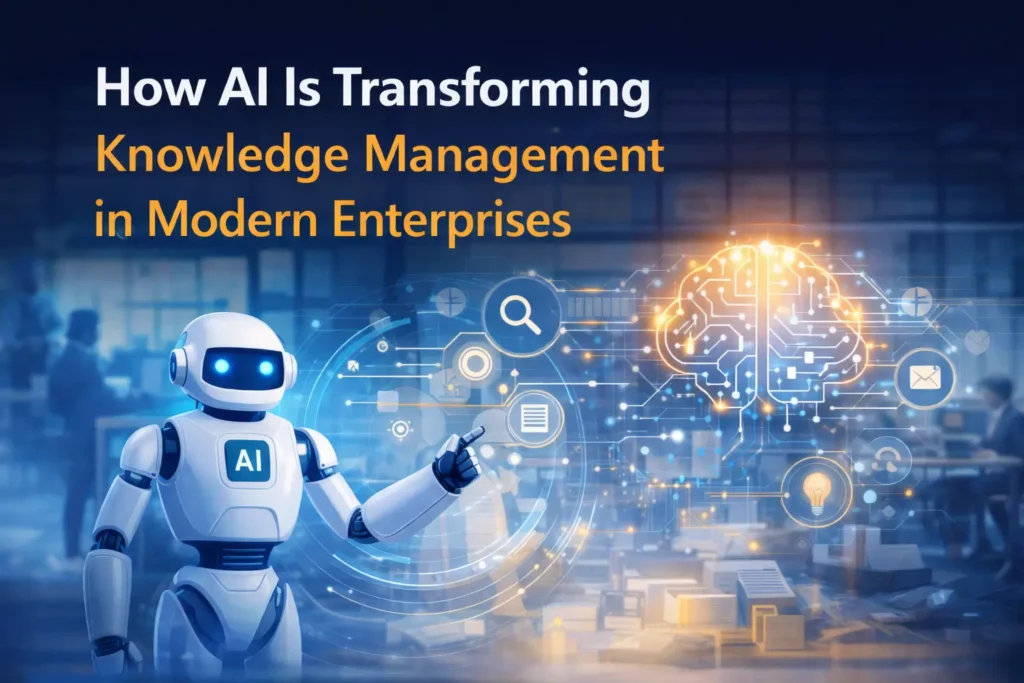
Artificial intelligence is now reshaping how organizations capture, organize, and use knowledge. Instead of relying on static repositories and manual documentation processes, enterprises are increasingly turning to AI-powered knowledge systems that can analyze, discover, and deliver knowledge automatically.
For knowledge managers, digital leaders, and enterprise architects, the question is no longer whether AI will influence knowledge management. The real question is how quickly organizations can adapt.
Why AI Has Become Critical for Knowledge Management
Modern organizations are experiencing an explosion of information.
Every project generates documentation. Every customer interaction produces insights. Every internal discussion creates valuable organizational knowledge.
Without intelligent systems, this information becomes fragmented across emails, collaboration platforms, databases, and document repositories.
Artificial intelligence addresses this challenge by helping organizations process and understand large volumes of information. AI systems can analyze content, extract insights, and deliver relevant knowledge to employees when they need it.
The scale of AI adoption across enterprises shows how significant this shift has become.
Recent research shows that 88 percent of organizations now use AI in at least one business function, reflecting how quickly AI technologies have entered everyday enterprise operations.
At the same time, the number of employees interacting with AI tools continues to rise. Studies indicate that around 75 percent of global knowledge workers now use AI tools regularly at work.
These numbers highlight an important reality.
Knowledge workers are already using AI. Organizations must now rethink how knowledge systems support this new way of working.
Read: Knowledge Management Trends 2026: 10 Trends Every Leader Should Watch
From Traditional Knowledge Systems to AI-Driven Knowledge Platforms
Traditional knowledge management systems focused mainly on storing and organizing information.
These platforms provided document repositories, knowledge bases, and collaboration portals where employees could contribute and access knowledge.
However, traditional systems often struggled with several limitations.
Employees needed to know exactly where information was stored. Search results depended heavily on keywords rather than meaning. Knowledge classification required manual tagging and categorization.
AI changes this dynamic.
Modern AI knowledge platforms analyze content automatically and understand relationships between ideas, documents, and topics. This enables knowledge systems to deliver more relevant information with far less manual effort.
Generative AI tools add another layer of capability by allowing employees to ask questions directly and receive synthesized answers drawn from organizational knowledge.
In effect, AI is transforming knowledge management from a storage system into a knowledge discovery system.
AI Is Making Organizational Knowledge Easier to Discover
One of the most powerful ways AI improves knowledge management is through intelligent search.
Traditional enterprise search often fails because employees do not know the exact words used in a document. A technical report may contain the answer someone needs, but if the search query uses different terminology, the document remains hidden.
AI-powered knowledge discovery solves this problem by using natural language processing and semantic search.
Instead of matching only keywords, AI systems analyze the meaning behind a query.
For example, if an employee asks:
“How do we resolve a customer authentication issue?”
The AI system can locate relevant knowledge across troubleshooting guides, support documentation, internal discussions, and technical articles.
This dramatically improves the accessibility of knowledge.
It also changes how employees interact with knowledge systems. Rather than browsing through folders or searching repeatedly, they can ask questions in natural language.
Generative AI Is Changing How Employees Interact With Knowledge
Perhaps the most visible transformation in knowledge management comes from generative AI assistants.
These tools act as conversational interfaces to organizational knowledge.
Instead of searching through documents manually, employees can simply ask questions. The AI assistant analyzes relevant information across knowledge repositories and generates an answer.
For example, an employee might ask:
What are the onboarding steps for new enterprise clients?
How does our product integrate with customer identity systems?
What lessons did we learn from the last product launch?
The AI system can retrieve relevant knowledge from multiple sources and present a concise response.
Industry analysts increasingly describe this capability as a knowledge copilot for employees.
According to technology market analysts, generative AI knowledge management tools help organizations retrieve and contextualize information from enterprise knowledge bases through conversational interfaces and intelligent search systems.
This shift fundamentally changes how knowledge flows inside organizations.
AI Helps Organizations Break Down Knowledge Silos
Knowledge silos remain one of the biggest challenges for enterprises.
Engineering teams often maintain separate documentation systems. Customer support teams manage their own knowledge bases. Marketing and product teams store insights in different platforms.
AI-powered knowledge systems help bridge these silos by connecting information across repositories.
Instead of requiring teams to manually consolidate knowledge into a single system, AI can analyze content across multiple sources and create unified knowledge experiences.
This capability is particularly valuable in large enterprises where knowledge is distributed across dozens of platforms.
Knowledge managers increasingly recognize that AI can act as the connective layer between information, content, and organizational knowledge.
Experts in the KM field emphasize that the future of knowledge management lies in integrating semantic technologies and AI with traditional KM practices to break down information silos and improve knowledge flow across organizations.
AI Is Accelerating Enterprise Decision Making
Knowledge management has always been closely tied to decision making.
When employees have access to accurate knowledge, they make better decisions. When information is incomplete or outdated, mistakes increase.
AI improves decision making by enabling faster analysis of organizational knowledge and data.
Research examining AI adoption in organizations found that AI systems improve managerial decision efficiency by accelerating data analysis and supporting evidence-based decision making.
In practice, this means managers can quickly access insights that previously required hours of research.
Executives can review historical project outcomes. Product teams can analyze customer feedback. Support teams can identify recurring issues.
By combining knowledge discovery with data analysis, AI helps organizations move from reactive decision making to proactive insight.
The Economic Impact of AI in Knowledge Management
Beyond productivity improvements, AI is also reshaping the economics of knowledge management.
The market for AI-driven knowledge management systems is expanding rapidly.
Industry analysis predicts that the global AI knowledge management market could grow from roughly 9.6 billion dollars in 2026 to over 251 billion dollars by 2034, reflecting enormous enterprise demand for AI-enabled knowledge platforms.
This growth is driven by several factors.
Organizations are generating more knowledge than ever before. Digital transformation initiatives are increasing reliance on data and information. Employees expect faster access to answers.
AI knowledge systems address all of these challenges simultaneously.
Challenges Organizations Must Address
Despite its potential, implementing AI in knowledge management is not without challenges.
Many organizations struggle with workforce readiness and training.
Studies indicate that while AI adoption is rising rapidly, large numbers of employees still lack formal training on how to use AI effectively.
Change management also plays a major role. Successful AI adoption requires cultural adaptation, not just new technology.
Employees must trust AI-generated insights and learn how to collaborate with AI systems.
Leaders must ensure that knowledge governance frameworks remain strong, particularly as generative AI systems generate new content.
Experts consistently emphasize that AI success depends as much on organizational readiness as on technological capability.
What Knowledge Leaders Should Do Next
For knowledge managers and enterprise leaders, AI represents both an opportunity and a responsibility.
The opportunity lies in transforming knowledge systems into intelligent platforms that actively support employees.
The responsibility lies in ensuring that these systems remain accurate, transparent, and aligned with organizational values.
Successful organizations typically focus on several key priorities.
First, they improve the quality and structure of organizational knowledge. AI systems perform best when knowledge assets are well organized and clearly documented.
Second, they encourage employees to adopt AI tools responsibly and effectively.
Third, they integrate AI capabilities gradually rather than attempting large-scale transformations overnight.
Organizations that approach AI strategically will unlock significant benefits from their knowledge assets.
The Future of Knowledge Management in the AI Era
Artificial intelligence is not replacing knowledge management.
It is amplifying it.
The role of knowledge professionals is evolving from managing repositories to designing intelligent knowledge ecosystems.
Future knowledge platforms will likely include advanced capabilities such as knowledge graphs, predictive knowledge recommendations, and autonomous AI agents that assist employees with complex tasks.
In this environment, knowledge management will become even more central to organizational success.
Companies that successfully combine human expertise with AI-driven knowledge systems will have a clear advantage in innovation, decision making, and organizational learning.
The enterprises that recognize this shift early will shape the future of knowledge work.