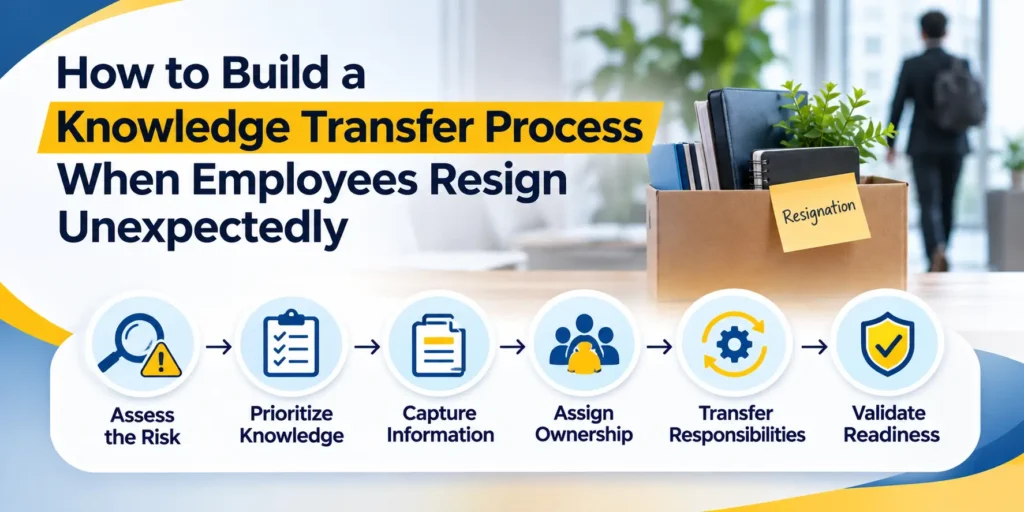
An employee resigns on Monday morning. By the end of the week, their manager discovers that nobody else knows how to run an important monthly report. A customer has been waiting for an update that exists only in the departing employee’s email. A project is approaching a critical deadline, but the reasoning behind several important decisions is unclear.
The organization has systems, documented procedures, shared folders, and a team of capable people. Yet, when one employee leaves, the gaps become immediately visible.
This situation is more common than many organizations realize. Employees carry knowledge that is not always captured in job descriptions, process documents, or company databases. They know which person to contact when a problem occurs, how to handle an unusual customer request, where important information is stored, and which steps in a process require extra attention.
When someone resigns unexpectedly, much of this knowledge can become inaccessible before the organization has an opportunity to transfer it.
The usual response is to ask the departing employee to prepare a handover document, share pending tasks, and explain their responsibilities to a colleague. That may be sufficient for routine work. It is rarely enough when the employee manages complex processes, important relationships, specialist responsibilities, or knowledge that has accumulated over several years.
Organizations need a more reliable approach.
A knowledge transfer process for unexpected resignations should help teams identify what is at risk, recover information from available sources, involve the right people, and keep essential work moving. It should also reduce the likelihood of facing the same problem when another employee leaves.
This guide explains how to establish that process, even when there is very little time available.
Why Unexpected Resignations Create Knowledge Gaps
Not every resignation creates a serious knowledge management problem. If an employee performs well-documented, routine tasks that several colleagues already understand, the transition may be relatively straightforward.
The difficulty arises when the organization depends on knowledge held by one individual.
Consider a sales operations executive who has managed a group of enterprise accounts for four years. The CRM contains customer names, contact details, and sales opportunities. However, the executive also knows which decision-makers influence purchasing decisions, why a particular proposal was delayed, what commitments were made during previous discussions, and which issues could affect the next renewal.
The CRM may contain some of this information, but not necessarily the context behind it.
A similar situation can occur in IT, finance, HR, procurement, project management, customer support, and operations. An employee may become the person everyone approaches when something goes wrong. Over time, colleagues begin depending on that individual without realizing how much knowledge has become concentrated in one place.
Unexpected resignations expose these dependencies.
There are several reasons this happens:
Knowledge remains in individual workspaces. Important information is scattered across personal folders, email accounts, spreadsheets, meeting notes, and messaging conversations.
Processes have never been fully documented. Employees learn how to complete tasks through experience and informal guidance. The official procedure may describe only the basic steps.
Managers underestimate individual knowledge dependencies. A team may appear to have adequate staffing, but only one person understands a particular process or system.
Knowledge sharing is postponed. Employees are busy with daily responsibilities, so documentation and cross-training are repeatedly delayed.
There is no established handover procedure for short-notice departures. Organizations may have a standard resignation checklist, but it often focuses on administrative matters rather than knowledge continuity.
The result is a gap between what the organization believes it knows and what its employees can actually access and use.
What Should a Knowledge Transfer Process Achieve?
The objective is not to document every activity performed by a departing employee. That would be unrealistic, particularly when the resignation comes with little notice.
The priority is to preserve the knowledge required to keep important work running.
A well-designed process should achieve five things:
- Identify the responsibilities and knowledge areas that would create problems if they became unavailable.
- Recover essential information from the departing employee and existing organizational records.
- Transfer immediate responsibilities to suitable colleagues or managers.
- Preserve useful knowledge in a shared and accessible location.
- Reduce future dependence on individual employees by improving documentation and knowledge sharing.
It is useful to distinguish between two related activities.
Task handover focuses on what needs to be completed next: pending assignments, deadlines, approvals, customer follow-ups, and immediate responsibilities.
Knowledge transfer focuses on what another employee needs to understand to perform the work: processes, decisions, exceptions, relationships, practical experience, and problem-solving methods.
Both are necessary. A task handover without knowledge transfer may keep work moving temporarily, but it does not necessarily prepare another employee to handle the responsibilities independently.
Step 1: Assess the Immediate Impact of the Resignation
When a resignation is announced, the first response should be to understand its operational impact.
Managers should resist the temptation to begin with a long documentation exercise. The immediate question is simpler:
What will become difficult, delayed, or impossible if this employee is no longer available?
Start by reviewing the employee’s responsibilities and identifying work that depends heavily on their knowledge.
Look particularly at:
- Critical business processes that only the employee understands.
- Projects with approaching deadlines or unresolved issues.
- Customer accounts, supplier relationships, and external commitments.
- Activities involving financial approvals or compliance requirements.
- Technical systems or tools that depend on the employee’s expertise.
- Recurring reports, operational schedules, and administrative responsibilities.
- Decisions or agreements that have not been properly recorded.
Managers should speak with the employee’s colleagues and other stakeholders to identify dependencies that may not be visible in the job description.
A project manager, for example, may be responsible for more than the projects formally assigned to them. Other departments might regularly approach them for historical information, technical clarification, or help resolving delivery issues.
These informal responsibilities can be just as important as the employee’s official duties.
The assessment should produce a short list of critical knowledge areas, ranked according to business impact and urgency.
Step 2: Prioritize What Must Be Transferred First
When an employee resigns unexpectedly, there may be only a few days available for knowledge transfer. Trying to capture everything at once can waste valuable time.
A priority-based approach is more effective.
Divide the employee’s knowledge into three categories.
Priority 1: Essential for immediate business continuity
This includes work that must continue without interruption. Examples include critical system administration, customer commitments, payroll activities, regulatory reporting, financial approvals, and time-sensitive project responsibilities.
Priority 2: Important for ongoing operations
This includes recurring processes, stakeholder relationships, historical decisions, reporting methods, and specialized tasks that another employee will need to understand.
Priority 3: Useful for future improvement
This includes general experience, lessons learned, process improvement ideas, historical context, and recommendations that may benefit the department over time.
The first category deserves immediate attention. The second should be addressed before the employee leaves wherever possible. The third can be recovered from existing records or discussed if time permits.
A simple prioritization matrix can help managers make these decisions.
| Knowledge area | Business impact if lost | Current availability | Priority |
|---|---|---|---|
| Monthly financial reporting | High | One employee understands the process | Critical |
| Customer renewal commitments | High | Information partly recorded in CRM | High |
| Internal project status | Medium | Available in project management tool | Medium |
| General process improvement ideas | Low | Some documentation exists | Low |
| System troubleshooting | High | No trained backup | Critical |
The ratings should reflect the actual situation within each organization.
The important point is to avoid treating all knowledge equally. Protecting essential business activities comes before capturing every detail of an employee’s experience.
Step 3: Conduct a Focused Knowledge Handover Conversation
If the departing employee is available and willing to participate, arrange a focused knowledge transfer conversation as early as possible.
Do not rely entirely on a standard exit interview. Exit interviews generally serve a different purpose. They may explore the employee’s experience, reasons for leaving, and feedback about the organization. A knowledge handover needs to focus on the work and the information required to continue it.
Prepare questions in advance.
Responsibilities and recurring work
- What activities are you currently responsible for?
- Which tasks happen daily, weekly, monthly, or quarterly?
- Are there any deadlines or commitments that the team should know about?
- Which responsibilities require specialist knowledge?
Processes and exceptions
- How do you normally complete these tasks?
- Are there steps that are not documented?
- What situations require a different approach from the standard procedure?
- What common mistakes should the next person avoid?
Projects and decisions
- What is the current status of your important projects?
- Which decisions are still pending?
- Why were particular decisions made?
- Are there unresolved problems or risks that others should understand?
Relationships and communication
- Which customers, suppliers, stakeholders, or colleagues should the next person contact?
- Are there ongoing discussions or commitments that have not been recorded?
- Are there communication preferences or relationship considerations worth knowing?
Practical experience
- What problems do you regularly encounter?
- How do you recognize that something is going wrong?
- What would you advise someone taking over your responsibilities?
- Which parts of your work would be most difficult for a new employee to learn?
Encourage the employee to explain actual situations rather than simply describe responsibilities.
For example, instead of recording “Manage customer escalations,” capture how the employee identifies an escalation, who needs to be involved, what information should be collected, and which issues require management approval.
That context is often what makes the difference between a useful handover and a document that merely lists activities.
Step 4: Recover Knowledge From Existing Work Records
Sometimes the employee has already left, is unavailable, or has very limited time to participate.
In these circumstances, organizations should not assume that all their knowledge has disappeared.
A significant amount of useful information may already exist in organizational systems, even if it was never assembled into a formal handover.
Start with the sources most closely connected to the employee’s responsibilities.
Email and business communication: Review relevant business correspondence for customer commitments, approvals, decisions, unresolved questions, and important discussions. Access should follow company policies, privacy requirements, and applicable law.
Project management platforms: Examine task histories, project updates, dependencies, deadlines, issue logs, and assigned responsibilities.
CRM systems: Review customer interactions, account notes, sales opportunities, renewal dates, meeting summaries, and pending follow-ups.
Shared drives and document repositories: Locate process documents, working spreadsheets, presentations, reports, proposals, and technical references.
Meeting records: Check meeting minutes, action items, recordings where permitted, and decision logs.
Ticketing and support systems: Examine previously resolved issues, recurring problems, troubleshooting steps, and escalation histories.
Internal communication platforms: Review relevant business discussions and decisions in collaboration tools, subject to access controls and retention policies.
The goal is to reconstruct the information needed to continue the work.
For example, if a departing project coordinator managed several client projects, the team could review project records, meeting notes, email commitments, and issue logs to establish the current status of each project.
This approach is particularly useful when the employee cannot provide a complete handover. However, records should not be treated as automatically accurate or complete. Important information must be checked with colleagues, managers, customers, or other authorized stakeholders.
Step 5: Assign a Temporary Knowledge Owner
One of the biggest mistakes organizations make is assuming that the departing employee’s responsibilities will somehow be absorbed by the remaining team.
Without a named owner, important activities can fall between departments or remain unattended.
Assign a temporary knowledge owner as soon as possible.
This person may be the employee’s manager, a senior colleague, a project lead, or someone with sufficient experience to coordinate the transition.
The temporary owner does not need to understand everything immediately. Their responsibility is to ensure that important information is collected, outstanding work is visible, and the right people are involved.
For example, when an experienced finance executive resigns, the finance manager may take responsibility for coordinating the handover. Another employee may handle routine reporting, while a senior accountant takes over reconciliation activities.
This division of responsibilities prevents one colleague from inheriting an unmanageable workload and makes knowledge gaps easier to identify.
A temporary knowledge owner should be responsible for:
- Maintaining a list of critical responsibilities.
- Assigning each responsibility to an appropriate colleague.
- Tracking incomplete handover activities.
- Confirming access to required systems and documentation.
- Escalating unresolved operational risks.
- Ensuring that knowledge is stored in approved organizational locations.
The assignment should be explicit. Simply asking the team to “manage the transition” is not enough.
Step 6: Document Critical Processes, Not Just Daily Tasks
A useful knowledge transfer document should explain how important work is performed and what someone needs to know to perform it correctly.
A list of activities such as “Prepare reports,” “Coordinate vendors,” or “Handle customer requests” provides very little practical guidance.
Instead, capture the information that allows another employee to continue the work.
For each critical responsibility, document:
Purpose: Why is the activity performed?
Frequency: When does it happen, and are there important deadlines?
Inputs: What information, systems, approvals, or resources are required?
Process: What are the main steps involved?
Decision points: What situations require judgement or approval?
Exceptions: What can go wrong, and how should unusual situations be handled?
Dependencies: Which people, teams, suppliers, or systems are involved?
Outputs: What should be completed, submitted, updated, or communicated?
References: Where can someone find the relevant documents, records, or supporting information?
Consider a recurring monthly report.
A weak handover might say:
“Prepare the monthly operations report and send it to management.”
A more useful handover would explain which systems provide the data, when the reporting period closes, how missing information is handled, which figures require validation, who reviews the report, where the final version is stored, and when it must be submitted.
The second version gives another employee a realistic starting point.
Do not aim for lengthy manuals in every case. A clear process guide, checklist, annotated spreadsheet, or short demonstration may be more useful than a large document that nobody has time to read.
Step 7: Transfer Knowledge to the Right People
Capturing information is only one part of the process. Someone must be able to use it.
The organization should identify the people who will take over the departing employee’s responsibilities and match them with the relevant knowledge areas.
Where time permits, use a combination of:
Job shadowing: A colleague observes the departing employee performing important tasks and asks questions about the decisions involved.
Demonstrations: The employee walks through a process or system while explaining each step.
Guided practice: The recipient performs the task with the employee available to provide feedback.
Mentoring: An experienced colleague explains the context, judgement, and practical considerations behind the work.
Recorded walkthroughs: Short recordings demonstrate processes that are difficult to explain through written instructions alone.
If the employee has already left, colleagues who previously worked with them may help reconstruct important processes. Managers can also arrange short training sessions with internal subject matter experts.
For highly specialized responsibilities, it may be necessary to divide the knowledge among several employees rather than assign everything to one person.
For instance, a departing IT specialist may have managed infrastructure, vendor coordination, security reviews, and incident response. Different team members may be better equipped to take ownership of each area.
The objective is to build sufficient capability across the team, not simply transfer a long list of responsibilities to the next available employee.
Step 8: Make Sure Access and Information Are Not Lost
Knowledge continuity also depends on access to the systems and resources required to perform the work.
An employee may have documented a process correctly, but the successor could still be unable to use it because access permissions, shared files, or system ownership have not been transferred.
Include an access and information review in the handover process.
Check:
- Whether important files are stored in approved shared locations.
- Whether business documents are associated with organizational accounts.
- Whether recurring reports and automated workflows have clear owners.
- Whether relevant systems have appropriate backup administrators.
- Whether project, CRM, and ticketing records are accessible to authorized colleagues.
- Whether important supplier and customer information is maintained in approved systems.
- Whether scheduled activities and recurring responsibilities have been reassigned.
Credentials and access should be transferred through approved identity and access management procedures. Employees should not share personal passwords or bypass security controls to make a handover easier.
IT and information security teams should also follow the organization’s offboarding policies when disabling accounts and revoking permissions.
The aim is to maintain legitimate business access while protecting organizational information.
Step 9: Validate the Handover Before Closing It
A completed checklist does not necessarily mean that knowledge has been transferred successfully.
The organization needs to verify whether the receiving employee can actually perform the work.
Ask the recipient to complete selected responsibilities independently.
For example:
- Can they prepare the recurring report without assistance?
- Can they locate the information required to resolve a customer issue?
- Can they explain the status of an important project?
- Can they identify the right person to contact for an operational problem?
- Can they follow the documented process and handle common exceptions?
If they cannot, the handover is incomplete.
This is also an opportunity to identify gaps in the organization’s documentation. If the recipient repeatedly needs to ask colleagues for information that should be available in a process guide, the knowledge asset needs improvement.
A practical validation exercise is more useful than asking whether the employee has read the handover document.
Managers should record unresolved gaps, assign someone to address them, and confirm that critical responsibilities have an accountable owner.
Step 10: Turn the Experience Into a Better Knowledge Management Process
An unexpected resignation should not be treated only as an isolated staffing problem. It can reveal weaknesses in how the organization creates, shares, and maintains knowledge.
If one employee’s departure causes a major disruption, the organization should examine why that knowledge was concentrated in one person.
Were important procedures never documented? Did the employee become the only person who understood a particular system? Was there no backup for critical responsibilities? Were lessons from previous projects never captured?
These questions point towards longer-term improvements.
Organizations can reduce future knowledge loss by introducing:
- Knowledge inventories for critical roles.
- Regular reviews of single-person dependencies.
- Cross-training for important responsibilities.
- Standardized handover templates.
- Shared repositories for approved business knowledge.
- Documented procedures for recurring activities.
- Lessons learned reviews after major projects.
- Mentoring and knowledge-sharing arrangements.
- Clear ownership and review dates for important knowledge assets.
This is where knowledge management moves beyond documentation. It becomes part of how an organization maintains continuity, develops employee capability, and reduces operational dependence on individual people.
A Practical 5-Day Knowledge Transfer Plan for Unexpected Resignations
When an employee provides very short notice, managers may not have the luxury of a 30- or 90-day transition plan. A focused five-day approach can help organize the most urgent activities, provided the employee remains available and the situation permits it.
The timeline below is an example, not a fixed rule. Some transitions will require more time, and urgent operational or security matters may need to be handled immediately.
Day 1: Identify the risks
- Review the employee’s current responsibilities.
- Identify critical projects, customers, processes, and deadlines.
- Determine which activities depend on the employee alone.
- Assign a temporary knowledge owner.
- Prioritize the most urgent knowledge gaps.
Day 2: Capture essential information
- Conduct a focused knowledge handover conversation.
- Record pending work, commitments, and unresolved issues.
- Identify important systems, files, and business records.
- Document the most critical processes.
- Confirm the location of relevant information.
Day 3: Reassign responsibilities
- Identify colleagues who can take over essential activities.
- Transfer ownership of projects and recurring tasks.
- Introduce new contacts to relevant stakeholders where appropriate.
- Arrange demonstrations of critical processes.
- Confirm that authorized system access is available.
Day 4: Practice and validate
- Ask recipients to perform selected activities.
- Review unresolved questions and exceptions.
- Check whether documentation is understandable.
- Identify any responsibilities without an owner.
- Escalate risks that cannot be resolved internally.
Day 5: Complete the continuity review
- Confirm ownership of all critical responsibilities.
- Record outstanding work and follow-up actions.
- Store approved documentation in shared repositories.
- Verify access and handover arrangements.
- Create an action plan for knowledge gaps that remain.
If the employee has already left, the same priorities still apply. The organization should use available business records, colleagues, managers, and subject matter experts to reconstruct essential knowledge.
The most important outcome is that critical work has an owner and that remaining knowledge gaps are visible rather than hidden.
Can AI Help With Knowledge Transfer During Unexpected Resignations?
AI tools can help organizations recover and organize information more quickly, particularly when business knowledge is spread across multiple documents and communication channels.
However, AI should support the process rather than become the process itself.
Some practical applications include:
Summarizing business records: AI can help summarize authorized project documents, meeting notes, reports, and other relevant records to provide a quick overview of ongoing work.
Creating handover drafts: Existing process documents, task records, and approved business information can be used to prepare an initial handover document for review.
Extracting action items: AI can help identify pending tasks, deadlines, unresolved issues, and decisions from meeting records and project documentation.
Building searchable knowledge resources: AI-powered search can help colleagues find relevant information across approved knowledge repositories without knowing the exact file name or location.
Identifying possible knowledge gaps: Comparing documented responsibilities with available process information may help highlight activities that lack clear instructions or ownership.
There are important limitations.
AI cannot reliably reconstruct every conversation, informal decision, or piece of practical judgement that an employee carries in their experience. It may also misunderstand incomplete records or produce summaries that omit important context.
Organizations should use approved tools, respect confidentiality and data protection requirements, and ensure that subject matter experts validate important outputs.
AI can accelerate information recovery. It cannot guarantee that the recovered information is complete or correct.
How to Measure the Effectiveness of Knowledge Transfer
Organizations should evaluate whether their knowledge transfer process helps maintain business operations, not simply how many documents employees complete.
A useful set of indicators includes:
| Measurement | What it tells the organization |
|---|---|
| Critical responsibilities with assigned owners | Whether essential work has clear accountability |
| High-priority knowledge areas captured | Whether the most important information has been preserved |
| Handover completion rate | Whether planned transfer activities were completed |
| Recipient task readiness | Whether colleagues can perform critical work independently |
| Unresolved knowledge gaps | What information or expertise is still missing |
| Operational delays after departure | Whether the transition disrupted important activities |
| Knowledge repository accessibility | Whether employees can locate the captured information |
Organizations can also compare the number of operational issues associated with employee departures over time.
For example, if teams repeatedly experience reporting delays, customer follow-up problems, or project disruptions whenever experienced employees leave, it may indicate that the knowledge transfer process is not sufficiently mature.
The purpose of measurement is to identify weaknesses and improve the process before the next resignation occurs.
Common Mistakes to Avoid
Even when managers understand the importance of knowledge transfer, certain practices can make an unexpected transition more difficult.
Treating the handover document as the entire process: A document listing responsibilities does not automatically explain how the work is performed. Include processes, decisions, exceptions, and relevant context.
Trying to capture everything: Under time pressure, excessive documentation can distract from the knowledge needed to keep the business running. Prioritize according to operational risk.
Assigning all responsibilities to one colleague: This can create another single-person dependency and overload the receiving employee. Distribute responsibilities based on capability and workload.
Ignoring information outside formal repositories: Important knowledge may exist in project histories, business emails, meeting records, and support tickets. Review authorized sources when direct knowledge transfer is not possible.
Failing to validate the handover: A colleague who has received information may still be unable to perform the work. Test practical capability.
Overlooking stakeholder relationships: A list of customer or supplier contacts is not always enough. Record relevant business history, open commitments, and communication context.
Waiting until the resignation is announced: By that point, there may be very little time. Knowledge sharing and cross-training should be ongoing activities.
Conclusion: Build a Process That Does Not Depend on Perfect Handover Conditions
Unexpected employee resignations cannot always be prevented. The knowledge gaps they create, however, can be reduced.
Organizations need a clear process for identifying critical responsibilities, prioritizing knowledge risks, collecting information, assigning temporary ownership, and helping colleagues take over essential work.
When time is limited, the focus should be on business continuity rather than producing perfect documentation. Capture what matters most, use existing organizational records, involve the right people, and verify that the receiving team can perform the work.
More importantly, organizations should not wait for the next resignation to improve their approach. Critical knowledge should be shared, documented, and maintained throughout an employee’s time with the organization.
A healthy knowledge management environment does not depend on one person remembering everything or being available whenever a problem occurs. It makes important knowledge accessible to the people who need it, even when the person who originally held that knowledge is no longer there.
References
1. NASA – Knowledge Management: Knowledge Capture and Transfer
Practical resources covering departing employees, incoming employees, supervisors, continuity guides, and task documentation.
NASA Knowledge Management Resources
2. NASA – Sustaining Knowledge Through Transitions Guide
Guidance on assessing knowledge risks, identifying undocumented expertise, and maintaining continuity during employee departures.
Read the NASA Guide (PDF)
3. APQC – Why Is Knowledge Transfer Important in Business Continuity?
Explains how knowledge transfer protects critical business operations when employees leave or change roles.
Read the APQC Article