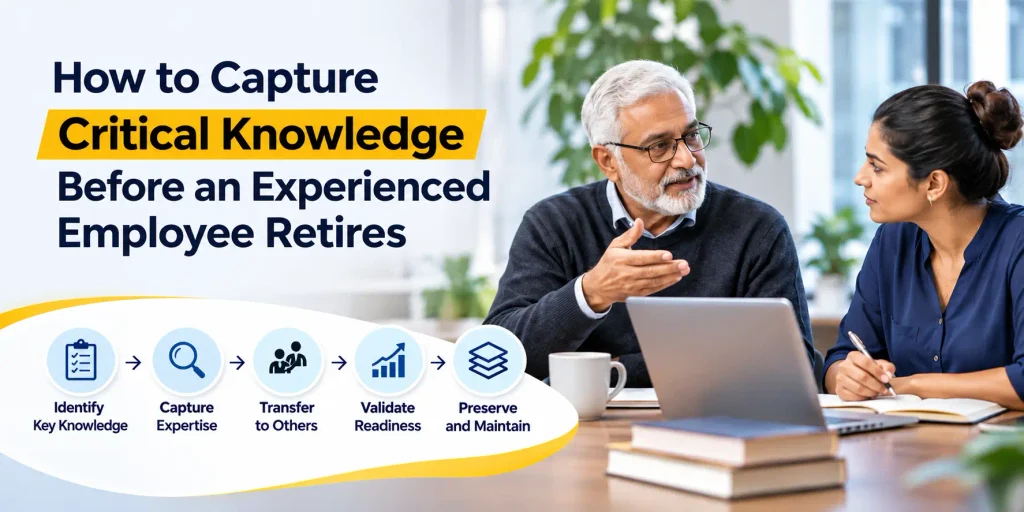
When an experienced employee retires, an organization loses more than a person who performed a particular job. It may also lose years of practical knowledge, professional judgement, problem-solving experience, customer relationships, and an understanding of how the organization actually works.
Consider a manufacturing company where a senior maintenance engineer has worked for 25 years. The company has documented maintenance schedules, equipment manuals, and standard operating procedures. However, the engineer knows which machines are likely to fail under particular conditions, which suppliers can resolve urgent problems, and how to recognize early warning signs that are not covered in the official documentation.
When the engineer retires, the documents remain. Much of the knowledge needed to interpret and apply them may not.
This is a common organizational knowledge management challenge. Important expertise often develops through years of experience and becomes embedded in everyday decisions, informal practices, and relationships. If organizations do not identify and transfer this knowledge before employees leave, they risk losing capabilities that may take years to rebuild.
The solution is not simply to ask retiring employees to write down everything they know. Organizations need a structured knowledge transfer process that identifies what is critical, determines who needs it, selects appropriate transfer methods, and verifies that the knowledge can be applied by others.
This article explains how to build that process step by step.
Why Employee Retirement Creates a Knowledge Loss Risk
Employees develop different types of knowledge throughout their careers. Some of it is documented in policies, procedures, reports, technical manuals, and shared repositories. Other knowledge exists primarily through experience.
The second category is particularly difficult to transfer.
An experienced procurement manager, for example, may understand the formal purchasing process. However, they may also know which suppliers consistently meet deadlines, how to resolve complicated negotiations, which contract terms require additional attention, and whom to contact when an urgent purchase needs approval.
These insights may never appear in the procurement manual.
This distinction is often described through two forms of organizational knowledge:
Explicit knowledge is knowledge that can be documented, stored, and communicated through structured formats. Examples include process documents, training materials, technical specifications, policies, and checklists.
Tacit knowledge is knowledge developed through personal experience, practice, observation, and judgement. It can be difficult to explain without examples, discussion, and direct interaction.
Both forms matter. However, tacit knowledge requires particular attention during employee transitions because documentation alone may not preserve the context and judgement needed to perform a task successfully.
The risk is not limited to senior management or highly technical roles. It can affect experienced customer service representatives, project managers, sales professionals, engineers, operations specialists, finance employees, and administrative staff.
The consequences may include:
- Repeated mistakes because employees do not understand why certain decisions were made.
- Longer onboarding periods for successors.
- Delays in resolving technical or operational problems.
- Loss of important customer, supplier, and partner relationships.
- Repetition of previously solved problems.
- Dependence on a small number of remaining experts.
- Reduced productivity while teams reconstruct missing knowledge.
NASA has developed dedicated knowledge capture and transfer resources to help teams retain expertise held by experienced personnel before retirement and other workforce transitions. Its guidance emphasizes planning, mentoring, documentation, and knowledge sharing rather than relying on a single handover document.
Explore NASA’s Knowledge Management resources.
Step 1: Identify Employees Whose Knowledge Is at Risk
The first step is to identify where critical knowledge resides.
Organizations should not assume that every employee approaching retirement presents the same level of knowledge risk. A person’s age or years of service alone do not determine how important their knowledge is. The key question is whether the organization depends on expertise that is difficult to replace or transfer.
Start by reviewing critical roles and identifying employees who:
- Have specialized technical or operational expertise.
- Understand complex processes that are poorly documented.
- Are the only people capable of performing certain tasks.
- Maintain important customer, supplier, or partner relationships.
- Have extensive experience handling unusual situations.
- Understand the history behind important business decisions.
- Regularly support or advise employees across multiple departments.
Involve department managers, HR, and knowledge management teams in this assessment. Managers can identify operational dependencies, HR can provide workforce planning information, and KM professionals can help determine how knowledge should be captured and transferred.
An important point is that knowledge retention should not depend entirely on employees announcing their retirement. Organizations benefit from regularly identifying critical knowledge and potential single-person dependencies across the workforce.
Step 2: Conduct a Knowledge Risk Assessment
After identifying employees whose knowledge may be at risk, determine which knowledge needs immediate attention.
Not everything an experienced employee knows needs to be documented. Trying to capture an entire career’s worth of information is neither realistic nor useful.
Instead, prioritize knowledge based on its importance to business operations and the difficulty of replacing it.
Consider these five questions:
- Business impact: What would happen if this knowledge became unavailable?
- Uniqueness: How many other employees understand or can perform this work?
- Documentation: Is the knowledge already recorded in a reliable and accessible format?
- Transfer difficulty: How much time and experience would someone need to develop the same capability?
- Urgency: How soon will the knowledge holder leave, and how much time is available for transfer?
A simple knowledge risk matrix can help managers make consistent decisions.
| Knowledge area | Business impact | Availability of other experts | Documentation status | Priority |
|---|---|---|---|---|
| Equipment troubleshooting | High | Low | Limited | Critical |
| Customer account history | High | Medium | Partial | High |
| Monthly reporting process | Medium | High | Complete | Low |
| Supplier negotiation practices | High | Low | Limited | Critical |
| Routine administrative tasks | Low | High | Complete | Low |
The ratings in this example are illustrative. Each organization should assess its own roles, processes, and operational risks.
Knowledge that is highly important, difficult to replace, and poorly documented should receive priority.
The International Atomic Energy Agency has described an approach in which organizations identify critical knowledge and skills, assess the risk of losing them, and develop action plans involving documentation, mentoring, training, and expertise sharing.
This is a useful principle for organizations outside the nuclear industry as well: identify the risk before selecting the solution.
Step 3: Create a Knowledge Inventory
Once priorities are established, create a knowledge inventory for each employee or critical role.
A knowledge inventory is a structured record of the expertise, responsibilities, relationships, processes, and experience that need to be transferred.
It should go beyond a job description.
A job description explains what an employee is expected to do. A knowledge inventory explores what the employee needs to know to perform those responsibilities effectively.
For example, a senior project manager’s inventory might include:
Core responsibilities: Project planning, budget monitoring, stakeholder coordination, risk management, and delivery oversight.
Technical and process knowledge: Project management tools, reporting requirements, approval procedures, and internal workflows.
Experience-based knowledge: Common project delays, early warning signs, lessons from previous projects, and methods for handling unexpected changes.
Relationship knowledge: Key internal stakeholders, external partners, client contacts, and escalation channels.
Historical knowledge: Why certain project decisions were made, what approaches were unsuccessful, and which lessons should influence future projects.
Unwritten practices: Informal coordination methods, decision-making patterns, and practical ways to resolve recurring problems.
The employee should help create and validate this inventory. Managers and potential successors should also contribute because they may identify knowledge gaps that the employee does not initially recognize.
A useful starting question is:
What would a replacement employee struggle to understand or do if you were no longer available tomorrow?
The answers can reveal knowledge that is rarely included in formal documentation.
Step 4: Use Structured Interviews to Capture Tacit Knowledge
Structured interviews are one of the most useful methods for discovering experience-based knowledge.
However, asking an employee to describe their job responsibilities is not enough. The purpose is to uncover how they make decisions, handle exceptions, recognize problems, and apply experience in real situations.
A knowledge capture interview should be organized around specific themes.
Decision-making and judgement
- What information do you consider before making an important decision?
- How do you decide when a standard procedure is not sufficient?
- What warning signs tell you that a situation may become a problem?
- What mistakes should someone in this role avoid?
Problem-solving
- What are the most difficult problems you have encountered?
- How did you resolve them?
- Which problems occur repeatedly?
- Are there situations where the usual process does not work?
Relationships and collaboration
- Which people or departments are essential to getting the work done?
- Who should a new employee contact when a particular issue arises?
- Are there important relationships that require careful management?
Lessons from experience
- What do you know now that you wish you had known when you started?
- Which past decisions had the greatest impact on your work?
- What practices would you recommend changing?
- What knowledge should never be overlooked by your successor?
Interviewers should encourage employees to describe real examples rather than provide only general explanations.
For instance, instead of asking, “How do you manage supplier relationships?”, ask, “Can you describe a situation where a supplier failed to meet an important deadline and explain how you handled it?”
Specific examples reveal the context, judgement, and actions behind successful work.
With the employee’s agreement, interviews can be recorded and transcribed. The resulting material should be reviewed, organized, and converted into useful knowledge assets rather than simply stored as lengthy recordings.
Step 5: Transfer Knowledge Through Job Shadowing and Mentoring
Documentation is important, but it cannot replace practical experience.
Some knowledge is best transferred through observation, discussion, and repeated practice. This is particularly true for technical work, complex decision-making, customer interactions, and situations that require professional judgement.
Two useful methods are job shadowing and mentoring.
Job shadowing allows a successor or colleague to observe the experienced employee performing real tasks. The employee explains what they are doing, why they are doing it, and what factors influence their decisions.
For example, a retiring quality manager could demonstrate how to inspect a production issue, interpret unusual results, identify the likely cause, and decide whether an escalation is necessary.
Mentoring creates a more sustained relationship in which the experienced employee helps another person develop the knowledge and judgement needed for the role.
A mentoring arrangement should have clear objectives. It should not become a series of informal conversations without measurable progress.
A practical arrangement could include:
- Weekly knowledge-sharing sessions.
- Joint handling of selected tasks.
- Review of difficult cases and decisions.
- Discussion of lessons learned from previous projects.
- Guided practice with feedback from the experienced employee.
- Regular assessment of the successor’s confidence and capability.
Where possible, organizations should identify successors early enough to allow meaningful overlap. If a direct successor is unavailable, knowledge can be transferred to several team members who collectively cover the departing employee’s responsibilities.
NASA’s knowledge continuity guidance also recommends mentoring, cross-training, and job shadowing as ways to reduce dependence on individual employees.
Step 6: Convert Experience into Practical Knowledge Assets
Knowledge capture should produce materials that people can actually use.
A large collection of interview transcripts or recorded meetings does not automatically become an effective knowledge management resource. The information needs to be organized, validated, and connected to the work it supports.
Depending on the knowledge being transferred, useful assets may include:
Process guides: Step-by-step instructions explaining how important activities are performed.
Decision guides: Information about the factors, criteria, and conditions that influence important decisions.
Troubleshooting guides: Common problems, possible causes, diagnostic steps, and recommended responses.
Role continuity documents: Essential responsibilities, recurring activities, contacts, dependencies, and pending work.
Lessons learned records: Examples of previous successes, failures, unexpected challenges, and recommendations for future work.
Relationship maps: Important stakeholders, suppliers, customers, subject matter experts, and internal contacts, with appropriate business context.
Short instructional videos: Demonstrations of tasks that are easier to understand visually than through written instructions.
For example, a retiring IT infrastructure specialist might create a troubleshooting guide for recurring system issues, record a short demonstration of critical maintenance activities, and document escalation contacts and known technical dependencies.
The objective is not to create more documentation for its own sake. It is to make essential knowledge easier to find, understand, and apply.
Step 7: Build a Knowledge Transfer Plan With Clear Responsibilities
Knowledge transfer should be managed as a planned activity, not left to the final weeks of an employee’s career.
Create an individual knowledge transfer plan that identifies what needs to be transferred, who will receive it, how the transfer will happen, and when it should be completed.
A practical plan might look like this:
| Knowledge area | Transfer method | Recipient | Expected output |
|---|---|---|---|
| Critical operational processes | Documentation and demonstration | Successor | Updated process guide |
| Technical troubleshooting | Job shadowing | Two team members | Troubleshooting guide and practical assessment |
| Customer relationships | Joint meetings and handover | Account manager | Relationship and account history record |
| Historical decisions | Structured interviews | Department manager | Decision history and lessons learned |
| Recurring responsibilities | Mentoring and guided practice | Successor | Completed responsibility checklist |
Assign clear responsibilities:
- Departing employee: Explains, demonstrates, and validates their knowledge.
- Successor or recipient: Learns, practices, asks questions, and demonstrates competency.
- Department manager: Prioritizes activities and provides time and resources.
- HR: Connects the process with retirement and succession planning.
- KM team: Provides methods, templates, repositories, and quality standards.
The plan should also include milestones and regular reviews. If a critical knowledge area remains incomplete, managers need to know early enough to take corrective action.
Step 8: Verify That Knowledge Has Actually Been Transferred
One of the most common mistakes in knowledge transfer is measuring completion by the number of documents created.
A completed document does not prove that another employee can perform the task.
The real test is whether the recipient can use the knowledge independently and appropriately.
For example, a successor may have received a detailed technical guide and attended several training sessions. However, if they cannot diagnose a common equipment problem without the retiring expert’s assistance, the transfer is incomplete.
Organizations should use practical assessments to verify knowledge transfer.
These may include:
- Asking the successor to perform a task independently.
- Reviewing how they respond to a simulated problem.
- Observing them handle a customer or supplier interaction.
- Asking them to explain the reasoning behind a decision.
- Testing whether they can locate and use relevant documentation.
- Reviewing their ability to manage exceptions and unusual situations.
The departing employee can provide feedback, but the manager should also assess whether the recipient is ready to take responsibility.
Knowledge transfer is successful when the recipient can apply the knowledge in the actual work environment, not merely repeat what they have been told.
Step 9: Store and Maintain the Captured Knowledge
Once knowledge has been captured and validated, it needs to remain accessible.
Organizations often store important information across personal drives, email accounts, shared folders, collaboration platforms, and departmental repositories. This creates another problem: knowledge may be captured but remain difficult to locate.
Establish a clear location for approved knowledge assets. Depending on the organization’s existing technology, this could be a knowledge management platform, intranet, SharePoint environment, or structured document repository.
Every important knowledge asset should have:
- A descriptive title.
- Relevant keywords and categories.
- A named owner or responsible department.
- A review date.
- Version information.
- Appropriate access permissions.
- Links to related processes and resources.
Do not assume that storing everything in one repository automatically creates a single source of truth. Employees need to know which version is authoritative and where to find it.
The organization should also assign responsibility for reviewing captured knowledge. Procedures, systems, supplier information, and business requirements change. Without maintenance, today’s useful knowledge asset can become tomorrow’s source of incorrect information.
Step 10: Make Knowledge Retention an Ongoing KM Practice
A retirement-focused knowledge transfer exercise is useful, but organizations should not wait until employees are preparing to leave before preserving important expertise.
Knowledge retention should become part of normal business operations.
Managers can introduce regular knowledge-sharing activities, cross-training, lessons learned reviews, mentoring arrangements, and process documentation. Employees working in critical roles should have opportunities to share expertise throughout their careers.
For example, a department could conduct a quarterly knowledge review to identify undocumented processes, emerging knowledge gaps, and responsibilities that depend too heavily on one individual.
Project teams can capture lessons learned at the end of major projects. Technical teams can maintain troubleshooting guides. Experienced employees can mentor colleagues before a retirement date becomes imminent.
This approach reduces the pressure associated with last-minute knowledge capture and helps build organizational resilience over time.
Can AI Help Capture Knowledge Before Employees Retire?
AI tools can support knowledge capture and make recorded expertise easier to organize and retrieve. However, they should be used as part of a broader knowledge transfer process rather than treated as a replacement for human interaction.
Some practical applications include:
Interview transcription: AI-powered transcription tools can convert recorded knowledge-sharing interviews into searchable text.
Summarization: AI can help turn lengthy interviews, meeting recordings, and discussions into structured summaries.
Knowledge extraction: With appropriate review, AI can identify recurring themes, important processes, key decisions, and potential knowledge gaps across captured material.
Knowledge base development: AI can help draft frequently asked questions, process guides, troubleshooting resources, and training materials from validated source documents.
Semantic search: AI-powered search can help employees locate relevant information even when they do not know the exact document title or terminology.
However, there are important limitations.
AI-generated summaries can omit context, misunderstand technical details, or produce statements that the employee never intended. A transcript may also contain confidential customer information, personal data, or commercially sensitive material.
Organizations should obtain appropriate consent, define access permissions, follow data protection requirements, and ensure that subject matter experts review AI-generated content before publication.
Most importantly, AI cannot fully reproduce the experience-based judgement developed through years of practical work. It can help preserve and retrieve knowledge, but mentoring, observation, discussion, and guided practice remain essential.
How to Measure the Success of a Knowledge Transfer Program
Organizations should measure whether the transfer process reduces knowledge risk and improves operational continuity.
Counting interviews, documents, and training sessions can help track activity, but these measures do not demonstrate whether knowledge has been successfully transferred.
A more useful measurement approach combines activity indicators with practical outcomes.
| Measurement area | Example indicator |
|---|---|
| Knowledge identification | Percentage of critical roles assessed for knowledge risk |
| Knowledge capture | Percentage of high-priority knowledge areas documented or transferred |
| Knowledge sharing | Number of completed mentoring and job-shadowing activities |
| Knowledge accessibility | Percentage of captured assets available in the approved repository |
| Recipient readiness | Percentage of critical tasks successors can perform independently |
| Operational continuity | Number of disruptions linked to missing or inaccessible knowledge |
| Knowledge maintenance | Percentage of critical assets reviewed by their scheduled dates |
Organizations should establish a baseline before the transfer process begins and review progress at agreed intervals.
For example, if a retiring engineer is responsible for ten critical maintenance activities, the organization can assess how many of those activities another employee can perform independently before and after the transfer program.
This provides a more meaningful indication of whether the initiative has improved operational readiness.
A Practical 90-Day Knowledge Transfer Approach
When an experienced employee has approximately three months before retirement, organizations can use a structured 90-day plan to organize the transfer.
The timeline below is an example. It should be adjusted according to the complexity of the role, the availability of successors, and the urgency of the knowledge risk.
Days 1–15: Identify and prioritize
- Identify the employee’s critical responsibilities and areas of expertise.
- Conduct a knowledge risk assessment.
- Create a knowledge inventory.
- Identify recipients and potential successors.
- Agree on the knowledge transfer objectives.
Days 16–45: Capture and document
- Conduct structured knowledge capture interviews.
- Record important decisions, lessons, and practical experiences.
- Document critical processes and recurring responsibilities.
- Create troubleshooting guides and continuity documents.
- Organize relevant files and resources.
Days 46–75: Transfer and practice
- Arrange job shadowing and mentoring sessions.
- Conduct joint work on important activities.
- Introduce successors to key stakeholders.
- Review difficult cases and historical decisions.
- Allow recipients to perform selected tasks with guidance.
Days 76–90: Validate and hand over
- Ask recipients to perform critical tasks independently.
- Identify and address remaining knowledge gaps.
- Review and approve the captured documentation.
- Confirm access to systems, files, and relevant contacts.
- Complete the formal knowledge handover.
If the role involves highly specialized expertise, 90 days may not be sufficient. Some knowledge requires a longer period of mentoring and practical experience. Organizations should therefore identify critical knowledge as early as possible rather than treating the final three months as the entire transfer window.
Common Mistakes Organizations Should Avoid
Even organizations that recognize the importance of knowledge retention can make mistakes during implementation.
Waiting until the employee’s final weeks: Knowledge transfer requires time, particularly when the expertise is highly specialized or difficult to explain. Begin as early as possible.
Relying only on exit interviews: Traditional exit interviews usually focus on the employee’s experience and reasons for leaving. They are not designed to capture the full range of operational and experience-based knowledge.
Asking employees to document everything: This creates an unrealistic workload and often produces large volumes of information with little practical value. Prioritize knowledge according to business risk.
Treating documentation as the complete solution: Documents can explain processes, but they may not transfer judgement, context, or practical skills. Combine documentation with mentoring and guided practice.
Failing to involve the recipient: Knowledge transfer is not simply an information collection exercise. The person who will use the knowledge should actively participate, ask questions, and demonstrate what they have learned.
Ignoring knowledge maintenance: Captured information can become outdated. Assign ownership and review dates to important knowledge assets.
Making knowledge transfer an informal responsibility: Without management support, dedicated time, and clear expectations, knowledge-sharing activities are easily delayed by daily operational demands.
Conclusion: Preserve Experience Before It Becomes a Knowledge Gap
Employee retirement is a natural part of workforce change. Losing critical organizational knowledge does not have to be.
Organizations can reduce knowledge loss by identifying expertise at risk, prioritizing what matters, capturing practical experience, and transferring knowledge through documentation, mentoring, job shadowing, and guided practice.
The most important shift is to stop treating knowledge transfer as a final administrative task in the employee offboarding process. It should be a planned knowledge management activity connected to workforce planning, succession management, and business continuity.
A well-written procedure is valuable. A recorded interview can preserve important insights. A knowledge repository can make information accessible. But the real measure of success is whether another employee can use that knowledge to make decisions, solve problems, and perform the work effectively.
Experienced employees may eventually leave an organization. Their valuable knowledge, however, should not have to leave with them.
Frequently Asked Questions
1. What is knowledge transfer before employee retirement?
Knowledge transfer before retirement is the process of identifying, capturing, and sharing an experienced employee’s critical knowledge with colleagues or successors before they leave the organization. It helps preserve operational expertise, practical judgement, and important organizational information.
2. What types of knowledge should organizations capture before an employee retires?
Organizations should prioritize knowledge that is essential to business operations and difficult to replace. This includes technical expertise, undocumented processes, decision-making experience, troubleshooting methods, customer and supplier relationships, historical context, and lessons learned.
3. What is the best method for capturing tacit knowledge?
There is no single best method. Structured interviews, mentoring, job shadowing, storytelling, guided practice, and after-action reviews can all help capture tacit knowledge. The most appropriate approach depends on the type of expertise and how it is used.
4. How early should organizations begin knowledge transfer before retirement?
Organizations should begin as early as possible, ideally well before an employee’s retirement becomes imminent. Critical knowledge should be identified continuously through workforce planning and knowledge risk assessments. Complex roles may require months or longer to transfer effectively.
5. Can AI help preserve knowledge from retiring employees?
Yes. AI can support transcription, summarization, knowledge extraction, content development, and information retrieval. However, AI-generated material must be reviewed by knowledgeable employees, and AI should complement rather than replace mentoring and practical knowledge transfer.
6. How can organizations know whether knowledge transfer has been successful?
Organizations should assess whether recipients can independently perform critical tasks, solve relevant problems, locate the right information, and make appropriate decisions. Completed documents and training sessions are useful activity measures, but demonstrated capability is a stronger indicator of success.
7. Who is responsible for managing knowledge transfer?
Responsibility should be shared. Department managers identify operational priorities, HR connects the process with workforce and succession planning, KM teams provide methods and knowledge systems, and experienced employees and recipients actively participate in the transfer.
Further reading: NASA Knowledge Management and Knowledge Capture Resources.