
Introduction
Professional football has evolved far beyond a game won solely by extraordinary talent. While world-class players remain invaluable, the real difference between championship teams and their rivals increasingly lies in their ability to learn faster, share experience more effectively, analyze information more intelligently, and transform individual expertise into collective performance.
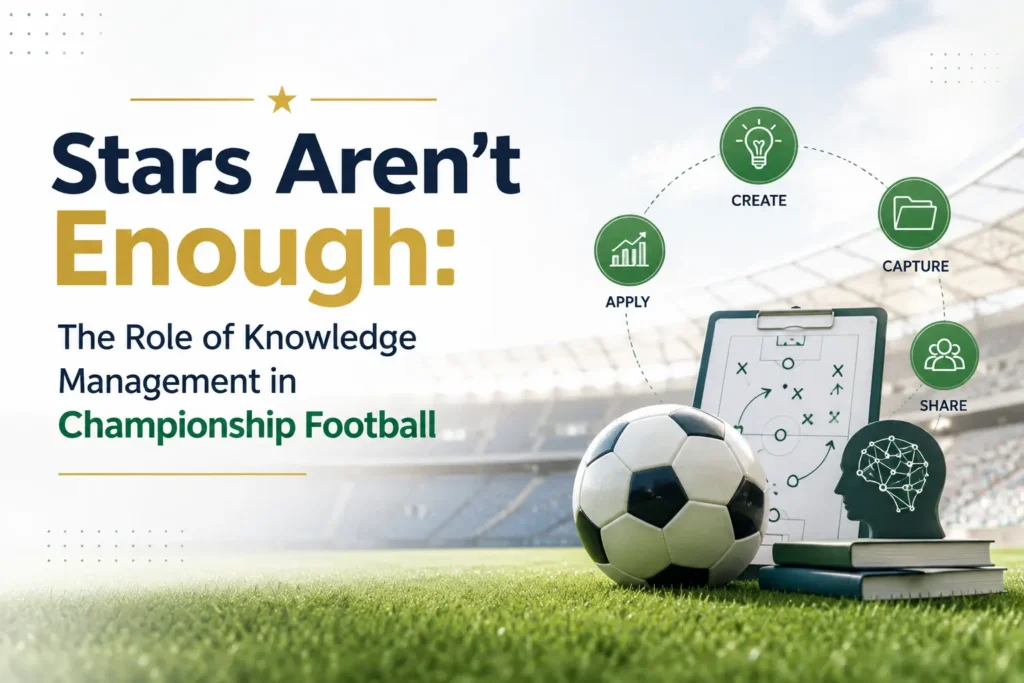
Just as leading organizations rely on knowledge management to remain competitive, elite football clubs depend on their ability to create knowledge, preserve valuable experience, transfer insights across the squad, and apply what they have learned when it matters most. Winning titles is no longer just about assembling gifted players it is about building an environment where knowledge continuously flows, evolves, and improves decision-making on and off the pitch.
This article examines the knowledge management cycle through the lens of professional football. Drawing on real-world examples—from Pep Guardiola’s tactical innovations at FC Barcelona and Liverpool’s data-driven approach under Jürgen Klopp to Carlo Ancelotti’s leadership at Real Madrid, Spain’s golden generation, and Argentina’s journey from disappointment to World Cup glory—it illustrates how elite teams transform knowledge into sustained competitive advantage. More importantly, it highlights what organizations can learn from football about creating, preserving, sharing, and applying knowledge to achieve long-term success.
Why Champions Are Built on More Than Star Players
For decades, football success was commonly attributed to the presence of exceptional individuals players capable of changing the course of a match through moments of brilliance. Although talent remains essential, modern football has repeatedly demonstrated that even the world’s greatest players cannot consistently succeed without a cohesive system built on learning, collaboration, and shared understanding.
Football history is filled with teams packed with superstars that failed to meet expectations because they lacked tactical cohesion, effective communication, or mechanisms for transferring experience across the squad. In contrast, many championship-winning teams were not necessarily the most talented on paper. Instead, they outperformed stronger opponents by continuously learning, analyzing past performances, sharing knowledge between coaches and players, and fostering a culture of collaboration.
Within these teams, tactical expertise from coaches, practical wisdom from experienced players, performance analytics, and lessons learned from both victories and defeats become collective assets rather than individual possessions. This shared intelligence enables the team to perform at a level far greater than the sum of its individual talents.
Elite football closely resembles high-performing organizations. No successful company can sustain its competitive advantage by relying solely on a handful of experts, and football clubs face the same challenge. Long-term success depends on systems that continuously create, capture, transfer, and apply knowledge across generations of players, coaches, and staff.
Teams capable of transforming individual experience into organizational knowledge gain a significant competitive advantage. They adapt more quickly, learn from mistakes more effectively, and preserve valuable expertise even as players retire or move to other clubs.
Modern championships, therefore, are won not simply through individual brilliance but through effective knowledge management. Knowledge is created on the training ground, refined during competition, enriched through continuous learning, and ultimately transformed into one of the most valuable strategic assets a football team can possess.
Spain’s triumph at the 2010 FIFA World Cup perfectly illustrates this principle. Their success was not merely the result of an outstanding generation of players; it reflected more than a decade of investment in a clear football philosophy based on possession, tactical intelligence, and the continuous transfer of knowledge between successive generations of coaches and players.
Argentina’s 2022 World Cup victory tells a similar story. Although Lionel Messi played a decisive role, the team’s success was equally built upon years of learning from previous disappointments, maintaining tactical consistency, leveraging the experience of veteran players, and developing a shared football identity throughout the squad.
In both cases, championships were achieved not simply because of extraordinary talent, but because these teams successfully created, transferred, and applied collective knowledge—precisely the principles that define effective knowledge management in successful organizations.
Knowledge Creation: Where Every Championship Begins
Every competitive advantage begins with a new idea. In football, as in business, knowledge is not created in boardrooms or meeting halls—it emerges where real problems are solved. For elite football clubs, that place is the training ground.
Training sessions are far more than physical preparation. They are laboratories of experimentation where coaches and players test tactical concepts, refine decision-making, and search for innovative solutions to the challenges they expect to face during competition. Many of the ideas that have transformed modern football were born not during matches, but through countless hours of practice, observation, trial, and continuous feedback.
One of the clearest examples is Pep Guardiola’s tenure at FC Barcelona. During his years at the club, Guardiola refined concepts such as positional play (Juego de Posición) and the now-famous principle of counter-pressing immediately after losing possession. These ideas did not emerge overnight. They evolved through repeated experimentation on the training pitch, where players continuously practiced positioning, movement, spacing, and decision-making until complex tactical behaviors became second nature.
What began as practical solutions to tactical challenges eventually developed into a structured body of knowledge that reshaped not only Barcelona but modern football itself. Coaches across Europe and beyond adopted and adapted these principles, turning them into part of football’s global tactical language.
This process closely mirrors knowledge creation within organizations. Valuable knowledge rarely appears fully formed. Instead, it develops as individuals confront real challenges, experiment with new approaches, evaluate outcomes, and refine their ideas through continuous learning. Over time, these experiences become organizational knowledge that can be reused, improved, and transferred to others.
Innovation, therefore, is not simply the result of creativity; it is the outcome of a systematic learning process.
Organizations that encourage experimentation, accept calculated risk, and create opportunities for employees to learn from everyday work generate knowledge that competitors cannot easily replicate. Likewise, football teams that treat training sessions as opportunities for learning rather than routine preparation continually develop new capabilities that strengthen their competitive advantage.
The lesson extends far beyond football. Sustainable success depends on creating an environment where curiosity is encouraged, experimentation is valued, and learning becomes part of everyday work. When organizations institutionalize these behaviors, knowledge evolves from isolated insights into a strategic asset that drives innovation and long-term performance.
Capturing Knowledge: Turning Experience into Organizational Memory
Creating knowledge is only the first step. Without preserving it, even the most valuable insights can disappear when key individuals leave. In both football and business, lasting success depends not only on generating knowledge but also on capturing and retaining it.
Many organizations produce brilliant ideas and accumulate years of valuable experience, yet much of that knowledge remains locked in the minds of individuals. When employees retire, change jobs, or move to new roles, a significant portion of that intellectual capital disappears with them.
Elite football clubs understand this challenge remarkably well. Victories should not exist only in the memories of coaches and players; they must become part of the club’s institutional knowledge.
For this reason, leading clubs have developed sophisticated systems to document and preserve their football intelligence. Match footage, training videos, tactical reports, player performance metrics, medical records, fitness data, opponent analyses, and even coaching decisions during games all contribute to what can be described as the club’s organizational memory.
These resources serve a purpose far beyond historical record-keeping. They allow coaches and analysts to evaluate previous performances, identify recurring patterns, improve future decision-making, and continuously refine training methods.
Modern football has transformed countless subjective observations into measurable knowledge. Coaches no longer focus only on the final score. They seek to understand when their team applied effective pressure, where possession was repeatedly lost, how defensive structures broke down, and which movement patterns created the greatest attacking opportunities.
Every training session, every match, and every player movement becomes another source of knowledge. A compelling example can be found at Liverpool FC during Jürgen Klopp’s tenure. The club continuously collected and analyzed enormous volumes of performance data, including total distance covered, pressing intensity, recovery runs, passing networks, off-the-ball movement, chance creation, sprint frequency, and dozens of other performance indicators.
These data were never collected simply for statistical reports. They directly informed training design, workload management, tactical preparation, opponent analysis, player selection, and in-game decision-making.
In this sense, performance databases in football play the same role that knowledge repositories, lessons-learned databases, and organizational memory systems play in successful organizations. They prevent valuable experience from being lost and ensure that every success—and every failure—becomes an opportunity for future learning
A team that fails to capture its knowledge is forced to solve the same problems repeatedly. Instead of building on previous experience, it continually starts from scratch, paying the cost of the same mistakes over and over again.
Organizations face exactly the same risk. Capturing knowledge creates continuity. People may leave, but their expertise does not have to leave with them. When experiences, best practices, and lessons learned are systematically documented, knowledge becomes a lasting organizational asset rather than an individual possession.
Knowledge Sharing: From the Dressing Room to the Pitch
Knowledge creates value only when it moves beyond individual minds and becomes a shared capability. In football, having a brilliant coach or a handful of experienced players is not enough to guarantee success. What distinguishes elite teams from the rest is their ability to transfer knowledge, experience, and tactical understanding throughout the entire squad.
If knowledge remains concentrated in a few key players or members of the coaching staff, the team becomes vulnerable. An injury, transfer, or retirement can immediately weaken its performance. Championship teams avoid this risk by embedding knowledge into the culture of the club, ensuring that it survives changes in personnel and continues to benefit future generations of players.
Knowledge sharing in football takes many forms. It happens during tactical meetings, video analysis sessions, one-on-one coaching conversations, mentoring relationships between senior and younger players, and the countless interactions that occur during daily training. Many of the split-second decisions made on the pitch are the result of hundreds of hours of shared learning behind the scenes.
When a defender instinctively knows how a teammate will cover space, or when a midfielder delivers a pass without even looking because he already understands where the striker will be, they are not relying on intuition alone. They are operating with a shared mental model—a common football language developed through continuous communication, practice, and learning.
One of the best examples of this approach was Spain’s golden generation. Players such as Xavi Hernández and Andrés Iniesta contributed far more than technical brilliance. They acted as carriers of the team’s football philosophy, passing tactical knowledge, decision-making principles, and playing culture to teammates throughout the squad.
Their influence enabled new players to integrate quickly into Spain’s possession-based system. Instead of learning every tactical principle from scratch, newcomers absorbed an established way of thinking about the game. This shared understanding allowed the team to maintain its identity despite changes in personnel and contributed significantly to Spain’s remarkable period of international dominance.
The same principle applies to organizations.
Knowledge trapped inside individual experts limits organizational performance. When expertise remains personal rather than collective, organizations become increasingly dependent on a small number of people whose departure can create significant knowledge gaps.
High-performing organizations deliberately create opportunities for knowledge sharing. Communities of practice, expert networks, mentoring programs, storytelling sessions, after-action reviews, lessons learned workshops, and collaborative digital platforms all help transform personal expertise into organizational capability.
When knowledge flows freely across an organization, learning accelerates, innovation becomes more frequent, and employees make better decisions because they build upon each other’s experience instead of working in isolation.
Ultimately, championship football teams do not succeed simply because they have talented individuals; they succeed because those individuals think, communicate, and learn as one cohesive system. Organizations that cultivate the same culture of collaboration and knowledge sharing are equally well positioned to build sustainable competitive advantage.
Learning from Failure: The Greatest Asset of Championship Teams
In football, as in business, success is often celebrated—but failure is where the most valuable learning takes place. Victories can create confidence, yet they may also conceal weaknesses that remain unnoticed beneath a positive result. Defeats, on the other hand, force teams to confront uncomfortable realities, question their assumptions, and search for better ways to compete.
The world’s greatest teams understand that failure is not the opposite of success it is an essential part of achieving it.
What distinguishes championship teams is not that they lose less often, but that they learn more effectively when they do. Rather than searching for excuses or assigning blame, they analyze the root causes of failure. Was the tactical approach ineffective? Did preparation fall short? Were communication and decision-making under pressure inadequate? Could player development or team structure be improved?
By asking these questions, failure becomes more than a disappointing result. It becomes a source of new knowledge.
Argentina’s journey to winning the 2022 FIFA World Cup is a powerful example. Before lifting the trophy in Qatar, Argentina endured years of painful setbacks, including defeats in the 2014 World Cup Final and consecutive Copa América finals. Instead of abandoning their long-term vision, the team gradually learned from those experiences. Tactical adjustments, stronger team cohesion, improved leadership, and greater psychological resilience eventually transformed repeated disappointment into world championship success.
Germany offers another important lesson. The country’s early elimination from the 2018 FIFA World Cup—and another disappointing campaign in 2022—raised serious concerns about the future of one of football’s most successful nations. Rather than viewing these failures as isolated events, the German Football Association (DFB) launched a comprehensive review of its football development system. Youth development programs, talent identification processes, coaching methods, and player education were reassessed to understand why performance had declined and how future generations could be better prepared.
These examples illustrate a fundamental principle of knowledge management: failure creates value only when organizations deliberately learn from it.
Many of the most significant innovations in football have emerged not after victories, but after painful defeats that exposed weaknesses and inspired meaningful change. Teams capable of transforming setbacks into organizational learning become stronger, more resilient, and better prepared for future challenges.
The same principle applies across every industry.
Organizations that systematically document unsuccessful projects, operational incidents, and strategic mistakes build an invaluable repository of lessons learned. These insights help prevent repeated errors, improve decision-making, and strengthen future performance.
In contrast, organizations that hide failures or quickly move on without reflection often find themselves repeating the same mistakes. The cost of failing is rarely the failure itself—it is the failure to learn.
For this reason, Lessons Learned has become one of the cornerstones of modern knowledge management. Capturing insights from both success and failure enables organizations to continuously improve their processes, strengthen organizational memory, and develop greater resilience in an increasingly uncertain environment.
Perhaps this is why many legendary football managers have long believed that teams often learn more from defeat than from victory. When analyzed honestly and systematically, failure becomes the starting point for future success rather than the end of the journey.
Technology and Data Analytics: The Brain of Modern Football
If twentieth-century football relied primarily on talent, experience, and managerial intuition, the modern game increasingly depends on data, analytics, and technology. Today’s elite clubs make decisions based not only on observation but also on vast amounts of technical, tactical, and physical information that provide deeper insights into player and team performance.
Technology has therefore become one of the most powerful enablers of knowledge management in professional football.
Almost every movement on the pitch can now be measured. Distance covered, sprint frequency, pressing intensity, passing accuracy, positioning, spatial control, expected goals, player workload, recovery rates, and fatigue levels are continuously monitored through sophisticated tracking systems and performance analytics.
These data allow coaches to evaluate their own teams with remarkable precision while also identifying patterns, strengths, and vulnerabilities in their opponents. Instead of relying solely on instinct, decisions about training intensity, player selection, tactical adjustments, and injury prevention are increasingly supported by objective evidence.
Perhaps more importantly, technology transforms tacit knowledge into explicit knowledge.
Many insights that once existed only in the minds of experienced coaches can now be captured, analyzed, visualized, and shared across the organization. Artificial intelligence, video analysis platforms, GPS tracking systems, and advanced statistical models make previously invisible patterns visible, allowing clubs to understand the game at an entirely new level.
In many respects, technology functions as the brain and memory of modern football. It enables clubs not only to collect enormous amounts of information but also to convert that information into practical knowledge that improves performance.
Organizations face a similar transformation.
Business intelligence platforms, knowledge management systems, analytics dashboards, and artificial intelligence tools now help organizations make faster and more informed decisions. However, technology itself is not the source of competitive advantage.
Competitive advantage emerges when organizations successfully transform data into information, information into knowledge, and knowledge into action.
Football demonstrates this principle exceptionally well. The clubs that consistently succeed are not necessarily those with the largest budgets or the biggest stars. They are the ones that learn faster, analyze more intelligently, and use technology to make better decisions than their competitors.
This is precisely the goal of effective knowledge management: enabling better decisions through better use of knowledge. In both football and business, technology is most valuable not because it stores information, but because it helps people learn, adapt, and perform more effectively.
The Coach: The Team’s Chief Knowledge Officer
Traditionally, a football coach was expected to design tactics, select the starting lineup, and make decisions during matches. In modern football, however, the role has expanded far beyond these responsibilities. Today’s most successful coaches function not only as tacticians but also as knowledge leaders—individuals who create learning environments, facilitate knowledge transfer, and transform individual talent into collective excellence.
Every football team is a diverse collection of experiences, skills, and perspectives. Young players bring energy, ambition, and adaptability. Veteran players contribute tactical awareness, emotional control, and years of competitive experience. Analysts, fitness coaches, psychologists, and medical staff each possess specialized expertise that influences performance.
The coach’s challenge is not simply to manage these resources but to integrate them into a coherent system where knowledge flows freely and every member contributes to the team’s success.
Great coaches do more than issue instructions. They create cultures of continuous learning.
Tactical meetings, video analysis sessions, individual coaching conversations, post-match reviews, and daily feedback all become opportunities to improve understanding and reinforce shared objectives. Experienced players mentor younger teammates, coaching staff collaborate across disciplines, and lessons from previous matches are continuously incorporated into future preparation.
Knowledge, therefore, becomes part of the team’s daily routine rather than something reserved for formal meetings.
One of the best examples of this leadership style is Carlo Ancelotti. Throughout his career, Ancelotti has successfully managed teams composed of world-class players from different generations, cultures, and footballing backgrounds. Rather than imposing a rigid system, he has consistently built environments based on trust, communication, and mutual respect.
His greatest strength lies in connecting people.
By combining the experience of veteran players with the enthusiasm of emerging talent, Ancelotti creates teams that learn from one another and operate with a shared understanding. His ability to manage strong personalities while maintaining unity has been one of the defining characteristics of his success at clubs such as Real Madrid, AC Milan, and Chelsea.
In many respects, his role mirrors that of an effective knowledge manager within an organization. He identifies expertise, encourages collaboration, facilitates learning, and ensures that valuable experience benefits the entire team rather than remaining with individuals.
This is why many great football clubs remain competitive even after key players leave.
Their success is not built solely on exceptional individuals but on a learning system that preserves knowledge, develops new talent, and continuously strengthens organizational capability.
Ultimately, a great coach is not simply someone who wins matches.
A great coach builds an organization that continues to learn.
He transforms experience into institutional knowledge, encourages continuous improvement, and creates a team whose collective intelligence consistently exceeds the sum of its individual talents.
From Football Clubs to Organizations: What Leaders Can Learn
At first glance, professional football and organizational management appear to belong to entirely different worlds. One unfolds on the pitch before millions of spectators, while the other takes place in offices, factories, and boardrooms.
Yet beneath the surface, both operate according to remarkably similar principles.
The same factors that enable football teams to compete for championships also enable organizations to achieve sustainable success: continuous learning, effective knowledge sharing, teamwork, trust, adaptability, and the ability to improve through experience.
Championship teams understand that long-term success cannot depend on a handful of exceptional individuals. If critical knowledge remains concentrated in only a few players, the team’s performance becomes vulnerable whenever those individuals retire, transfer to another club, or suffer injuries.
Organizations face exactly the same risk.
When expertise exists only in the minds of a small number of specialists, employee turnover, retirement, or organizational change can result in significant knowledge loss.
The solution is identical in both settings: transform individual knowledge into organizational knowledge.
When valuable experiences are documented, lessons learned are shared, and knowledge transfer becomes part of everyday work, organizations become more resilient. New employees no longer begin from scratch; instead, they build upon the accumulated knowledge of those who came before them.
This accelerates learning, reduces costly mistakes, and improves long-term performance. Football also teaches an important lesson about collaboration.
Championships are rarely won through isolated individual brilliance. They are won through coordinated action, shared purpose, and mutual trust.
Likewise, organizations that foster collaboration and encourage knowledge sharing are generally more innovative, more agile, and better prepared to respond to change.
Perhaps the most valuable lesson football offers leaders is that championships are not events—they are outcomes of continuous learning.
Winning is never a single achievement. It is the result of countless cycles of experimentation, reflection, adaptation, and improvement.
Sustainable competitive advantage is achieved not by hiring the brightest individuals alone, but by creating systems that allow knowledge to grow, spread, and remain within the organization over time.
When knowledge becomes part of an organization’s culture rather than the property of individuals, success becomes repeatable. hat is the hallmark of both championship football teams and truly outstanding organizations.
Conclusion: Championships Are Won Through Knowledge
The stories of football’s greatest teams reveal a simple but powerful truth: championships are not won by talent alone.
While exceptional players and visionary coaches are undoubtedly important, sustainable success depends on something far more enduring—the ability to create, capture, share, apply, and continuously refine knowledge.
Elite football clubs understand that every training session is an opportunity to learn, every match generates valuable experience, every setback contains lessons, and every success should strengthen the organization’s collective memory. Over time, these practices transform individual expertise into a lasting competitive advantage.
The same principle applies to organizations across every industry. Companies that systematically manage knowledge are better equipped to innovate, adapt to change, preserve critical expertise, and make better decisions. They recognize that their greatest asset is not simply talented people, but their ability to ensure that what those people know becomes part of the organization’s collective intelligence.
In the end, football offers a compelling lesson for every leader. The strongest teams are not those with the biggest stars, the largest budgets, or the most impressive reputations. They are the teams that learn faster than their competitors, share knowledge more effectively, and consistently transform experience into better performance.
Author

I am a Knowledge Management consultant and instructor, currently serving as a Board Member and Senior Project Manager at DANA KM Consulting Group, a leading KM consulting firm in Iran.
Drawing on over 15 years of hands-on experience, I help organizations transform KM strategies into practical systems that drive collaboration, innovation, and continuous learning. Over the years, I have contributed as a consultant to more than 100 KM projects, implementing effective techniques and solutions that have enhanced organizational knowledge performance.
Internationally, I have completed professional development programs in management consulting and hold a Productivity Specialist certification from the Asian Productivity Organization (APO).
Since 2019, I have been the Editor-in-Chief of the “DANA Knowledge Management and Innovation Journal,” which has published over 40 issues, promoting thought leadership and best practices in the KM community. In addition, since 2023, I have served as the Executive Secretary of the Knowledge Management Excellence Award in Iran, a national initiative that assesses and recognizes outstanding KM practices across organizations.