
Every Organization Carries Invisible Debt
When business leaders discuss organizational debt, the conversation usually revolves around financial liabilities or technical debt. Software engineering teams understand technical debt as the long-term cost created when short-term development decisions make future changes more difficult. Executives readily appreciate how outdated systems, poor architectural choices, and accumulated shortcuts gradually reduce agility and increase operational costs.
Far fewer organizations recognise that an equally significant form of debt exists within their knowledge environment.
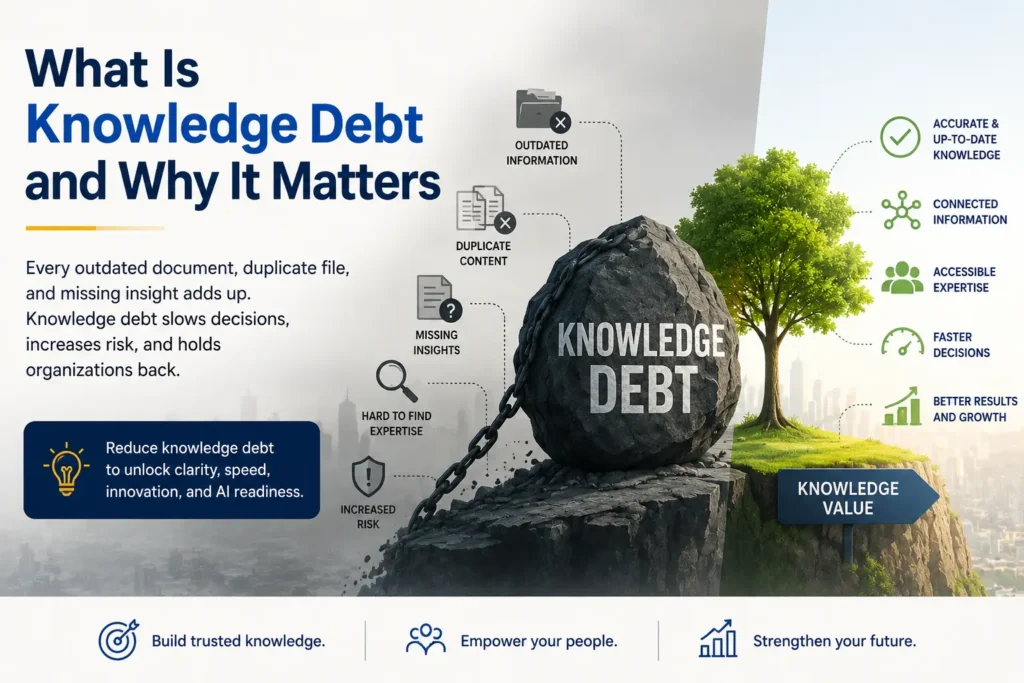
Every duplicate document, outdated procedure, undocumented decision, abandoned repository, missing lesson learned, inconsistent taxonomy, inaccessible expert, or obsolete policy represents an obligation that the organization will eventually need to address. Individually these problems appear relatively minor. Collectively they create a hidden burden that slows decision-making, increases operational risk, reduces productivity, and weakens the effectiveness of artificial intelligence.
This hidden burden can be understood as knowledge debt.
Knowledge debt is the accumulated cost created when organizational knowledge becomes incomplete, outdated, fragmented, inconsistent, or difficult to discover. Like financial debt, knowledge debt does not disappear simply because it is ignored. It accumulates over time, generating interest through repeated inefficiencies, duplicated work, avoidable mistakes, and declining organizational learning.
Many organizations unknowingly invest millions of dollars each year servicing this invisible debt. Employees spend excessive time searching for information, recreating work that already exists, validating conflicting documentation, asking colleagues questions that should already have reliable answers, or making decisions without access to previous organizational experience. The cost rarely appears in financial statements, yet it influences almost every aspect of organizational performance.
Artificial intelligence has made this challenge impossible to ignore. AI systems retrieve, interpret, and generate responses using the knowledge available to them. When the underlying knowledge environment contains significant debt, AI simply exposes those weaknesses more quickly and at greater scale. Rather than solving knowledge problems, AI often reveals how much knowledge debt has accumulated over years of unmanaged growth.
Understanding knowledge debt is therefore becoming essential for every organization seeking to improve knowledge management, digital transformation, and enterprise AI readiness.
Knowledge Debt Is More Than Poor Documentation
Many organizations assume that knowledge debt simply reflects incomplete documentation. Although missing documentation contributes to the problem, the concept is considerably broader.
Knowledge debt emerges whenever organizational knowledge becomes more difficult to trust, understand, discover, or apply.
A project team may develop valuable expertise without documenting its decisions. Another department may create similar guidance independently because previous work could not be found. Policies remain available years after they have become obsolete. Employees continue using outdated templates because newer versions are difficult to locate. Experts retire without transferring contextual knowledge developed through decades of experience. Taxonomies evolve inconsistently across business units until similar concepts are described using entirely different language.
None of these situations appear catastrophic individually.
Together they create an organizational environment in which finding reliable knowledge becomes increasingly difficult despite substantial investments in knowledge management technologies.
Unlike information overload, which concerns excessive quantities of information, knowledge debt concerns declining knowledge quality and usability. Organizations often possess more knowledge than ever before while simultaneously becoming less capable of using it effectively.
This distinction is important.
Knowledge debt is not created because organizations know too little.
It develops because organizations struggle to manage what they already know.
How Knowledge Debt Accumulates
Knowledge debt rarely results from a single decision. It accumulates gradually through hundreds of small compromises made over many years.
Projects conclude without structured retrospectives because delivery deadlines take priority.
Documentation reviews are postponed because subject matter experts have limited time.
Departments create local repositories because enterprise systems appear too slow or difficult to use.
Employees save copies of important guidance rather than linking to authoritative sources.
Taxonomies expand without governance until similar concepts are classified differently across business units.
Business acquisitions introduce new terminology, duplicate repositories, and incompatible information architectures.
Experienced employees solve increasingly complex problems without recording the reasoning behind their decisions.
Each compromise appears reasonable in isolation.
Collectively they create an expanding layer of organizational complexity that future employees inherit.
The longer knowledge debt remains unmanaged, the more difficult it becomes to reverse. Outdated content must be reviewed, duplicate assets reconciled, ownership re-established, metadata corrected, expertise rediscovered, and organizational memory reconstructed. The effort required increases disproportionately as the volume of unmanaged knowledge continues to grow.
Knowledge debt therefore resembles technical debt in one important respect.
Small shortcuts appear inexpensive today while creating substantially larger costs tomorrow.
Why Artificial Intelligence Makes Knowledge Debt Visible
One of the most significant impacts of enterprise AI is not that it creates new knowledge problems.
It reveals existing ones.
Before generative AI, employees often accepted imperfect knowledge retrieval as part of organizational life. They expected to search several repositories, compare multiple documents, consult colleagues, and verify uncertain information before making important decisions.
AI changes those expectations.
Employees increasingly assume that intelligent systems should provide accurate, contextual, and trustworthy answers immediately.
When AI produces inconsistent responses, organizations frequently attribute the problem to the language model.
In many cases, the model is not the primary issue.
The knowledge environment is.
Retrieval systems cannot distinguish authoritative guidance when ownership is unclear. AI cannot consistently identify the correct procedure when several outdated versions remain available. Semantic search cannot compensate for fragmented taxonomies. Conversational assistants cannot generate reliable recommendations when critical context has never been documented.
Artificial intelligence therefore functions as a diagnostic tool for organizational knowledge maturity.
Organizations with limited knowledge debt typically experience stronger AI performance because retrieval systems operate on governed, high-quality knowledge assets.
Organizations carrying substantial knowledge debt experience the opposite.
The AI simply reflects the condition of the knowledge ecosystem supporting it.
Read: How to Improve Your Knowledge Management Strategy for AI
The Business Cost of Knowledge Debt
Knowledge debt rarely appears on financial reports, yet its economic impact is considerable.
Employees spend valuable time searching for information that should be immediately available. Teams unknowingly repeat work already completed elsewhere. Projects revisit questions previously resolved because historical decisions cannot be located. New employees require longer onboarding because organizational knowledge remains fragmented across multiple systems. Managers hesitate before acting because conflicting guidance reduces confidence in available information.
The cumulative effect extends well beyond productivity.
Knowledge debt slows innovation because employees struggle to build upon previous work. It increases operational risk because important expertise remains concentrated within individuals rather than becoming organizational capability. It reduces customer experience when inconsistent knowledge produces inconsistent service. It weakens strategic decision-making because historical context becomes increasingly difficult to recover.
Perhaps most importantly, knowledge debt compounds over time.
Every unresolved knowledge problem creates conditions that make future knowledge management more difficult. Without deliberate intervention, organizational complexity gradually increases until maintaining knowledge becomes substantially more expensive than creating it.
Knowledge Debt Is Becoming a Strategic Risk
For many years, organizations viewed knowledge management primarily as an operational discipline.
Artificial intelligence changes that perspective.
Knowledge quality now directly influences AI performance.
Knowledge governance influences regulatory compliance.
Knowledge architecture affects digital transformation.
Knowledge discoverability determines workforce productivity.
Knowledge continuity influences organizational resilience.
Knowledge debt therefore becomes far more than a documentation problem.
It becomes a strategic business risk.
Organizations that continue allowing knowledge debt to accumulate will increasingly struggle to realise value from AI investments regardless of which technology platforms they deploy.
Those that systematically reduce knowledge debt will create stronger foundations for enterprise intelligence, faster decision-making, more resilient operations, and better organizational learning.
Managing Knowledge Debt Requires Continuous Investment
Technical debt cannot be eliminated permanently because organizations continuously develop new software.
Knowledge debt follows the same principle.
Every new project, policy, lesson learned, customer interaction, research report, and operational change creates additional knowledge requiring governance throughout its lifecycle.
Consequently, managing knowledge debt should become a continuous organizational capability rather than an occasional clean-up initiative.
Organizations should establish clear ownership for significant knowledge assets, maintain disciplined review cycles, remove obsolete content, consolidate duplication, strengthen metadata, improve enterprise taxonomy, preserve decision rationale, identify critical expertise, and continuously monitor the health of the knowledge environment.
These activities may appear less visible than deploying new AI capabilities.
In reality, they determine whether those capabilities succeed.
Knowledge Debt Will Define the Next Generation of Knowledge Management
Knowledge management has traditionally focused on creating, sharing, preserving, and discovering knowledge.
Artificial intelligence expands that mission.
Organizations must now understand the quality of the knowledge environment that intelligent systems depend upon.
Knowledge debt provides a powerful framework for understanding this challenge.
It explains why organizations possessing enormous volumes of information often struggle to convert that information into reliable organizational intelligence. It explains why AI implementations produce dramatically different outcomes despite using similar technologies. Most importantly, it shifts executive attention away from accumulating more knowledge toward improving the quality of the knowledge already available.
Over the next decade, organizations are likely to discuss knowledge debt with the same seriousness that software engineering now discusses technical debt.
The organizations that begin reducing it today will not simply improve their knowledge management programmes.
They will strengthen the foundation upon which every future AI initiative, strategic decision, and organizational capability will depend.