
Knowledge database software has become an increasingly important part of the enterprise technology landscape, but the category is often poorly understood. The term is used interchangeably with knowledge base software, document management systems, databases, intranets, enterprise search platforms, and more recently, AI knowledge systems. These technologies overlap, but they are not identical.
For knowledge management leaders, the distinction matters.
An organization can store millions of documents without having an effective knowledge database. It can deploy an enterprise search engine without solving knowledge quality problems. It can implement a conversational AI assistant without creating reliable organizational memory. It can build a technically sophisticated retrieval system that produces disappointing results because the underlying knowledge is outdated, duplicated, fragmented, or poorly governed.
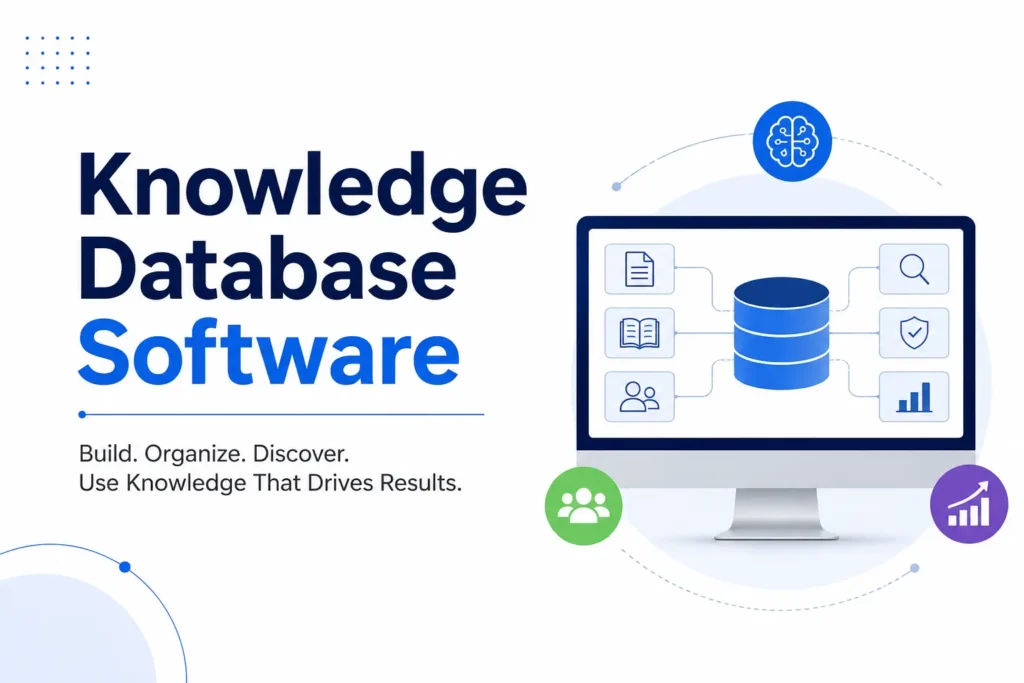
The central purpose of knowledge database software is not simply to store information. It is to create an environment in which organizational knowledge can be structured, maintained, discovered, trusted, connected, and applied.
That purpose is becoming more important as enterprise knowledge environments become more complex. Knowledge now exists across formal documentation, project records, policies, technical guidance, collaboration platforms, customer interactions, communities of practice, expert networks, learning systems, and operational applications. At the same time, artificial intelligence is changing how employees expect to interact with this knowledge.
The traditional model of opening a repository, navigating a folder structure, and searching for a document is giving way to a more dynamic model. Employees increasingly expect to ask questions, discover related knowledge, understand source authority, locate relevant expertise, and receive contextual guidance within the flow of work.
This evolution is changing what organizations should expect from knowledge database software.
A modern knowledge database is no longer simply a digital library. At its best, it becomes part of the organization’s knowledge infrastructure.
Table of Contents
What Is Knowledge Database Software
Knowledge database software is a system designed to capture, organize, maintain, retrieve, and deliver reusable organizational knowledge.
The knowledge may include policies, procedures, technical documentation, frequently asked questions, troubleshooting guidance, research, project experience, lessons learned, product knowledge, customer support information, decision records, and other forms of explicit organizational knowledge.
More advanced environments may also connect documented knowledge with experts, projects, processes, communities, systems, and business entities.
This broader definition is important.
A conventional database stores structured records and supports queries against those records. A knowledge database is concerned not only with storage but also with meaning, context, relevance, usability, and reuse.
Consider a customer record stored in a transactional database. The record may contain the customer’s name, contract details, purchases, service history, and account status. This is structured business data.
A knowledge database may contain guidance explaining how to resolve a particular customer problem, lessons from similar cases, product limitations, approved procedures, diagnostic knowledge, and links to specialists who can provide deeper expertise.
Both environments contain valuable information, but they support different forms of work.
The value of knowledge database software lies in reducing the distance between a question and the knowledge required to answer it.
Knowledge Database Software and Knowledge Base Software
The terms knowledge database software and knowledge base software are frequently used to describe similar products. In practice, the distinction is often more conceptual than technical.
Knowledge base software generally focuses on publishing and organizing reusable knowledge articles. Common applications include customer self-service, internal employee support, IT service management, product documentation, and standard operating procedures.
Knowledge database software can be understood more broadly as the underlying environment in which knowledge is stored, classified, connected, retrieved, maintained, and increasingly made available to AI systems.
A knowledge base may therefore be one interface or application built on top of a wider knowledge database architecture.
This distinction becomes clearer in large organizations.
An enterprise may operate a customer support knowledge base, an engineering knowledge repository, a policy library, a project lessons system, and several professional communities. Employees may also use enterprise search and an AI assistant across these environments.
The organization does not necessarily need to move everything into one physical repository.
It needs a coherent knowledge architecture.
This is one of the most important ideas for KM leaders evaluating knowledge database software. Centralization of access does not always require centralization of storage. In some enterprises, a federated model is more realistic. Knowledge remains within governed source systems while search, metadata, integration, and retrieval capabilities create a more unified discovery experience.
The strategic question is therefore not simply where knowledge should be stored. It is how knowledge distributed across the enterprise can be made discoverable and trustworthy.
How Knowledge Database Software Differs from a Document Management System
Document management and knowledge management are closely related, but their objectives are different.
A document management system is primarily designed to control documents throughout their lifecycle. Important capabilities may include version control, permissions, approval workflows, records management, retention policies, and document collaboration.
These functions are essential in many organizations.
However, managing documents is not the same as managing knowledge.
A project report may be properly versioned, approved, retained, and secured while still being almost impossible for another project team to discover at the moment it becomes relevant. A lessons-learned document may be stored correctly while the insights inside it remain disconnected from future work.
Knowledge database software must address questions beyond document control.
What problem does this knowledge solve? In which situations is it relevant? Which knowledge is authoritative? Who owns it? What related knowledge should a user see? Which expert can provide context? What has the organization learned from applying this knowledge?
Document management protects and controls information assets. Knowledge management seeks to ensure that organizational knowledge can contribute to action.
A mature enterprise architecture may need both.
How Knowledge Database Software Differs from Enterprise Search
Enterprise search helps users retrieve information from multiple organizational sources. It is an important component of knowledge discovery, but search alone does not constitute a knowledge database strategy.
The distinction becomes important when considering relevance and authority.
A search system may successfully retrieve five documents related to a question. The employee must still determine which source is current, which one is authoritative, whether the documents conflict, and whether the guidance applies to the current context.
Modern search technologies are becoming significantly more capable. Semantic retrieval can find conceptually related content even when exact terminology differs. Vector search can retrieve content based on similarity in meaning. Hybrid retrieval can combine semantic and lexical methods.
These capabilities improve discovery, but retrieval quality still depends on the knowledge environment around the search engine.
Search does not automatically establish ownership. It does not decide which policy should replace an obsolete version. It does not resolve contradictory guidance. It does not determine the business context in which knowledge should be applied.
This is why knowledge database software and enterprise search should be viewed as complementary.
The knowledge environment provides governed, contextualized, and maintainable knowledge. Search provides mechanisms for discovering it.
The Core Capabilities of Modern Knowledge Database Software
The most effective way to evaluate knowledge database software is not through a long feature checklist. KM leaders should understand the capabilities required across the knowledge lifecycle.
The first capability is knowledge capture.
Organizations need practical mechanisms for creating and capturing reusable knowledge. This may involve structured article creation, document ingestion, templates, collaborative authoring, meeting transcription, expert interviews, project reviews, and integration with operational systems.
The second capability is knowledge organization.
Content must be classified in ways that support both human navigation and machine retrieval. Taxonomies, metadata, tags, entity recognition, relationships, and content types all contribute to this structure.
The third capability is discovery.
Users need multiple paths to knowledge. Some will browse by category. Some will search exact terminology. Others will describe a problem in natural language. Increasingly, users will ask an AI assistant a question and expect a grounded response.
The fourth capability is governance.
Knowledge needs ownership, review processes, lifecycle controls, access permissions, and clear rules for authority. Without governance, a knowledge database can become an accumulation of content whose reliability declines over time.
The fifth capability is application.
Knowledge should be available where work happens. A technically excellent repository creates limited value if employees must leave their operational environment, navigate another platform, and perform several searches before finding useful guidance.
Modern knowledge database software should therefore be evaluated as part of a broader knowledge system, not as an isolated content platform.
Why Knowledge Architecture Matters More Than Storage Capacity
Organizations sometimes evaluate knowledge software using criteria inherited from document management and IT infrastructure. Storage capacity, supported file formats, migration capability, and technical scalability matter, but they do not determine whether employees will actually benefit from the knowledge environment.
The more difficult challenge is knowledge architecture.
Knowledge architecture defines how content types, metadata, taxonomies, relationships, ownership, permissions, retrieval, and user experiences work together.
Without a coherent architecture, organizations often create a familiar pattern. Content is migrated from an old system to a new system, the interface improves, initial adoption increases, and within several years the new platform develops many of the same problems as the old one.
Duplicate content accumulates. Taxonomies become inconsistent. Ownership becomes unclear. Search quality declines. Employees create parallel information stores because the formal system no longer meets their needs.
The problem was never only the software.
A strong knowledge database requires decisions about how knowledge will be structured and maintained over time.
This includes difficult questions. What deserves to become a formal knowledge asset? Which knowledge should remain conversational? Who can publish authoritative guidance? How are regional variations represented? How are relationships between policies, procedures, lessons, projects, and experts maintained? What happens when knowledge becomes obsolete?
Software can support these decisions.
It cannot make them on behalf of the organization.
Search Architecture Is Becoming More Sophisticated
One of the most important developments in knowledge database software is the evolution of retrieval architecture.
Traditional search relied heavily on lexical matching. A user entered words, and the system retrieved documents containing those words.
Lexical retrieval remains valuable. Exact terminology matters when employees search for policy numbers, product names, error codes, regulations, technical identifiers, and specific phrases.
However, knowledge workers often search conceptually.
An employee may describe a business problem using language different from the terminology used by the person who documented the solution. Different functions may use different terms for related concepts. Employees may understand the situation they face without knowing the formal name of the relevant process.
Semantic retrieval helps address this problem by identifying similarity in meaning.
Vector search uses numerical representations known as embeddings to support similarity-based retrieval. Hybrid approaches combine semantic and lexical methods because neither approach is optimal for every query. Microsoft’s description of a standard RAG pipeline, for example, notes that source content can be prepared as semantically coherent chunks, transformed into vector embeddings, and stored with metadata such as source, permissions, and timestamps for retrieval.
For KM leaders, the important lesson is not that every knowledge database needs the most sophisticated retrieval technology available.
The lesson is that search architecture should reflect the nature of organizational questions.
An employee looking for an exact policy and a researcher exploring conceptually related project experience have different retrieval requirements. A mature knowledge environment may need to support both.
AI Is Redefining Knowledge Database Software
Artificial intelligence is changing both the capabilities and expectations surrounding knowledge database software.
The most visible change is conversational access.
Instead of presenting a list of search results, AI-enabled systems can retrieve relevant sources and generate a synthesized answer. This is often implemented through Retrieval-Augmented Generation.
RAG connects a language model with external knowledge sources so that the model can use retrieved information when generating a response. This enables AI systems to work with organization-specific or current knowledge beyond the model’s original training data.
For knowledge management, the potential is significant.
An employee can ask a complex question in natural language. The system can retrieve relevant knowledge from approved sources, synthesize the material, and provide an answer with supporting evidence.
But the architecture introduces a critical dependency.
The generated answer can only be as reliable as the retrieval process and the underlying knowledge sources allow.
If the knowledge database contains outdated procedures, duplicate guidance, weak metadata, or unclear authority, the AI system inherits those conditions. A language model may produce a fluent answer, but fluency is not evidence of organizational correctness.
This is why AI readiness should be treated as a knowledge management challenge as much as a technology challenge.
Before connecting generative AI to enterprise knowledge, organizations need to understand source authority, content quality, permissions, ownership, lifecycle status, and traceability.
AI changes the interface.
It does not remove the need for knowledge governance.
Knowledge Databases as the Foundation for RAG
The growth of enterprise RAG has made the quality of knowledge databases strategically important.
A typical RAG system involves several stages. Content is ingested, prepared for retrieval, indexed, retrieved in response to a query, supplied as context to a language model, and used to generate a response. Microsoft summarizes a standard workflow as ingestion, retrieval, augmentation, and generation.
From a KM perspective, much of the most important work happens before generation.
Which sources are included?
How is content segmented?
Which metadata travels with the content?
How are access permissions enforced?
How does the retrieval system distinguish current guidance from historical knowledge?
How can users inspect the sources behind an answer?
What happens when two authoritative sources disagree?
These questions reveal why RAG should not be treated as a shortcut around knowledge management.
A weak knowledge environment connected to a powerful model remains a weak knowledge environment.
The strongest implementations will combine technical retrieval design with disciplined knowledge ownership and governance.
Knowledge Graphs and Relationship-Aware Knowledge
Most traditional knowledge databases are document-centric.
They store articles, pages, files, and records. This is useful, but many important organizational questions are relational.
Which experts worked on projects involving this technology?
Which lessons were produced by those projects?
Which customers experienced similar problems?
Which decisions were influenced by a particular risk?
Which processes depend on a specific policy?
These questions require understanding relationships between entities.
Knowledge graphs provide one approach to representing these relationships. Instead of treating every knowledge asset as an isolated object, a graph can connect people, projects, technologies, processes, decisions, lessons, products, and other organizational entities.
Microsoft’s documentation on AI knowledge graphs notes that graph-based retrieval is particularly useful for complex relationship queries, hierarchical structures, and contextual paths, while vector search is strong at identifying similarity across unstructured data. It also describes architectures that combine database queries, vector matching, and graph traversal according to query intent.
This does not mean every organization should immediately build a knowledge graph.
Graph architecture is valuable when the knowledge problem is genuinely relational. If most user questions can be answered from clear, authoritative documents, simpler retrieval approaches may be more appropriate.
The principle for KM leaders is consistent.
Architecture should follow the knowledge problem.
Internal Knowledge Databases and Customer-Facing Knowledge Databases
Not every knowledge database serves the same audience.
Customer-facing knowledge databases are designed to help users solve problems independently. Their success depends on clarity, findability, accessibility, product alignment, and continuous analysis of customer questions.
Internal knowledge databases operate in a more complex environment.
Employees may need policy guidance, operational procedures, technical knowledge, project experience, market intelligence, research, templates, and access to expertise. Different functions have different vocabularies and security requirements. Some knowledge is enterprise-wide. Other knowledge is restricted by role, geography, project, client, or regulatory obligation.
The design implications are significant.
A customer knowledge base may optimize for a defined product and a relatively predictable set of user problems.
An enterprise knowledge database must often work across multiple domains while preserving context and permissions.
For global organizations, language and localization add further complexity. Translating words is not always sufficient. Policies may differ across jurisdictions. Processes may vary by region. Terminology may carry different meanings across professional communities.
Knowledge database software must therefore support context, not merely content.
Knowledge Governance Determines Whether the Database Can Be Trusted
The greatest long-term threat to a knowledge database is often not technical failure.
It is declining trust.
Employees stop using knowledge systems when they repeatedly encounter outdated content, conflicting guidance, weak search results, or pages whose ownership is unclear. Once trust declines, employees return to personal networks, local files, private messaging groups, and informal workarounds.
The formal knowledge database continues to exist while the organization’s real knowledge flows around it.
Governance is therefore not an administrative layer added after implementation.
It is part of the value proposition.
A strong governance model should establish ownership, authority, review expectations, lifecycle status, permissions, and escalation paths.
Not all knowledge requires the same level of governance.
A regulatory procedure requires stronger controls than a community discussion. Safety-critical technical guidance requires different validation from an informal project reflection. A frequently changing operational article may need a shorter review cycle than a stable conceptual reference.
The correct approach is risk-based governance.
Organizations should apply controls according to the consequences of incorrect, outdated, or unauthorized knowledge.
This becomes even more important when AI systems use the knowledge database as a source. The employee may no longer inspect several documents individually. The system may synthesize information into one answer, making source quality and traceability even more consequential.
Permission-Aware Knowledge Access
Enterprise knowledge is not equally accessible to everyone.
A modern knowledge database must respect security boundaries while still enabling useful discovery.
This is technically and organizationally difficult.
Knowledge may be restricted because of personal data, intellectual property, commercial sensitivity, client confidentiality, legal privilege, security requirements, or regulatory obligations.
AI-enabled knowledge access makes permission handling particularly important. The system must not retrieve content for a user who lacks authorization simply because the content is semantically relevant to the question.
Current enterprise implementations increasingly preserve source permissions during AI-mediated retrieval. For example, Microsoft’s documentation for SharePoint knowledge sources in Copilot Studio states that content is surfaced according to the user’s permissions and that users need access to the underlying source material.
For KM leaders, permission design creates a strategic tension.
Excessive restriction makes knowledge difficult to discover and encourages silos. Insufficient control creates risk.
The objective is not maximum openness or maximum restriction.
It is appropriate access.
Knowledge Database Software Must Support the Flow of Work
One of the oldest problems in knowledge management remains unresolved in many organizations.
The knowledge system is separate from the work system.
Employees complete their work in customer platforms, project tools, service environments, engineering systems, communication platforms, and business applications. When they need knowledge, they are expected to stop, open another system, search for information, interpret the results, and return to the original task.
Every additional step creates friction.
Modern knowledge database software should increasingly support knowledge delivery within the flow of work.
A support employee may need relevant troubleshooting guidance while viewing a customer case. An engineer may need previous incident knowledge while investigating a technical problem. A project manager may benefit from related lessons and experts during project initiation.
The goal is not to push more information at employees.
Poorly designed contextual recommendations can create noise and reduce trust.
The goal is to make relevant knowledge available at the moment when it can improve action.
This requires integration between the knowledge database and operational systems. It also requires careful attention to context, role, permissions, and timing.
A knowledge database creates the most value when employees do not need to become experts in the knowledge architecture before they can benefit from it.
The Role of Experts and Communities
Knowledge database software can create the impression that knowledge management is primarily a content discipline.
It is not.
Some of the most valuable organizational knowledge cannot be fully represented in articles or documents. Experienced professionals develop judgment, pattern recognition, intuition, and contextual understanding through years of practice.
A knowledge database should therefore help connect people to people, not only people to content.
An employee reading technical guidance may need to identify the expert responsible for it. A project team reviewing a previous lesson may need to speak with someone who understands the original context. A community discussion may reveal emerging knowledge before it is mature enough to become formal guidance.
This is where knowledge databases should connect with expertise directories, communities of practice, project histories, and professional networks.
The strongest knowledge environment recognizes that documents and people play different roles.
A document can preserve and scale explicit knowledge.
An expert can interpret ambiguity.
A community can develop shared understanding.
A well-designed knowledge architecture connects all three.
Measuring the Value of Knowledge Database Software
Usage metrics are necessary but insufficient.
Page views, searches, article counts, active users, and downloads can show whether a system is being used. They do not prove that it is creating business value.
A knowledge database should be evaluated against the problems it was designed to solve.
If the objective is faster customer support, relevant measures may include resolution time, escalation rates, knowledge reuse, and first-contact resolution.
If the objective is employee productivity, organizations may examine time spent searching, speed to competence, repeated questions, and task completion.
If the objective is project knowledge reuse, the organization may examine whether previous lessons are consulted during planning, whether teams reuse proven assets, and whether repeated mistakes decline.
If the objective is AI-enabled knowledge access, measurement should include retrieval quality, source coverage, citation accuracy, unanswered questions, user trust, correction rates, and the quality of the underlying knowledge corpus.
The important principle is that knowledge metrics should follow the business purpose.
A database with high traffic but low trust is not successful.
A smaller knowledge environment that consistently improves critical decisions may create far greater value.
How to Choose Knowledge Database Software
The software selection process should begin with a knowledge diagnosis rather than a vendor demonstration.
Organizations should first understand the problems they are trying to solve.
Is the main challenge fragmented documentation?
Poor enterprise search?
Repeated support questions?
Loss of expert knowledge?
Weak project learning?
Slow onboarding?
AI readiness?
Inability to connect knowledge across systems?
The answer determines the required architecture.
A support knowledge base and an enterprise knowledge discovery platform are not the same investment. A policy repository and an expertise discovery system address different needs. A graph-based knowledge environment may be valuable for relationship-intensive use cases but unnecessarily complex for a straightforward procedural knowledge base.
Organizations should also evaluate how the software handles authoring, metadata, search, integrations, APIs, permissions, versioning, review cycles, analytics, multilingual content, mobile access, AI retrieval, source citation, and interoperability.
But feature comparison should come after strategic clarity.
The best software is not the platform with the longest feature list.
It is the platform that fits the organization’s knowledge model, governance capacity, technical environment, user needs, and strategic priorities.
Common Mistakes in Knowledge Database Implementations
One common mistake is migrating everything.
Organizations often treat a new knowledge platform as an opportunity to transfer the entire contents of an old repository. This can move years of duplication, outdated content, and weak structure into a modern interface.
Migration should include curation.
Another mistake is focusing heavily on launch and lightly on maintenance.
Knowledge databases deteriorate when ownership is unclear. A successful launch campaign cannot compensate for years of unmanaged content growth.
A third mistake is assuming that AI will solve discovery automatically.
AI can improve retrieval and access, but it cannot reliably determine organizational authority where governance is absent. It cannot know that an old procedure should have been retired if the organization never marked it as obsolete.
Another mistake is building the system around the organizational chart.
Knowledge frequently crosses functional boundaries. Taxonomies based entirely on departmental structure can make knowledge difficult to discover when users approach problems from a different context.
Finally, organizations often underestimate change management.
Employees already have established ways of finding answers. They ask colleagues, search personal files, use chat groups, or rely on familiar experts. A new knowledge database must demonstrate enough value to change those behaviors.
Adoption is earned through usefulness.
The Future of Knowledge Database Software
Knowledge database software is evolving from passive storage toward active knowledge infrastructure.
Several developments are driving this transition.
Conversational interfaces are changing how employees access knowledge. Semantic and hybrid retrieval are improving discovery across varied language. AI-assisted classification can reduce the manual burden of metadata. Knowledge graphs can represent relationships that document repositories cannot easily express. AI-assisted curation can help identify duplicate, conflicting, or potentially outdated knowledge.
At the same time, agentic AI is creating a new set of requirements.
Future AI agents may retrieve knowledge, compare sources, prepare briefings, identify experts, monitor policy changes, and support multi-step work. These systems will require reliable access to governed organizational knowledge.
The emergence of protocols for connecting AI systems to external tools and sources does not remove the need for retrieval architecture. As Elastic has argued in discussing Model Context Protocol and enterprise search, connectivity does not by itself perform relevance ranking, metadata normalization, permission enforcement, or retrieval optimization.
This distinction is important.
Connecting an AI system to more sources is not the same as creating a coherent knowledge environment.
The future will likely involve increasingly sophisticated orchestration across different forms of retrieval. Exact keyword search, semantic similarity, structured database queries, and graph traversal each solve different classes of problems. Microsoft’s documentation on AI knowledge graphs similarly describes combined approaches that route queries toward database records, vector matching, or graph traversal depending on user intent.
For KM leaders, the future is not about selecting one fashionable retrieval method.
It is about designing a knowledge architecture capable of supporting different knowledge needs with appropriate levels of authority, context, and trust.
Knowledge Database Software Is Becoming Strategic Infrastructure
The history of enterprise knowledge technology has often been dominated by the repository.
Organizations created places to store documents and expected value to emerge from access.
The modern knowledge environment requires more.
Knowledge must be structured without becoming rigid. It must be governed without becoming inaccessible. It must be discoverable across different vocabularies and contexts. It must connect content with expertise and organizational memory. It must serve employees directly while also supporting AI-mediated access.
This is why knowledge database software should no longer be evaluated as another content platform.
For knowledge-intensive organizations, it is becoming part of the infrastructure through which the enterprise learns, remembers, decides, and increasingly powers artificial intelligence.
The strongest knowledge database will not necessarily be the one that contains the most content.
It will be the one that helps the organization answer more consequential questions with trusted knowledge, find relevant experience before work is duplicated, connect employees with expertise when documents are insufficient, and preserve context as the organization changes.
That is the standard KM leaders should use.
The objective is not to build a larger database.
It is to build an organization that can use what it knows.