Knowledge strategy is entering a period of significant change. For years, organizations built their knowledge strategies around familiar priorities: capturing critical knowledge, encouraging employees to share what they know, building repositories, creating communities of practice, and improving access to information. These priorities remain important, but they are no longer sufficient.
The environment in which knowledge strategy operates has changed.
Organizations now generate information faster than employees can interpret it. Expertise is increasingly distributed across functions, geographies, partners, and digital environments. Artificial intelligence can produce answers in seconds, but the reliability of those answers depends on the quality and context of the knowledge available to it. Employees expect immediate access to relevant knowledge while organizations continue to struggle with fragmented systems, outdated content, hidden expertise, and weak organizational memory.
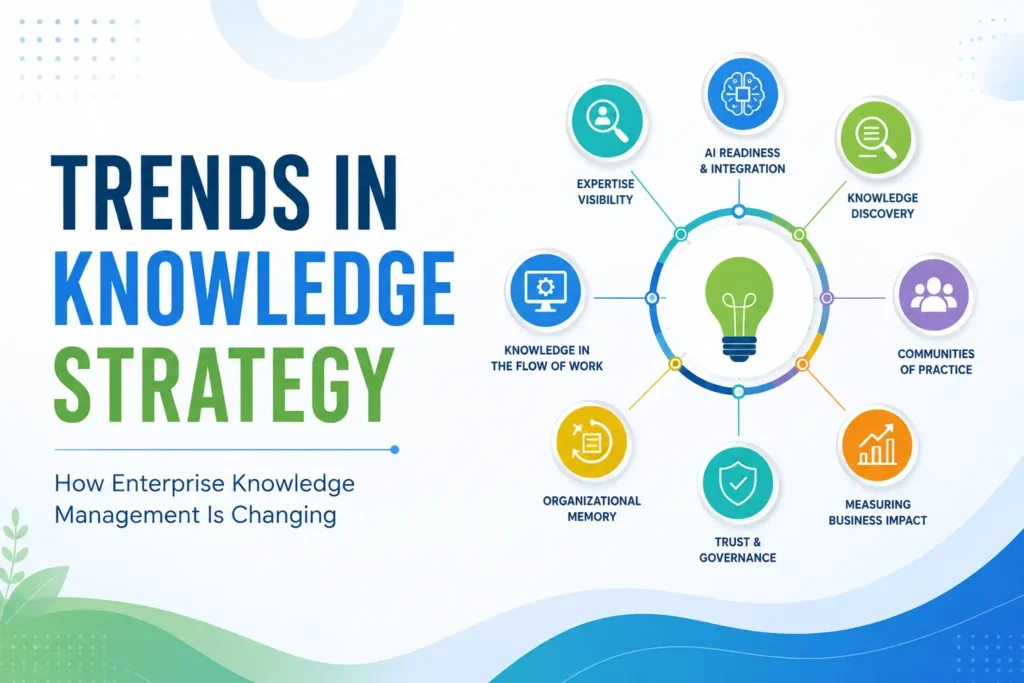
The emerging trends in knowledge strategy reflect this changing reality. The strategic question is no longer simply how an organization should capture and share knowledge. It is how the organization can create a knowledge environment capable of supporting people, decisions, learning, and artificial intelligence simultaneously.
This requires a different understanding of knowledge strategy.
A modern knowledge strategy cannot be reduced to a technology roadmap, a repository plan, or a collection of knowledge-sharing initiatives. It must define how knowledge contributes to organizational capability. It must address how critical knowledge is identified, how expertise becomes visible, how knowledge moves across boundaries, how organizational memory is maintained, how knowledge quality is governed, and how both people and AI systems access trusted knowledge in context.
The most important trends in knowledge strategy therefore represent more than changes in KM technology. They indicate a deeper transition in how organizations understand the role of knowledge itself.
Table of Contents
- 1. Knowledge Strategy Is Moving Beyond Content Management
- 2. AI Readiness Is Becoming a Knowledge Strategy Priority
- 3. Knowledge Discovery Is Replacing Repository Growth as a Strategic Goal
- 4. Expertise Visibility Is Becoming as Important as Content Visibility
- 5. Organizational Memory Is Moving from Preservation to Activation
- 6. Knowledge in the Flow of Work Is Becoming the Default Expectation
- 7. Knowledge Governance Is Shifting from Control to Trust
- 8. Communities of Practice Are Becoming Knowledge Infrastructure
- 9. Knowledge Strategy Is Becoming More Closely Connected to Business Resilience
- 10. KM Measurement Is Moving Toward Business Outcomes
- What These Trends in Knowledge Strategy Mean for KM Leaders
- The Future of Knowledge Strategy Is About Capability, Not Accumulation
1. Knowledge Strategy Is Moving Beyond Content Management
One of the clearest trends in knowledge strategy is the movement away from treating knowledge management primarily as a content problem.
For many years, KM programs concentrated heavily on content creation, storage, classification, and retrieval. The underlying assumption was understandable: if important knowledge could be documented and placed in the correct system, employees would be able to find and reuse it.
The experience of many organizations has shown the limits of this assumption.
A large repository does not necessarily represent a knowledgeable organization. Thousands of documents may be available while employees continue to struggle to answer basic questions: Who has solved this problem before? Which version of this guidance should I trust? What did we learn from the previous project? Why was this decision made? Who has the experience required to evaluate this situation?
These are not simply content retrieval questions. They are questions about context, expertise, experience, relationships, and organizational memory.
As a result, knowledge strategy is becoming broader than content management. The focus is moving toward knowledge ecosystems that connect documents with people, projects, decisions, communities, processes, and business outcomes.
This does not make content management irrelevant. High-quality content remains essential. The change is that content is increasingly understood as one component of a larger knowledge environment rather than the entire focus of KM.
For knowledge leaders, this means that future strategies must answer more than where information will be stored. They must explain how different forms of organizational knowledge relate to one another and how those relationships will become useful in the flow of work.
2. AI Readiness Is Becoming a Knowledge Strategy Priority
Artificial intelligence has become impossible to separate from conversations about enterprise knowledge.
Organizations are deploying AI assistants, enterprise search tools, conversational interfaces, summarization capabilities, and retrieval-augmented generation systems. These technologies create significant opportunities, but they are also revealing weaknesses that knowledge management teams have understood for years.
AI does not automatically repair a fragmented knowledge environment.
If an organization has duplicate content, unclear ownership, obsolete documents, inconsistent terminology, poor metadata, and disconnected systems, AI inherits those conditions. A conversational interface may make access easier, but it does not automatically make the underlying knowledge accurate, authoritative, or complete.
This is changing the strategic position of KM.
Knowledge quality, provenance, permissions, context, taxonomy, metadata, and lifecycle governance are no longer concerns limited to repository administrators. They are becoming part of enterprise AI readiness.
The relationship works in both directions. AI can improve knowledge discovery, classification, summarization, and connection. At the same time, effective AI depends on strong knowledge foundations.
This creates an important shift in knowledge strategy. KM leaders must increasingly design knowledge environments for two audiences: people and machines.
People need knowledge that is understandable, relevant, contextual, and easy to apply. AI systems need knowledge that is accessible, governed, sufficiently structured, permission-aware, and connected to reliable sources.
A knowledge strategy that ignores either audience will become increasingly incomplete.
3. Knowledge Discovery Is Replacing Repository Growth as a Strategic Goal
For many KM programs, growth has traditionally been easy to measure. More documents were contributed. More pages were created. More employees joined the platform. More content was captured.
The problem is that accumulation and value are not the same thing.
Organizations can accumulate enormous quantities of knowledge while making discovery progressively more difficult. As content volumes increase, employees encounter more duplicate material, more outdated guidance, more competing versions of documents, and more difficulty determining which source should be trusted.
One of the most important trends in knowledge strategy is therefore the shift from accumulation to discovery.
The strategic objective is becoming less about increasing the quantity of stored knowledge and more about improving the organization’s ability to locate relevant knowledge, expertise, and experience.
This requires attention to search, but knowledge discovery is broader than search.
Search assumes that a person knows what to ask for. Discovery must also help people find knowledge they did not know existed. A project leader may not know that another region completed a similar initiative. A technical team may not know that an expert elsewhere in the enterprise has already solved a comparable problem. A decision-maker may not know that a historical project contains a relevant warning.
A discovery-oriented knowledge strategy seeks to reveal these connections.
This is why enterprise search, semantic retrieval, knowledge graphs, recommendation systems, expertise location, and contextual knowledge delivery are becoming increasingly important. The strategic value lies not in the technologies themselves but in their ability to reduce the distance between a business need and the knowledge required to address it.
4. Expertise Visibility Is Becoming as Important as Content Visibility
Organizations have historically found it easier to manage documents than expertise.
Documents can be stored, tagged, indexed, and searched. Human expertise is more difficult to represent. It develops through education, projects, failures, customer interactions, professional networks, and years of practical judgment.
A job title captures only a small part of this knowledge.
This creates a persistent organizational problem. An enterprise may possess exactly the expertise required to address a challenge while having no effective way to identify the people who possess it.
The future of knowledge strategy will increasingly address this visibility gap.
Traditional expert directories based on self-declared skills have limitations. Profiles become outdated, employees describe similar expertise using different terminology, and some of the most experienced people may never maintain detailed profiles.
More mature approaches to expertise discovery will draw from multiple signals. Project participation, authored content, community activity, professional experience, contributions to problem-solving, and other evidence of practice can help organizations build richer views of expertise.
This must be approached carefully. Expertise cannot be reduced to an algorithmic score, and collaboration data should not be interpreted without appropriate governance and context. But the strategic direction is clear: organizations need better ways to understand who knows what.
As work becomes more specialized and organizations become more distributed, expertise visibility will become an increasingly important part of knowledge strategy.
5. Organizational Memory Is Moving from Preservation to Activation
Organizational memory has always been an important KM concern, but its role is changing.
Historically, organizations often approached memory as a preservation problem. The objective was to retain critical documents, capture lessons learned, record project outcomes, and prevent important knowledge from disappearing when employees left.
Preservation remains necessary, but preserved knowledge has limited value if it never influences future work.
A lessons-learned report that sits unread in an archive is technically retained but operationally inactive. A record of a strategic decision may exist without future leaders understanding the reasoning behind it. A project may generate important insights that remain disconnected from every subsequent initiative facing similar conditions.
The emerging trend is toward the activation of organizational memory.
The strategic question is no longer only, “How do we preserve what the organization has learned?” It is also, “How do we make previous experience relevant to current work?”
This requires stronger connections between historical knowledge and present activity. Project teams should be able to discover relevant previous initiatives during planning, not after a problem occurs. Decision-makers should be able to access the context behind earlier decisions. New employees should be able to understand not only current procedures but how and why those practices developed.
AI may help surface historical knowledge more effectively, but technology is not the entire answer. Organizations also need disciplined approaches to capturing context, maintaining knowledge quality, and connecting experience across time.
Organizational memory becomes valuable when the past can inform the present.
6. Knowledge in the Flow of Work Is Becoming the Default Expectation
One persistent weakness of traditional KM programs is the separation of knowledge activity from work activity.
Employees complete their work in one environment and are expected to contribute or retrieve knowledge in another. Lessons are captured after projects. Knowledge bases require separate searches. Employees must leave operational workflows to locate guidance.
Every additional step creates friction.
One of the most practical trends in knowledge strategy is the movement toward knowledge in the flow of work. The objective is to make relevant knowledge available within the environments where decisions and actions occur.
For a service employee, this may mean contextual guidance within a support workflow. For an engineer, it may mean access to relevant technical knowledge and previous incidents during troubleshooting. For a project leader, it may mean surfacing similar projects, experts, and lessons during planning.
The principle is more important than any particular platform.
Employees should not need to understand the organization’s entire knowledge architecture before they can benefit from it.
This changes the design question for KM leaders. Instead of asking only where knowledge should live, they must also ask where knowledge needs to appear.
That distinction is fundamental. Storage architecture determines where knowledge is maintained. Knowledge strategy must determine how knowledge becomes available at the moment of need.
7. Knowledge Governance Is Shifting from Control to Trust
Governance has sometimes been treated as the administrative side of knowledge management: permissions, naming conventions, review dates, ownership, retention, and approval processes.
In an AI-enabled environment, governance has a much more strategic purpose.
It creates trust.
When an employee receives an answer from an AI assistant, several questions immediately matter. Where did the answer come from? Is the source authoritative? Is the content current? Does the employee have permission to access the underlying information? Is there another source that contradicts it? Who is responsible for correcting the knowledge if it is wrong?
These are knowledge governance questions.
The future of governance will therefore require a balance between control and usability. Excessive governance can slow knowledge flows and discourage contribution. Weak governance can create environments filled with outdated, contradictory, or unreliable content.
The objective should not be to control every piece of knowledge equally. Organizations need risk-based governance that recognizes differences in knowledge criticality.
A policy affecting regulatory compliance requires stronger controls than an informal community discussion. Technical guidance affecting safety requires different governance from a brainstorming document. A knowledge strategy must distinguish between these contexts rather than applying a single governance model to everything.
Trust will become one of the most important outcomes of knowledge governance.
8. Communities of Practice Are Becoming Knowledge Infrastructure
Communities of practice have existed in KM for decades, but their strategic role deserves renewed attention.
As organizations adopt more AI and automation, there is a risk of assuming that knowledge can be separated from social interaction. In reality, some of the most valuable organizational knowledge develops through discussion, interpretation, disagreement, experimentation, and collective sense-making.
Communities provide the environment for this work.
A repository can preserve a solution. A community can discuss whether the solution applies in a different context. An AI system can retrieve an answer. A community can challenge the assumptions behind it. A document can describe current practice. A community can recognize that the practice is becoming obsolete.
This is why communities should not be treated simply as engagement programs.
Strong communities of practice are part of organizational knowledge infrastructure. They connect expertise across formal boundaries, provide environments for tacit knowledge exchange, accelerate the development of professional capability, and help organizations interpret emerging change.
The future knowledge strategy will need both technological and social architecture. AI can improve access and scale. Communities provide interpretation, trust, challenge, and professional judgment.
The two should complement one another.
9. Knowledge Strategy Is Becoming More Closely Connected to Business Resilience
Knowledge risk is often invisible until something goes wrong.
A critical expert leaves. A team discovers that nobody understands an old but essential system. A crisis reveals that important decisions depend on undocumented knowledge. A merger exposes incompatible terminology and disconnected knowledge environments. A transformation program repeats mistakes from an earlier initiative because institutional memory was never consulted.
These are not isolated KM problems. They are resilience problems.
One of the emerging trends in knowledge strategy is closer alignment with business continuity, workforce planning, transformation, and risk management.
Organizations need to understand where critical knowledge is concentrated, where expertise dependencies exist, which capabilities rely heavily on a small number of individuals, and what knowledge would be difficult to replace.
This requires moving beyond reactive knowledge transfer programs launched shortly before an expert retires.
Knowledge risk should be identified before departure becomes imminent. Critical knowledge should be understood in relation to business processes, strategic capabilities, and operational dependencies. Knowledge continuity should become part of organizational resilience planning.
The strongest knowledge strategies will increasingly connect KM with questions of enterprise risk: What must the organization continue to know in order to operate, adapt, and compete?
10. KM Measurement Is Moving Toward Business Outcomes
Knowledge management has long struggled with measurement.
Many programs rely on metrics that are easy to collect: page views, document downloads, active users, contributions, community membership, and search volume. These measures can provide useful operational information, but they do not necessarily demonstrate business value.
A platform can have high traffic while employees continue to struggle with important knowledge problems.
The next generation of knowledge strategy will require more meaningful measures.
The relevant questions are increasingly about outcomes. Did access to previous knowledge reduce the time required to solve a problem? Did expertise discovery prevent duplicated work? Did organizational memory improve project planning? Did knowledge reuse accelerate onboarding? Did better access to validated guidance reduce errors?
These measures are more difficult to establish because knowledge rarely acts alone. Business outcomes are influenced by multiple variables. KM leaders should be cautious about claiming direct causation where it cannot be demonstrated.
However, difficulty should not justify reliance only on activity metrics.
Knowledge strategy must establish a credible connection between knowledge capability and organizational performance. That may involve a combination of quantitative measures, process indicators, case evidence, network analysis, and outcome-based evaluation.
The strategic maturity of KM will increasingly be judged not by how much activity it generates but by what organizational capabilities it improves.
What These Trends in Knowledge Strategy Mean for KM Leaders
Taken together, these trends in knowledge strategy point toward a larger transformation.
Knowledge management is moving away from a model centered primarily on repositories and contribution toward a model concerned with organizational capability.
This does not mean abandoning the foundations of KM. Content quality still matters. Taxonomies still matter. Communities still matter. Knowledge capture, sharing, retention, and governance remain essential.
What is changing is the strategic context around them.
KM leaders are increasingly responsible for questions that reach across organizational boundaries. How prepared is the enterprise knowledge environment for AI? Can employees discover expertise beyond their immediate networks? Is organizational memory connected to current decisions? Can critical knowledge survive workforce transitions? Is knowledge available in the flow of work? Can people trust the knowledge delivered through intelligent systems?
These questions cannot be answered by a repository strategy alone.
They require coordination across technology, information architecture, organizational development, learning, risk, AI governance, and business leadership.
This may be one of the most important opportunities for the KM profession. Organizations are beginning to confront challenges that knowledge management has studied for decades: context, trust, expertise, tacit knowledge, organizational memory, knowledge flow, and learning.
The terminology may be changing, but the underlying organizational problems are deeply connected to KM.
The opportunity for knowledge leaders is not simply to defend traditional KM programs. It is to demonstrate how knowledge strategy contributes to the emerging architecture of an intelligent organization.
The Future of Knowledge Strategy Is About Capability, Not Accumulation
The next era of knowledge management will not be defined by who stores the most information.
Organizations already possess enormous volumes of content, data, experience, and expertise. The strategic challenge is making those assets useful.
The most important trends in knowledge strategy are therefore moving toward a common destination: better connection between knowledge and organizational action.
AI readiness requires trusted and discoverable knowledge. Knowledge discovery requires visibility across systems and boundaries. Expertise location requires a deeper understanding of human capability. Organizational memory must become active rather than archival. Communities must support sense-making as well as sharing. Governance must create trust. Measurement must demonstrate contribution to business outcomes.
These developments suggest that knowledge strategy is becoming both more complex and more important.
The future KM function will not succeed by encouraging organizations to create more content without a clear purpose. It will succeed by reducing the distance between a question and trusted knowledge, between a problem and relevant expertise, between present decisions and past experience, and between organizational learning and organizational action.
For KM leaders, the strategic question is changing.
It is no longer simply: How do we manage the knowledge we have?
The more important question is: How do we build an organization capable of using what it knows?
That question will shape the next generation of knowledge strategy.