
IDC research has found that knowledge workers spend approximately 30% of their working day searching for information or recreating work that already exists somewhere else in their organization. The lost productivity is significant. The more revealing problem is structural: the knowledge existed. The organization simply could not move it to the person who needed it at the moment they needed it.
This is a knowledge flow problem, and it is distinct from the knowledge storage problems that most KM programs are designed to solve. Organizations invest heavily in capturing and storing knowledge. Relatively few invest systematically in understanding how knowledge actually moves, where it stops moving, and what conditions enable healthy circulation of expertise across complex operational environments.
The distinction matters practically because the interventions that improve knowledge storage and the interventions that improve knowledge flow are different. An organization can have a comprehensive, well-organized knowledge base and still suffer from severe knowledge flow problems if the structural conditions that govern how knowledge moves between people, teams, and systems are not deliberately designed.
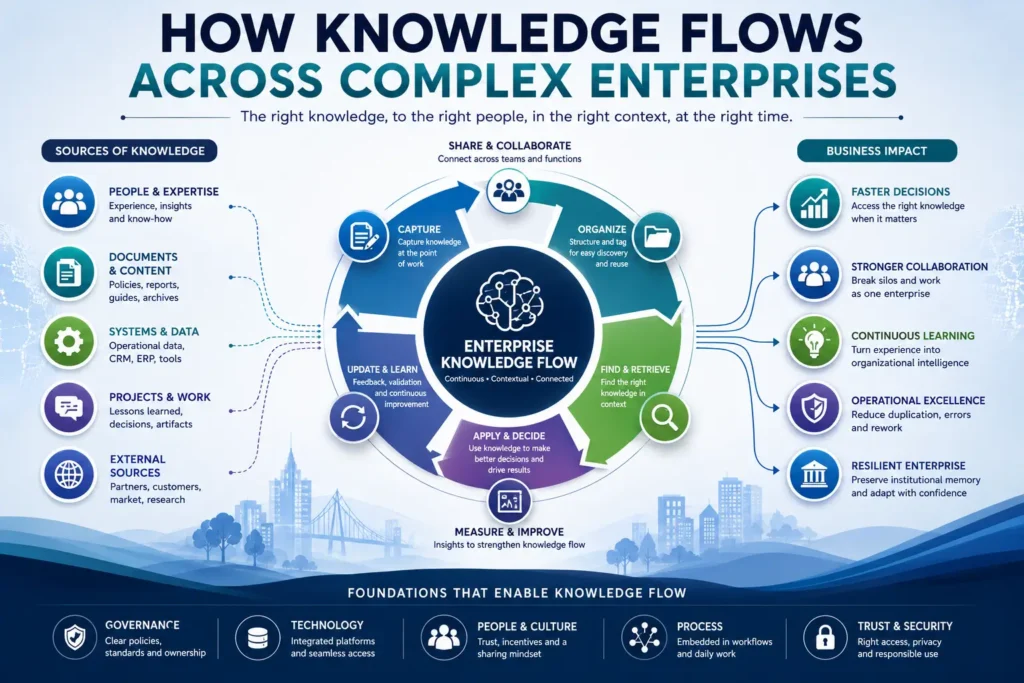
What Knowledge Flow Means and Why It Differs from Information Sharing
Knowledge flow describes the movement of understanding, judgment, and contextual expertise from where it exists in an organization to where it is needed to inform decisions and actions. It is broader than information sharing, which typically refers to the distribution of documented content through formal channels.
The distinction is important because a significant portion of organizational knowledge never exists in documented form at all. Ikujiro Nonaka and Hirotaka Takeuchi, in their foundational research on knowledge creation, identified tacit knowledge, the expertise embedded in professional experience, judgment, and pattern recognition, as the primary source of organizational competitive advantage. This knowledge does not flow through document repositories. It flows through conversation, mentoring, observation, apprenticeship, and collaborative problem-solving.
An organization that manages information sharing effectively but neglects tacit knowledge flow has addressed only the more visible and less valuable portion of its knowledge circulation challenge. The organizations that build genuine knowledge flow capacity manage both dimensions simultaneously and understand that different channels are required for each.
Knowledge flow also differs from information sharing in its temporal dimension. Information can be shared asynchronously, stored and retrieved at any time. Knowledge often has a context dependency, meaning its value diminishes if it does not reach a decision-maker while the relevant decision is still open. A lessons-learned document published six months after a project closes reaches a future team that may face an analogous situation. The same insight delivered to the project team during execution changes the outcome of the active decision. Both are knowledge flow, but the operational value is fundamentally different.
The Four Channels Through Which Knowledge Flows
Understanding how knowledge moves in organizations requires recognizing that multiple channels operate simultaneously, each suited to different types of knowledge and different transfer conditions.
Formal Structured Channels
Formal channels include documented procedures, training programs, onboarding curricula, policy libraries, and knowledge bases. These channels are designed to move explicit knowledge, information that can be documented and standardized, at scale across large organizations consistently.
Formal channels excel at distributing operational standards, compliance requirements, and process documentation. Their limitation is precision: they carry explicit knowledge well but lose the contextual judgment and situational reasoning that gives explicit knowledge its operational meaning. A procedure document explains what to do. It rarely communicates why specific steps matter under specific conditions, which is the knowledge that distinguishes competent execution from expert execution.
Social and Peer Channels
Social channels include communities of practice, mentoring relationships, peer consultation, team discussions, and informal expert networks. These channels carry tacit knowledge that formal documentation cannot transfer because they involve direct interaction between people.
Research on communities of practice, developed significantly through the work of Etienne Wenger, has consistently shown that peer communities generate and distribute knowledge that formal systems do not capture. The financial services sector provides consistent evidence: the risk intuitions, client relationship insights, and deal evaluation frameworks that produce superior performance in experienced practitioners circulate through professional networks and mentoring relationships rather than through documented knowledge bases.
Social channels are high-bandwidth for complex, contextual knowledge and low-scalability. They transfer knowledge effectively between individuals and small groups but cannot distribute expertise to large populations simultaneously. Organizations that rely exclusively on social channels for knowledge circulation face knowledge concentration in informal networks that are invisible to governance and fragile to personnel change.
Embedded Workflow Channels
Embedded channels surface knowledge within the operational environments where decisions are made, without requiring workers to navigate separately to a knowledge system. Decision support tools, CRM systems that surface relevant customer knowledge during service interactions, project management platforms that present relevant lessons at project initiation, and AI assistants that answer questions within communication tools all represent embedded knowledge flow.
Embedded channels are the highest-leverage investment in knowledge flow because they eliminate the navigation cost that is the primary barrier to knowledge application in practice. Research on knowledge application rates consistently shows that workers apply knowledge at significantly higher rates when it is available within their primary work environment than when the same knowledge requires them to leave that environment to retrieve it.
Toyota’s production system provides a well-documented example of embedded knowledge flow. Rather than relying on workers to consult separate documentation systems, production knowledge is embedded in visual management systems, standardized work documentation positioned at workstations, and immediate escalation structures that connect workers to expert knowledge without disrupting production flow. The knowledge comes to the worker, not the other way around.
AI-Mediated Channels
AI-mediated knowledge flow represents the most significant development in organizational knowledge circulation in the current period. Retrieval-augmented generation systems, AI assistants trained on organizational knowledge bases, and intelligent search platforms now enable a form of knowledge distribution that was not previously possible: synthesized, contextually appropriate answers generated from multiple knowledge sources and delivered conversationally within the flow of work.
The organizational implication is substantial. A practitioner facing a complex problem can query an AI assistant that has been trained on the organization’s documented expertise and receive a synthesized answer that draws from engineering specifications, past project lessons, regulatory guidance, and expert commentary simultaneously. This capability compresses knowledge retrieval times and broadens access to expertise that would previously have required identifying and contacting a human expert.
The critical dependency is content quality. AI-mediated channels amplify whatever is in the underlying knowledge base. Organizations with comprehensive, current, well-governed knowledge assets receive correspondingly better AI-mediated knowledge flow. Organizations with fragmented, outdated, or ungoverned content receive AI responses that reflect those conditions at scale.
The Three Points Where Knowledge Flow Breaks Down
Even organizations with well-designed formal and social channels experience knowledge flow failure at predictable friction points. Understanding these points specifically allows organizations to intervene structurally rather than symptomatically.
The Expertise-to-Documentation Gap
The first friction point is the conversion of tacit expert knowledge into documented form that can circulate through formal channels. This gap is consistently larger than organizations estimate because the conversion process is cognitively demanding for experts and structurally underinvested by organizations.
Experts who are asked to document their knowledge face a genuine difficulty: the most valuable portions of their expertise operate below the level of conscious articulation. Experienced practitioners make decisions through pattern recognition and judgment that they cannot easily decompose into documentable steps. Standard documentation approaches, which ask experts to describe what they do, capture surface-level process while missing the contextual reasoning that constitutes genuine expertise.
Organizations that close this gap use structured elicitation methodologies rather than self-documentation. Knowledge elicitation interviews, conducted by practitioners skilled in surfacing tacit reasoning, extract decision frameworks, risk intuitions, and situational heuristics that experts cannot easily generate through self-directed documentation. The investment per expert is higher but the knowledge captured is substantially more valuable.
The Retrieval-to-Relevance Gap
The second friction point occurs between knowledge retrieval and knowledge application. Workers who search a knowledge base and find technically relevant content frequently cannot apply that content to their specific situation without additional interpretation. The documented knowledge is accurate but not contextually specific enough to guide the decision at hand.
This gap reflects a fundamental difference between how knowledge is organized for storage and how it needs to be organized for use. Knowledge stored by subject or functional area must be mentally translated by the user into the specific operational context they face. Knowledge organized around decision types, problem patterns, and situational conditions requires less translation and reaches application more reliably.
Organizations that close the retrieval-to-relevance gap design knowledge architecture around how practitioners think about problems rather than how subject matter experts categorize information. The two perspectives are consistently different, and the user perspective must drive architecture design if knowledge is to move effectively from retrieval to application.
The Application-to-Feedback Gap
The third friction point is the absence of feedback from knowledge application back to the knowledge system. When a practitioner applies knowledge from an organizational system and discovers that it is incomplete, outdated, or contextually inaccurate, that discovery rarely reaches the knowledge base in a way that improves the content for subsequent users.
Without closed feedback loops, knowledge quality degrades over time at a rate proportional to how rapidly the operational environment changes. In stable environments, documented knowledge retains relevance longer. In dynamic environments, particularly those undergoing digital transformation, regulatory change, or significant operational shifts, knowledge that is not continuously updated through application feedback becomes misleading rather than helpful.
Organizations that close the application-to-feedback gap build explicit mechanisms for practitioners to signal knowledge quality in context: relevance ratings, accuracy flags, and contribution prompts that surface at the point of application rather than requiring separate navigation to a knowledge management system.
Measuring Knowledge Flow Health
Organizations that manage knowledge flow seriously measure it with outcome indicators rather than activity metrics. Three measurements provide reliable signals of flow health:
Knowledge reuse rate measures what percentage of work performed in the organization draws on previously captured knowledge rather than starting from scratch. A rising reuse rate indicates that knowledge is flowing from where it was created to where it is subsequently needed. A flat or declining reuse rate in a growing organization typically indicates that new knowledge is being created faster than existing knowledge is circulating.
Time to competence for new practitioners measures how quickly individuals joining a team or role reach independent performance standards. This metric reflects how effectively organizational knowledge flows to newcomers through onboarding, mentoring, and embedded knowledge systems. Organizations with healthy knowledge flow typically see time-to-competence fall as their KM systems mature. Organizations with flow problems see it remain flat or lengthen as complexity grows.
Decision cycle time for recurring decision types measures whether practitioners facing familiar categories of decision can resolve them faster when knowledge about analogous past decisions is accessible. Declining decision cycle time for specific decision categories, accompanied by stable or improving decision quality, indicates that knowledge flow is reaching decision-makers effectively.
Designing for Knowledge Flow
Organizations that design deliberately for knowledge flow, rather than allowing it to emerge from platform adoption, make three structural investments that consistently differentiate effective from ineffective KM programs.
They map knowledge movement before designing systems. Before selecting platforms or building content, they trace how knowledge actually moves currently: which channels carry which types of knowledge, where movement stops, and what structural conditions create friction. This mapping reveals intervention priorities that platform selection almost never surfaces.
They design for the receiver, not the creator. Most knowledge systems are architected from the perspective of people who produce knowledge: subject matter experts, documentation teams, and governance functions. Knowledge flow is determined by whether receivers find and apply knowledge, which requires designing navigation, search, and retrieval from the receiver’s operational perspective rather than the creator’s organizational structure.
They close feedback loops at the point of application. Rather than relying on periodic governance reviews to identify knowledge quality issues, they build application-point feedback mechanisms that surface quality signals continuously and route them to knowledge owners who can respond.
Conclusion
Knowledge flow is the operational infrastructure through which organizational intelligence reaches the decisions, actions, and practitioners that determine performance outcomes. Understanding how it moves, where it stops, and what conditions enable healthy circulation is the prerequisite to designing KM programs that deliver sustained business value rather than accumulating knowledge assets that remain largely inaccessible in practice.
The four channels through which knowledge flows, formal, social, embedded, and AI-mediated, each require different design considerations and governance approaches. The three friction points where flow consistently breaks down, the expertise-to-documentation gap, the retrieval-to-relevance gap, and the application-to-feedback gap, each respond to structural interventions rather than motivational campaigns.
Organizations that invest in understanding and designing their knowledge flow architecture, rather than focusing exclusively on knowledge storage, build the circulatory systems that make organizational intelligence operational rather than theoretical.
Related reading: Systems Thinking in Knowledge Management | Why Knowledge Management Fails | Knowledge Management Strategy Framework
References
- Nonaka, I. and Takeuchi, H. (1995). The Knowledge-Creating Company. Oxford University Press.
- Wenger, E. (1998). Communities of Practice: Learning, Meaning, and Identity. Cambridge University Press.
- IDC. (2018). The Hidden Costs of Information Work. IDC White Paper.
- Davenport, T.H. and Prusak, L. (1998). Working Knowledge: How Organizations Manage What They Know. Harvard Business School Press.
- Liker, J.K. (2004). The Toyota Way: 14 Management Principles from the World’s Greatest Manufacturer. McGraw-Hill.