Why the First Six Months Determine Everything
Most knowledge management software implementations do not fail at month eighteen. They fail at month two, month three, or month four, and nobody notices until month eighteen when the symptoms become impossible to ignore.
The symptoms are familiar: employees who stopped using the platform after the initial launch enthusiasm faded, a knowledge base that was never fully built because content creation stalled after the first thirty articles, search results that nobody trusts because outdated content was never removed, and leadership asking why the organization spent significant money on a platform that does not appear to be working.
By month eighteen, the failure is organizational fact. The decisions that produced it were made in the first six months, often in the first six weeks, and often before the software was even fully configured.
This is the implementation reality that vendor onboarding guides do not describe because vendor onboarding guides are written to get the platform deployed, not to ensure the platform succeeds. Configuration steps, user invitation workflows, and template setup instructions are all covered in detail. The organizational and governance decisions that determine whether any of that configuration delivers lasting value are not covered at all, because they are not the vendor’s responsibility. They are the organization’s.
This article covers them.
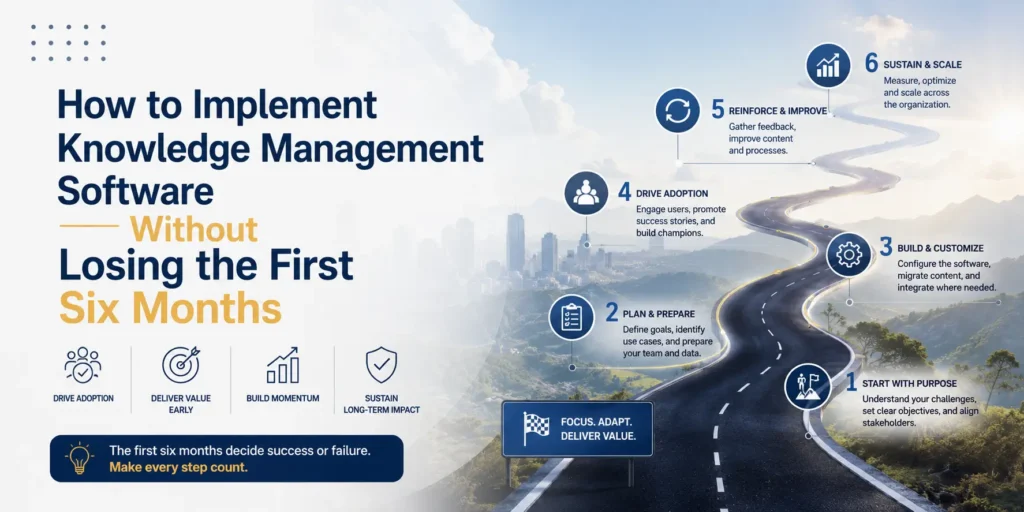
Table of Contents
- Why the First Six Months Determine Everything
- The Implementation Failure Patterns That Repeat Across Every Organization
- The Pre-Implementation Work That Most Organizations Skip
- The Implementation Sequence That Works
- The Measurement Framework: What to Track and When
- The Governance Maintenance Model: What Ongoing Operations Look Like
- Common Implementation Mistakes and How to Avoid Them
- The Implementation Timeline: A Practical Summary
- Frequently Asked Questions: KM Software Implementation
- The Reality of Implementation Success
The Implementation Failure Patterns That Repeat Across Every Organization
Before describing what a successful implementation looks like, the failure patterns that produce unsuccessful ones need to be named precisely. They are consistent enough across organizations of different sizes, industries, and platform choices that they constitute a pattern rather than a collection of individual mistakes.
The Empty Platform Launch
The organization configures the platform, sets up user accounts, and sends an all-staff announcement inviting everyone to start using the new knowledge management system. The platform is empty. Or it contains fifteen articles written during the implementation period by the project team, none of which are the articles employees actually need.
Employees visit the platform, find nothing useful, and do not return. The platform’s first impression is an impression of emptiness, and first impressions in software adoption are disproportionately durable. The team that implemented the platform spends the following months trying to rebuild adoption from a standing start against an organizational memory of “I tried that and it had nothing in it.”
The Everything Migration
The organization decides that the most important first step is getting all existing knowledge into the new platform. Documents are bulk-migrated from SharePoint, pages are exported from the old wiki, and email attachments are uploaded in batches. The new platform launches with thousands of content items, a significant percentage of which are outdated, duplicated, incorrectly categorized, or simply wrong.
Employees search the new platform, find content they cannot trust, and revert to asking colleagues. The platform’s first impression is an impression of unreliability, and the organization discovers that a large ungoverned knowledge base is worse than a small governed one because it creates the appearance of having solved the knowledge management problem while actually recreating it in a new container.
The Governance Afterthought
The organization launches the platform, builds initial content, and achieves reasonable initial adoption. Nobody assigns ownership to the knowledge articles that have been created. Nobody establishes review cycles. Nobody monitors content age or search quality. Six months later, the initial content is outdated. Twelve months later, employees have stopped trusting the platform. Eighteen months later, leadership is asking why the investment has not delivered the expected return.
This is the most common failure pattern and the one most directly addressed by this article. It is also the most preventable, because governance design is not technically complex. It is organizationally demanding, which is why most implementations skip it.
The Adoption Program That Replaces Workflow Integration
The organization invests significantly in training sessions, launch communications, and adoption incentive programs designed to drive employees to the new platform. Employees attend the training, understand how the platform works, and then return to their normal workflows, which do not include the platform. Usage spikes after each training session and declines steadily between them.
The fundamental problem is that adoption programs drive awareness, not behavior change. Behavior change in knowledge access happens when accessing knowledge through the platform is easier than the alternative, specifically easier than asking a colleague, searching an email inbox, or recreating knowledge from scratch. Until the platform is integrated into the workflows where knowledge needs arise, adoption programs are fighting a behavioral gravity that they cannot overcome.
The Pre-Implementation Work That Most Organizations Skip
The decisions that determine implementation success are made before the platform is configured, not during configuration. Organizations that skip the pre-implementation work and move directly to platform setup are making those decisions by default rather than by design, and the defaults are almost always wrong.
The Knowledge Audit
A knowledge audit is a structured assessment of what organizational knowledge currently exists, where it lives, who owns it, how current it is, and how it is used. It sounds like significant work because it is significant work. It is also the single most valuable investment an organization can make before a knowledge management implementation because it answers the questions that determine every subsequent implementation decision.
What knowledge do we have that is worth migrating to the new platform, and what should be retired rather than migrated? Without a knowledge audit, this question is answered by bulk migration or by intuition, both of which produce poor outcomes.
What knowledge is missing that the platform needs to contain from day one? Without a knowledge audit, this question is not answered at all, which is why platforms launch empty.
Who are the subject matter experts whose knowledge most needs to be captured and organized? Without a knowledge audit, content creation depends on whoever is most motivated to contribute rather than on a strategic assessment of where knowledge gaps are most costly.
Which knowledge domains generate the most employee questions, the most onboarding confusion, and the most repeated mistakes? Without a knowledge audit, platform content is organized around what contributors find easiest to write rather than what employees most need to find.
A focused knowledge audit covering the organization’s five to ten most critical knowledge domains takes two to three weeks for a small organization and four to six weeks for a larger one. The implementation timeline savings produced by having clear answers to these questions before configuration begins consistently exceed the audit investment.
The Governance Model Design
Before the platform is configured, the organization needs a clear governance model that defines how knowledge will be owned, maintained, and improved over time. The governance model does not need to be complex. It needs to be specific.
Ownership assignment defines who is responsible for which knowledge domains. This is an organizational decision, not a platform configuration decision. The platform can enforce ownership once it is assigned. It cannot determine who the right owner is. That determination requires understanding the organizational structure, the subject matter expertise distribution, and the capacity that different roles have for ongoing knowledge maintenance.
Review cycle definition establishes how frequently different categories of knowledge require review. Not all knowledge ages at the same rate. A policy document in a regulated industry may require quarterly review. A process guide in a stable operational environment may require annual review. A technology tutorial may require review every time the technology updates. Defining these cycles before platform configuration allows the platform’s review reminder system to be configured correctly from the first day of operation.
Quality standards define what a publishable knowledge article looks like. Without explicit quality standards, knowledge base quality is determined by the most motivated contributor’s personal standards, which vary widely. Quality standards do not need to be prescriptive about writing style. They need to be clear about completeness: what questions does a good knowledge article answer, what format makes it most findable, what metadata is required before publication.
Contribution workflow design defines the path from knowledge in a subject matter expert’s head to a published, governed knowledge article. The number of steps in this path is the primary determinant of contribution rate. Every unnecessary step reduces contribution frequency. Every ambiguity about who reviews content before publication creates bottlenecks that stall the knowledge creation pipeline.
Content Planning and Prioritization
The content plan identifies what the knowledge base needs to contain, in what order, and who will create it. It is not a comprehensive content strategy. It is a minimum viable knowledge base specification: the articles that need to exist on launch day for the platform to deliver immediate value to employees who access it for the first time.
The content planning exercise has three components.
First, identify the twenty to thirty questions that employees ask most frequently, whether to colleagues, to managers, to IT helpdesks, or to HR. These questions define the highest-value initial content because they represent the knowledge employees most need and most consistently cannot find. Every one of these questions should have a corresponding knowledge article on launch day.
Second, identify the ten processes that would cause the most operational disruption if the person who normally runs them were unavailable for two weeks. These processes represent the highest knowledge retention risk in the organization. Their documentation is both the highest-value content for the knowledge base and the most urgent capture priority for the organization.
Third, identify the five areas where onboarding new employees most consistently produces confusion, inconsistency, or extended time-to-productivity. These areas define the onboarding knowledge gap that the platform needs to close, and closing it is one of the most measurable ROI demonstrations available in the first six months of operation.
With these thirty to forty-five content priorities identified before launch, the platform goes live with a knowledge base that employees find useful from the first visit rather than discovering to be empty.
The Implementation Sequence That Works
Successful knowledge management software implementations follow a sequence that most vendor onboarding guides do not describe because it does not follow the vendor’s preferred timeline. It follows the organization’s readiness curve.
Phase One: Foundation (Weeks One and Two)
Phase one is entirely internal. No employees are invited to the platform. No announcements are made. The work of phase one is platform configuration, taxonomy setup, and initial governance model implementation.
Platform configuration in phase one covers the structural decisions: the organizational hierarchy for content, the permission model for different user roles, the metadata schema that will govern how content is tagged and categorized, and the integration connections with the tools employees already use, specifically the communication platforms where knowledge access needs to be embedded.
Taxonomy setup is the most consequential configuration decision in phase one and the one most frequently rushed. The taxonomy defines how knowledge is organized and therefore how it is found. A taxonomy built around departmental structure is navigable by people who know the organizational structure and opaque to people who do not. A taxonomy built around employee needs and knowledge topics is navigable by anyone who has the need, regardless of their knowledge of organizational structure. Building the right taxonomy requires the knowledge audit findings. Organizations that skip the knowledge audit build the wrong taxonomy and spend months trying to reorganize content around it.
Governance model implementation in phase one means configuring the platform to enforce the governance decisions made in pre-implementation. Ownership assignment workflows, review reminder schedules, approval processes, and content quality checkpoints should all be configured before any content is created, because retrofitting governance onto an existing content structure is significantly more difficult than building content within a governance structure from the start.
Phase Two: Seed Content Creation (Weeks Three and Four)
Phase two creates the initial knowledge base content that makes the platform worth visiting on launch day. It is not a content migration phase. It is a content creation phase, and the distinction matters.
Content migration moves existing content from one place to another. Content creation builds new knowledge articles that are structured, governed, and optimized for the new platform from the start. The seed content created in phase two should come from the content prioritization exercise: the thirty to forty-five highest-value articles identified before implementation began.
Each seed content article should be created with full governance metadata from the start: an assigned owner, a defined review date, appropriate taxonomy tags, and the metadata fields required by the platform’s content health monitoring. Articles created without this metadata require retroactive governance work that almost never gets done, producing a governance debt that accumulates from the platform’s first day of operation.
Subject matter expert involvement in phase two is essential and requires deliberate management. Subject matter experts have the knowledge. They do not have the time or the inclination to spend significant hours writing knowledge articles alongside their normal workload. The contribution model that works at this phase is structured interviews: a knowledge manager or implementation lead conducts a thirty to forty-five minute conversation with the subject matter expert, extracts the knowledge, and drafts the article, which the expert reviews and approves. This model produces higher-quality articles faster than asking experts to write their own, and it dramatically reduces the contribution friction that stalls content creation in most implementations.
Phase Three: Pilot Deployment (Weeks Five and Six)
Phase three deploys the platform to a pilot group of twenty to thirty users before the broader organizational rollout. The pilot group should be selected to represent the range of use cases the platform needs to serve, not to be the most enthusiastic early adopters. Enthusiastic early adopters give positive feedback regardless of platform quality. Representative users give accurate feedback about what is and is not working for normal employees.
The pilot phase has two objectives. The first is validation: confirming that the taxonomy works for real users, that search surfaces the right content, that the contribution workflow is frictionless enough for non-technical contributors, and that the governance model operates as designed. The second is feedback collection: gathering specific, actionable information about what is missing, what is confusing, and what is working well.
The feedback mechanisms in the pilot phase should be structured rather than open-ended. Specific questions produce specific answers. What did you search for that you could not find? What articles did you find but not trust? What knowledge do you wish existed in the platform that does not? These questions produce actionable implementation improvements. General questions like “what do you think of the platform” produce sentiment, not direction.
The pilot phase should last two full weeks rather than one, because the first week of platform use produces first-impression feedback and the second week produces behavior-based feedback. The difference is significant. First-impression feedback tells you what the platform looks like. Behavior-based feedback tells you what employees actually do after the novelty of a new tool fades.
Phase Four: Organizational Rollout (Week Seven Onward)
Phase four deploys the platform to the full organization with the improvements identified in the pilot phase already implemented. This sequencing is important: rolling out to the full organization before incorporating pilot feedback means the organizational launch produces the same problems the pilot identified, at ten times the scale and with ten times the visibility.
The organizational rollout communication should be specific rather than general. Generic announcements about a new knowledge management system tell employees that something new exists. Specific announcements about where to find the answer to the question they asked last week, how to find the process documentation they needed but could not locate, and how to get their own knowledge into the system tell employees why the platform is worth their attention.
The rollout communication that drives the highest initial adoption is a demonstration of specific value rather than a description of general capability. A two-minute video showing an employee finding the answer to a real organizational question in ten seconds is more effective than a ten-slide presentation describing the platform’s features.
Phase Five: Embedding in Existing Workflows (Weeks Eight Through Twelve)
Phase five is the implementation phase that most vendor timelines treat as complete by phase four, and it is the phase where most of the actual adoption work happens.
Workflow embedding means making knowledge access happen inside the tools employees already use rather than requiring a deliberate trip to a separate platform. The specific integrations that matter most depend on the organization’s existing tool stack.
For organizations where most communication happens in Slack or Microsoft Teams, the knowledge management platform’s integration with those tools is the highest-priority embedding work. When an employee can type a question in Slack and receive a knowledge base answer without leaving Slack, the behavioral change required for knowledge access approaches zero. When accessing the knowledge base requires navigating to a separate URL, logging in, and searching in a different interface, the behavioral change required is significant enough that most employees will ask a colleague instead.
For organizations where customer service or support is a primary knowledge management use case, embedding knowledge access within the support ticketing system is the highest-priority workflow integration. Agents who can surface relevant knowledge articles from within the ticket they are working reduce handle time, improve response consistency, and naturally identify knowledge gaps when the knowledge they need does not exist.
For organizations where onboarding is a primary use case, embedding knowledge access within the onboarding checklist and the tools new employees are directed to in their first week is the critical workflow integration. New employees who encounter the knowledge base as part of their onboarding workflow develop knowledge access habits from their first day. New employees who are introduced to the knowledge base as a separate destination in a training session develop a relationship with it defined by a training context rather than a work context.
The Measurement Framework: What to Track and When
Organizations that define success metrics before implementation have a mechanism for detecting failure signals early and intervening before problems become structural. Organizations that wait until the platform is live to think about measurement discover problems only after they have become organizational facts.
Month One Metrics
The metrics that matter in month one are access and contribution indicators. They answer the question: is the platform being used and is knowledge being added?
Active users as a percentage of total licensed users measures initial adoption breadth. A healthy month one metric is 60 to 70 percent of licensed users accessing the platform at least once in the first four weeks. Below 40 percent suggests the rollout communication was insufficient or the initial content was not valuable enough to drive return visits.
Articles created in month one measures content creation velocity. This metric should be measured against the content plan established before implementation. If the plan called for fifty articles in the first month and thirty have been created, the contribution workflow has friction that needs to be identified and removed.
Search queries with no results as a percentage of total searches measures knowledge gap visibility. This metric is the most actionable early indicator available: it tells the implementation team specifically what content to create next. A healthy month one metric is below 20 percent of searches returning no results. Above 30 percent suggests the seed content phase did not adequately cover the knowledge domains employees are actually searching for.
Month Three Metrics
By month three, the metrics shift from access and creation to quality and trust indicators. They answer the question: is the knowledge base becoming more reliable and is employee behavior reflecting that?
Return visit rate measures whether employees who accessed the platform in month one are still accessing it in month three. This is the single most revealing adoption metric available because it separates initial curiosity from genuine utility. A healthy month three return visit rate is 50 percent or more of month one users still actively accessing the platform.
Article review completion rate measures whether the governance model is functioning. What percentage of articles that reached their review date in month three were actually reviewed and updated by their assigned owners? Below 70 percent suggests the review workflow has friction, the review reminder communication is ineffective, or ownership assignments are not being honored.
Search abandonment rate measures what percentage of search sessions end without the user clicking on a result. High search abandonment indicates that search results are not matching user intent, either because the content does not exist, because the taxonomy is misaligned with how employees think about knowledge, or because search quality is insufficient. This metric should be declining month over month in a healthy implementation.
Month Six Metrics
By month six, the metrics shift to business impact indicators. They answer the question: is the knowledge management investment producing measurable organizational value?
Onboarding time to productivity measures whether new employees who are onboarding with the knowledge base are reaching full productivity faster than those who onboarded before the platform existed. This requires a baseline measurement established before implementation and is one of the most compelling ROI demonstrations available to knowledge management program leaders.
Repeat question reduction measures whether the volume of questions directed to subject matter experts, HR, IT, or other knowledge-holding functions has declined since the knowledge base went live. This metric requires a baseline and a tracking mechanism, but it represents one of the clearest organizational cost reductions that knowledge management software produces.
Knowledge contribution rate measures what percentage of employees have contributed at least one knowledge article in the first six months. In a healthy implementation, this should be 20 to 30 percent of the user base. Below 10 percent indicates that the contribution workflow has barriers that have not been removed or that the organizational culture has not shifted to treat knowledge contribution as a normal work activity.
The Governance Maintenance Model: What Ongoing Operations Look Like
The implementation phase ends at roughly month three, when the platform is fully deployed, workflow integrations are operational, and the governance model is functioning. What follows is not a project. It is an ongoing operational responsibility that must be budgeted, staffed, and managed as such.
The ongoing governance work required to maintain a healthy knowledge base has four components.
Content review management is the most time-intensive ongoing responsibility. Someone needs to monitor review completion rates, follow up with owners whose reviews are overdue, and escalate persistent non-compliance to management. For an organization under 100 people, this requires two to four hours per week. For larger organizations, it requires dedicated staff time or a distributed responsibility model where department-level knowledge champions own review compliance within their domains.
Knowledge gap monitoring requires someone to review search analytics weekly and identify the queries returning no results that represent the highest-priority content creation needs. This work produces the content creation agenda that keeps the knowledge base growing in response to actual employee needs rather than the content team’s assumptions about what employees need.
Content quality auditing requires a quarterly review of a sample of the knowledge base’s content to assess accuracy, completeness, and structural quality. Automated governance tools catch content that has not been reviewed. Quality auditing catches content that has been reviewed but is still inadequate. The distinction matters because review completion and content quality are not the same thing.
Platform performance monitoring requires ongoing attention to the technical health of the implementation: search quality, integration reliability, user permission accuracy, and storage management. For cloud-hosted platforms, most of this monitoring is handled by the vendor. For self-hosted implementations, it is an internal IT responsibility.
Common Implementation Mistakes and How to Avoid Them
Launching Before the Content Is Ready
The pressure to show progress on a knowledge management implementation frequently drives teams to launch platforms before they contain enough useful content to deliver value on first visit. Resist this pressure. A platform that launches with thirty well-chosen, well-governed articles delivers more value and more durable adoption than a platform that launches with three hundred poorly organized, ungoverned articles or five articles and a promise of more to come.
Treating Content Migration as Content Creation
Migrating existing content from SharePoint, a wiki, or a file system into the new platform feels like progress. It produces the appearance of a full knowledge base without the substance of a governed one. Every article that migrates should be actively reviewed, updated if necessary, assigned an owner, tagged with appropriate metadata, and given a review date. Articles that cannot be reviewed before migration should not be migrated until they are. This standard is demanding. It is also the difference between a knowledge base that employees trust and one that they do not.
Skipping the Pilot Phase to Save Time
The pilot phase feels like a delay when implementation timelines are under pressure. It is actually a time-saving measure because it surfaces the problems that would otherwise surface during the organizational rollout at ten times the visibility and organizational cost. Two weeks of pilot testing consistently identifies taxonomy problems, search quality issues, contribution workflow friction, and governance gaps that would otherwise require months of post-launch remediation.
Measuring Adoption Without Measuring Value
Active user counts tell implementation teams how many people are using the platform. They do not tell them whether the platform is solving the knowledge management problem it was implemented to solve. Organizations that measure adoption without measuring value optimize for usage statistics rather than organizational outcomes, and consistently arrive at month twelve with impressive usage numbers and persistent knowledge management problems.
Treating Implementation as Complete at Launch
The most consequential implementation mistake is treating the platform launch as the end of the implementation rather than the beginning of the operational phase. Knowledge management software that is deployed and then managed passively degrades at a predictable rate. Knowledge management software that is actively managed, with ongoing content review, gap monitoring, and quality auditing, improves continuously. The difference between these two outcomes is not the platform. It is the ongoing investment in governance operations that the organization either makes or does not make.
The Implementation Timeline: A Practical Summary
Pre-implementation (two to four weeks before platform access): knowledge audit, governance model design, content prioritization, taxonomy design.
Week one and two: platform configuration, taxonomy implementation, governance workflow setup, integration configuration.
Week three and four: seed content creation covering the thirty to forty-five highest-priority knowledge articles, with full governance metadata from the start.
Week five and six: pilot deployment to twenty to thirty representative users, structured feedback collection, taxonomy and search quality refinement.
Week seven: pilot feedback implementation, organizational rollout preparation.
Week seven onward: organizational rollout with specific value communication, workflow embedding, adoption monitoring.
Week eight through twelve: workflow integration completion, contribution habit development, month one metrics review and response.
Month three: governance model assessment, return visit rate analysis, first business impact measurement.
Month six: full business impact review, ROI demonstration, phase two content expansion planning.
Frequently Asked Questions: KM Software Implementation
How long does knowledge management software implementation take?
For organizations under 50 people with straightforward knowledge management requirements and no significant content migration, the implementation timeline from pre-implementation work to organizational rollout is six to eight weeks. For organizations between 50 and 500 people with more complex governance requirements and content migration needs, the timeline is three to five months. For enterprise implementations with significant integration requirements, multi-language support, and large-scale content migration, six to twelve months is realistic.
What is the most common reason knowledge management implementations fail?
The most common failure cause is the absence of governance infrastructure before launch. Platforms that launch without defined content ownership, review cycles, and quality standards produce knowledge bases that decay within twelve to eighteen months regardless of initial adoption rates. The second most common failure cause is launching without adequate seed content, which produces an empty platform first impression that permanently damages adoption potential.
How much staff time does ongoing knowledge base management require?
For organizations under 50 people, two to four hours per week from one person is sufficient for basic governance operations. For organizations between 50 and 200 people, a part-time knowledge management role of ten to fifteen hours per week is typically required. Above 200 people, a dedicated knowledge management function with at least one full-time person is generally necessary to maintain knowledge base quality at organizational scale.
Should content be migrated from existing systems before or after platform launch?
Content migration should happen before platform launch, but only after each piece of content has been reviewed, updated, assigned an owner, and given appropriate metadata. Bulk pre-launch migration of unreviewed content produces an ungoverned knowledge base from day one. Post-launch migration of reviewed, governed content builds the knowledge base incrementally on a foundation of quality rather than volume.
How do you get subject matter experts to contribute knowledge?
The most effective contribution model for subject matter experts is structured knowledge interviews rather than asking them to write articles independently. A thirty to forty-five minute conversation with a knowledge manager who extracts and drafts the knowledge, submitted to the expert for review and approval, produces higher-quality content faster and with less friction than expecting experts to write their own articles alongside their normal workload.
The Reality of Implementation Success
Knowledge management software implementations succeed when organizations treat them as organizational change initiatives rather than technology deployments. The platform is not the product. The organizational knowledge management capability that the platform enables is the product, and building that capability requires governance design, content creation investment, workflow integration, behavioral change management, and ongoing operational commitment that no platform delivers automatically.
Organizations that understand this from the start build knowledge management capabilities that improve continuously and deliver compounding organizational value over time. Organizations that expect the platform to solve the knowledge management problem by being deployed will discover, at roughly month eighteen, that the platform was only one component of the solution and not the most important one.
The most important components are the governance decisions made before the platform was configured, the content creation investment made before the platform was launched, and the operational commitment made after the platform went live.
Those decisions were never the vendor’s responsibility.
They were always the organization’s.
Related reading:
- How to Choose Knowledge Management Software: The Buyer’s Guide No Vendor Will Write
- Knowledge Management Software vs SharePoint vs Wiki: What Most Organizations Get Wrong
- Knowledge Management Software for Small Business: What Works Under 100 Employees
- Free Knowledge Management Software: What It Can and Cannot Do