Knowledge management is entering one of the most important transitions in its history. For decades, organizations approached enterprise knowledge primarily through storage-oriented systems designed to capture documents, preserve information, and support basic retrieval. In many enterprises, knowledge management became closely associated with repositories, intranets, file structures, collaboration portals, and enterprise content management platforms.
Those systems solved part of the problem.
They allowed organizations to digitize information, centralize documentation, and distribute operational knowledge at greater scale than ever before. Yet despite massive investments in enterprise technology over the past two decades, most organizations continue facing the same underlying challenge: employees still struggle to locate the right knowledge at the right moment with the right context.
Artificial intelligence is now exposing the limitations of traditional knowledge systems at unprecedented scale.
The problem is no longer information availability. Modern enterprises already possess enormous volumes of operational knowledge, historical data, customer intelligence, policies, project records, research materials, technical documentation, and collaborative insights. The deeper issue is that most enterprise knowledge environments were never designed to understand meaning.
This is why semantic knowledge management systems are rapidly emerging as one of the most strategically important developments in enterprise technology.
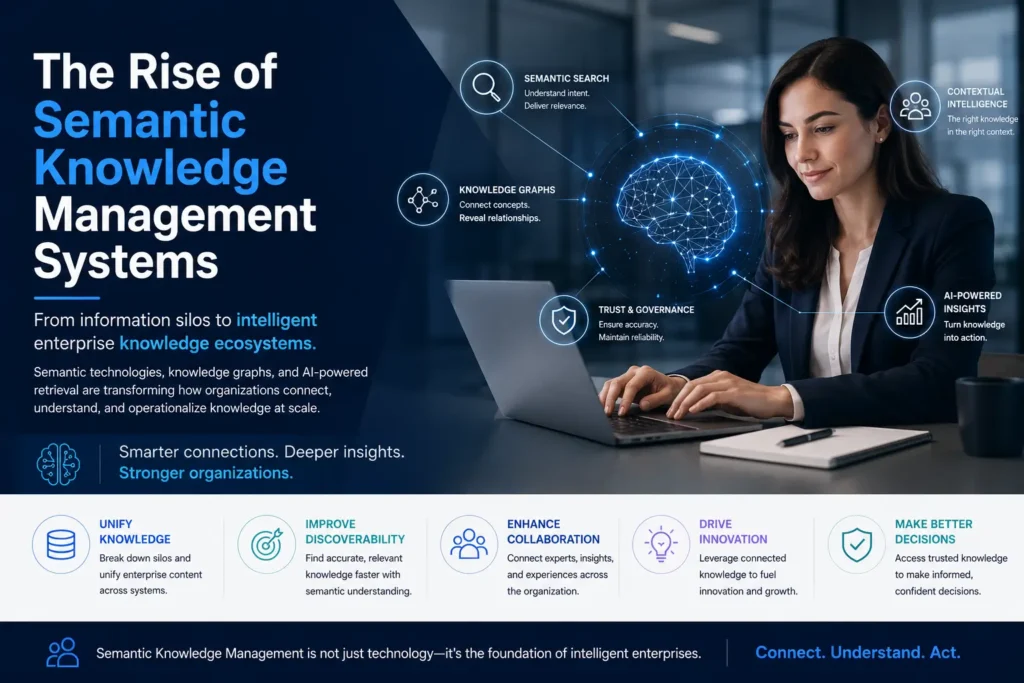
The rise of semantic systems represents far more than a technical upgrade to search infrastructure. It signals a broader transformation in how organizations structure, interpret, retrieve, govern, and operationalize knowledge itself. In many ways, semantic knowledge management may ultimately become the intelligence layer behind the future enterprise.
Why Traditional Knowledge Systems Reached Their Limits
Traditional knowledge management systems were largely built around hierarchical structures. Information was organized through folders, categories, document libraries, metadata fields, and predefined taxonomies designed primarily for human navigation. Enterprise search systems typically relied heavily on keyword matching, file indexing, and static retrieval logic.
For many years, this approach appeared sufficient.
However, as organizations expanded digitally, information complexity grew exponentially. Enterprise knowledge became distributed across cloud platforms, collaboration systems, project management tools, CRMs, ERP systems, customer support environments, internal communication channels, and countless specialized applications. At the same time, the volume of enterprise content increased dramatically.
This created a major structural problem.
Traditional systems could store information, but they struggled to understand relationships between information. They treated knowledge largely as isolated content assets rather than interconnected organizational intelligence.
Employees increasingly encountered situations where relevant knowledge technically existed somewhere inside the organization, yet remained operationally invisible because retrieval systems lacked contextual understanding. Search results often produced irrelevant documents, duplicate records, outdated policies, or incomplete operational guidance because systems relied heavily on literal keyword matching rather than semantic meaning.
This issue became especially severe in large enterprises where different departments used inconsistent terminology, overlapping classifications, fragmented metadata standards, and disconnected information architectures.
The result was widespread knowledge friction.
Employees spent enormous amounts of time searching for information, validating accuracy, reconstructing operational context, or recreating work that already existed elsewhere in the organization. Over time, these inefficiencies created substantial operational drag that affected productivity, innovation, customer experience, and decision quality.
The rise of generative AI accelerated the urgency surrounding this problem dramatically.
Why Artificial Intelligence Changed Enterprise Knowledge Management
The arrival of large language models and enterprise AI systems fundamentally changed organizational expectations around knowledge access.
Employees increasingly expect enterprise systems to function conversationally. They no longer want to navigate deeply nested folder structures, manually search through disconnected repositories, or interpret fragmented search results independently. Instead, they expect intelligent systems capable of understanding context, retrieving relevant information dynamically, and delivering operational knowledge with minimal friction.
This expectation exposed the structural weaknesses hidden inside many enterprise knowledge environments.
Organizations quickly realized that AI systems are only as effective as the knowledge ecosystems supporting them. Large language models can generate fluent responses, but without strong retrieval infrastructure and semantically organized enterprise knowledge, outputs become unreliable, inconsistent, or operationally risky.
This realization triggered a major shift in enterprise thinking.
Knowledge management was no longer simply about storage or publishing. It became increasingly connected to machine reasoning itself.
AI systems require knowledge environments capable of understanding relationships, context, meaning, operational dependencies, and semantic connections between information assets. Traditional repository models were never designed for that level of intelligence.
Semantic knowledge management systems emerged in response to this challenge.
What Makes Semantic Knowledge Management Different
Semantic knowledge management systems differ fundamentally from traditional repository-based environments because they focus on meaning rather than isolated information storage.
Instead of treating documents as disconnected files organized primarily through folders or keywords, semantic systems analyze relationships between concepts, entities, operational contexts, workflows, expertise domains, and organizational knowledge structures.
This creates a dramatically different model for enterprise retrieval.
A semantic system does not simply search for matching words. It attempts to understand intent, contextual relationships, conceptual similarity, and operational relevance. This allows knowledge retrieval to function more like human reasoning rather than static database querying.
For example, in a traditional enterprise search environment, an employee searching for cybersecurity incident response procedures might only retrieve documents containing exact matching terminology. A semantic system, however, can identify related concepts such as breach escalation workflows, security governance frameworks, historical incident reports, operational dependencies, compliance protocols, and subject matter expertise even when terminology differs substantially.
This distinction is enormously important.
Organizations are gradually moving away from information retrieval models based primarily on document matching toward systems designed around contextual intelligence.
The enterprise knowledge environment itself is becoming more intelligent.
The Role of Knowledge Graphs in Semantic Systems
One of the foundational technologies behind semantic knowledge management is the knowledge graph.
Knowledge graphs allow organizations to model relationships between people, concepts, processes, systems, projects, expertise areas, operational workflows, and enterprise entities dynamically. Instead of storing information in isolated silos, knowledge graphs create interconnected representations of organizational intelligence.
This changes how enterprise knowledge functions operationally.
For example, a semantic system may understand that a particular project relates to specific technologies, regulatory frameworks, internal experts, customer accounts, operational risks, historical decisions, and associated workflows simultaneously. These relationships become machine-readable and contextually retrievable.
As a result, enterprise systems gain the ability to surface relevant connections dynamically rather than relying solely on manual categorization.
Knowledge graphs also improve discoverability in environments where terminology varies across departments or regions. Large enterprises frequently suffer from semantic inconsistency where identical concepts are described differently across teams. Semantic systems help bridge those gaps by understanding conceptual relationships rather than depending entirely on standardized vocabulary alone.
This is one reason semantic technologies are becoming increasingly important for global organizations operating across highly complex digital ecosystems.
Why Semantic Search Is Becoming Strategic Infrastructure
Enterprise search has historically been treated as a utility function rather than a strategic capability.
That perception is changing rapidly.
In modern organizations, search quality directly affects productivity, onboarding efficiency, innovation speed, operational consistency, customer service quality, and AI effectiveness. Poor retrieval systems create invisible operational friction across nearly every business function.
Semantic search addresses this challenge by enabling systems to interpret meaning, intent, and contextual relevance rather than relying solely on exact keyword matching.
This creates far more intelligent retrieval experiences.
Employees can increasingly search conversationally using natural language while systems dynamically interpret operational intent, semantic similarity, historical context, and related expertise. Retrieval becomes less dependent on knowing the precise terminology used inside organizational documentation.
This shift has major implications for enterprise AI.
Retrieval-Augmented Generation architectures, commonly known as RAG systems, depend heavily on semantic retrieval infrastructure. These architectures combine large language models with enterprise retrieval systems capable of dynamically surfacing trusted organizational knowledge before generating responses.
Without semantic retrieval, enterprise AI systems struggle to provide contextually reliable outputs.
This is why semantic search is increasingly becoming foundational infrastructure for AI-enabled organizations.
The Growing Importance of Metadata and Taxonomy
Ironically, the rise of semantic systems is also increasing the importance of metadata governance and taxonomy design.
For many years, organizations treated metadata management as an administrative concern rather than a strategic discipline. AI is changing that perception rapidly.
Semantic systems depend heavily on structured relationships, contextual classification, entity mapping, and organizational consistency. Weak metadata environments reduce retrieval quality, semantic accuracy, and AI reliability significantly.
Many enterprises deploying AI copilots are discovering that their underlying knowledge architecture lacks the semantic maturity required to support intelligent retrieval effectively. Duplicate content, inconsistent terminology, fragmented classifications, and poorly governed repositories create operational confusion for both humans and machines.
As a result, taxonomy specialists, information architects, ontology engineers, and knowledge governance professionals are becoming increasingly important again.
The future enterprise will likely depend heavily on semantically structured knowledge environments capable of supporting machine-readable organizational intelligence at scale.
Why Semantic Systems Matter for Organizational Learning
One of the most important long-term implications of semantic knowledge management involves organizational learning itself.
Traditional knowledge systems often struggled to connect operational experience across departments, projects, and workflows effectively. Valuable insights remained fragmented because systems lacked contextual relationship mapping.
Semantic environments improve this dramatically.
Organizations can increasingly connect lessons learned, operational decisions, customer interactions, historical outcomes, expertise domains, regulatory changes, and workflow dependencies into integrated knowledge ecosystems capable of supporting continuous learning.
This creates more adaptive enterprises.
Instead of simply storing information passively, semantic systems help organizations recognize patterns, identify emerging operational risks, surface hidden expertise, and accelerate collective learning across distributed environments.
Knowledge becomes operationally active rather than archivally passive.
This may ultimately become one of the most transformative aspects of semantic enterprise intelligence.
The Human Side of Semantic Knowledge Management
Despite the technological sophistication surrounding semantic systems, the rise of semantic knowledge management is not solely a technical transformation.
It is also deeply organizational.
Many enterprise knowledge problems are not caused by technology limitations alone. They stem from governance fragmentation, unclear ownership, inconsistent publishing practices, cultural silos, weak collaboration models, and poor operational alignment.
Semantic systems can improve retrieval and contextual understanding significantly, but organizations still require strong governance, trusted content, leadership alignment, and human-centered knowledge cultures.
This is especially important because enterprise knowledge is not purely informational. Much of the most valuable expertise inside organizations remains tacit, experiential, and context-dependent.
Semantic systems can help surface relationships and improve discoverability, but they do not eliminate the importance of human judgment, collaborative reasoning, and organizational learning communities.
The future of knowledge management will likely depend on balancing machine intelligence with human expertise effectively.
The Future of Semantic Enterprise Intelligence
Semantic knowledge management systems are still evolving, but their long-term implications are becoming increasingly clear.
The next generation of enterprises will likely operate through intelligent knowledge ecosystems capable of connecting workflows, operational context, expertise, governance, decision support, and AI reasoning dynamically.
Employees may increasingly interact with enterprise knowledge through conversational interfaces capable of retrieving contextual insights instantly across distributed organizational systems. AI systems may proactively surface operational guidance, identify expertise networks, detect emerging risks, recommend historical precedents, and support strategic decision-making continuously.
Knowledge environments themselves may become adaptive, context-aware, and operationally intelligent.
This represents a profound transformation in enterprise infrastructure.
Organizations are no longer simply digitizing information.
They are gradually building machine-readable organizational intelligence systems.
Final Thoughts
The rise of semantic knowledge management systems reflects a larger shift occurring across the modern enterprise.
Organizations are moving beyond static repositories, disconnected search environments, and storage-centric knowledge architectures toward intelligent systems capable of understanding relationships, meaning, context, and operational relevance.
Artificial intelligence is accelerating this transition because machine reasoning depends heavily on semantic structure, contextual retrieval, and trusted organizational knowledge.
In many ways, semantic knowledge management is becoming the foundation upon which enterprise AI will operate.
The organizations that succeed in the coming decade will likely be those capable of transforming fragmented information environments into semantically connected intelligence ecosystems that support both human expertise and machine-assisted reasoning simultaneously.
Knowledge management is no longer simply about storing information.
It is becoming the architecture of enterprise intelligence itself.