
The modern enterprise was built around the rise of the knowledge worker. For decades, organizations depended on professionals whose primary value came from their ability to analyze information, apply expertise, solve problems, make decisions, and operationalize institutional knowledge across increasingly complex business environments. Entire industries evolved around this model. Consulting firms, technology companies, financial institutions, healthcare systems, research organizations, and global enterprises all expanded through the productivity of workers whose output was largely intellectual rather than physical.
Artificial intelligence is now reshaping that foundation in ways many organizations are only beginning to understand.
Most conversations surrounding AI and work focus heavily on automation or job replacement. Those discussions often oversimplify what is actually happening inside enterprises. The deeper transformation is not merely about machines performing tasks faster than humans. It is about a fundamental shift in how organizations create, distribute, validate, and operationalize intelligence itself.
The future knowledge worker will not disappear. However, the nature of knowledge work is changing rapidly, and the organizations that adapt successfully will likely redefine workforce strategy, learning models, leadership structures, and operational decision-making over the next decade.
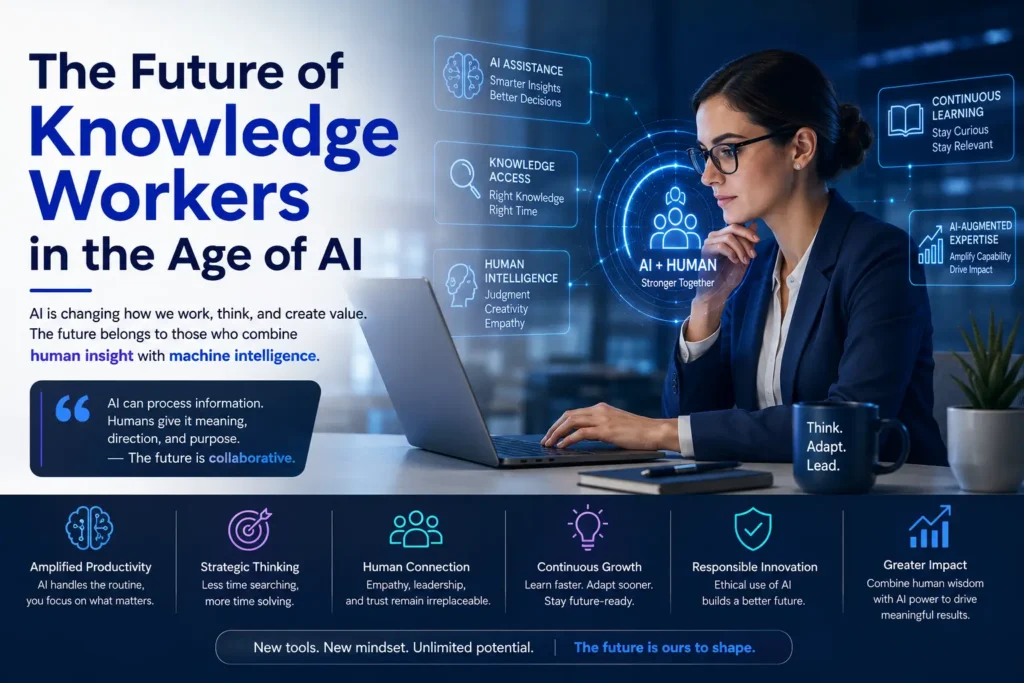
How the Knowledge Worker Became the Center of Modern Enterprise Growth
The concept of the knowledge worker gained prominence during the late twentieth century as economies shifted away from industrial production toward information-driven business models. Management thinker Peter Drucker recognized earlier than most that intellectual capability would eventually become one of the primary drivers of organizational value creation.
This represented a major historical transition.
Industrial-era organizations were designed around operational efficiency, physical infrastructure, manufacturing systems, and process standardization. The emerging digital economy required something different. Organizations increasingly depended on people capable of interpreting information, solving abstract problems, generating innovation, managing complexity, and making strategic decisions in rapidly changing environments.
As enterprises became more digitized and globally connected, intellectual work expanded across every function. Strategic planning, analytics, engineering, product management, legal operations, financial modeling, customer intelligence, marketing, research, and enterprise technology all became heavily knowledge-driven disciplines.
Technology accelerated this transformation further. Enterprise software systems, cloud platforms, digital communication tools, and collaboration environments allowed organizations to scale cognitive work across global operations. The modern enterprise gradually evolved into a network of information systems supported by highly specialized knowledge professionals.
For years, this model defined corporate productivity.
Artificial intelligence is now transforming it at an unprecedented pace.
Why AI Is Different From Previous Technological Revolutions
Many technological shifts throughout history automated physical labor or repetitive operational processes. AI is fundamentally different because it increasingly affects cognitive work itself.
Generative AI systems can now analyze reports, summarize documents, retrieve enterprise knowledge, generate content, support coding workflows, automate research tasks, interpret large information sets, and assist with operational decision-making. These capabilities are reshaping how intellectual work is performed across industries.
This creates understandable uncertainty.
However, much of the public conversation surrounding AI still misunderstands the true nature of enterprise knowledge work. Real organizational value rarely comes from isolated task execution alone. Most high-value professional work exists within environments filled with ambiguity, incomplete information, competing priorities, organizational politics, operational constraints, human relationships, and contextual judgment.
This distinction matters enormously.
AI systems excel at processing information patterns, generating language, identifying relationships, and accelerating cognitive workflows. Yet organizations do not operate solely through information processing. Enterprises function through context, governance, trust, experience, leadership, timing, collaboration, and strategic reasoning.
That is why the future of knowledge work will likely involve augmentation rather than simple replacement.
The most valuable professionals in the coming decade may not be those who compete against AI systems directly, but those capable of integrating human judgment with machine intelligence more effectively than others.
The Shift From Information Ownership to Intelligence Navigation
One of the biggest changes happening inside organizations is the declining strategic value of information access alone.
Historically, professionals gained influence partly because they controlled access to expertise, documentation, operational history, research, or institutional knowledge. Organizational hierarchies themselves were often structured around information flow.
Artificial intelligence is changing this dynamic rapidly.
Large language models and intelligent retrieval systems are making information increasingly accessible across organizations. Employees can now retrieve explanations, summaries, recommendations, and operational guidance conversationally through AI systems that understand context and semantic relationships.
As information access becomes more democratized, the value of knowledge work shifts upward toward interpretation, judgment, validation, contextual reasoning, and strategic decision-making.
This creates a very different professional environment.
Future knowledge workers may increasingly differentiate themselves through their ability to evaluate AI-generated insights, identify operational risks, understand business implications, navigate ambiguity, and connect organizational context with machine-assisted intelligence.
In many ways, enterprises are moving from information scarcity toward intelligence abundance.
That transition changes what expertise means.
Read: Knowledge Management Process in the AI Era: From Capture to Discoverability
Why Human Judgment Is Becoming More Important
One of the most misunderstood assumptions surrounding artificial intelligence is the belief that intelligence and judgment are equivalent concepts.
They are not.
AI systems are becoming increasingly sophisticated at recognizing patterns, generating predictions, retrieving information, and automating certain forms of analysis. However, enterprise environments frequently require contextual reasoning that extends beyond data interpretation alone.
Experienced professionals understand organizational dynamics that rarely exist inside formal systems. They recognize political sensitivities, stakeholder relationships, historical failures, customer behavior patterns, regulatory implications, operational tradeoffs, and cultural realities that shape enterprise decisions.
These forms of understanding develop through experience rather than information retrieval alone.
Ironically, as AI-generated outputs become more common, human judgment may become even more strategically important. Organizations will increasingly depend on professionals capable of validating AI recommendations, detecting contextual inaccuracies, governing operational decisions, and understanding broader business consequences.
The future knowledge worker may increasingly function as an orchestrator of intelligence rather than simply a processor of information.
The Emergence of AI-Augmented Expertise
One of the most important changes occurring today is the rise of AI-augmented expertise.
Historically, knowledge professionals spent enormous amounts of time searching for information, organizing documentation, preparing reports, reviewing data, drafting communications, summarizing research, and navigating fragmented enterprise systems. Much of this work involved cognitive effort, but not necessarily deep strategic reasoning.
Artificial intelligence is beginning to reduce that burden substantially.
This creates opportunities for professionals to focus more heavily on strategic analysis, innovation, customer engagement, operational design, leadership, creativity, and high-value decision-making. However, it also raises expectations significantly.
As AI systems accelerate productivity, organizations may expect employees to operate at higher levels of complexity and strategic contribution. The baseline expectation for analytical capability could rise across nearly every knowledge-intensive industry.
This may create a widening divide between professionals who effectively integrate AI into their workflows and those who struggle to adapt.
The future workforce will likely reward professionals who combine deep domain expertise with strong AI literacy, contextual reasoning, and operational intelligence.
Why Continuous Learning Is Becoming a Survival Skill
The pace of technological change inside enterprises is accelerating faster than many traditional workforce models can support.
Historically, professionals could rely on relatively stable career paths where expertise evolved gradually over time. AI is compressing those timelines dramatically. Entire workflow categories are already being redesigned within short periods as new capabilities emerge.
This means adaptability itself is becoming one of the most important professional capabilities.
Future knowledge workers will likely require continuous reskilling, higher learning agility, broader systems thinking, and greater cross-functional understanding than previous generations. Professionals may increasingly need to understand not only their domain expertise, but also how AI systems influence workflows, governance, enterprise operations, and organizational decision-making.
The most valuable employees may no longer be those with narrowly specialized expertise alone. Instead, organizations may prioritize individuals capable of integrating knowledge across multiple domains while adapting continuously to rapidly evolving technological environments.
This shift is changing the nature of professional development itself.
Why Tacit Knowledge Still Matters
Despite the rapid advancement of AI systems, one area remains extraordinarily difficult to replicate fully: tacit knowledge.
Tacit knowledge refers to expertise developed through experience rather than formal documentation. It includes intuition, judgment, negotiation capability, troubleshooting instincts, leadership behavior, operational wisdom, and contextual awareness built gradually over years of exposure.
Many enterprise decisions depend heavily on these forms of understanding.
Organizations often underestimate how much operational intelligence exists informally inside experienced employees rather than structured systems. AI can retrieve documented information extremely effectively, but many critical enterprise decisions still require human interpretation shaped by lived experience and organizational familiarity.
This is one reason mentorship, apprenticeship, collaboration, and experiential learning will likely remain extremely important even in highly AI-driven workplaces.
The future enterprise may depend less on choosing between humans and AI, and more on building environments where human tacit expertise and machine intelligence reinforce one another effectively.
How AI May Reshape Organizational Structures
Artificial intelligence may also transform how organizations themselves are structured.
Historically, many enterprises operated through hierarchical information distribution models where knowledge moved gradually across departments, leadership layers, and operational systems. Managers often functioned partly as information coordinators responsible for distributing knowledge across teams.
AI-powered retrieval systems and enterprise search environments are beginning to flatten some of those barriers.
Employees increasingly gain direct access to organizational intelligence through conversational systems capable of retrieving policies, operational guidance, historical knowledge, expertise recommendations, and contextual information instantly.
This may gradually reduce the importance of certain management structures built primarily around information control.
Leadership itself may evolve toward governance, strategic alignment, decision orchestration, ethical oversight, and organizational coordination rather than information distribution alone.
The enterprise may become increasingly intelligence-driven rather than hierarchy-driven over time.
The Risk of Cognitive Dependency
While AI creates enormous opportunities, it also introduces significant organizational risks.
One of the most important concerns involves cognitive dependency.
As professionals increasingly rely on AI systems for analysis, summarization, recommendations, and operational guidance, organizations risk weakening internal critical thinking capabilities over time. This concern is especially important for younger professionals still developing foundational expertise.
Historically, deep expertise developed through repetition, analysis, problem-solving, operational exposure, and experiential learning. If AI systems handle too much cognitive processing too early, enterprises may eventually face long-term capability erosion in areas requiring deep reasoning and independent judgment.
This creates a delicate balance.
Organizations must find ways to integrate AI augmentation while still preserving human capability development, intellectual rigor, and experiential learning pathways.
The future workforce challenge will not simply involve deploying AI effectively.
It will involve ensuring humans continue developing expertise alongside it.
Final Thoughts
The future of knowledge workers is not simply a story about automation.
It is a story about the transformation of enterprise intelligence itself.
Artificial intelligence is reshaping how organizations create, operationalize, distribute, retrieve, and govern knowledge across nearly every industry. This transition will undoubtedly redefine professional roles, workforce expectations, organizational structures, and operational workflows.
Yet the long-term importance of human expertise is unlikely to disappear.
In many ways, AI may increase the strategic value of distinctly human capabilities such as judgment, contextual reasoning, creativity, leadership, ethical interpretation, adaptability, and operational wisdom.
As machine-generated intelligence becomes increasingly accessible, the future enterprise may place even greater importance on professionals capable of navigating complexity, ambiguity, and human-centered decision-making effectively.
The future knowledge worker will not simply compete with artificial intelligence.
The future knowledge worker will increasingly learn how to think alongside it.