Knowledge management in healthcare is often described in abstract terms, but the real value becomes clear when it is applied inside hospitals, clinics, health systems, and administrative teams. In practice, knowledge management in healthcare is not just about storing policies or maintaining documents. It is about making sure the right knowledge reaches the right person at the right time, in a form they can actually use.
That distinction matters because healthcare is one of the few industries where knowledge directly affects safety, continuity, compliance, and operational performance every single day. A missed update in a protocol, a poorly documented workaround, or a fragmented support process can create serious consequences. When knowledge management in healthcare is done well, it reduces that friction. It helps clinicians move faster, support teams respond more consistently, and leaders make better decisions with less guesswork.
Read: Knowledge Management in Healthcare 9 Proven Ways to Improve Clinical and Operational Outcomes
The best way to understand knowledge management in healthcare is through real examples. These examples show how hospitals and healthcare organizations use knowledge systems, internal content, search tools, governance processes, and collaboration workflows to improve outcomes across the enterprise. Some of these examples are clinical. Others are operational. A few are focused on patient communication, compliance, or digital support. Together, they show that knowledge management in healthcare is not a side project. It is a core capability.
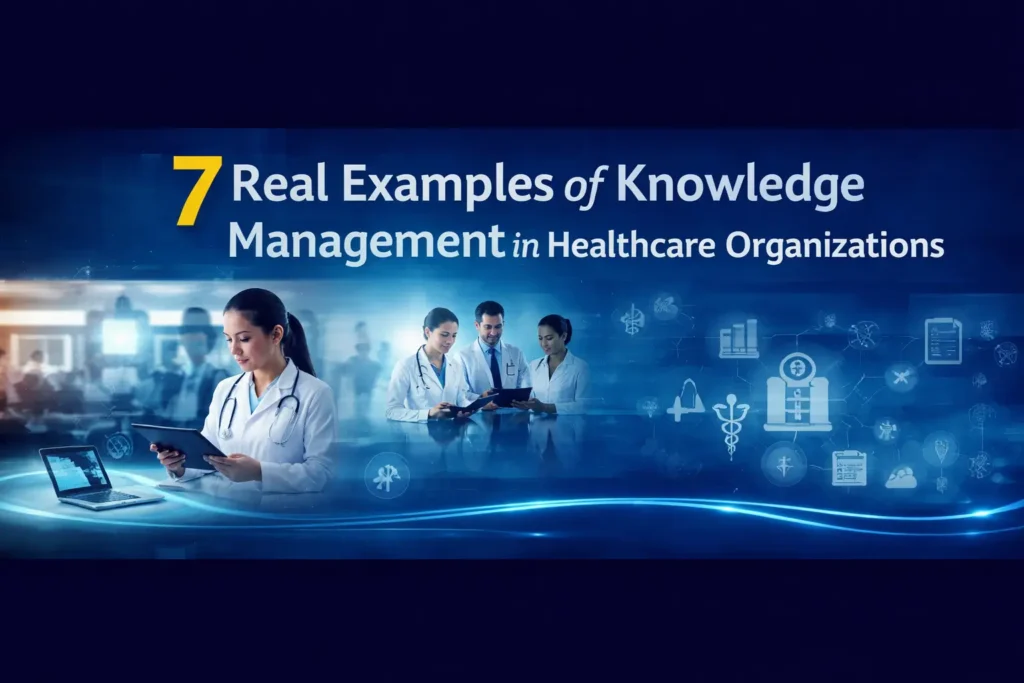
Table of Contents
- 1. Clinical protocol libraries for faster and safer decision-making
- 2. Hospital knowledge bases for repeated operational questions
- 3. AI-assisted search for clinical and operational knowledge
- 4. Incident review systems that convert lessons into reusable knowledge
- 5. Discharge education content tailored for patients and families
- 6. Internal nursing playbooks for standardizing day-to-day practice
- 7. Cross-functional knowledge hubs for large healthcare systems
- What these examples reveal about strong knowledge management in healthcare
- How healthcare organizations can apply these examples
- Final thoughts
1. Clinical protocol libraries for faster and safer decision-making
One of the most common examples of knowledge management in healthcare is the use of centralized clinical protocol libraries. These libraries store approved guidance for common care scenarios such as infection control, medication administration, wound care, triage, discharge planning, and escalation procedures.
In a busy hospital, clinicians do not have time to search across multiple drives, email attachments, or outdated PDFs. A protocol library gives them one trusted source of truth. When the content is maintained properly, it reduces variation and helps staff act with greater confidence.
This is a strong example of knowledge management in healthcare because it solves a very practical problem. Medical teams often know what needs to happen, but they need immediate access to the current version of the instruction. A centralized protocol library prevents staff from relying on memory or old habits. It also supports onboarding, since new team members can learn from a consistent knowledge base rather than from fragmented local practices.
The key here is governance. A protocol library only works when ownership is clear, review cycles are defined, and obsolete content is retired. Without that discipline, the system becomes a document archive instead of a living knowledge asset.
2. Hospital knowledge bases for repeated operational questions
A second example of knowledge management in healthcare is the hospital knowledge base used by staff departments such as HR, IT, billing, and patient services. These knowledge bases answer recurring questions that do not require escalation every time.
For example, staff may need to know how to reset access, where to submit a form, how to request a system change, or what the current policy is for a particular administrative process. Instead of relying on tribal knowledge or asking the same colleague repeatedly, they can search a knowledge base and find the approved answer.
This kind of knowledge management in healthcare is often overlooked because it sits outside direct patient care. But its impact is substantial. When administrative staff can resolve questions faster, call volume drops, resolution times improve, and employees spend less time waiting for help.
In many organizations, the biggest productivity drain is not a major crisis. It is the constant stream of small, repetitive questions. A well-structured hospital knowledge base turns those questions into self-service knowledge. That frees support teams to focus on complex issues and gives frontline employees faster access to the information they need.
3. AI-assisted search for clinical and operational knowledge
Another important example of knowledge management in healthcare is AI-assisted search. Healthcare organizations generate large volumes of information, but people do not always know the exact title of the document they need. They may remember a concept, a symptom, a policy theme, or a workflow term, but not the precise file name.
AI-assisted search helps solve that problem by matching intent instead of just keywords. It can surface relevant content, suggest related terms, and improve findability across large knowledge repositories. In a healthcare setting, that may mean a clinician finds the right escalation guideline faster, or an operations team member locates the latest workflow update without digging through folder structures.
This is particularly valuable in knowledge management in healthcare because time pressure is constant. Search needs to be intuitive, not academic. If users must guess how the content is labeled, the system fails them. AI-supported retrieval improves the odds that the right answer appears quickly enough to matter.
Of course, AI search is only as good as the underlying content structure. If the knowledge base is full of duplicate, stale, or poorly labeled information, search will still struggle. That is why AI should support knowledge management in healthcare, not replace the governance behind it.
4. Incident review systems that convert lessons into reusable knowledge
A very strong example of knowledge management in healthcare is the way organizations capture lessons from incidents, near misses, patient complaints, and process failures. Too often, these reviews are treated as one-time events. The report is written, the issue is discussed, and then the insight disappears into a file no one revisits.
Mature organizations treat incident reviews as a knowledge creation process. The lesson is not simply recorded. It is translated into updated guidance, revised procedures, training material, or new checks built into the workflow.
This is knowledge management in healthcare at its most practical. It turns operational pain into institutional memory. Instead of repeating the same mistakes, the organization learns from them and embeds the learning into everyday work.
For example, if a recurring medication issue is identified, the review may lead to a clarification in the protocol, a better verification step, or a change in how the guidance is surfaced inside the workflow. That is the power of knowledge management in healthcare. It does not just document what went wrong. It makes the system smarter.
5. Discharge education content tailored for patients and families
Patient education is another real example of knowledge management in healthcare. Hospitals and care teams often rely on standardized discharge instructions, condition-specific education materials, medication guidance, and recovery checklists to help patients understand what happens after they leave the facility.
This is more than a communications task. It is a knowledge management function because the organization is curating, organizing, and delivering validated knowledge in a usable form for a specific audience.
When discharge information is inconsistent, patients become confused. That confusion can lead to missed medications, improper follow-up, unnecessary readmissions, or avoidable calls back to the care team. A strong knowledge management in healthcare approach ensures that education materials are current, easy to understand, and aligned with clinical guidance.
The best systems also make this content configurable by condition, language, literacy level, and care setting. That is especially important in diverse healthcare environments where patient populations have different needs. Good knowledge management in healthcare makes knowledge accessible not only to professionals, but also to patients and families.
6. Internal nursing playbooks for standardizing day-to-day practice
Nursing teams often depend on practical know-how that is refined over time but not always written down in a usable way. Internal nursing playbooks are a clear example of knowledge management in healthcare because they capture that operational knowledge and make it reusable.
These playbooks may include procedures for shift handoffs, escalation thresholds, equipment use, common interventions, infection control steps, or unit-specific routines. They help new nurses learn faster, support consistent practice, and reduce the chance that important steps are forgotten during busy shifts.
The value of this approach is not only in documentation. It is in clarity. Nurses should not have to interpret vague instructions or depend on informal advice from whoever is nearby. A good playbook removes ambiguity and supports confident action.
This is one of the strongest examples of knowledge management in healthcare because it connects directly to frontline execution. It also reduces the knowledge gap between experienced staff and newer team members, which is critical in organizations dealing with turnover or staffing constraints.
7. Cross-functional knowledge hubs for large healthcare systems
Large healthcare organizations often operate across many sites, departments, and service lines. In those environments, one of the biggest challenges is not lack of knowledge, but fragmentation. Different teams create their own process notes, spreadsheets, guides, and local workarounds. Over time, this creates inconsistency and duplication.
A cross-functional knowledge hub is a more mature example of knowledge management in healthcare. It brings together approved knowledge from clinical, operational, administrative, and technical teams in one environment. The goal is not simply to store information. The goal is to connect people to the knowledge they need across departmental boundaries.
This matters for organizations that run multiple hospitals, outpatient centers, specialty clinics, and support functions. A shared hub makes it easier to standardize policies, align communication, and reduce duplicated effort. It also helps leaders identify where knowledge gaps exist and where different teams are solving the same problem in different ways.
When this type of knowledge management in healthcare works well, it becomes a source of organizational memory. A staff member in one region can benefit from a solution developed elsewhere. A policy update can reach multiple departments consistently. A process improvement from one site can be scaled across the enterprise more quickly.
What these examples reveal about strong knowledge management in healthcare
These seven examples point to a common pattern. The organizations that succeed with knowledge management in healthcare do not treat knowledge as a passive repository. They treat it as an operational asset.
That means several things in practice. The content must be owned. It must be current. It must be easy to find. It must fit the workflow. It must serve a specific user need. It must be governed with enough discipline to prevent drift.
It also means that knowledge management in healthcare must support both clinical and nonclinical work. A hospital does not only run on clinical expertise. It also runs on scheduling, billing, staffing, documentation, technology support, patient education, and process coordination. Knowledge touches all of it.
The best systems are usually built in stages. They start with the most painful knowledge gaps, then expand into broader workflows. They do not try to solve everything at once. Instead, they focus on the places where knowledge loss, inconsistency, or delay creates the most harm.
How healthcare organizations can apply these examples
If an organization wants to strengthen knowledge management in healthcare, the first step is to identify recurring questions and repeated friction points. That is where the best opportunities usually sit. Common categories include clinical guidance, patient education, internal support, onboarding, incident learning, and cross-department coordination.
Then the organization should look at where that knowledge currently lives. Is it in documents, inboxes, static folders, spreadsheets, or informal conversations? If the answer is yes, it is likely too fragmented to support reliable performance.
From there, the organization can begin consolidating, validating, and publishing knowledge in a more structured way. Ownership should be assigned. Search should be improved. Review cycles should be defined. Usage should be measured. The system should evolve based on real staff behavior, not just what looks organized on paper.
That is how knowledge management in healthcare moves from theory to impact.
Final thoughts
The strongest examples of knowledge management in healthcare are not theoretical frameworks. They are practical systems that help people make better decisions faster. Whether it is a clinical protocol library, a hospital knowledge base, AI-assisted search, incident review documentation, discharge education, nursing playbooks, or a cross-functional knowledge hub, the pattern is the same. Knowledge becomes more valuable when it is organized, trusted, and accessible at the point of need.
Healthcare organizations that invest in knowledge management in healthcare are not simply improving documentation. They are improving care consistency, operational efficiency, and organizational resilience. In a sector where complexity is high and the cost of confusion is real, that is a meaningful advantage.